
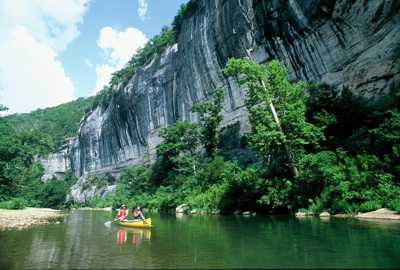
A coalition of groups is suing to close a hog facility upstream of the Buffalo National River.
Federal agencies that approved a loan to a hog farm operating upstream of Buffalo National River in Arkansas are being sued for not adequately reviewing the project.
A coalition of groups -- the Arkansas Canoe Club, Buffalo River Watershed Alliance, National Parks Conservation Association, and The Ozark Society -- are hoping to halt the 6,500-pig operation run by C&H Hog Farms on a tributary of the Buffalo River.
The groups back in June had indicated they would sue over the project, which they argue could produce more than 2 million gallons of manure and wastewater annually over porous karst geology.
Karst geology is composed of easily dissolved rocks, such as limestone and dolomite. Via sinkholes and underground caves in the geology, groundwater can flow miles very quickly. In the National Park System, karst geology is perhaps mostly visibly connected to Mammoth Cave National Park in Kentucky, but it can also be found along the Buffalo National River and at Ozark National Scenic Riverways in Missouri.
The coalition contends the loan guarantee to the hog facility hinges on a flawed environmental review process that violates the law and does not follow USDA’s own regulations.
“(U.S. Department of Agriculture's Farm Service Agency and the Small Business Association) failed to provide the public notice and undertake the environmental review and consultations required by law, so we’re asking the court to set aside the loan guarantees and instruct the agencies to comply,” said Emily Jones of the National Parks Conservation Association. “We have asked FSA and SBA to do the right thing without litigation, but they have not, and today we find ourselves in court to protect the Buffalo River, a national treasure of immeasurable worth.”
The Buffalo River travels through the heart of the Ozark Mountains in northwestern Arkansas, and runs beneath magnificent cliffs which at times extend nearly 700 feet above the river's clear, quiet pools and rushing rapids. One hundred thirty-five miles of the Buffalo comprise the national river, which attracts more than one million visitors each year who float the crystal waters, camp on the gravel bars, and hike the trails – generating $38 million toward the local economy.
“The Buffalo is an astonishingly beautiful natural resource, Arkansas’ crown jewel,” said Jack Stewart of the Buffalo River Watershed Alliance. “Siting an industrial hog facility so close to the river threatens to desecrate this national treasure, known to so many for its peaceful meanderings and the scent of wild azaleas in bloom.”
The C&H facility is located on the banks of Big Creek in Mount Judea, Arkansas. Under a contract with Cargill, Inc., an international agricultural and food conglomerate, C&H will confine 6,500 pigs at a time making the operation the first of its size and scale in the Buffalo River watershed, the coalition said in a release.
The pigs' manure and the farm's wastewater will be collected in open-air storage ponds on site and spread onto approximately 630 acres of land surrounding the farm and adjacent to the banks of Big Creek, they said. These manure application fields are less than six miles upstream from Big Creek’s confluence with the Buffalo National River, and several are located directly adjacent to Mount Judea School.
“Local residents will suffer the most from this absurdly located factory farm,” said Debbie Doss of the Arkansas Canoe Club. “Residents of Mount Judea will be exposed, downwind, to the smell and adverse health effects of methane and hydrogen sulfide. A swine facility this large will put children at the Mount Judea School at high risk of health impacts including asthma and other respiratory conditions.”
According to the coalition, the C&H facility received more than $3.4 million in loan guarantee assistance from the federal government. FSA approved a loan guarantee for 90 percent of a $1,302,000 loan to C&H. SBA approved a loan guarantee for a $2,318,136 loan.
In providing this federal assistance, SBA undertook no environmental review whatsoever, while FSA prepared a deeply flawed and insufficient environmental assessment that fails to comply with the requirements of the National Environmental Policy Act (NEPA). Among multiple errors and omissions, FSA’s environmental assessment incorrectly defines the acreage of the C&H facility, does not take into account nearby sensitive areas such as the Mount Judea School, and ignores the consequences of manure draining through the porous karst geology of the Buffalo River region.
“In the '60s and '70s, the Ozark Society worked with Congress to have the Buffalo protected for posterity as the nation’s first national river,” said Robert Cross of the Ozark Society. “We have countered threats to the river before, but now face the biggest threat to date. Despite the assurances of C&H that they have the highest level of technology to prevent accidents, the siting of this facility in karst terrain and directly adjacent to a tributary of the Buffalo River will not require an accident to cause tremendous damage to the river and the surrounding environment. SBA and FSA should have, but did not, consider these factors in its review of the proposed project.”
Story Categories:
A copy of National Parks Traveler's financial statements may be obtained by sending a stamped, self-addressed envelope to: National Parks Traveler, P.O. Box 980452, Park City, Utah 84098. National Parks Traveler was formed in the state of Utah for the purpose of informing and educating about national parks and protected areas.
Residents of the following states may obtain a copy of our financial and additional information as stated below:
- Florida: A COPY OF THE OFFICIAL REGISTRATION AND FINANCIAL INFORMATION FOR NATIONAL PARKS TRAVELER, (REGISTRATION NO. CH 51659), MAY BE OBTAINED FROM THE DIVISION OF CONSUMER SERVICES BY CALLING 800-435-7352 OR VISITING THEIR WEBSITE. REGISTRATION DOES NOT IMPLY ENDORSEMENT, APPROVAL, OR RECOMMENDATION BY THE STATE.
- Georgia: A full and fair description of the programs and financial statement summary of National Parks Traveler is available upon request at the office and phone number indicated above.
- Maryland: Documents and information submitted under the Maryland Solicitations Act are also available, for the cost of postage and copies, from the Secretary of State, State House, Annapolis, MD 21401 (410-974-5534).
- North Carolina: Financial information about this organization and a copy of its license are available from the State Solicitation Licensing Branch at 888-830-4989 or 919-807-2214. The license is not an endorsement by the State.
- Pennsylvania: The official registration and financial information of National Parks Traveler may be obtained from the Pennsylvania Department of State by calling 800-732-0999. Registration does not imply endorsement.
- Virginia: Financial statements are available from the Virginia Department of Agriculture and Consumer Services, 102 Governor Street, Richmond, Virginia 23219.
- Washington: National Parks Traveler is registered with Washington State’s Charities Program as required by law and additional information is available by calling 800-332-4483 or visiting www.sos.wa.gov/charities, or on file at Charities Division, Office of the Secretary of State, State of Washington, Olympia, WA 98504.


National parks and their natural resources belong to you. The National Parks Traveler works to ensure you know how these essential places are being cared for.
Sign Up For Our Weekly Newsletter
Unsubscribe at any time.
INN Member

The easiest way to explore RV-friendly National Park campgrounds.

Here’s the definitive guide to National Park System campgrounds where RVers can park their rigs.
Our app is packed with RVing- specific details on more than 250 campgrounds in more than 70 national parks.
You’ll also find stories about RVing in the parks, tips helpful if you’ve just recently become an RVer, and useful planning suggestions.


Comments
August 17, 2013
It is unbelieveable that I was able to float the Buffalo River from Ponca Low water bridge to Steel Creek campground on August 15, 2013. It may be another 40 years before conditions are right for there to be enought water in the Upper Buffalo to float that section in August...or for that matter.....anytime after June, since the water is usually down.
I have been closely following the Hog Farm controversy in the Buffalo River Watershed since the CAFO that is up and operating is situated in "the wrong place". It is quite likely that the CAFO operation will damage the Buffalo River as the lawsuit details. One more immeadiate effect of the CAFO will be the smell. I have smelled a large Pig farm with around 1500 pigs....imagine....6500 pigs. It's not the animals...its the ponds and the sludge that will be spread around the area. The residents of the area will soon smell it.
Meanwhile I wrote a Song, "Big Stink on the Buffalo" which you google. If you want to see the protest that occurred in Newton County just google...jocatgo123 and click on the Protest Video. It includes photos of the river to the words of Jimmie Driftwood's song "Beautiful Buffalo River" which he wrote after the Buffalo was saved from being dammed in 1971. Please share these with your friends so this CAFO can be stopped.
http://www.youtube.com/user/jocatgo123
Wow! I haven't been to Buffalo NSR, but I've been to the wonderful Ozark NSR. It's a really bad idea to put such a facility on karst topography. Even if there are no leaks during normal operations, accidents do happen.
Unfortunately, most people here seem to be concerned about a hydration station at Lake Mead.
Just like Congress. Argue about insignificant things in hopes it will divert attention from their failures on important issues.
I wish I could send a smellavision video of the huge pig farms near Milford, Utah.
Meanwhile, at Lake Powell, NPS may cave in to political pressures to dredge a channel for a shortcut so boaters won't have to travel extra miles due to rapidly dropping lake levels. It may cost a million dollars. An earlier attempt failed when water dropped so low that the channel failed to fill with water.
But y'sure don't want to inconvenience anyone with a houseboat, do you?
Maybe if we empty enough disposable water bottles into Lake Powell, it will help. Toss the empties in, too, and that might help reduce the surface evaporation that pulls enough water from the lake to supply a large city.
Sagebrusher is correct - the karst topography in this area creates a much higher risk for serious water quality issues from any facility of this kind.
The USGS notes that "Karst terrain is characterized by springs, caves, sinkholes, and a unique hydrogeology that results in aquifers that are highly productive but extremely vulnerable to contamination.