
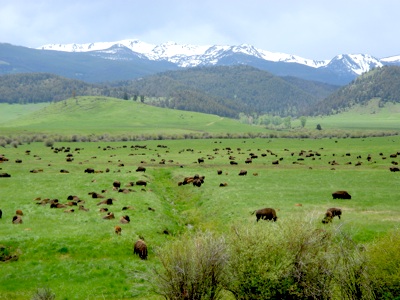
Many of the private lands around wildland parks, such as Yellowstone, are protected by conservation easements and support wilderness wildlife, such as these bison on Ted Turner’s Flying D Ranch in Montana. Rural homes next to public lands can constrain fire management on public lands, as illustrated by this subdivision in the Greater Yellowstone Ecosystem. Photos by Andrew Hansen via Montana State University.
Development and population density around units of the National Park System greatly outpaces that occurring around other parts of the country, according to a Montana State University study.
It certainly would seem only natural that units of the park system would attract people who want a park in their backyard. And the study by Montana State ecologist Andrew Hansen and lead author Cory Davis, a former biologist at Glacier National Park who works as a research associate in the College of Forestry and Conservation at the University of Montana, seemingly confirms that expectation.
"For example, the national increase in population density in the United States from 1940 to 2000 was 113 percent, but the change in density in PACEs (Protected-area centered ecosystems) was almost double that rate, 224 percent," the two noted in their study, Trajectories in land use change around U.S. National Parks, which was recently published by the Ecological Society of America. "Similarly, housing density increased by 210 percent nationwide in the same time period, while PACE housing density increased 329 percent."
The two uncovered some high rates of development around parks. At Rocky Mountain National Park, for instance, there was a 34 percent loss of undeveloped private land to higher housing densities from 1940 to 2000, and a 387 percent increase in population density during that period, the study points out.
The areas around Yellowstone and Grand Teton national parks lost 24 percent of their undeveloped land during the study period, a loss that is particularly significant due to the poor general quality of the surrounding lands for wildlife, they noted.
"Many western mountain parks consist of high-elevation terrain with harsh climates and can lack productive, lower elevation land often needed seasonally by ungulates and other wildlife. Therefore, maintaining connections to these lower elevation areas will be essential to park functioning," Professor Hansen and Mr. Davis wrote.
Still, growth around Yellowstone, Grand Teton and Glacier pales to that around some other units of the park system.
For example, while population densities rose 246 percent around Yellowstone/Grand Teton and 210 percent around Glacier between 1940 and 2000, they surged 3,092 percent around the Mojave National Preserve in California, 2,962 percent around the Colorado River parks, and almost 2,473 percent around the Everglades National Park/Big Cypress National Preserve area in Florida, the study notes.
And while housing densities grew 13.2 percent around Yellowstone and 11.4 percent around Glacier, they increased 75.6 percent around the Santa Monica Mountains National Recreation Area in California, a Montana State University release on the study pointed out.
The study (attached below) is believed to be the first into population density and land-use changes in the ecosystems around U.S. national parks. It focused on 57 units of the National Park System in the lower 48 states. It did not consider parks surrounded largely, if not entirely, by water, such as Isle Royale National Park, Channel Islands National Park, and Gulf Islands National Seashore.
The authors found that population densities around the 57 parks rose an average of 224 percent between 1940 and 2000, while housing densities grew 329 percent. Those increases are considerably higher than the national increases in population and housing densities in the United States during the same time, the authors noted.
At the same time, the researchers said growth differed widely among the parks in their study.
"Parks largely in the East, like Great Smoky Mountain, changed dramatically from being surrounded mostly by forests and farms to cities, suburbs and ranchettes," Professor Hansen said. "This was also true at a moderate level for some western parks such as Olympic and Rocky Mountain. Others, such as Yellowstone and Bighorn Canyon, that we locally think are changing rapidly, had very slow rates of growth relative to the national rates."
In the course of their work, the researchers divided the parks they studied into five categories according to types and rates of land use change around the parks. Twenty-five parks were classified as wildland-protected. Sixteen were "wildland developable." Five were agricultural. Eight were exurban. Three were urban.
Yellowstone, Glacier, the Grand Canyon and Yosemite National Park were among the wildland-protected parks. As such, they share some common issues, Professor Hansen said.
For instance, the parks may experience increasing conflicts between humans and wildlife as private land is developed outside their boundaries, said a Montana State University release describing the study. As a result, administrators may have to work to maintain or, potentially, restore top predators to their ecosystems. They may be concerned about resource extraction disrupting migration corridors, wintering grounds or key ecological processes if federal or state mandates allow mining, logging and livestock grazing near the parks, the release continued.
Many of the private lands around wildland parks are protected by conservation easements and support wildlife, such as bison on Ted Turner's Flying D Ranch near Yellowstone.
Approximately 35 percent of the land around Yellowstone and 45 percent of the land around Glacier is private, according to Professor Hansen. Of that private land, 75 percent remains undeveloped. Tribal land is included in private land.
Each category in the study faces unique challenges, so the researchers hope that park administrators in the same category will band together to find solutions, he added.
Mr. Davis and Professor Hansen prepared their study with statistics from the U.S. Census between 1940 through 2000, the latest year that Census figures were available while the study was being conducted. They updated their findings with 2007 estimates of population and housing densities.

Story Categories:
A copy of National Parks Traveler's financial statements may be obtained by sending a stamped, self-addressed envelope to: National Parks Traveler, P.O. Box 980452, Park City, Utah 84098. National Parks Traveler was formed in the state of Utah for the purpose of informing and educating about national parks and protected areas.
Residents of the following states may obtain a copy of our financial and additional information as stated below:
- Florida: A COPY OF THE OFFICIAL REGISTRATION AND FINANCIAL INFORMATION FOR NATIONAL PARKS TRAVELER, (REGISTRATION NO. CH 51659), MAY BE OBTAINED FROM THE DIVISION OF CONSUMER SERVICES BY CALLING 800-435-7352 OR VISITING THEIR WEBSITE. REGISTRATION DOES NOT IMPLY ENDORSEMENT, APPROVAL, OR RECOMMENDATION BY THE STATE.
- Georgia: A full and fair description of the programs and financial statement summary of National Parks Traveler is available upon request at the office and phone number indicated above.
- Maryland: Documents and information submitted under the Maryland Solicitations Act are also available, for the cost of postage and copies, from the Secretary of State, State House, Annapolis, MD 21401 (410-974-5534).
- North Carolina: Financial information about this organization and a copy of its license are available from the State Solicitation Licensing Branch at 888-830-4989 or 919-807-2214. The license is not an endorsement by the State.
- Pennsylvania: The official registration and financial information of National Parks Traveler may be obtained from the Pennsylvania Department of State by calling 800-732-0999. Registration does not imply endorsement.
- Virginia: Financial statements are available from the Virginia Department of Agriculture and Consumer Services, 102 Governor Street, Richmond, Virginia 23219.
- Washington: National Parks Traveler is registered with Washington State’s Charities Program as required by law and additional information is available by calling 800-332-4483 or visiting www.sos.wa.gov/charities, or on file at Charities Division, Office of the Secretary of State, State of Washington, Olympia, WA 98504.


National parks and their natural resources belong to you. The National Parks Traveler works to ensure you know how these essential places are being cared for.
Sign Up For Our Weekly Newsletter
Unsubscribe at any time.
INN Member

The easiest way to explore RV-friendly National Park campgrounds.

Here’s the definitive guide to National Park System campgrounds where RVers can park their rigs.
Our app is packed with RVing- specific details on more than 250 campgrounds in more than 70 national parks.
You’ll also find stories about RVing in the parks, tips helpful if you’ve just recently become an RVer, and useful planning suggestions.


Comments
It's an interesting report; I wonder, though, if the tremendous percentage increase around Mojave National Preserve is the result of the prison at Baker?
Regarding the prison at Baker, possibly. Vegas has been promoting destinations such as the preserve and Death Valley a bit more in recent years, however, especially as people are less prone to spend money in a casino during a depression, but will still stay in a nice hotel as they make excursions out around the glitz.