
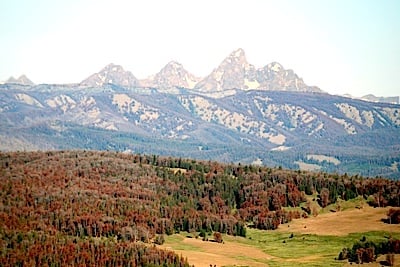
The U.S. Fish and Wildlife Service has agreed that climate change is imperiling the future of whitebark pine trees across the West. Photo of dying pine forests near Grand Teton National Park by Kurt Repanshek.
Whitebark pine trees, a "foundation species" that grows high in the upper reaches of parks such as Yellowstone, Grand Teton, Glacier, Yosemite, and Kings Canyon, is in need of Endangered Species Act protection from climate change, according to the U.S. Fish and Wildlife Service.
A year after being petitioned by the Natural Resources Defense Council to consider ESA protection for the trees due to a warming climate regime, the FWS agrees the trees' existence is threatened.
In a statement (attached below) to be published Tuesday in the Federal Register, the agency says that, "(A)fter review of all available scientific and commercial information, we find that listing P. albicaulis as threatened or endangered is warranted."
However, the statement continues, that listing is "precluded by higher priority actions to amend the Lists of Endangered and Threatened Wildlife and Plants."
“The rapid decline of whitebark pine is one of the most dramatic signs of how quickly our mountain ecosystems are warming,” Dr. Sylvia Fallon, lead author of NRDC's listing petition, said in a prepared statement. “There are things we can do to buoy these trees and the ecosystems that depend on them for a while---but we have to get to the hard work of dealing with the underlying climate issue before a host of other species join whitebark on the long, hot march to extinction.”
Whitebark pines are a member of the "stone" pine family. They grow in the very highest reaches of Yellowstone, Glacier, Rocky Mountain, Yosemite, Sequoia and Kings Canyon national parks.
Scientists regard the tree as a “foundation species” because it creates the conditions necessary for other plants and animals to get established in harsh alpine ecosystems. These high-elevation trees produce a calorie-rich nut that grizzly bears in the greater Yellowstone ecosystem like to feast on in the fall. It's a nut that also feeds red squirrels and the Clark's nutcracker.
The sheer stature of the tree also helps maintain watersheds. In winter its bulk serves as natural snow fences, and in spring that same bulk helps shield the resulting snowbanks from the sun, thus allowing for a relatively slow and even snow melt.
But the tree is in danger these days from non-native diseases, such as blister rust, and insects such as the mountain pine beetle, which are beginning to flourish in the trees' habitat thanks to climate change. Unlike lodgepole pines, which co-evolved with mountain pine beetles and developed defenses against them, whitebark pines did not and so are defenseless against the bugs.
And whitebark pines are slow to reproduce; they can take 75 years of growth before they sprout their first pine cone. Plus, they rely largely on the Clark's nutcracker, which feasts on whitebark seeds, to, basically, plant new whitebark pine stands by caching seeds that later go on to germinate.
According to NRDC officials, the listing decision is the first time the federal government has "clearly pegged" a broadly dispersed tree as a casualty to climate change.
In supporting its decision, the FWS said that by the end of the century "less than 3 percent of currently suitable" whitebark pine habitat is expected to remain as spreading climate change "is expected to significantly decrease the probability of rangewide persistence" of the trees.
On Monday, Louisa Willcox, a senior wildlife advocate for NRDC, said the FWS's decision is proof that climate change is occurring.
“Anyone who doesn’t believe in climate change can look at this decision and the reams of scientific research behind it,” she said. “The masses of grey and red trees that litter the forests above my home in Montana are a testament to the damage already being wreaked on our high-elevation ecosystems. This designation will help bring attention to saving these tough trees and the long list of species, like Yellowstone’s grizzly bears, that are reliant on them to live in this harsh environment.”
While FWS officials said an official listing of whitebark pines as either threatened or endangered is precluded by other species' needs, the agency will have to reexamine the matter in 12 months to determine if resources are available to begin crafting a species recovery plan, NRDC officials said.
In the meantime, it will be considered a “candidate species” which affords some important protections. According to FWS, approximately 96 percent of land where the species occurs is federally owned or managed, making U.S. Bureau of Land Management and U.S. Forest Service policies requiring added protections for candidate species potentially very important in the fight to save these trees.

Story Categories:
A copy of National Parks Traveler's financial statements may be obtained by sending a stamped, self-addressed envelope to: National Parks Traveler, P.O. Box 980452, Park City, Utah 84098. National Parks Traveler was formed in the state of Utah for the purpose of informing and educating about national parks and protected areas.
Residents of the following states may obtain a copy of our financial and additional information as stated below:
- Florida: A COPY OF THE OFFICIAL REGISTRATION AND FINANCIAL INFORMATION FOR NATIONAL PARKS TRAVELER, (REGISTRATION NO. CH 51659), MAY BE OBTAINED FROM THE DIVISION OF CONSUMER SERVICES BY CALLING 800-435-7352 OR VISITING THEIR WEBSITE. REGISTRATION DOES NOT IMPLY ENDORSEMENT, APPROVAL, OR RECOMMENDATION BY THE STATE.
- Georgia: A full and fair description of the programs and financial statement summary of National Parks Traveler is available upon request at the office and phone number indicated above.
- Maryland: Documents and information submitted under the Maryland Solicitations Act are also available, for the cost of postage and copies, from the Secretary of State, State House, Annapolis, MD 21401 (410-974-5534).
- North Carolina: Financial information about this organization and a copy of its license are available from the State Solicitation Licensing Branch at 888-830-4989 or 919-807-2214. The license is not an endorsement by the State.
- Pennsylvania: The official registration and financial information of National Parks Traveler may be obtained from the Pennsylvania Department of State by calling 800-732-0999. Registration does not imply endorsement.
- Virginia: Financial statements are available from the Virginia Department of Agriculture and Consumer Services, 102 Governor Street, Richmond, Virginia 23219.
- Washington: National Parks Traveler is registered with Washington State’s Charities Program as required by law and additional information is available by calling 800-332-4483 or visiting www.sos.wa.gov/charities, or on file at Charities Division, Office of the Secretary of State, State of Washington, Olympia, WA 98504.


National parks and their natural resources belong to you. The National Parks Traveler works to ensure you know how these essential places are being cared for.
Sign Up For Our Weekly Newsletter
Unsubscribe at any time.
INN Member

The easiest way to explore RV-friendly National Park campgrounds.

Here’s the definitive guide to National Park System campgrounds where RVers can park their rigs.
Our app is packed with RVing- specific details on more than 250 campgrounds in more than 70 national parks.
You’ll also find stories about RVing in the parks, tips helpful if you’ve just recently become an RVer, and useful planning suggestions.


Comments
One place missed in the above story where visitors actually park near prime Lake Viewpoints graced
with dead and dying whitebark pine is Crater Lake National Park. All along the western Crater
Lake Caldera Rim, whitebark pines have been dying a slow death for over 25 years. When this obvious
fact was presented to Crater Lake's former Superintendent Lundy, his Chief of Resources
Management, actually called a "scientist" in the parks newspaper denied the obvious. When
non-scientists supervise science projects, the facts become distorted for many reasons
beginning with basic Human Ignorance. We hope that Science with Integrity gains a new foothold
within the National Park Service during this 21st Century. Tragically, these stories are not uncommon:
Read Michael Frome's Regreening of the National Parks (new edition arriving soon) for a Chapter
devoted to how former Superintendent Briggle at Glacier NP destroyed the career of a young biologist;
the same superintendent (WHO NEARLY APPOINTED HIMSELF AS REGIONAL DIRECTOR, Seattle) later
at Mt. Rainier denied A WHITEBARK PINE CONFERENCE for the presentation of research papers
on the decline of whitebark pine. So, for those readers who believe that national park natural resources
are managed in a manner respecting scientific integrity, reconsider and think again.
Great- so the earth is still changing as it has been doing since Day 1.
Go back a few hundred thousand years ago and see if the climate was like it is now.
But now humans are noticing that things just aren't the same as we remember it to be and so we must be to blame for it. Therefore we must stop the course of nature and intervene.
What a waste of money. Let's form a committee or a council and take it to the government to take care of. Right - when was the last time our government actually fixed something in a reasonable amount of time? The committees and government are most likely the source of all the hot air on this planet. An Endangered Species Act to protect from climate change!! There is no way humans can stop the acts of nature.
Visit: http://www.whitebarkfound.org/PDF-files/Whitebark%20USA%202011%20Mtg%20Announcement.pdf
and http://www.whitebarkfound.org