
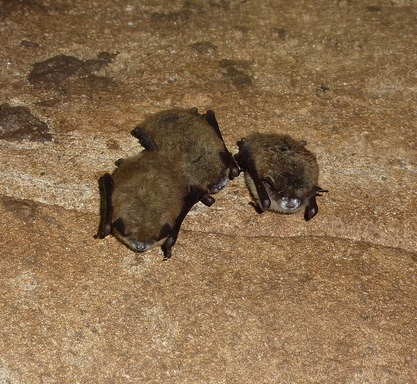
White-nose syndrome, a disease deadly to bats, has been found in a bat hibernacula in western Kentucky, some 180 miles from Mammoth Cave National Park. Photo of infected bats in the Trigg County cave by Kentucky Department of Fish and Wildlife Resources.
White-nose syndrome, a deadly disease that's spreading through bat colonies in the eastern half of the United States, has been detected in Kentucky, prompting officials at Mammoth Cave National Park to step up their safeguards against the disease.
The Kentucky Department of Fish and Wildlife Resources and the U.S. Fish and Wildlife Service on Wednesday announced that a little brown bat from a cave in Trigg County, in southwestern Kentucky near Paducah, was found to have the disease.
White-nose syndrome was first detected in New York state in 2006 and has killed more than one million cave-dwelling bats in eastern North America. Mortality rates of bats have reached almost 100 percent in multi-year infected caves, according to the Fish and Wildlife Service. With confirmation of WNS in Kentucky, a total of 16 states, mostly in the eastern United States, and three Canadian provinces have now been confirmed infected.
“This is likely the most significant disease threat to wildlife Kentucky has ever seen,” said KDFWR Commissioner, Dr. Jonathan Gassett. “It would be professionally irresponsible to take no action to stop or slow this disease. Bats are an important part of our natural environment, acting as pollinators and consuming mosquitoes and other insect pests across the landscape. We plan to aggressively manage this threat of WNS as it occurs in Kentucky in order to protect and conserve our bat populations.”
Kentucky is home to Mammoth Cave National Park, which has many bat colonies. So far WNS has not been detected in the park, which is roughly 180 miles east of the Trigg County cave. However, in response to the case confirmed in Trigg County, park officials said Wednesday that they "are initiating all the measures called for in our WNS Response Plan; measures to minimize the spread of WNS to Mammoth Cave, and measures to minimize the spread of WNS from Mammoth Cave."
"Mammoth Cave will continue to offer cave tours, but visitors will now be required to walk through bio-mats as they exit their tour; the mats will be deployed tomorrow (Thursday)," said park spokeswoman Vickie Carson. "We will still screen visitors prior to tours and decontaminate their shoes if necessary."
While it's not considered a health threat to humans, white-nose syndrome is deadly to bats, and there are fears that entire species could be eradicated by it. As the disease spreads, its impacts could ripple through ecosystems. Not only are bats efficient predators when it comes to insect control -- some bats can eat up to 2,000 mosquito-sized insects in a single night -- but they in turn are prey for hawks, owls, and skunks, just to name some predators.
At Great Smoky Mountains National Park, park officials shut off human access to all their caves back in April 2009. While Mammoth Cave still leads about 400,000 visitors a year through about 10 miles of the nearly 400 miles of passages interlaced within the park's massive cave systems, officials last year began developing protocols for dealing with WNS, both to keep it from entering the cave system or being carried out of the system on visitors' feet or clothing if it ever does show up there.
Those protocols range from addressing the issue on the park's website to discussing it with visitors before they go underground on cave tours. About 15 minutes before each tour leaves, an announcement concerning WNS is made. In it visitors are asked if they have been in a cave in the past five years and, if so, are they wearing any footwear or clothing, or carrying any items, such as a camera, that they had with them on those previous caving experiences.
If visitors are wearing footwear that has been in another cave, the shoes are treated with a concentration of an industrially concentrated solution of Lysol that testing at Northern Kentucky University has shown to be effective at killing the fungus. In the case of items such as jewelry or cameras, Lysol wipes are used to clean the items. Jewelry also can be placed in Ziplock baggies.
At the time, researchers were working to devise another decontamination system for footwear, one, for instance, that might entail simply walking across a pad or mat treated with a decontaminant. Since then the "bio mats" have been approved for use at Mammoth Cave.
"We have been screening visitors before they go in the cave since June 2009, and treating their shoes if they wore them in another cave previously," said Ms. Carson. "Last summer we began issuing coveralls and gear on all our crawling tours, decontaminating the coveralls and gear following every trip. (Thursday) we will deploy the bio-mats. Our cave guides speak to their groups about WNS -- about 400,000 people go through Mammoth Cave every year -- so it's a good opportunity for WNS education."
Wildlife officials in Kentucky were the first in the nation to develop a statewide response plan for addressing WNS, according to a FWS release. Part of that plan was regular monitoring of caves for the disease. Almost 100 hibernacula -- winter bat roosts -- were checked throughout Kentucky during the winter, according to state officials.
The Trigg County cave was one of five revisited by scientists upon confirmation of WNS in Ohio. These hibernacula were rechecked due to their known proximity to infected sites in adjacent states, the state said. The privately-owned Trigg County cave is used as a hibernaculum by six bat species, including the endangered Indiana bat, and is a summer roost for the endangered gray bats. Surrounding caves were checked within a 16-mile radius and no additional infected sites were found, the FWS said Wednesday.
Measures were taken to limit the spread of WNS beyond the Trigg County cave, which is regularly used as a hibernaculum by more than 2,000 bats. These included removing and euthanizing 60 highly suspect little brown bats and tri-colored bats as they were not expected to survive, the federal wildlife agency said.
Story Categories:
A copy of National Parks Traveler's financial statements may be obtained by sending a stamped, self-addressed envelope to: National Parks Traveler, P.O. Box 980452, Park City, Utah 84098. National Parks Traveler was formed in the state of Utah for the purpose of informing and educating about national parks and protected areas.
Residents of the following states may obtain a copy of our financial and additional information as stated below:
- Florida: A COPY OF THE OFFICIAL REGISTRATION AND FINANCIAL INFORMATION FOR NATIONAL PARKS TRAVELER, (REGISTRATION NO. CH 51659), MAY BE OBTAINED FROM THE DIVISION OF CONSUMER SERVICES BY CALLING 800-435-7352 OR VISITING THEIR WEBSITE. REGISTRATION DOES NOT IMPLY ENDORSEMENT, APPROVAL, OR RECOMMENDATION BY THE STATE.
- Georgia: A full and fair description of the programs and financial statement summary of National Parks Traveler is available upon request at the office and phone number indicated above.
- Maryland: Documents and information submitted under the Maryland Solicitations Act are also available, for the cost of postage and copies, from the Secretary of State, State House, Annapolis, MD 21401 (410-974-5534).
- North Carolina: Financial information about this organization and a copy of its license are available from the State Solicitation Licensing Branch at 888-830-4989 or 919-807-2214. The license is not an endorsement by the State.
- Pennsylvania: The official registration and financial information of National Parks Traveler may be obtained from the Pennsylvania Department of State by calling 800-732-0999. Registration does not imply endorsement.
- Virginia: Financial statements are available from the Virginia Department of Agriculture and Consumer Services, 102 Governor Street, Richmond, Virginia 23219.
- Washington: National Parks Traveler is registered with Washington State’s Charities Program as required by law and additional information is available by calling 800-332-4483 or visiting www.sos.wa.gov/charities, or on file at Charities Division, Office of the Secretary of State, State of Washington, Olympia, WA 98504.


National parks and their natural resources belong to you. The National Parks Traveler works to ensure you know how these essential places are being cared for.
Sign Up For Our Weekly Newsletter
Unsubscribe at any time.
INN Member

The easiest way to explore RV-friendly National Park campgrounds.

Here’s the definitive guide to National Park System campgrounds where RVers can park their rigs.
Our app is packed with RVing- specific details on more than 250 campgrounds in more than 70 national parks.
You’ll also find stories about RVing in the parks, tips helpful if you’ve just recently become an RVer, and useful planning suggestions.


Comments
Glad they are being proactive but may I ask how decontaminating shoes when leaving the caves will help from bringing it in?
Good question. The answer is, if WNS did show up inside Mammoth Cave, this approach is thought to be one way to keep it from being spread beyond the cave by visitors taking it out with them.
okay so even if you didnt decontaminat your shoes wouldnt what ever is on them just wipe off in the grass or something and instead of it being us humans couldnt it be the bugs they eat that could be causing them to die
There is no substatial proof that WNS is spread by humans. It is bat to bat. Most bat colonies have a 200 mile range for migration .
Staying out of caves and decontamination is something we can do, but that won't stop it from spreading.
Very bad for us.
Do scientists have any idea why this fungus has showed up or where it came from?? Is there anyway to innoculate the bats against the disease?
The disease was first spotted in New York state, but I'm not sure a definitive source has been identified. I believe a similar fungal disease has been identified in Europe. As for innoculating the bats, I'd guess that's out of the question due to the sheer numbers involved.
How awesome would that job be? Innoculating bats for a living.
Seriously though if this is going to completely wipe out bat populations, innoculation of just a few could at least let the colonies reinvent themselves.
The research and experimentation of this syndrome is our only chance against it
Yes, think it would be sensible to walk the biomat before and after the tours