
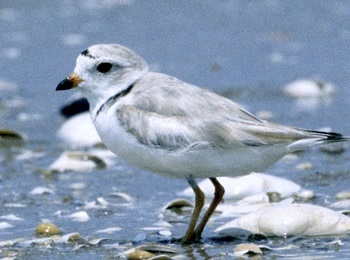
A federal judge has upheld designations of critical winter habitat for piping plovers along Cape Hatteras National Seashore. USFWS photo.
In an opinion that goes against off-road vehicle interests along Cape Hatteras in North Carolina, a federal judge has ruled that the U.S. Fish and Wildlife Service properly designated critical winter habitat for the piping plover, a threatened species of shorebirds.
Judge Royce C. Lamberth, chief judge of the U.S. District Court for the District of Columbia, held that the Fish and Wildlife Service properly considered economic impacts, special management considerations, and off-road vehicle regulations when it set aside 2,053 acres in North Carolina's Dare and Hyde counties -- including parts of Cape Hatteras National Seashore -- as critical habitat for the diminutive shorebirds.
The ruling handed down Tuesday was applauded by conservation groups.
“Cape Hatteras is unique. It’s one of the few places on the East Coast that hosts piping plover activity all year round,” said Jason Rylander, staff attorney for Defenders of Wildlife. “Critical habitat designation will provide a crucial, additional layer of protection throughout the year.”
At Audubon North Carolina, deputy director Walker Golder called the judge's decision "a great victory for piping plovers and reaffirms the importance of Cape Hatteras National Seashore for this threatened species.”
The ruling comes at the end of a long road of litigation and rule-making. The case at hand can be traced at least to 2001 when the Fish and Wildlife Service first designated critical winter habitat for the birds. Portions of that designation that involved Cape Hatteras were immediately challenged by the Cape Hatteras Access Preservation Association, a coalition of off-road and surf-fishing interests.
In 2004 a lower court remanded the matter back to the Fish and Wildlife Service with a direction to re-examine its designation of the four units that fell within both the national seashore and Pea Island National Wildlife Refuge.
While this was playing out, environmental groups -- Defenders of Wildlife and the National Audubon Society -- sued the National Park Service for failing to develop an ORV management plan for Cape Hatteras National Seashore.
Fish and Wildlife Service officials published their revised critical winter habitat designations in October 2008, about the same time national seashore officials and the environmental groups agreed to a consent decree mandating that the seashore would develop an ORV plan by April 2011.
While the Fish and Wildlife Service's revised designation of critical habitat was roughly 1,600 acres smaller than the original designation, and touched on no private lands, the preservation association sued again in February 2009.
In rejecting their claims for relief, Judge Lamberth held that the Fish and Wildlife Service properly and adequately identified why the lands in question were vital to the plovers, which spend 10 months a year "wintering" in North Carolina, and how they need to be managed to benefit the shorebirds.
The ruling (attached below) is only the latest chapter in a long-running saga pitting those who rely on off-road vehicles to enjoy the national seashore and fish from its shores against groups that have maintained the Park Service long has failed to protect threatened and endangered species of birds and sea turtles from those ORVs.
At Defenders, Mr. Rylander said Wednesday that the favorable ruling for winter habitat nevertheless is a smaller piece of the overall puzzle that will provide the necessary protections.
"The Park Service will have yet another reason to do what it's already obligated to do under the (National Park Service) Organic Act and the Endangered Species Act," he said from his Washington office. "So, it's another benefit. But it's not the entire ballgame."
The final piece to the puzzle, Mr. Rylander said, will be the adoption of a formal ORV plan for the national seashore.
Story Categories:
A copy of National Parks Traveler's financial statements may be obtained by sending a stamped, self-addressed envelope to: National Parks Traveler, P.O. Box 980452, Park City, Utah 84098. National Parks Traveler was formed in the state of Utah for the purpose of informing and educating about national parks and protected areas.
Residents of the following states may obtain a copy of our financial and additional information as stated below:
- Florida: A COPY OF THE OFFICIAL REGISTRATION AND FINANCIAL INFORMATION FOR NATIONAL PARKS TRAVELER, (REGISTRATION NO. CH 51659), MAY BE OBTAINED FROM THE DIVISION OF CONSUMER SERVICES BY CALLING 800-435-7352 OR VISITING THEIR WEBSITE. REGISTRATION DOES NOT IMPLY ENDORSEMENT, APPROVAL, OR RECOMMENDATION BY THE STATE.
- Georgia: A full and fair description of the programs and financial statement summary of National Parks Traveler is available upon request at the office and phone number indicated above.
- Maryland: Documents and information submitted under the Maryland Solicitations Act are also available, for the cost of postage and copies, from the Secretary of State, State House, Annapolis, MD 21401 (410-974-5534).
- North Carolina: Financial information about this organization and a copy of its license are available from the State Solicitation Licensing Branch at 888-830-4989 or 919-807-2214. The license is not an endorsement by the State.
- Pennsylvania: The official registration and financial information of National Parks Traveler may be obtained from the Pennsylvania Department of State by calling 800-732-0999. Registration does not imply endorsement.
- Virginia: Financial statements are available from the Virginia Department of Agriculture and Consumer Services, 102 Governor Street, Richmond, Virginia 23219.
- Washington: National Parks Traveler is registered with Washington State’s Charities Program as required by law and additional information is available by calling 800-332-4483 or visiting www.sos.wa.gov/charities, or on file at Charities Division, Office of the Secretary of State, State of Washington, Olympia, WA 98504.


National parks and their natural resources belong to you. The National Parks Traveler works to ensure you know how these essential places are being cared for.
Sign Up For Our Weekly Newsletter
Unsubscribe at any time.
INN Member

The easiest way to explore RV-friendly National Park campgrounds.

Here’s the definitive guide to National Park System campgrounds where RVers can park their rigs.
Our app is packed with RVing- specific details on more than 250 campgrounds in more than 70 national parks.
You’ll also find stories about RVing in the parks, tips helpful if you’ve just recently become an RVer, and useful planning suggestions.


Comments
“those who rely on off-road vehicles to enjoy the national seashore and fish from its shores”
Kurt it is a very vocal minority of users that want to make National Park policy that designates ORV access as the primary means of access to this National Seashore so they can fish while tail gating with their friends and family. To fully enjoy the Seashore they demand to drive where and when they want and carry in their vehicle or pack into a trailer all the gear (a full assortment of fishing rods, tents, campers, volleyball nets, coolers, full size pig cookers, flags, kites, boom boxes, and just about anything else you can dream up) that they deem necessary to create their National Park experience.
They (ORV) users claim to be good stewards of the Seashore and protectors of wildlife. In reality the only wildlife they want to protect are those (feral cats, raccoons, opossums and red fox) that prey on nesting shore birds. They kill thousands of fish to use as bait when targeting protected (over 28”) red drum for catch and release, but are opposed to the National Parks predator control policy.
Their opposition to critical habitat and predator control is just another example of their lack of concern for the singular indigenous wildlife of Cape Hatteras National Seashore.
Those users that are not lucky enough to own a SUV will find it daunting to access the ORV designated beaches not because of resource closures but because of the sheer volume of ORV’s. The Park’s proposed ORV carrying capacity is 1 vehicle for every 20 feet of shoreline and double that in some areas. The Park’s preferred plan designates a majority of the Seashore’s ocean beaches as an ORV route. The ORV routes encompass the beach from just beyond the toe of the dune to the tideline.
SS1
Hey Kurt,
Do you get the picture. What do you think is the "entire meaning' of "entire ballgame" in Mr. Rylander's statement. The final piece of the PUZZLE will be the adoption of the ORV plan Only if they get everything THEY are asking for. Who knows, they may already have assurance of that the way things have been going. They want us off the beach. Til that happens I doubt they will ever be satisified. Time will prove me right or wrong.
Regards,
Ron
Ron,
None of the Park Service's proposals for the ORV plan ban ORVs. At no point during the negotiated rulemaking process did any of the environmental groups advocate that. What they did advocate was a reasonable balance that protects the wildlife and natural resources of the park, which, like it or not, is the park's first responsibility.
At this very moment, of 68 miles of national seashore, more than 30 miles are open to ORVs and 59 are open to pedestrians. Four more miles are open but inaccessible due to other closures. Of the areas closed to ORVs much of that is seasonal closures to protect pedestrians in front of the villages or areas too narrow for vehicles to safely pass.
So I think the question for you and your friends are when will you be satisfied? Some of you think you own the place because NPS failed to regulate beach driving for so long. Well, guess what, all of us own the place, and it's time for balanced regulation. Cape Hatteras is so much more than an an ORV playground.
To Anonymous
Lots of miles open, thats true, but I want to fish the point at Oregan Inlet, as do dozens of others that have been corraled together for months. It has been closed all summer and still is. For one bird, A Lete, Not even a plover. I have probably fed that bird at some time. And as to "you think you own the place", Well as a matter of fact, I do. I have served this country and paid for it like most Americans, still do, as a senior. Furthermore, I also pay real estate taxes in and additionally support the OBX of North Carolina. Don't know about you because apparently you don't want anyone to know who you are, much less where you are from. Never have paid much attention to Anonymous. I always figured it is the same person and wondered how he or she had so much time on their hands cause they show up so often and sometimes they even talk and answer themselves. You can forget about educating me about what has taken place and how balanced things are going to be. Everyone will know how rediculous that statement is soon enough at the rate things are going. Only hope being that enough of America wakes up come November and we begin to see a different kind of change. A change back to COMMON SENSE.
If you take offense, Well I've taken my share lately. Tough.
Ron
Kurt, apolpgies to you for this kind of post.
Ron,
The point is that no ONE person owns the land--all American citizens do and this means there will be compromise. A compromise means generally that all parties are partially satisfied. While it is evident that you wish for certain areas to be open that are not, the other side invariably wishes to close areas that are open. Unfortunately, when it comes to threatened and endangered species, options are often limited by the biology/ecology of the species. Ecosystems and the benefits you enjoy from them, e.g., fishing, suffer when biodiversity is lost. Thus, it is important to conserve biodiversity generally and in your area, specifically, the piping plover. While there are always politics involved in these types of issues, it is important to remember that while you may have a choice of where you fish, live, recreate, or vacation, these birds do not. I am not suggesting that the birds are more important that humans, just that you have more options.
Cathy
Ron, first of all thank you for your service. It doesn't entitle you to any greater say on our national seashore than anyone else, but I appreciate it. Must be hard to reach retirement and not be able to do what you want when you want it. Lots of us feel that way. I don't take offense. I was simply explaining the way it is and the changes that are coming. You're free to shoot the messenger if you wish. I wouldn't be so confident, if I were you, that this election or any other will turn things back to your way of thinking. For most people, the idea of thousands of trucks on a national seashore beach is what defies common sense.
It's unfortunate that you take offense to the Park Service finally obeying laws that have been on the books since the 1970s. Isn't the rule of law one of the things you fought for? Perhaps if there had been more balanced regulation years ago, fewer species would need protection. And maybe fewer people would express such a sense of entitlement about not being able to fish when and where they want.
That's what I can't understand. This overblown and outrageous sense of entitlement has been on full display before in response to Kurt's articles and even more visceral on some of the fishing boards on the Outer Banks. Are you not the same Ron Saunders (obxguys) who on a local fishing tackle shop web board suggested it would be a good thing if the Defenders' lawyer "got his bell rung"? That's really classy. And it doesn't speak well of your position. Worse still, Park Service employees and environmental group staff have actually been thrown out of local businesses and been physically harassed ORV fishermen and their supporters. Talk about ridiculous!
So, here's my final message to you, sir. I'm sorry you can't fish Oregon Inlet whenever you want. It's open to fishing at other times of the year and you can go then. Or you can go to Cape Point, which is open, or the piers, or any of the other 59 miles of beach that are presently open to fishermen. There are plenty of places to fish. If you can't give way a little bit for wildlife, and you won't stand any "educating" on the issue, and you think wishing ill on environmentalists is appropriate, well, there's not much more I can say to you. Life is too short. Tight lines.
Annon,
Of the 59 miles open to pedestrian 30 of those miles pedestrians will have to contend with an ORV route that extend from about 20 feet from the dune to the waterline, virtually the entire beach. At the water’s edge pedestrians may encounter barking dogs tied on long tethers, multiple unattended fishing rods stuck in rod spikes in the sand and recreational activities that some people might find socially offensive (like large flags attached to vehicles with socially offensive slogans and symbols). The remaining section of the beach where ORVs are not parked likely will be an eyesore of random crisscrossing sand ruts as deep as your calf. Pedestrians are seldom seen on ORV beaches.
Leaving resource issues out of the picture the NP policy of managing ORVs in CHNS is inadequately and unfairly weighted toward ORV users. I believe there are other options that would protect resources and can provide more access (pedestrian and ORV) to the Park beaches unfortunately from my perspective those alternatives are largely blocked by ORV special interests.
Some of the other 29 miles of beach will be in front of the villages with access to those beaches difficult unless you don’t mind walking adjacent to a rental homes, there is little public access through the villages. In the summer these NP beaches receive heavy pedestrian use, more so than ORV beaches. After September 15 considerable more of the beach is open to ORV use, I don’t have the exact mileage (it changes from year to year) but most of the bird resource closures are gone then and much of the village beaches are open to ORV use. Most likely in the future driving will be permitted on the north facing village beaches of Hatteras Island from September 15 to May 15 (as is the current policy). This is a tragedy waiting to happen. Vehicles will have to be off the beach for sea turtle protection soon after dark it is likely scenario that a pedestrian will be stuck by an SUV driving to the ramp with their lights off on the Park beach in front of Avon or the Tri villages in September, October or November. I believe ORV proponents and the National park mangers are willing to put pedestrians in jeopardy to make these beaches available to ORV use.
Ron I think it much more accurate to say, “all of us own the place”, than, “"you think you own the place", Well as a matter of fact, I do.”
I too pay taxes, work in Dare County and am a senior. Obviously our opinion about the management of the seashore differs. It is not my intention to insult you although I can see where my perspective and opinion could. The way the beach is managed on the not federally owned Northern beaches (where I live now) is also having problems.
SS1
Since it seems agreed "all of us own it", I assumed that included me. "Some of you think you own the place", Kinda called for the response. That may just be the most important factor that is missing in the entire dispute. Environmentalists have a hard time seeing any of this as a personal issue. To many, It is purely biological and scientific and, listening to some from their side, one gets the impression that they truly believe that the shore should be exclusively set aside for the wildlife and those that wish to observe them. They feel that the ORV folks are intruders. The Orv folks for the most part love wildlife and support their wellbeing, even those who hunt and fish. I consider myself an environmentalist and conservationist and constantly try and "defend wildlife" as I deem appropriate. I also would like to continue to fish the obx as has been the custom, with modifications that are NECESSARY. There certainly needs to be controls put in place covering many aspects of activity. The ORV folks are all for it. Just be reasonable. We are not as concerned about what has happened this year as what is coming for the future. We can coexist on the shore. But, coexistance is not going to be good enough for some environmentalists and if you can't see that then there is no point in continuing the conversation. I have always tried to adhere to the old saying " Put yourself in the other man's shoes and see it from his viewpoint". I have done that on this issue and wish everyone would. I wonder at times if Lawyers are permitted to do that due to the nature of their job. And yes, I made the comment about Mr. Rylander. He may be a good guy in general, probably is. But in this dispute, well, I call it the way I see it.
Ron (obxguys)
“one gets the impression that they truly believe that the shore should be exclusively set aside for the wildlife and those that wish to observe them.”
Having read a good deal of the briefs, press releases, transcripts of public comments and viewing the agonizingly boring reg/neg videos I can find nothing that suggests the environmentalists that are involved in CHNS resource protection advocate what you suggest. Many of the ORV proponents bandy their impression as absolute truths; to bad they can’t back up their impressions with concrete quotes from the specific environmentalist.
“But, coexistence is not going to be good enough for some environmentalists and if you can't see that then there is no point in continuing the conversation.”
The conclusion I get is that ORV/fishermen truly believe that the NP Seashore should be exclusively set aside for them to fish and recreate as they see fit whenever and wherever they want. They assumed they have the right to slice the pie up themselves doling out slivers to whoever they deem fit.
Read the newsletters, position statement, suggested comments etc from NCBA (North Carolina Beach Buggy Association, CHAC (Cape Hatteras Anglers Club, OBPA (Outer Banks Preservation Association) whose leaders continue to advocate for the considerable majority of the ocean shoreline to be opened to ORV use all or some of the year. All of the major ORV proponents that have been a spokesperson or heads up an ORV or fishing organization insists this Park be called a “recreation area” with their interpretation that their personal recreational endeavors come first before other visitors and National Park standards. This particular fact among many others (continual references to “our” and “my beach”), gives me the impression that ORV enthusiast/fishermen truly believe that the Seashore was exclusively set aside for them to fish and recreate as they see fit.
Just got back from OBX. Drove on beach at Salvo and down by the lighthouse at the Cape . Went fishing with my daughter. Took everything I brought when I left. Didn' t run over any of the 10 breeding pairs of Plovins or any other wildlife. Went back to Waves for the evening. This is the typical day for ORV'ers at Hatteras Island. I have never seen any ORV'ers abusing the beach or dunes. I'ts more like drive on beach park, fish, swim,pack your stuff up and leave!
This is for Anon and anyone else that may be interested. With reference to my prior statement about Mr. Rylander, concerning the desire to "see him get his bell rung", I have posted a clearification on the Frank & Fran Fishing Forum where the statement was originally made. In essence, the clearification is an analogy between a commonly used term in football where a defense is constantly being whipped by an offense and compounded by bad calls from poor officials. One might wish to see them get their bell rung, be it the Quarterback, Runningback, Reciecer or all. There is another phrase that comes to mind now that I think of it. "Its hard to beat the team and the officials at the same time. Don't get me wrong. I'm not down on football officials, just obvious bad calls. Same in the dispute at Cape Hatteras. I would also like to state that I have always had a good relationship with the Rangers and other personnel and hope they do not have any ill feelings toward me. I have never detected any in my conversations with them. I would never wish any harm to them. I think there is a mutual respect for each others positions, at least I hope so. It's some of the others (Officials) which I find troubling. To be completely honest though, I can understand how some have come to make certain statements. It's the old saying " put yourself in the other man's shoes", then maybe you can understand, too.
Ron (obxguys)
I don't know all the facts, but as a Carteret County native of Shackleford Banks, I care about this issue. Here is a link to a documentary on this that I found interesting: http://vimeo.com/14696293. I found it interesting that according to the documentary, this bird is not endangered. The NPS is trapping its predators; the NPS uses ORV to access area. This is not making sense?? Just watch.