
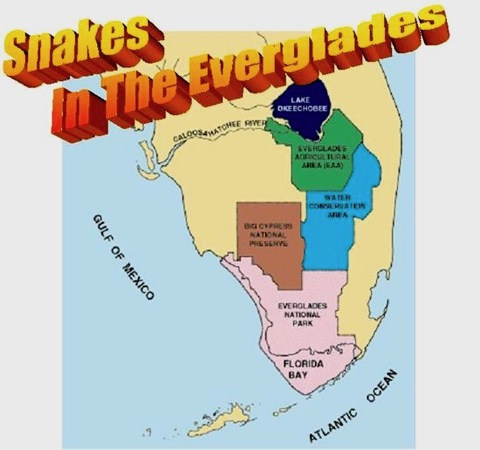
Republicans on the House Natural Resources Committee seem never to be at a loss for words when it comes to Democratic initiatives. This week the GOP members are shaking their heads over Interior Secretary Ken Salazar's efforts to get a grip on invasive snakes invading national parks in Florida.
Going so far as to produce an image reminiscent of those 1950s and 1960s horror film posters, the Republicans headed into a subcommittee hearing on Secretary Salazar's proposal with a suggestion that one and all Sit Back. Relax. Enjoy the Fright
Back in January the Interior secretary announced that the U.S. Fish and Wildlife Service would propose to list the Burmese python and eight other large constrictor snakes that threaten the Everglades and other sensitive ecosystems as “injurious wildlife” under the Lacey Act. The secretary made the announcement at the Port of New York, which his staff says serves as the largest point of entry in the nation for imports of wildlife and wildlife products. Last year, U.S. Fish and Wildlife Service inspectors at John F. Kennedy International Airport handled more than 27, 000 separate wildlife shipments valued at more than $1 billion, or 16 percent of all U.S. wildlife imports, according to a USFWS release.
This week the Republicans on the House Natural Resources Committee assailed that move, saying it would hurt small business owners. They added that America's sportsmen should be used to help fight the snakes spreading out across Everglades National Park, but noted that "hunters are currently only allowed to hunt snakes with their hands or a machete, making the sport incredibly inefficient and unpopular."
Here's what else the GOP had to say:
“Injurious” designation under the Lacey Act would make it unlawful to import, export, transport, sell, buy or posses any of the nine constrictor snakes listed by the DOI. An outright ban on these nine constrictor snakes would result in significant economic damage to the pet industry, and those who support the sale and transportation of snakes and snake supplies. The Administration’s proposed policies are targeted at lawful pet owners and their private property and do NOTHING to address the stated concern over snakes currently existing in the wild in South Florida.
Get the Facts
* There are approximately 3,800 pet retail stores across the country that average $3.5-5.25 million in annual snake sales.
* The U.S. Fish and Wildlife Service estimated the initial economic loss of snake supply revenue to be $3.6 to $10.7 million—that figure is believed to be greatly understated.
* In total, losses due to an “injurious” listing for Boa constrictors alone are expected to hit private pet dealers, pet supply stores and companies such Delta, FedEx, and UPS for a combined $1.6-$1.8 billion (Source: U.S. Association of Reptile Keepers.)
* The scope of this “injurious” listing is unprecedented and would cause severe economic pain for thousands of Americans by destroying livelihoods and possibly exacerbating the problem of constrictor snakes in South Florida as snake owners and breeders could then release their newly illegal snakes into the wild.
* Secretary Salazar based his decision on a 302-page report by the U.S. Geological Survey, which has been called into question by various scientists in a letter to the U.S. Senate’s Environment and Public Works Committee. The scientists called the report a “gross overestimate of potential habitat for these snake species” and noted the Everglades were the “the only known breeding population” for pythons as FWS notes “large constrictors are likely to be limited to the warmest areas of the US.”
* Proponents of the Lacey Act designation argue that these snakes were released into the wild by their pet owners. However, Hurricane Andrew, which devastated South Florida in 1992, completely destroyed a warehouse of exotic reptiles that potentially contained hundreds of Burmese pythons. This is thought to be a contributing factor to the prevalence of constrictor snakes in the Everglades.
* Sportsmen are good stewards of our public lands and their expertise and knowledge of the land should be used to help diminish the increasing snake population. Unfortunately, hunters are currently only allowed to hunt snakes with their hands or a machete, making the sport incredibly inefficient and unpopular.
And who said politics was boring?
Story Categories:
A copy of National Parks Traveler's financial statements may be obtained by sending a stamped, self-addressed envelope to: National Parks Traveler, P.O. Box 980452, Park City, Utah 84098. National Parks Traveler was formed in the state of Utah for the purpose of informing and educating about national parks and protected areas.
Residents of the following states may obtain a copy of our financial and additional information as stated below:
- Florida: A COPY OF THE OFFICIAL REGISTRATION AND FINANCIAL INFORMATION FOR NATIONAL PARKS TRAVELER, (REGISTRATION NO. CH 51659), MAY BE OBTAINED FROM THE DIVISION OF CONSUMER SERVICES BY CALLING 800-435-7352 OR VISITING THEIR WEBSITE. REGISTRATION DOES NOT IMPLY ENDORSEMENT, APPROVAL, OR RECOMMENDATION BY THE STATE.
- Georgia: A full and fair description of the programs and financial statement summary of National Parks Traveler is available upon request at the office and phone number indicated above.
- Maryland: Documents and information submitted under the Maryland Solicitations Act are also available, for the cost of postage and copies, from the Secretary of State, State House, Annapolis, MD 21401 (410-974-5534).
- North Carolina: Financial information about this organization and a copy of its license are available from the State Solicitation Licensing Branch at 888-830-4989 or 919-807-2214. The license is not an endorsement by the State.
- Pennsylvania: The official registration and financial information of National Parks Traveler may be obtained from the Pennsylvania Department of State by calling 800-732-0999. Registration does not imply endorsement.
- Virginia: Financial statements are available from the Virginia Department of Agriculture and Consumer Services, 102 Governor Street, Richmond, Virginia 23219.
- Washington: National Parks Traveler is registered with Washington State’s Charities Program as required by law and additional information is available by calling 800-332-4483 or visiting www.sos.wa.gov/charities, or on file at Charities Division, Office of the Secretary of State, State of Washington, Olympia, WA 98504.


National parks and their natural resources belong to you. The National Parks Traveler works to ensure you know how these essential places are being cared for.
Sign Up For Our Weekly Newsletter
Unsubscribe at any time.
INN Member

The easiest way to explore RV-friendly National Park campgrounds.

Here’s the definitive guide to National Park System campgrounds where RVers can park their rigs.
Our app is packed with RVing- specific details on more than 250 campgrounds in more than 70 national parks.
You’ll also find stories about RVing in the parks, tips helpful if you’ve just recently become an RVer, and useful planning suggestions.


Comments
There is an excellent National Geographic special called Python Wars that at least for me is currently available on Time Warner On Demand for those who want to watch it (for me it's under HD On Demand, which is all free). They followed park scientists and others trying to study the pythons in an attempt to understand them and find potential weaknesses. Very distressing situation (these snakes have been found to eat just about anything) and the native wildlife is essentially defenseless against them.
More distressing is the African python, which is apparently even nastier and could eat even larger prey. It's also been found in the Everglades but so far has not spread.
Highly recommend the program!
What do you expect from a bunch of snake oil salesmen? (Sorry, I can't resist.)
Those people who sell snakes can raise them instead of importing them, and they can still make their money. There should be more creatures that should not be allowed here than just snakes.
Many of "those people who sell snakes" support a ban on IMPORTS, because then their captive bred snakes wouldn't have to compete with dirt-cheap wild-caught animals. It is distressing for small scale breeders to invest thousands of dollars raising and caring for healthy, selectively bred snakes and breeding them, and then having to lower their prices drastically just so they can compete with the sickly wild-caught animals sold wholesale for $5 each. No constrictors should be removed by the thousands from their natural habitat. That is why so many Americans have dedicated their lives to the captive propagation of healthy, docile, beautiful snakes. Captive breeding reduces the strain on wild populations, and a ban on importing wild animals would help "those people who sell snakes" who really truly care about the health and safety of the animals they breed. Wild animals introduce disease to captive populations, and they are generally more aggressive than captive bred snakes.
The problem with all this new proposed legislation, is that it would destroy captive breeding projects. The legislation would make it illegal for a baby boa BORN in Indiana, to be sold and shipped to someone in Illinois. Interstate commerce would be banned, prices would plummet, and many breeders wouldn't make enough profit to even keep their animals. The result will be more snakes abandoned at shelters and pet stores. I would NEVER release a non-native animal into the wild, but what if I am forced to get rid of my animals and I have to sell them really cheap on craigslist? How do I know that the person who buys won't abandon it, or give it to someone else that will abandon it? At some point, as legislation makes it more and more difficult to keep snakes, they will fall in the hands of progressively inept owners, and THAT is how these animals end up suffering. Keep healthy captive bred snakes in the hands of people who can properly care for them. Penalize people severely for animal cruelty, require licenses for giant constrictors in Florida (already implemented), and promote proper and responsible husbandry.
they are not only trying to stop you from importing them into the country but keep you from crossing state lines with them. alot of business cross state line so it would hurt people even trying to raise their own to sell as well
This bill also stops the interstate transport of even captive bred animals. Please read and be well informed before making comments like this. That is the problem with this whole bill, there are a bunch of ignorant people with fear driven agendas involved.
It isn't just importing. The ban would be for interstate sales also.(couldn't sell from one state to another) Get your facts straight if you are going to discuss this.
Anonymous, the ban on interstate transportation was mentioned in the grey-highlighted text as well as in our original story, which was linked to in the very first paragraph. -- Ed.
thats what he said
Why can't Republicans support even the smallest victory for our natural environment? This is an easy one and they blew it. Could also be an example of the deep partisan divide infecting Congress these days. Regardless, this is another example of why I call myself a Jeffersonian Democrat.
How is this going to be a victory for the environment? If anything it will just cause more people to release their now illegal pets into the environment. If politicians were serious about protecting the Everglades they would focus on the Melaleuca trees and the ever increasing populations of feral cats, dogs, and hogs. Maybe they would also stop selling land to the frickin' sugar industry.
I couldn't care less about a business's cash flow.
This is about protecting Our Everglades National Park.
If I live in Indiana and want to sell an albino captive bred boa to someone in Illinois, WHAT does that have to do with Florida? I'm an environmentalist, but I also love snakes. Captive breeding is GOOD for the environment because it reduces strain on wild populations. The feral constrictors in the Everglades are a regional issue. No burmese python is going to survive the winter in Indiana, so why do thousands of Americans all over the country have to lose their jobs because of Florida's climate? Keep the restrictions limited to areas that are actually affected by feral constrictors.
Oh and this isn't just about a "business's cash flow". Snakes are not just merchandise. They are living, breathing creatures that can't just be "liquidated". Do you really think I would care more about the money if the government suddenly said that I have to have all of my babies euthanized? Could you euthanize your dog or cat just because THEY are a bigger feral threat to the everglades than the pythons? Of course not. This is a regional issue and should be dealt with at the state level. Ban all constrictor imports into Florida? Fine. Just leave everyone else to enjoy their pets.
I would lose my job and you don't care?
This measure would be to stop interstate sales of these certain snakes and to stop imports. It won't help the environment in any way. I am sure you don't care about the cash flow, however tell that to the 1000's of people who will have to file bankruptcy if this goes through.
look obviously you don't care about the recession we are in either doing this would cause major job loss that's like saying who cares about your job because i don't want this and this is why everyone hates us americans cause we are to closed minded and think we are right about everything and have our head so far up our.... that we choose not to see it. there are other ways of settling this without punishing everyone for a couple peoples stupidity. look the everglades are already cleared up since the winter now that your everglades aren't in direct effect at the moment and the coast is clear go and make responsible ownership laws not just punish people for someones stupidity or maybe we should shoot humans for destroying the planets ecosystem as well the pythons aren't the only ones destroying OUR EVERGLADES or the world as we know it.
Wow. I generally agree w/a lot the Repubs say but I'm so far off on this one its astounding. Maybe that's because I live in So. Fla. and have seen the devastation first hand. These snakes need to be banned everywhere except zoos and other places where professionals handle them.
And for the record, the regulations of the currently ongoing python hunt that is open to the public allow hunters to use firearms with the exception of centerfire rifles. It is only the state-licensed trappers who can capture/kill pythons at any time who cannot use firearms. So the facts the Repubs are touting on this are partially incorrect.
The bigger problem w/the current hunt is that it restricts where the hunters can go to certain state managed lands around Lake Okeechobee. Everglades Natl. Park is not open to hunters, the only people who can capture snakes there are the state licensed trappers. However, most of the officials who know anything agree that the largest concentration of snakes is in ENP. So why not open the park to snake hunters for a month and see what they find? It can't hurt at this point . . .
Ecosystems continue to evolve as new species are added. This has been true of the ENP since the beginning. It would be true even if the Burmese Python was never introduced. It's rediculous to call this evolution "devastation".
This proposed legislation would not only ban importation but also the INTERSTATE trade and transportation. So even if snake breeders raise captive bred snakes they would not be able to "make their money". It's also not targeting just the Burmese Python but 8 other constrictor species as well.
To those who "do not care about a businesses cash flow". Behind these SMALL businesses are people. Human beings trying to provide for their families and make the ends meet by doing what they love to do.
Well only fools would start a business in this kind of trade. People forever use money and the excuse of making a living to continue in a business or not to come to meet new standards which they will never ever meet unless pushed by the law. This is just plain B.S. find another business you do not have the freedom to destroy the Native species in this country.
I find your statement about an evolving eco system to be self serving at best but your just plain greedy like most people now days you have over commercialized the pet trade and it is has spiraled out of control.
FIND ANOTHER LINE OF WORK
They won't be able to control the snake infestation until they can stop the new ones coming in. The Secretary should ignore these fools. Come on, 1.6-1.8 billion US is not "small business". It's BIG business, and it shows just how much the GOP cares about safeguarding our country's natural resources. What's astounding to me is the contemptible level of greed and ignorance which, if you'll forgive me, rates no higher than a snake's belt buckle. It's all about what they can exploit. "Ecosystems continue to evolve as new species are added." It wasn't Hurricane Andrew or any other natural process that brought these snakes into our country. The snake sellers can just learn to love selling something else.
These snakes aren't going to respect borders and fences, you know - and they WILL get around. They are aggressive and not picky about what they eat, so long as it's alive and they can fit it in their mouth. Wonder what these same Republicans will say when people's pets and children start to go missing.
"Come on, 1.6-1.8 billion US is not "small business". It's BIG business"
That number is for over 10000 businesses not one.
Ok the snakes can not take the cold weather this fact has been proven. So even if your scared of what you dont know about educate your self before you speak.
So on that last bit you say snakes are no different than you and me ok sounds right to me
Though most people are not used to snakes there are a few things you should know, one they are not mindless aggressors, the only time they are aggressive is when they are scared ( self defense) and feeding. Naturally they dont eat much due to the fact that they are so large, they require one meal and they can go on that for several months and sometimes a year. Also due to their size they don't travel like most animals. They need to save energy since they dont produce their own heat. Most important of all they have personalities just like a dog or cat. Personally I have worked with large snakes my entire life and I don't think anyone should be able to own a burm or anaconda, but to completely outlaw them would be nutz. Also its not BIG business, most breeders I know gain little on each clutch sold, they don't do more than break even due to the costs involved in breeding. They do it for a little extra cash to get by and pay the bills and they are passionate about it. For those who do make a significant amount on a clutch only get that amount a few times a year so in the end it balances out to very little (again considering the amount to put into the breeding). Why should we have to part with loved ones (our slithering family) because a small percentage of people were not responsible owners. The same thing happens with hamsters, birds, dogs, fish, and so on but they are not banned, and why, because they are socially accepted and have shorter lifespans.
PRESS RELEASE November 24, 2009, 5 AM EST
Scientists Characterize Justification for Congressional Python Ban as “Unscientific”
November 24, 2009, Wilmington, NC- In a letter to the U.S. House Committee on the Judiciary an independent group of scientists today characterized a United States Geological Survey (USGS) report being touted as the justification for a ban on import and trade in pythons as “unscientific”.
The independent group of scientists and herpetologists, including professors from the University of Florida, Arizona State, and Texas A&M among others penned members of Congress in response to comments made by the U.S. Fish & Wildlife Service (USFWS) during a November 6th hearing on H.R. 2811, a bill that could determine the fate of much of the reptile trade in the United States. During that hearing USFWS Deputy Director Dan Ashe characterized the USGS report as “peer-reviewed science”, a claim that struck a nerve within the scientific community.
“It is a misrepresentation to call the USGS document ‘scientific’” stated the scientists. “As written, this [USGS] document is not suitable as the basis for legislative or regulatory policies, as its content is not based on best science practices, it has not undergone external peer-review, and it diverts attention away from the primary concern. We encourage the USFWS and USGS to submit this document to an independent body for proper and legitimate peer review. Additionally, we encourage the Committee to review this document, not as an authoritative scientific publication, but rather as a report currently drafted to support a predetermined policy”.
H.R. 2811, Introduced by U.S. Representative Kendrick Meek (D-FL), who recently announced his candidacy for the U.S. Senate, could add all pythons, and even boas, to the Injurious Wildlife list of the Lacey Act; a designation reserved for only the most dangerous alien invaders to our natural ecosystem. Such a move would prevent all import, export, and interstate transport of pythons in the U.S. The scientific justification for such a move hinges on a recently published report of the United States Geological Survey (USGS) entitled ‘Risk Assessment of Nine Large Constricting Snakes’, which attempts to paints a picture of large constrictor snakes as an immediate threat to eco-systems over much of the U.S.
Source: United States Association of Reptile Keepers (USARK)
Contact: Andrew Wyatt [email protected]
Letter To Congress:
24 November 2009
U.S. House of Representatives Committee on the Judiciary
The Subcommittee on Crime, Terrorism & Homeland Security
2138 Rayburn House Office Building
Washington, DC 20515
Dear Chairman Bobby Scott and Ranking Member Louie Gohmert:
We write in regard to the recent Congressional hearing on HR 2811. As scientists who have worked with reptiles including those cited in HR2811, we express our reservations regarding the document recently released by USGS as an “Open-Report”, titled Giant Constrictors: Biological and Management Profiles and an Establishment Risk Assessment for Nine Large Species of Pythons, Anacondas, and the Boa Constrictor.
Simply put, this report is not a bona-fide “scientific” paper that has gone through external peer review. Part of this report is fact-driven, described by the authors as “traditional library scholarship.” By the authors’ admissions, there are surprisingly little data available regarding the natural history of these species. In their attempt to compile as much information as possible, the authors draw from a wide variety of references, ranging from articles published in peer-reviewed professional journals to far less authoritative hobbyist sources, including popular magazines, the internet, pet industry publications, and even various media sources. While such an approach is inclusive, it tends to include information that is unsubstantiated and, in some cases, contradicts sound existing data.
As scientists whose careers are focused around publishing in peer-reviewed journals and providing expert reviews of papers submitted to these journals, we feel it is a misrepresentation to call the USGS document “scientific”. In fact, much of this report is based on an unproven risk assessment model that produces results that contradict the findings presented in a recently published scientific paper that used a more complex and superior model (see: Pyron R.A., F.T. Burbrink, and T.J. Guiher. 2008. Claims of Potential Expansion throughout the U.S. by Invasive Python Species Are Contradicted by Ecological Niche Models, PLoS One 3: e2931. doi:10.1371/journal.pone.0002931). Unfortunately, the authors of the USGS document limit their reference to this scientific work to an unsubstantiated criticism. To the contrary, this alternate model is validated by its relatively accurate prediction of the natural distribution of the species in question (something the USGS model does not even attempt). Furthermore, despite its conclusion of a limited potential distribution of Burmese pythons in the United States, the model presented by Pyron et al. accurately predicts the presence of Burmese pythons in the Everglades.
The USGS model likely provides a gross overestimate of potential habitat for these snake species. People throughout the United States keep pythons as pets, yet the only known breeding populations in the United States are in the Everglades. Such a wide distribution of potential sources of invasion, but only a localized invasive event, suggests that factors beyond those used in the USGS model are critical to limiting the suitability of habitat for pythons. The authors even state that climate is only one factor of several that affect the distribution of an animal, yet they develop a model that only uses overly simplistic climatic data (e.g., the climatic data did not take seasonality into consideration).
We are further concerned by the pervasive bias throughout this report. There is an obvious effort to emphasize the size, fecundity and dangers posed by each species; no chance is missed to speculate on negative scenarios. The report appears designed to promote the tenuous concept that invasive giant snakes are a national threat. However, throughout the report there is a preponderance of grammatical qualifiers that serve to weaken many, if not most, statements that are made.
We fully recognize the serious concerns associated with the presence of persistent python populations in southern Florida. As top predators, these animals can and will have a dramatic impact on the community of wildlife that lives in the Everglades. Inaccurately extending this threat to a much large geographic area is not only inappropriate, but likely takes needed focus away from the real problem in the Everglades.
In conclusion, as written, this document is not suitable as the basis for legislative or regulatory policies, as its content is not based on best science practices, it has not gone through external peer-review, and it diverts attention away from the primary concern. We encourage the USFWS and USGS to submit this document to an independent body for proper and legitimate peer review. Additionally, we encourage the Committee to review this document, not as an authoritative scientific publication, but rather as a report currently drafted to support a predetermined policy.
Signed:
Elliott Jacobson, MS, DVM, PhD, Dipl. ACZM
Professor of Zoological Medicine
University of Florida
Dale DeNardo, DVM, PhD
Associate Professor School of Life Sciences
Arizona State University
Paul M. Gibbons, DVM, MS, Dipl. ABVP (Avian)
President-Elect, Association of Reptilian and Amphibian Veterinarians
Interim Regent, Reptiles & Amphibians, American Board of Veterinary Practitioners
Director, Exotic Species Specialty Service
Animal Emergency Center and Specialty Services
Chris Griffin, DVM, Dipl. ABVP (Avian)
President, Association of Reptilian and Amphibian Veterinarians
Owner and Medical Director
Griffin Avian and Exotic Veterinary Hospital
Brady Barr, PhD
Resident Herpetologist
National Geographic Society
Endangered Species Coalition of the Council of State Governments
Crocodilian Specialist Group
Warren Booth, PhD
Invasive Species Biologist
Research Associate
North Carolina State University
Director of Science
United States Association of Reptile Keepers
Ray E. Ashton, Jr.
President
Ashton Biodiversity Research & Preservation Institute
Robert Herrington, PhD
Professor of Biology
Georgia Southwestern State University
Douglas L. Hotle
Curator of Herpetology/Conservation/Research
Natural Toxins Research Center
Texas A&M University
Francis L. Rose (Retired) , B.S., M.S. (Zoology), PhD (Zoology)
Professor Emeritus
Texas State University
Edward J. Wozniak DVM, PhD
Regional Veterinarian
Zoonosis Control Division
Texas Department of State Health Services
CC: Secretary Kenneth Salazar, US Dept of the Interior; Director Marcia McNutt, US Geological Survey; Director Sam Hamilton, US Fish & Wildlife Service
While I understand some people are concerned about the health of park lands. The amount of pythons has been grossly over estimated. As stated in the article these non native reptiles could be easily wiped out by sportsmen. a catch all you want type license would do it, for that matter they could profit from it by selling licenses.. Yet the fish and game dept of Florida issued as few as 15 permits per year. I don't see reason to kick those who comply with the laws with proposed legislation that would cripple their family incomes, as well as a massive amount of retailers who make or sell products for keeping these type animals properly.
bat: "These snakes aren't going to respect borders and fences"
-that's a true statement, but what they DO respect is CLIMATE. the temperatures experienced during the recent cold snap that killed SO MANY of them in the 'glades are COMMON-PLACE just a few hundred miles north of the 'glades. these animals simply CANNOT survive outside of south florida. that one event ALONE debunks the USGS reports.
random walker: "This is about protecting Our Everglades National Park"
-FYI... this proposal does NOT penalize releasing pythons into the wild (in fact, this is ALREADY illegal). this proposal ALSO does NOT propose any process for REMOVING the pythons already established in the 'glades. so let's think through that statement with a little more LOGIC, please.
anonymous: "Those people who sell snakes can raise them instead of importing them, and they can still make their money"
-the VAST VAST VAST majority of snakes sold in the US ARE captive bred. unfortunately, the bans would prohibit interstate transport, which would DEVASTATE the industry. we would only be allowed to buy/sell within our own state. prices would plummet, and vast (VERY expensive) collections would be rendered worthless overnight, causing many people to dump their now-worthless animals because they can no longer afford to keep them (they fund their collections by SELLING snakes, so if they can no longer sell their animals, they can no longer afford to KEEP them).
square grouper: "I live in So. Fla. and have seen the devastation first hand"
-oh really? what "devastation" have you "seen" that is caused by the pythons? there's no evidence yet that these are "devastating" at all. there is SOME evidence that they COULD become a problem, but as of yet nobody can PROVE that they are indeed HARMFULL. the vast majority of established exotics find their own place in the ecosystem and life goes on. when people say the burms have no natural predators, this is only PARTIALLY true. the "natural" predators that prey on the burms in their native environment do not exist in the 'glades. HOWEVER, american alligators and crocodiles can EASILY take all but the absolute largest of burms (on a separate note, did you know that the size ranges commonly given for burms include the extremes found in captivity? which, btw, CANNOT be found in the wild... wild burms are smaller and leaner than captive burms). numerous birds and other animals native to the 'glades EASILY prey on young burms. so again i ask you to TELL us about the "devastation" you have "seen" in the 'glades caused by burms. there very well could be "devastation," but it is NOT caused by burms.
house cats have and will continue to cause more devistation in the US than any snake ever could but yet people still leave food outside for stray cats and let they cats roam free outside why dont they make more laws on the real thing fucking up the enviorment.
the 1.6 billion dollars isnt the toal from one place selling reptiles its from every little person selling reptiles across the country from the kid that bred a ball python in his room and sold it for $15 to the bigger breeders that sell a couple hundred month to the petstores
people need to do real research and learn what is really going on b4 making stupid comments about getting rid of reptiles just cuz you dont like them doesnt mean others dont. if we got rid of everything that atleast one person didnt like we wouldnt be left with nothing so instead of trying to get rid of stuff lets find a way to live with it all
What's this all really about? It's about money. It's about money that the USGS will receive if this passes. It's about the USGS producing a report that will help them secure that money, and then having it 'peer reviewed' by insiders who also stand to gain by putting pythons on the injurious wildlife list.
I'm an environmentalist, I am a primarily a Democrat, and I am a snake breeder. I would love to work with Dwarf Burms, Super Dwarf Retics, and small island locality boa constrictors--all of these animals would be out of the question for my business if this proposal passes. They stay small and harmless, but they're still the same species as the giants.
This is not a situation where the Republicans are trying to do something harmful to the environment or block environmental protection acts (again). This is a situation where some rogue politicians have gotten into bed with animal rights extremists, and concocted a plan to systematically dismantle the reptile industry in the US. The giant pythons are just an easy place to start. If you don't believe it, go to the HSUS website, and check out what they have to say about pet reptiles for yourself. This is not a paranoid fantasy, it's really happening.
Adding these animals to the Lacey Act will do NOTHING to help solve the problem of these animals being loose in the Everglades. Absolutely nothing. Not now, not EVER. Instead, it vastly increases the risk of an owner who has to move out of State simply releasing their animal, rather than choosing to take it with them illegally, or have it euthanized. This is because pet owners love their animals. The fact that it's not a cat or dog makes no difference--snake owners LOVE their animals like family members. Go to any reptile forum, and see for yourself.
These snakes are present in private collections and are bred in every State in the US apart from Hawaii. What purpose is served in preventing their transport between States? The ONLY purpose behind this is to harm the TRADE in reptiles--they are actively seeking to reduce and eliminate this as a BUSINESS. Look at the wording.
The Everglades is clogged with toxic mercury, choked with pesticide runoff, overrun by vigorous and invasive non-native plants, and besieged by non-native animals. The most prominent animal offenders are HOUSECATS, and norway rats. Burmese pythons ate 2 Key Largo Woodrats. How many woodrats do you think were killed by feral cats?
This isn't about protecting the Everglades, it is about politics. Lots of people fear snakes, so they felt they could railroad the Reptile Nation, because they might have the support to pass it. It won't do any good for the Everglades, but they figure they can hoodwink people into letting it happen, and walk away with the cash, at OUR expense. If they had proposed feral cat hunts, they would be pretty darned unpopular, wouldn't they? But that WOULD have done some good for the Everglades.
These sensationalistic shows they're putting out on TV--don't believe it. LOOK INTO THIS FOR YOURSELF. These shows aren't giving you a balanced picture, or an accurate one. They're just designed to inspire more fear, and promote this agenda. It's absurd to think these animals can live outside of Southern Florida. A simple cold snap killed over 60% of them in just one season. All but one radio-tracked Burm DIED. They CANNOT withstand the cold. They simply are not equipped with the instincts or the physiology to do so.
I couldnt agree more with this post.
I am 100% Democrat and yet I side with the Republicans 100% on this issue. Causing a law that will seriously cripple an industry is absurd just to save a small area in Florida.
Sorry, but there are other ways around this. Completely banning imported pythons would help for starters. Then allowing snake hunting licenses in the area would help as well.
This "devastation seen first hand" is erroneous at best. Yes it is a slight population control problem, but "devastating" it is not. What will be "devastating" is the families of the small business breeders (who take up most of the industry mind you, not big companies) and their livelihood.
I dont own, nor do I sell snakes. Never had. But just as a logic and informed person you can see the vast misplaced fear and overkill going on in this discussion.
Let me give you an example.. Upper state NY and Alaska for example are WAY to cold for these animals to sustain life, how does it make sense to cripple every state in the US to benefit that of one state?
Banning interstate trade of snakes will destroy this economy even further. No wonder this country is turning into crap with people like this leading us. This has got to be the biggest overblown recourse I have ever seen.
The way I read it, the listing would only be of four python species, four anaconda species, and all boa constrictors. My understanding is that there are many species of pythons (and anacondas) that wouldn't be made illegal for import or interstate transport under the new ruling.
What would stop breeders and sellers from dealing with the remaining species that are legal? We have a large, well known reptile seller near where I live, and they are very diverse in their offerings. I would think they could maintain their supply of the restricted species via California breeders, and would likely deal more in the species that don't have the restrictions.
There are many specialist breeders out there who have chosen to focus on only 1, or only a few species. The biggest investment is in VERY high dollar 'morphs'--color mutations of animals, such as albinos. Single animals can be worth over $10,000...but only if you can sell them to someone who also feels they are a good investment. If these animals cannot be transported across State lines, they will lose their value almost entirely. That's NOT chump change. A breeder of these animals can't just switch over to some other species, because they've LOST all the money they invested. Most of monetary issue involved is with Boa Constrictors. Boa morphs are HUGE business. There are many breeders who specialize in boas exclusively, because of the very high dollar individual animals they can breed. Burmese pythons come in second--Burms are popular giant snakes, and Burm morphs can also be worth quite a bit of money.
But it truly is the Boas that have made this idea so INCREDIBLY economically devastating. The addition of boa constrictors was truly an ill-thought-out notion. Boas do not get as large as any of the python species listed, or anacondas.
Who RIGHT NOW is willing to pay 10 grand for a boa morph, when they know that in a few months, that animal could be worth perhaps $100? The person who paid for that animal will have COMPLETELY lost their investment--and most likely their business, their livelihood, perhaps their home, and their entire economic future in one fell swoop. Can YOU eat a loss of 10 grand right now without flinching? Now consider the person who owns 10 animals like this, and is making a living from selling their offspring each year. What will they be left with?
There is NOTHING these people will be able to do. They can barely sell their animals right now, due to this proposal.
Now, given that doing this will NOT benefit the Everglades or any wild habitat in ANY fashion, how exactly is this a good idea?
Through selective breeding for specific genetic traits there is a huge list of boa constrictors that will be illegal to transport accross state lines to sell at reptile shows . This list of boa constrictors are currently worth thousands of dollars for each animal if the government was to ban these they would all be worthless.
here is a list of them:
The following list are all Boa constrictor imperator or hybrids of Bcc x Bci
Hypo x Hypo = Super Hypo
Hypo x Albino = Sunglow
Hypo x Anery = Ghost
Hypo x Blood = Hypo Bloods
Hypo x Caramel = Creamy Hypo
Hypo x Reverse Stripe = Hypo Reversed Stripes
Hypo x Genetic Stripe = Hypo Stripe
Hypo x Motley = Hypo Motley
Hypo x Arabesque = Hypo Arabesque
Hypo x Jungle = Hypo Jungle
Motley x Motley = Super Motley
Motley x Albino = Albino Motley
Motley x Anery = Anerythristic Motley
Motley x Blood = Very Red Motley
Motley x Caramel = T+ Motley
Motley x Reverse Stripe =
Motley x Genetic Stripe = Stripe with small circle patterns inside
Motley x Arabesque = Reduced Pattern Motley
Motley x Jungle = Odd Pattern Motley
Arabesque x Arabesque = Super Arabesque
Arabesque x Albino = Albino Arabesque
Arabesque x Anery = Anerythristic Arabesque
Arabesque x Blood = Blood Arabesque
Arabesque x Leopard = Busy Patterned Boa
Arabesque x Caramel = T+ Arabesque
Arabesque x Reverse Stripe = Reverse Stripe Arabesque
Arabesque x Genetic Stripe = AWESOME Stripes
Arabesque x Jungle = Jungle with Lateral Stripes
Jungle x Jungle = Super Jungle
Jungle x Albino = Albino Jungle
Jungle x Anery = Anerythristic Jungle
Jungle x Blood = Bloody Jungle
Jungle x Leopard = Leopard with bold markings
Jungle x Caramel = T+ Jungle
Jungle x Reverse Stripe = Reverse Stripe Jungle
Jungle x Genetic Stripe = Genetic Striped Jungle
Albino x Anery = Snow
Albino x Blood = Red Albino
Albino x Leopard = Albino Leopard
Albino x Caramel =
Albino x Reverse Stripe = Reverse Stripe Albino
Albino x Genetic Stripe = Striped Albino
Anery x Blood =
Anery x Leopard =Anerythristic Leopard
Anery x Caramel = VERY Light Ghost-like Boa or creamy looking Snow
Anery x Reverse Stripe = Anerythristic Reverse Stripe
Anery x Genetic Stripe = Anerythristic Stripe
Blood x Leopard = Very Red Leopard
Blood x Caramel = Orangy Blood
Blood x Reverse Stripe = Reverse Stripe Blood
Blood x Genetic Stripe = Striped Blood
Leopard x Caramel = Creamy colored Leopard
Leopard x Reverse Stripe = Reverse Stripe Leopard
Leopard x Genetic Stripe = Striped Busy Pattern Boa
Caramel x Reverse Stripe = T+ Reverse Stripe
Caramel x Genetic Stripe = Striped T+
Reversed Stripe x Genetic Stripe = Genetic Stripe with reversed tail stripe
Super Hypo x Super Hypo = Super Hypo
Super Hypo x Motley = Super Hypo Motley
Super Hypo x Arabesque = Super Hypo Arabesque
Super Hypo x Jungle = Super Hypo Jungle
Super Hypo x Albino = Super Sunglow
Super Hypo x Anery = Super Ghost
Super Hypo x Blood = Very Red Boa
Super Hypo x Leopard = Reduced Pattern Red Leopard
Super Hypo x Caramel = High Orange Super Hypo
Super Hypo x Reverse Stripe = Reversed Stripe Super Hypo
Super Hypo x Genetic Stripe = Genetic Striped Super Hypo
Super Motley x Super Motley = Super Motley
Super Motley x Hypo = Patternless RED Boa
Super Motley x Arabesque =Patternless boa with few broken Lateral Stripes
Super Motley x Jungle =
Super Motley x Albino = Albino Super Motley
Super Motley x Anery =
Super Motley x Blood =
Super Motley x Leopard = Dark Faded Pattern Boa
Super Motley x Caramel = Patternless Cream Colored Boa
Super Motley x Reverse Stripe =
Super Motley x Genetic Stripe = MAYBE a Dark Faded Striped Boa
SUPER ARABESQUE
Super Jungle x Super Jungle = Super Jungle
Super Jungle x Hypo = Super Jungle Hypo
Super Jungle x Motley = Super Jungle Motley
Super Jungle x Arabesque =Speckled Multi-Striped Boa
Super Jungle x Albino = Albino Super Jungle
Super Jungle x Anery = Anerythristic Super Jungle
Super Jungle x Blood = Bloody Super Jungle/ VERY red Super Jungle
Super Jungle x Leopard = Oddly Striped Boa with Busy Pattern
Super Jungle x Caramel =
Super Jungle x Reverse Stripe = Reverse Striped Super Jungle
Super Jungle x Genetic Stripe =
Sunglow x Sunglow = Sunglow
Sunglow x Hypo = Super Sunglow
Sunglow x Motley = VERY high contrast Albino Motley
Sunglow x Arabesque = Sunglow Arabesque
Sunglow x Jungle = Sunglow Jungle
Sunglow x Anery = Moonglow
Sunglow x Blood = Very Red Sunglow
Sunglow Leopard = High Constrast Albino Leopard
Sunglow x Caramel = NOT AVAILABLE
Sunglow x Reverse Stripe = Reverse Stripe Sunglow
Sunglow x Genetic Stripe = Striped Sunglow
Ghost x Hypo = Super Ghost
Ghost x Motley = Ghost Motley
Ghost x Arabesque = Ghost Arabeque
Ghost x Jungle = Jungle Ghost
Ghost x Albino = Moonglow
Ghost x Blood =
Ghost x Leopard = Leopard Ghost
Ghost x Caramel = Very creamy looking Ghost
Ghost x Reverse Stripe = Reverse Stripe Ghost
Ghost x Genetic Stripe = Striped Ghost
- SKIPPING HYPO BLOODS -
- SKIPPING CREAMY HYPOS -
Hypo Reverse Stripe x Hypo = Super Hypo Reversed Stripe
Hypo Reverse Stripe x Motley = Hypo Reversed Stripe Motley
Hypo Reverse Stripe x Arabesque = Hypo Reversed Stripe Arabesque
Hypo Reverse Stripe x Jungle = Hypo Reversed Stripe Jungle
Hypo Reversed Stripe x Albino = Reversed Stripe Sunglow
hypo Reversed Stripe x Anery = Reversed Stripe Ghost
Hypo Reverse Stripe x Blood = Hypo Reversed Stripe Blood
Hypo Reverse Stripe x Leopard = Hypo Reversed Stripe Leopard
Hypo Reverse Stripe x Caramel = T+ Hypo Reverse Stripe (odd sunglow-like reverse stripe)
Hypo Reverse Stripe x Genetic Stripe = Hypo Super Stripe Crazy Looking Boa
Hypo Stripe x Hypo = Super Hypo Stripe
Hypo Stripe x Motley = Hypo Stripe Motley
Hypo Stripe x Arabesque = Hypo Multi-Striped Boa
Hypo Stripe x Jungle = Hypo Stripe Jungle
Hypo Stripe x Albino = Striped Sunglow
Hypo Stripe x Anery = Striped Ghost
Hypo Stripe x Blood = Hypo Striped Blood
Hypo Stripe x Leopard = Hypo Striped Leopard
Hypo Stripe x Caramel = T+ Hypo Stripe (odd sunglow-like striped boa)
Hypo Stripe x Reverse Stripe = Hypo "Super" Stripe
Hypo Motley x Hypo = Super Hypo Motley
Hypo Motley x Motley = Hypo Super Motley
Hypo Motley x Arabesque = Hypo Motley with Lateral Striping
Hypo Motley x Jungle = Hypo Motley Jungle
Hypo Motley x Albino = Sunglow Motley
Hypo Motley x Anery = Ghost Motley
Hypo Motley x Blood = High red Motley
Hypo Motley x Leopard =Busy Patterned Hypo Motley
Hypo Motley x Caramel = T+ Hypo Motley
Hypo Motley x Reverse Stripe = Reversed Stripe Hypo Motley
Hypo Motley x Genetic Stripe = Hypo Motley Stripe
Blood x Type II anery = pewter
Sharp albino x Boawoman caramel = Paradigm
Aztec x Aztec = Super Aztec
Orangetail Hypo x Aztec = Hypo Aztec (Hytec)
Sunglow x Caramel (using a T pos Nic) = T pos sunglow
Blood x Albino = Bloody Albino
I hope this bill passes and is the start of a full ban of exotic imports and captive breeding. I volunteer at a humane society that deals mainly with unwanted reptiles. If any of you saw the condition that some of these reptiles come in it would make you sick. People breed these animals because its easy and because they think they can make money. When they find out they cant, they dump off their whole breeding colony onto a humane society. I've seen 50 snakes surrendered in one plastic tote together, and the ones on the bottom die from being suffocated. Worse yet we have animals come in from someone who ordered them off the internet from a so called "white blooded American business owner", usually the animal is in such a sate of ill health we have to put them down immediately. For every 50 animals that come in maybe 1-5 find proper homes. If someone was a dog breeder and kept puppies in a rack system like most of the commercial reptile breeders do they would be called a puppy mill. Whether you are reading this thinking you are one of the good reptile breeders out there who doesn't mistreat your animals just remember, you are contributing/causing the problem. When was the last time you followed up on a reptile you sold? Do you know where the Green Labyrinth Burmese python morph ended up after you sold it? Don't worry I've seen it, it's in a freezer with all of the other animals who [couldn't] find homes.
"I hope this bill passes and is the start of a full ban of exotic imports and captive breeding ... "
So you support a ban of breeding cats and dogs then? What about horses and sheep? Hamsters and guinea pigs are a no no as well I suppose. Oh that's right, humane societies and rescues are not over run with dogs, just reptiles. Feral cats are not a problem, just large snakes.
As for banning the breeding of snakes, why should responsible breeders be made to suffer? It doesn't matter if its snakes or dogs or hamsters or rabbits. A ban is a ban. It eliminates all breeders not just the irresponsible ones. You are insinuating that reptile breeders do not follow up on sales. I'd guess as many reptile breeders follow up as dog breeders. Do you know where that chocolate lab ended up. Its in the incinerator with the all the other animals who couldn't find homes.
You do make some legitimate points but to limit them to reptiles shows you prejudice and ignorance on the matter. Your argument only makes sense if you support the ban on captive breeding of every single species of animal because there are abuses regarding every one of them.
If you are prepared to come on here and say that you support a ban on breeding every companion animal species then I can and will respect your opinion ( I won't agree with with it but I will respect it) Until then, as long as you are limiting your ban to reptiles your opinion just doesn't hold any merit with me.
I actually do support a ban of breeding of all animals. I didn't think I had to share all of my views because this discussion of this board was about reptiles.
We do not NEED dogs, cats, hamsters, turtles, cows, chickens, and any other animal to survive. They are merely entertainment for us.
Tell me im wrong.
Why do we keep dogs? For companionship. Why do we keep cats? For companionship. Why do we keep cows? Because we like the way they taste.
All of our human needs can be met without the assistance of animals.
I understand that people make a livelihood out of breeding reptiles, but a lot of people provide for their family by not breeding reptiles.
I know the world will not change in my lifetime. I know we wont all be vegans. I know people will keep breeding reptiles even if it is outlawed. I just wanted to share my side of all of the torture and death I see from this "industry".
Yeah, I'm practically a Democrat (very liberal independent) but I take exception to your play at party politics in this matter. There are a number of politicians, both Democrat and Republicans, behind the proposed snake ban. It is, for all intents and purposes, a bipartisan bill. Yet when you make the statement that it is supported only by the Democrats you get all the unthinking progressive wannabe followers behind this bill (hey, anything the Republicans support is evil, no matter what, right?)
If this bill was only about the importation of pythons and boas then maybe it could have had support from reptile owners and even some breeders but it isn't. Instead, it will make it virtually a crime simply to own one of these snakes. I own a python (one that I personally rescued btw!) and do not want to be confined to the state I live in just because I chose to save and keep this animal. As I stated to "Roadranger", who thinks that pythons and boas are somehow behind every environmental problem in Florida: if any of you arm-chair activists gave a sh!t about the environment you would demand better control of feral cats, pigs, and dogs, not to mention the introduced fish and dog species, not to mention the buying out of the Everglades by the sugar industry. but, no, it's all about the snakes, because snakes are "evil" right?
Then you have people like the "Anonymous" at April 15 and April 21. Someone who volunteers at the humane society, sees the suffering of unwanted pets first hand, and then has the gall to think that:
A: If humans were to stop breeding animals then animal suffering would actually be reduced and
B: Humans should keep their distance from animals, not have them in their lives, and view nature remotely!
What insanity!! This is why zoologists and other animal rights activists don't take PETA or the HSUS seriously, because they think that animals can just be banished to the wild and that humans can somehow live without interacting with animals at all. I won't even get into the ridiculousness of that point of view.
What I will get into is the simple fact that if the breeding and ownership of companion animals is outlawed, the number of unwanted, malnourished animals that that bonehead will have to try to help will SKYROCKET! Just look at what's happening in Vancouver: aside from animals unsuited for pet ownership (big cats and great apes) the City of Vancouver, BC had the bright idea to outlaw many reptile and amphibian species. Now vets are complaining about animals being abandoned en mass. Many of them will have to be put to sleep and the so called "Humane Society" has the chutzpah to say that things will improve if this is duplicated in the United States!? I want every environmentalist reading this thread to take a good long look at what Anonymous at April 21 wrote down. This is what you are siding with if you support the S373. People who actually love their pets and will do anything to take care of them will be forced to give them up and probably put many of them to sleep while people like him/her say what a "victory" it is for animal lovers.
Instead, we really should look to breeders and owners to better regulate themselves. In the Carolinas this is already beginning to happen. USARK is doing everything in its power to make sure that large snake owners are allowed to keep and breed their pets so long as they prove that they meet the housing requirements for such animals. I would very much support State and even a Federal law that is very similar. Instead of banning an animal and thus making contraband out of living and breathing creatures we can enforce existing animal rights laws and add housing requirement laws. That way, people who are actually knowledgeable about reptiles would be able to oversee any private ownership and breeding industry that occurs and the environment, along with the lives of animals and people, will be much better protected than if this farce of a bill, which would be like sticking an adhesive strip on a jugular wound, is passed.
Oh yes, I forgot to mention, many pythons and other introduced reptiles in Florida were killed off during the cold front of 2010. I would say that is nature correcting things but the whole thing might have been due to Anthropogenic Climatic Shift (you know, Global Warming).
Funny how the snake breeders want to quote their "science".. bull. The vast majority of snake shows and dealers want to sell you the newest color morph, offering nothing for conservation breeding or any science to save endangered species. So if they actually cared about wildlife and habitats, it would be new. All they want is some cool looking pet, and overbreed in hopes of the almightly dollar. I have talked to wildlife oficers in the Eveglads and the snake problem IS real along with the invasive plant life. So will we be repsonsible fora while, no will cry about our freedoms being taken away. This country and our environment is going to the dumps cause of dumb short sighted people.
listen I am no breeder I'm not a pet owner i am a father.My CHILD is a 8 month old burmese alby python named Porhtose. He is barely 3 ft long and as beautiful as a sunrise over Moab Utah his favorite hobby is to drape over my shoulders and watch fraggle rock with me. He has never even hissssd at his brother High Gear or any of the kittens that live with me. Unlike some negligible parents with their own human children as he does get bigger I look forward to watching my CHILD grow up.As far as being "injurious" goes i have seen 85 pit bulls and 67 rotts (dogs) have to be put down for attacking children in neighborhoods, in my home city alone, in the last six months. WHY ARE THESE THINGS NOT BEING CONSIDERED? Why are they picking on my 8 month old child? They are nothing more than school yard bullies!!!!!
There is little I can say or do to change anyones opinion of this situation, however, I want to start off by saying that my Scaled Americans are the world to me. My whole life I have never been without a Burmese or a Reticulated Python, they have become my children and my best friends. I trust my "snakes" more than any human I know. I care for them and love them and in return they do the same for me. It is inherently a human trait to turn on those who have loved us and taken care of us, other animals do not posses this, as they are smart enough to know better. I sleep with my snakes, I take them for walks, I let them swim and take showers, they are my world. Not only would a ban like this ruin my world, it would destroy the worlds of many large breeders who have also dedicated their lives to raising captive bred reptiles. It is already illegal to import most species of boids, therefor, that is really not the issue at this point. Do not tell me to find a different job, this is what makes me happy, this is what I know and what I love, and I know for a fact that I am not alone when I say this.
They're planning on banning interstate trade and transportation concerning huge pythons and boas? Just because Florida can't managetheir ecosystem? That's ridiculous. I have a corn snake and ball python, and am just a little woried. If they ban the interstate sell and transport of these babies, where will it stop? Will I be able to take my snakes with me when I move, or will they get to banning interstate transport of cornsnakes because some got out and started eating baby mice and started curling up in nests of endangered species? Besides, any one who knows anything about breeding snakes is aware if this bill passed, the snake breeders would be bankrupt. 7,000.00 or so is a lot of money invested to just lose on a lawmaker's whim.
I have lived in Collier County, Florida for over 20 years and have heard the stories of giant snakes in our wetlands. Speaking for most South Floridians, I believe that the importation of giant snakes from exotic places should be completely illegal. People get pythons and anacondas as pets, thinking they will stay the same size as they were when they bought them, WRONG. The snakes end up being too huge to handle and in turn, their “owners” release them into the Everglades. This causes horrible consequences for our native Florida wildlife and discourages tourism to our South Florida National Parks. So, thanks all you Python owners out there :(
P.S. To Haley Shaver, you shouldnt even have a ball python as a pet, its not like it acts like a pet, all they do is eat and slither, reptiles are not even capable of any form of emotion, so how it is a pet I am not entirely sure. What are you going to do when the snake gets to big for you to handle, or you finally realize that a snake is not a pet. Are you going to release it into the Everglades too?
Ball pythons rarely even grow to 5 feet in length so I am pretty sure it wont get to big to handle. Not to mention it is one of the most docile snakes you could own. Also once you spend some time around them you would notice, they do act like pets and they do have emotion. EVERYONE not all pythons get to be giants. There are hundreds of different pythons and only the ones listed in the ban grow to great lengths. Out of all the others most dont get bigger than 5ft and same goes for boa's. Before everyone decides to despise these creatures, try learning more about them, and that doent include the horror stories you hear in the news or the gossip on the streets. I mean actually taking the time to learn something, then form an opinion.
I keep and am working on starting a small business centered around Reticulated Pythons.To the general public they see them as a mindless eating machine.Yes they get 20+ feet long but they have to be one of the best snakes if have the joy to keep.I have 3 and not once have I or anyone that has come in contact with them has been bitten, responsibility plays a huge role in this .People must take time to see that these gentle giants mean us no harm, but rather like human contact.Now looking at the profit aspect reticulated pythons are tipping the scales in sales and most breeders today are taking steps to ensure they end up in caring hands.Perusing this ban would destroy billions on dollars pouring into the American economy.In short stop and smell the roses because once there gone there gone and that's one more blow, one more buck that falls out of the American peoples hands.
Hi. My name is Brian Beale and I am a reptile breeder in Oregon. I just want to say that I believe Banning constrictors is not a good solution to Florida's problem in the Everglades. This would be a devistating blow to all Herpers. Keepers and breeders alike. I am however, very much apposed to the gross importation off ALL reptile/animal species from their native habitats. In 1995 alone, 800,000 green iguanas were imported into the united states from the wild. These numbers are extremely outrageous and disturbing!! We should definately do something to control the sheer numbers of wildlife population that are being taken from their natural homes and being shipped into the US for people's amusement. I am all for having pet reptiles, as long as they are properly cared for. I believe that we should rely on domestic breeding of exotic reptiles as the source for our pets though. Way too many reptiles are imported every year. Many of these animals die during shipping or soon after arrival. Out of those that survive, many carry ticks, mites and other pests and illnesses with them. Wild caught reptiles do not make good pets either. Many do not take well to being in captivity - a lot of snakes won't breed in captivity if taken from the wild. And many reptiles end up in homes where they are not properly cared for, neglected and unfortunately released to the wild here. Tighter laws need to be formed to regulate the reptile/exotic pet industry, for the animals sake. But do not feel sorry for states such as Florida, for having problems with infestations of large constrictors, for they are one of the largest importers of these reptiles from other countries. Florida itself sells anacondas in their pet stores!! So to Florida I say, why don't you start by fighting your snake infestation right where the problems lye?: In your own state!
And to breeders: We need to unite! Many of us became breeders because of our love for reptiles. We need to start doing something about all this importing of wildcaught animals. It would benefit the animals, the earth, and the domestic breeding industry, but most of all the animals. If you feel like I do and want to make a difference, you can contact me at [email protected]. I have no grand plan yet, but I am looking for like minded individuals, breeders and organizations that would like to get involved and help form proposals and more to help make a change. Let's make a differance.
Brian Beale
[email protected]
What you all don't seem to understand is that while it is perfectly reasonable to ban these snakes in florida, they cannot survive elsewhere, thus it is ridiculous to ban them in other areas of the united states. Also, these snakes are not dangerous.
In one year, 90 people are killed by horses. 30 people are killed by large dogs. .5 people are killed by snakes. This isn't an issue of environmentalism or humanitarianism anywhere except florida, but it effects us all.
Also, you treat this as if this is a matter of big buisnessman who are making their money of the snakes. ITS NOT. These are average, middle class people, and if they lose their job, they won't be able to support their families. All for no good reason.