
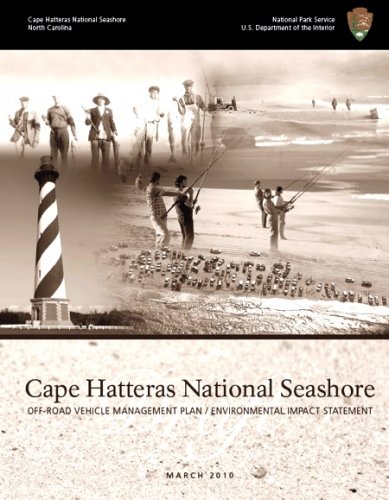
Cape Hatteras National Seashore has released a hefty draft environmental impact statement that addressed ORV management on the seashore.
Improved access for vehicles and pedestrians, better parking, and vehicle capacity limits are among the items contained in the draft off-road-vehicle management plan released Friday by Cape Hatteras National Seashore officials.
The voluminous draft environmental impact statement, spanning more than 800 pages, seeks to find a suitable middle ground between the access ORVers want and protection for threatened or endangered shorebirds and sea turtles sought by environmental and conservation groups. It will be open for public review for 60 days before a final decision is made on an official ORV management plan for the seashore.
The spit of sand that buffers the North Carolina coast from the worst the Atlantic Ocean can toss at it carries an array of contentious issues that seemingly have no easy answers. Foremost among the issues at the national seashore is the use of off-road vehicles to negotiate beaches that are either far from parking lots or which are just far enough from those lots to make it difficult to carry all your gear for a weekend fishing trip.
Cape Hatteras, authorized as America's first national seashore in 1937 but not actually established until 1953, is a beach lover's jewel. The heart of North Carolina's Outer Banks, the cape offers some of the best beaches in the country, is renowned for its surf fishing, has some of the East Coast's best waves for surfing, and has a decided tinge of wildness that is a welcome respite from the Mid-Atlantic's metropolitan areas.
But the seashore's lack of an official ORV management plan led conservation groups a few years back to sue the National Park Service to protect bird and turtle nesting from ORV traffic.
That lack of a formal management plan has "led over time to inconsistent management of ORV use, user conflicts, and safety concerns," as the DEIS notes, and nearly prompted a federal judge to ban ORV traffic entirely. He acquiesced when a management team representing both the Park Service and the opposing groups agreed to work toward a long-term plan while temporary rules were instituted to protect shorebird and sea turtle nesting sites by seasonally and intermittently restricting beach driving access to popular fishing areas.
Environmentalists defended the strict controls on beach driving, arguing that protecting wildlife resources should trump recreationists’ demands for convenient ORV access to the beach. Beach driving fishermen have strongly protested the strict rules. They argue that the federal government has greatly exaggerated the threat posed to wildlife by ORV driving on the beach, and that the current rules make it unreasonably difficult to get to traditionally popular fishing areas. Area businesses detest the restrictions too, citing reduced spending by ORV users.
With that as a backdrop, seashore officials have produced a DEIS that looks at five options, two of which essentially are "no action" proposals. Among the provisions of the seashore's preferred alternative are:
* A permit system for ORV access, although no permit limit would be instituted;
* Annual and short-term permits would be available;
* There would be a "carrying-capacity requirement (peak use limit) for all areas based on a physical space requirement of one vehicle per 20 linear feet for Bodie Island, Hatteras Island, and Ocracoke Island Districts, except that 400 vehicles would be allowed within a 1-mile area centered on Cape Point";
* There would be a variety of access points for "both ORV and pedestrian users, including access to the spits and points, but often with controls or restrictions in place to limit impacts on sensitive resources. This means that some areas may be kept open to ORV users for longer periods of time by reopening some ORV corridors at the spits and points sooner
after shorebird breeding activity is completed" than would be allowed in other alternatives, "or by improving interdunal road and ORV ramp access";
* Increasing parking at pedestrian-access points leading to vehicle-free areas of the seashore, and;
* Seasonal and year-round ORV routes would be designated, although they still could be impacted by temporary closures "when protected-species breeding behavior warrants and/or if new habitat is created."
It's worth noting that while the number of sea turtle nests observed on Cape Hatteras in 2009 slightly declined from 2008, the 104 verified nests were far above the 43 counted just five years ago. Those 2009 nests also produced roughly 5,000 turtle hatchlings, according to the seashore's annual sea turtle report.
Story Categories:
A copy of National Parks Traveler's financial statements may be obtained by sending a stamped, self-addressed envelope to: National Parks Traveler, P.O. Box 980452, Park City, Utah 84098. National Parks Traveler was formed in the state of Utah for the purpose of informing and educating about national parks and protected areas.
Residents of the following states may obtain a copy of our financial and additional information as stated below:
- Florida: A COPY OF THE OFFICIAL REGISTRATION AND FINANCIAL INFORMATION FOR NATIONAL PARKS TRAVELER, (REGISTRATION NO. CH 51659), MAY BE OBTAINED FROM THE DIVISION OF CONSUMER SERVICES BY CALLING 800-435-7352 OR VISITING THEIR WEBSITE. REGISTRATION DOES NOT IMPLY ENDORSEMENT, APPROVAL, OR RECOMMENDATION BY THE STATE.
- Georgia: A full and fair description of the programs and financial statement summary of National Parks Traveler is available upon request at the office and phone number indicated above.
- Maryland: Documents and information submitted under the Maryland Solicitations Act are also available, for the cost of postage and copies, from the Secretary of State, State House, Annapolis, MD 21401 (410-974-5534).
- North Carolina: Financial information about this organization and a copy of its license are available from the State Solicitation Licensing Branch at 888-830-4989 or 919-807-2214. The license is not an endorsement by the State.
- Pennsylvania: The official registration and financial information of National Parks Traveler may be obtained from the Pennsylvania Department of State by calling 800-732-0999. Registration does not imply endorsement.
- Virginia: Financial statements are available from the Virginia Department of Agriculture and Consumer Services, 102 Governor Street, Richmond, Virginia 23219.
- Washington: National Parks Traveler is registered with Washington State’s Charities Program as required by law and additional information is available by calling 800-332-4483 or visiting www.sos.wa.gov/charities, or on file at Charities Division, Office of the Secretary of State, State of Washington, Olympia, WA 98504.


National parks and their natural resources belong to you. The National Parks Traveler works to ensure you know how these essential places are being cared for.
Sign Up For Our Weekly Newsletter
Unsubscribe at any time.
INN Member

The easiest way to explore RV-friendly National Park campgrounds.

Here’s the definitive guide to National Park System campgrounds where RVers can park their rigs.
Our app is packed with RVing- specific details on more than 250 campgrounds in more than 70 national parks.
You’ll also find stories about RVing in the parks, tips helpful if you’ve just recently become an RVer, and useful planning suggestions.


Comments
The Park Service's preferred alternative is still an embarrassing giveaway to the ORV groups. It doesn't come close to meeting the recommendations of the government's own scientists. It enshrines ORVs as the preferred user of the park. Such a plan would be dead on arrival at Cape Cod, Assateague, or Fire Island. Is it too much to ask the Park Service to do its job and protect this wonderful resources and wildlife from ORV users?
ORV users do not kill birds nor do we think birds should not have protection. We are not red neck idiots, playing "Dukes of Hazard" on the beach, running down plover or crushing sea turtles. The majority of us are fishermen, respectful of the resources. Conservationists. We have never asked for nor sought complete, unbridled access. Never have had it all. What we do oppose is stupid science with political aims, such as declaring every single bird endangered or protected as an means to an end, which to us looks like no access. Ghost crabs, storm overwash and predators do much more damage than any ORV. In 20 years of driving, I have never killed a bird. Besides, I enjoy watching them, identifying the species. Sound like a red neck?
Back a few years ago, I think it was the spring of 2007 maybe 2006 a large freighter lost its cargo of ceiling fans in a storm. Literally millions of chunks of styrofoam packaging for the fans was scattered on the beaches the entire length of CHNSRA and Pea Island NWR. It was an unsightly mess.
Immediately the ORV groups and ORV users, most of whom were fisherman mobilized to clean up the beaches. Trash bags were distributed at every ramp by the North Carolina Beach Buggy Association to every ORV accessing the beach. I personally filled over 20 bags with the trash and carried them out in my "gas-guzzling, oil-leaking, vehicle of destruction". In a matter of days within the ORV areas the styrofoam was gone. Fishermen and other ORV users picked it all up.
Interestingly, the Audoban Society, the Defenders of Wildlife and other anti-ORV groups were nowhere to be found. They did absolutely nothing to return the beaches to a "natural state" when the situation dictated real action with "boots on the ground". When I left at the end of my fishing vacation the ORV beaches were clean. Pedestrian only areas like Pea Island NWR were still littered with the styrofoam. So apparently along with the above mentioned anti-ORV organizations those who accessed the beaches by foot did little to clean up as well.
This begs the question. Who really does care about the welfare of the park?
Make up your own mind. Follow the links below.
The comment period deadline is May 11, 2010. For links to specific requirements for commenting and to the DEIS, go to. This site includes a link to the DEIS and commentary from many on the front lines.
http://www.preservebeachaccess.org/
The OBPA position statement clearly articulates the rationale for less restrictive options. Rather than just say no, read it then make up your mind.
http://www.obpa.org/obpa_newsBlog.asp
Anonymous--
Then make your voice heard in the process! This is a draft EIR, with an explicit period for public comment.
In the past Kurt has explicitly linked to the public comment website. His link to the draft EIS has the link for submitting comments in the upper right:
http://parkplanning.nps.gov/document.cfm?parkID=358&projectId=10641&docu...
protect the humans!! keep em open!! special interest groups have no say in a national park!!
I'm guessing that's somewhat tongue and cheek, but I'll bite.
I love it when people use the term "special interest group" to describe various interests lobbying the government. If someone agrees with a side, it's a "just cause". If one disagrees, it's a "special interest".
The ORV advocacy groups have tried to portray this as an issue of access to the National Park. They give little more than lip service to any other kind of access other than ORV access.
The local Park Mangers have tried to placate the highly organized ORV specialist interest advocates with their preferred plan by allocating a mere 16 miles of year round pedestrian access only (out of 68 miles of ocean beach) on Body Island, Hatteras Island and Ocracoke Island.
Much of these designated pedestrian access areas are in such highly eroded shoreline that pedestrians can’t access the beach at high tide without walking in the dunes. It appears that one of the criteria for choosing these areas are beaches that are so eroded that you can’t drive an ORV there.
It is obvious to me that some of the folks posting comments have never been to the cape hatteras national seashore. as far as the comment about the lack of pedestrian only beach areas and the over abundance or orv beach access ... let me explain that so mucc of the national seashore is miles from any paved road, so therefore is inaccessible to pedestrians anyway (unless you are a triathalon trained athelete and if you were how would you lug your beach chair and cooler with you that far). and it was a ridiculous comments that was made that the pedestrian beaches were the areas that the ORV drivers did not want. it's not as if there are parking lots lining highway 12 for the pedestrian visitors to park their cars and walk to the beaches. take a trip to cape hatteras, and then you might think differently and on the side of the ORV groups that you talk to highly of.
Having followed this issue for quite some time and having read through the DEIS, the National Park Service is giving away Cape Hatteras National Seashore to placate a handful of ORV advocates that do not care about the natural resources that are harmed by their actions. Not only is this a travesty for all of this nation's great National Parks and Seashores, it clearly violates National Park Service policy and law. The National Park Service has ignored the safety of visitors and the safety of wildlife in the DEIS and, if the preferred alternative is implemented, it will forever ruin the scenic beauty of one of our great coastal treasures.
What NPS policy is the DEIS violating anonymous? The entire exestence of DEIS was predicated on the fact that NPS did not have a policy in place. The consent decree you speak of that protects 11 documented pairs of piping plovers has resulted int he death of 882 animals deemed predators in just over 2 years. Also the issue is not ORV access it is human access. When the park closes a section of beach for a turtle nest NO ONE has any access to the beach or beyond it. Why is it in Florida a turtle closure is a clearly maked area 5 feet in diamater around the nest yet here in Cape Hatteras it results ina 250 foot closure on 120 foot on average beach that effectively closes it.
"The Park Service's preferred alternative is still an embarrassing giveaway to the ORV groups. It doesn't come close to meeting the recommendations of the government's own scientists. It enshrines ORVs as the preferred user of the park. Such a plan would be dead on arrival at Cape Cod, Assateague, or Fire Island. Is it too much to ask the Park Service to do its job and protect this wonderful resources and wildlife from ORV users?"
***********************************************
Anon, I must take you to task over your ascertion that the DEIS does not meet "the recommendations of the government's own scientists". In truth it does not. In the case of the Piping Plover, it exceeds them by 5X.
http://www.fws.gov/northeast/pipingplover/recplan/appendixg.html
To Wit:
"Specifies the minimum size of vehicle-free areas to be established in the vicinity of unfledged broods based on the mobility of broods observed on the site in past years and on the frequency of monitoring. Unless substantial data from past years show that broods on a site stay very close to their nest locations, vehicle-free areas should extend at least 200 meters on each side of the nest site during the first week following hatching. The size and location of the protected area should be adjusted in response to the observed mobility of the brood, but in no case should it be reduced to less than 100 meters on each side of the brood. In some cases, highly mobile broods may require protected areas up to 1000 meters, even where they are intensively monitored."
CHNSRA is retaining the 1000m closures under preferred Alt. "F". To me, that is the exception becoming the rule, since the "Gov't Scientists" recommend 200m.
Also, the only documented deaths of "Wonderful Resources and Wildlife" have occurred under the wheels of NPS vehicles. Look it up if you don't believe me.
The NPS is certainly doing it's job, as this this the offical NPS recommendation, not that of Pro-ORV groups, nor that of environmental NGO's.
"Much of these designated pedestrian access areas are in such highly eroded shoreline that pedestrians can’t access the beach at high tide without walking in the dunes. It appears that one of the criteria for choosing these areas are beaches that are so eroded that you can’t drive an ORV there."
ORV's are simply a reasonable way to access the many recreational opportunities at CHNSRA, whether it be fishing, shelling, kiteboarding, surfing, bird watching, etc. etc. Often to access the Seashore by foot, one would have to park on the side of Hwy 12 (good to have the number for a tow service handy in some location), hike 100 yds through the natural brushy vegetation, walk over the dune (like that's a good thing) and then out on the beach. Now imagine this with the munchkins in tow, Grandma, and all the paraphinalia (sp). And then back at the end of the day. And the spits and Cape Point are a mile+ from suitable parking.
Keep in mind the scientists are being asked for recommendations from a resource stand point only. The NPS and many other user groups are asking that these recommendation be in the mix, but the park must also managed for the purpose for which it was created - recreational opportunities.
In the past, I get the sense many posting here haven't personally visit CHNSRA. From a visitor of 40+ years, ORV users and wildlife have and will continue to coexist. The ORV groups, specifically NC Beach Buggy and Cape Hatteras Anglers Club, had a long history of supplying money and resources to protect bird nesting areas and turtles - that is until NGO's decided to try to turn the Seashore into a wildlife refuge and cram the visiting public in to smaller and smaller areas. That money is now being spent on legal fees.
And, as witnessed by the early results of Consent Decree management, this restiction is access is bearing no measurable benefit. Granted more birds are nesting (they claim this as a success) but predation and weather event are exacting the same high toll and no benefit in birds fledged (they conveniently don't mention this). And arguablely it would be better for a number of the bird species to continue nesting on the spoil islands where they do in great numbers just outside the Seashore boundaries for better productivity. If it were truly about the health of the birds.
And the near record number of turtle nests were reported up and down the coast of NC in 2008, e.g. Bald head Island. With a similar falloff in 2009. Suspect this may be more of a result of turtle excluders added to shrimp trawls a number of years ago and this is beginning to bear fruit in more juvilies surviving to reach breeding age.
THis isnt just about ORV's access as the article or even the DEIS suggests. This is about the possibilty that NO-ONE, not even bird watchers, nature lovers, etc will be allowed in the park. Then all NPS is doing is spending our tax dollars protecting birds and turtles from predators. In the process killing or "removing" the predators from the park.
What is largly mis-understood is that the people who access and use these areas for recreational purposes, are just as caring about protecting the resources and the park as the special interest groups. I have done and seen people who use the area pick up trash, guide others around protection areas, help enforce the protection areas, report hurt animals, etc many many times. It seems to me that they are helping more than hindering.
Dapster knows the single case of an alleged fatality of an oystercatcher chick by turtle patrol ATV is disputed by local NPS. He also knows the buffer distances he posted are not the recommended buffer distances, but the minimum buffers allowed IF, the state or FWS signs off on a special pleading.
Cro
When the park was established it was known as Cape Hatteras National Seashore Recreational Area, established by Congress to be a recreational area for people. To meet the demand of beach users, and to be enjoyed by everyone.
Many people use the park, surfers, kite boarders, shell hunters and fishermen. Some of the user groups use ORV's to access areas of the park that can not otherwise be accessed. The people that use the park are also the people that love the park, that love the freedom, that love the wildlife, that love the seashore.
Those same user groups are also the ones that clean the beaches, patrol for law breakers and help protect the wildlife. The park service asks for help, asks for volunteers for "turtle Patrol" for educating visitors, and for special programs for the visitors. Most of those volunteers are ORV users.
I live here and I own my own business. Me, and many other business owners have been gravely hurt by the beach closers. Many businesses have had to close.
Now my livelihood is in jeopardy, my ability to put food on the table for my children is being threatened by people that have never even visited the island. They sit in there law offices, hundreds of miles away and and think they know what is best for this beautiful, special place.
The group that have sued for beach closers, Defenders of Wild life, Southern Environmental Law Center, and the rest really have no interest is actually saving wildlife, they care nothing for the actual animals here on the island. They are in it for a land grab, they want to be in control of as mush public land and they can get. It is not just happening here, it is happening all over the country. If they have their way, everyone would live in cities and no one would be able to access any areas except their own chosen few.
Congress set lands aside all across this great land, some for wildlife preservation, and some for recreational uses.
Just as you should not change a wild life preserve into a recreational area, a recreational area should not be able to be changes into a wild life preserve.
The Off Road Vehicle users help protect and preserve this Island, they are the islands best hope for preservation, let keep it that way.
So-called "environmentalists", in their overzealousness to protect the piping plover, have stood silently by and watched the National Park Service slaughter or trap over 300 mammals in 2008 (feral cats, raccoons, mink, opossum, muskrat, otter, gray fox, red fox, nutria) and 464 of the same plus coyotes in 2009. With the exception of nutria, all are native species. All this bloodshed resulted in 7 fledged piping plovers in 2008 and 6 fledged piping plovers in 2009.
Nobody but the lawyers is benefiting from these lawsuits. When the (environmentalists) win, all American taxpayers pay their legal fees. At a time when our country is in such grave financial condition, I call the lawsuits a flim flam.
Another point is that it's not just us old redneck fishermen and women who drive SUV's on the beach. Family groups, shellers, surfers, swimmers, picnickers, walkers, birdwatchers, sunbathers, etc. also take their SUV's on the beach. More parking lots are not the solution. NOBODY wants more impervious surfaces anywhere on Hatteras Island. If you've never been to Cape Hatteras, you have no idea how remote some spots are. Walking is simply not an option. And if the beach is closed, it's often closed to pedestrians too.
A knowledgeable group here. It is Bodie Island not Body Island. They can only put Pedestrian Access areas where there are parking lots. Since much of the island is only a few hundred yards wide there are not many locations for this. I fail to see how the NPS has ignored the Safety of Visitors and Wildlife? There are more mile of beach closed in the NPS prefered alternative that are currently closed and they cannot show there were any negative impacts from the previous rules. As someone else mentioned Sea Turtles number in the park have fluctuated consistently with the rest of NC. The turtle rules which close wide swaths of beach for 104 nests in 68 Miles of beach are more restrictive than the rules in Florida where there are thousands of nests.
The users of the park just want to be able to share the park. It is a Recreation Area not a Wildlife Refuge. If you want a refuge go to Pea Island or Alligator River.
Tirecatcher
The original name is Body Island not Bodie Island! Don't believe it? After the lighthouse has been restored take a tour, learn some history.
The CHNSRA was designated as such by Congress for the people to enjoy the beaches in a recreational manner. People was driving on the beaches there before it was CHNSRA and have done so since. It is wrong to have a special place like this and close it. It is not about saving birds, turtles or animals. Audubon Society immediately after helping close this Recreational Area excepted a 25 million dollar offer for their sanctuary. This sanctuary is 30 miles north of the most northern closure. This sanctuary is ocean front and the the same plovers, turtles that they say need protecting at the CHNSRA also nest and feed on the sanctuary! The sanctuary is set for a high density development. This sanctuary turned resort will always have access for those who can afford it!
So how is it fair that an area where anyone could visit be closed? Is the beaches supposed to be for only those that can afford the high price of condos , hotels and houses! The CHNSRA is for everyone not just the rich or well to do!
So you decide what this is really about, animals, birds and turtles or Money!
Six hundred pages to keep people of the beach.millions of dollars spent planning and enforcing and paying legal fees so six threatened birds could hatch and fly away.This kind of waste of tax payer dollars is unbelievable.Recreation area means just that and not a birdie play ground.If the environmental groups want the designated lands and rules then feel free to purchase private land and make any rules you want. Let your members foot the bill and see how they feel about the return they get.Stay out of our Recreation Area and i will stay out of your private reserves.Call my response alternate x as this is the preferred and only plan that I will support!
C'mon, Cro, Show yourself in full daylight! You're amongst "friends" here, no need to hide.
"Dapster knows the single case of an alleged fatality of an oystercatcher chick by turtle patrol ATV is disputed by local NPS. He also knows the buffer distances he posted are not the recommended buffer distances, but the minimum buffers allowed IF, the state or FWS signs off on a special pleading."
Was the Fatality alleged, or the perpetrator?
Either way, my main point is the same and no less true. No documented cases of species being killed by civilian ORV users.
Okay, so the protection ranges from 200m to 1000m, and all that lies between. Riddle me this: What is the reason that CAHA PIPL require 1000m where Great Lakes PIPL, (where they ARE actually "Endangered"), only need 200m?
*********************************************************************************
"The ORV advocacy groups have tried to portray this as an issue of access to the National Park. They give little more than lip service to any other kind of access other than ORV access.
The local Park Mangers have tried to placate the highly organized ORV specialist interest advocates with their preferred plan by allocating a mere 16 miles of year round pedestrian access only (out of 68 miles of ocean beach) on Body Island, Hatteras Island and Ocracoke Island.
Much of these designated pedestrian access areas are in such highly eroded shoreline that pedestrians can’t access the beach at high tide without walking in the dunes. It appears that one of the criteria for choosing these areas are beaches that are so eroded that you can’t drive an ORV there."
Anon,'
I have to quite seriously ask if you have ever actually been to CHNSRA, as your posts lead me to believe you are only parroting back what you might have read elsewhere, and not like someone who has spent considerable time on these islands.
"Highly Organized ORV Special Interest Advocates"?!?!? Laughable. I'll have you know that this site, being mostly west-coast oriented, is likely to be the farthest that this news has traveled outside of NC neighboroing states. I've tried in vain to get any of the "National" ORV groups involved, and NOT ONE has come on board. This is as grass-roots as it gets, with local county officials and a handful of state-level officials only coming on board last year.
Want to talk about "Well Organized" and mega-heavily funded? Look no farther than those whom we oppose: SELC, DOW, and the NC Audobon Society. IF we possess 100th of the members and $$ involved, I'd be surprised.
"16 miles out of 68" is somewhat misleading, and the "16 miles" in question are entirely ORV-Free, whereas the entire 68 miles is open to pedestrians unless there are safety/resource closures involved. Also, your statement about eroded pedestrian beaches is a work of pure fiction.
Let's look at the big picture:
The entire Altlantic Seaboard from Maine to Florida in comprised of ~2100 miles of tidal coastline. http://www.infoplease.com/ipa/A0001801.html
We're asking to use <50 miles of that total in CHNSRA for ORV use, and all of that is subject ot resource/seasonal/safety closures, so ~50 miles is as good as it ever gets, period.
Pedestrians can have all of the rest of it!
Deal?
There has been so much back and forth, questioning of science, and frustration in al of this that I thought it might help to isolate the issues without name calling or sarcasim.
1) Cape Hatteras National Seashore recreation Area was meant to be just that - a RECREATION AREA - from the very moment of it's inception.
2) A fairly large part of the Park was set aside as a wild life refuge. It is called Pea Island Wildlife Refuge and should be the only Wildlife Refuge on Hatteras.
3) During the REG-NEG meetings, the pro access groups tried to compromise and work towards a solution. The "environmentalist goup" refused any compromise and stalled the process out so that a decision or agreement could not be made. (There are typed minutes and video recordings to back this up. Don't even think that this can't be proven - it CAN!)
4) NPS had always put measures in place to ensure the safety of the birds and turtles long before the Consent Decree even came about. So far, no environmentalist group has shown where these measure fell short of providing proper protection.
5) It has never been about the birds or turtles. If this whole thing was about wildlife, there would be compromisee and working together to solve the issues. One side tried that, the other did not!
6) Thanks to all of this mess, there are many individuals whose livlihoods have been ruined or are on the verge of being ruined.
CAPE HATTERAS NATIONAL SEASHORE RECREATIONAL AREA should be open for recreation. That was the purpose for developing it from day one. It is what it should be now.
I would note that the NPS does generally have a mandate to protect endangered or threatened species. Since the piping plover is threatened, I would think that any federal lands (or even private lands) where they are known to frequent would likely be subject to motorized vehicle restrictions. It shouldn't matter whether or not an area is a "wildlife area" or not. I mean - even the DoD is responding to the issue of a disease affecting cave bats.
This almost reminds me of the off-leash dog walking issues at Golden Gate National Recreation Area. Several areas were handed over to the NPS from the City of San Francisco with the caveat that they be left open to off-leash dog walking. However - some of those areas also happen to be beaches frequented by the Pacific snowy plover. All the back and forth between off-leash proponents and the NPS has been interesting.
I think it is silly that the environmental groups choose a location such as Cape Hatters that is not IDEAL for animals who breed in little teacup size nests with 1000 meter buffers and their children attend schools that are protected from DRUG DEALERS with a buffer of only 500ft. Yes that is right your kids get 1/6th the protection from people who wish to string them out on crack while a bird who rarely nests (people please do the math) on the beaches designated as a RECREATIONAL SEASHORE gets a mobile evergrowing aircraft carrier size bufferzone and the protection of a (oops I almost said "Boat Load") Gaggle of lawyers using your taxpayer dollars. I can and will state something that no one else will ever tell you. These birds do not do well in Cape Hatteras because of constant winds, Storms, Plentiful NATURAL predetors (Ghost crabs, Hawks, etc...). These and not the people are the major deterrant. The environmentalist lawyers will have you believe the ORV's prevent these birds from thriving and you get hooked on the picture of a cute little bird near the large SUV. You throw them some of your kids college fund and you pack up the family in your NON-SUV vehicle to drive to Cape Hatteras to see how your money is doing by checking out these thriving little birds in the natural habitat free of human interference... OOPS here is when the environmntalist lawyers show you the fine print. They show you the brochure pics, but you are not allowed to see the actual birds in thier natural habitat as it is closed to all humans. Then more of the truth comes out as you find out that your money was spent on ammunition to kill off natural predetors (Ghost crabs, foxes, etc...) and some unnatural predetors (Cats and dogs). Then is when you realize you should have invested your hard earned dollars in to your kids education and a well protected (500 feet) school and let them become a lawyer who goes on to sue on the behalf of a drug dealer and gets the buffer reduced to 2 feet so his kids can spend time with daddy while he is at work. Boy how the wheels turn in some peoples heads.
I think it is silly that the environmental groups choose a location such as Cape Hatters that is not IDEAL for animals who breed in little teacup size nests with 1000 meter buffers and their children attend schools that are protected from DRUG DEALERS with a buffer of only 500ft. Yes that is right your kids get 1/6th the protection from people who wish to string them out on crack while a bird who rarely nests (people please do the math) on the beaches designated as a RECREATIONAL SEASHORE gets a mobile evergrowing aircraft carrier size bufferzone and the protection of a (oops I almost said "Boat Load") Gaggle of lawyers using your taxpayer dollars. I can and will state something that no one else will ever tell you. These birds do not do well in Cape Hatteras because of constant winds, Storms, Plentiful NATURAL predetors (Ghost crabs, Hawks, etc...). These and not the people are the major deterrant. The environmentalist lawyers will have you believe the ORV's prevent these birds from thriving and you get hooked on the picture of a cute little bird near the large SUV. You throw them some of your kids college fund and you pack up the family in your NON-SUV vehicle to drive to Cape Hatteras to see how your money is doing by checking out these thriving little birds in the natural habitat free of human interference... OOPS here is when the environmntalist lawyers show you the fine print. They show you the brochure pics, but you are not allowed to see the actual birds in thier natural habitat as it is closed to all humans. Then more of the truth comes out as you find out that your money was spent on ammunition to kill off natural predetors (Ghost crabs, foxes, etc...) and some unnatural predetors (Cats and dogs). Then is when you realize you should have invested your hard earned dollars in to your kids education and a well protected (500 feet) school and let them become a lawyer who goes on to sue on the behalf of a drug dealer and gets the buffer reduced to 2 feet so his kids can spend time with daddy while he is at work. Boy how the wheels turn in some peoples heads.
The human and vehicle access is very restricted along the beaches of the Cape Hatteras National Seashore Recreation Area. The visitors have always been good stewards of the parks natural animal and plant resources. Vehicle access along the very remote and difficult to reach beaches is essential to keep the park open for recreation. Even bird watchers need vehicles to get there to observe the birds. The area can not be reached any other way and turning the recreation area park into a wildlife refuge will destroy the economic livelihoods of the Outer Banks inhabitants.
dap,
They agree a chick was found dead. They also agree it was found dead in the wrackline near, but not in the a tire track of an ATV. The 2007 report from the same researcher shows two chicks that were ran over by a recreational ATV user on Cape Lookout. They were flattened in the tracks and in no condition to run out of them and die a foot away. Odds are just as likely, according to my source, that the two chicks were roosting in the wrack and one chick killed the other one, which is common in oystercatchers, and the research assistant jumped to conclusions.
There have also been 8 other instances of oystercatcher chicks actually being found dead in tire tracks on Hatteras (9 more on Lookout). The first three were documented in '95. One wonders how many there were before researchers started looking for them?
http://www.shilohandshevaun.com/2007_NC_AMOY_Report.pdf
There have also been documented cases of tern chicks being ran over on Hatteras in the short period of time they've been looked for (<15 years). Again, one wonders how many there were before researchers/monitors started looking for them?
That said, direct deaths to ORV activities probably reside somewhere below 10 percent of all chick losses (disturbance-related issues are harder to quantify). With unnatural predation counting for the vast majority of the rest.
Redbug,
It wouldn't make a difference if the park was called Cape Hatteras National Disneyland Park
According to the Organic Act, the Park MUST:
"conserve the scenery and the natural and historic objects and the wild life
therein and to provide for the enjoyment of the same in such manner and by such
means as will leave them unimpaired for the enjoyment of future generations."
So they cannot allow activities, or must regulate activities so they do not impair the resource "for the enjoyment of future ..."
Cro
Keep the beaches open for all! Their ruining a way of life
I always get a good laugh when the minority ORV special interest supporters change the name of the seashore. It makes no difference what the seashore is called, the legal mandates to protect natural resources remain the same: in conflicts with natural resource protection and recreation, resource protection must be predominant. ORVs on the beach jeopardize natural resources on Cape Hatteras National Seashore. It is a plain and simple fact proven by many volumes of scientific literature and recommendations by the world's leading scientists. ORVs jeopardize birds, jeopardize sea turtles, jeopardize federally listed plants, jeopardize native plant communities of the outer banks. Not a single scientific study or conservation plan recommends 'free and open' ORV 'access' to beaches as a means of natural resource protection.
The National Park Service was all too generous in giving away the seashore to the minority special interest ORV groups that seek to rid the seashore of those pesky birds and sea turtles that nest on the beach, and those silly little birds that spend much of their lives on the Seashore when away from northern breeding sites. Be gone from our seashore, go somewhere else, we don't care if you die, the ORV special interests say, we want to drive on the beach. It's our "way of life." It's all we know how to do, say the ORV special interests; it's the only way to recreate on the seashore, they scream louder. Our world will end if we can't drive on the beach...
The National Park Service has consistently ignored the advice of leading experts and they failed to recognize good faith compromise by the resource protection advocates who did not ask for a ban on beach driving. They ignored their own policy and the law by which they must abide by, and they turned their back on the birds, turtles, and the Seashore itself. In doing so, they have now opened themselves up to a host of legal challenges of the preferred alternative is adopted.
Please quote the "proven" facts and "volumes of scientific literature" that allegedly support yor statements. In fact, the recreation area was established as just that, area to be used for recreational means. Also, the enabling legislation, has allowed for the preservation of natural resources for posterity. Your problem is that you fail to recognize what is fact or scientific fiction. Please, cite specific examples of peer-reviewed science that was properly conducted and reviewed. Until you do so your allegations are useless and provocative and only serve the purpose of misleading the public.
I have considerable knowledge and experiences concerning Cape Hatteras National Seashore. I meet my husband here and have lived and been part of the communities of Ocracoke and Hatteras Island. We reluctantly moved away from here a few years ago for a number of reasons. One of the main reasons being that the beaches here have lost most of the “primitive wilderness” that was identified in the enabling legislation for this National Park. You can’t have that experience when there are ORVs parked every 20 feet with, volleyball nets fishing lines, beach umbrellas and every other piece of recreational gear you can cram in a Ford explorer and tow behind trailer on the beach. In the last few years that we lived there we watched beaches that had been accessible by pedestrian access only for 20 or more years opened to ORVs. These beaches had good parking facilities off the highway for 2 wheel drive vehicles. This Park should be thinking where and how some of the primitive wilderness could be reestablished in this Park instead of placating the locals who have established themselves here to drive their ORVs on the beach or cater to the ORV users visiting the Park. The National Park should have addressed these issues years ago. Instead it has inadvertently encouraged ORV users to get so accustomed to recreating in this National Park using ORVs that they now view ORV use as a god given right.
ORV use is not just about access. It is not even specified in the enabling legislation as recreational activity. This is why the ORV groups have framed their ORV use as one of access and not recreation. Every other recreational activity here can and is enjoyed by thousands of visitors every year without access via an ORV. The argument that one must have an ORV to adequately enjoy the incredible recreational opportunities is just folly. Some of the best fishing my husband ever experienced was on beaches that had been closed to ORVs for safety reasons (the beaches were too narrow to safely drive on).
If the ORV groups have it their way they would virtually eliminate almost all the pedestrian beaches in CHNS. The local ORV groups have raised and allocated considerable more money for this fight than the 3 national groups. Dare County alone has spent well over 1/2 million dollars so far. Eight local and national ORV groups have written a counter proposal (www.obpa-nc.org/position/statement.pdf.) for management of ORVs at Cape Hatteras National Seashore. The lengthy document is full of exactly the same kind of propaganda their members have been organized to post on this site.
I am not saying that ORV use is inappropriate or that resource management could not be accomplished in a way that had less impact on access. I am saying that it doesn’t make any difference weather you call this park a “recreation area” or a “national parking lot” it is still a National Park and it should be managed under those guidelines.
If you care about National Parks please write the Superintendent of CHNS and ask that he increase the pedestrian access areas in the Park’s preferred option F in a way that provides a” wilderness experience”. It will help if you can explain in a couple of sentences how your visit is negatively impacted by vehicles parked every 20 feet (what the park is recommending) on the Seashore Beaches.
The precedent that vehicle access is more important than pedestrian access will have consequences beyond this National Park.
Mike Murray, Superintendent, CHNS, 1401 National Park Drive, Manteo, NC27954
Or you can read the entire 800-page document and comment on the PEPC site at:
http://parkplanning.nps.gov/document.cfm?parkID=358&projectId=10641&docu...
I will argue that the loss of historic access by ORVs to recreational opportunities in the Seashore as proposed by some NGO's does , in fact, impair the CHNSRA for "the enjoyment of future generations."
"Unnatural" predation? Interesting and perhaps convenient concept. Do you think think ghost crabs and raccoons and 'possums have only recently added shorebird eggs and chicks to their diet? The same predation at about the same rate takes place on sparely populated CALO where Camps are concentrated miles from most of the plover nesting sites.
Shouldn't you add "unatural" weather events as well?
And if you track the trend of human-caused mortality during the bast 15 years, I think that line has been at or essential zero in the past 6 or 7 years.
"In the last few years that we lived there we watched beaches that had been accessible by pedestrian access only for 20 or more years opened to ORVs. These beaches had good parking facilities off the highway for 2 wheel drive vehicles."
First trip to CHNSRA was 1958 and have been accessing the beaches with an ORV since 1974. Minimum of 3 weeks per year.
Other than the seasonal closures in front of the villages and safely closures due to narrow beaches, I'm at a loss to think of any "pedestrian only" areas with good parking facilities that were closed that are now opened.
But I'm getting old, so my memory may be fuzzy. Could you let us know where these area(s) are/were. I'm one that doesn't have an issue with a reasonable number of year-round pedestrian-only areas (not the spits or Cape Point) for predicatability so it would be helpful to know where these areas were.
Thanks.
“I always get a good laugh when the minority ORV special interest supporters change the name of the seashore. It makes no difference what the seashore is called, the legal mandates to protect natural resources remain the same: in conflicts with natural resource protection and recreation, resource protection must be predominant. ORVs on the beach jeopardize natural resources on Cape Hatteras National Seashore. It is a plain and simple fact proven by many volumes of scientific literature and recommendations by the world's leading scientists. ORVs jeopardize birds, jeopardize sea turtles, jeopardize federally listed plants, jeopardize native plant communities of the outer banks. Not a single scientific study or conservation plan recommends 'free and open' ORV 'access' to beaches as a means of natural resource protection.”
In turn, I “always get a good laugh” when people willfully ignore simple facts. The official name of the seashore is, and always has been, “Cape Hatteras National Seashore Recreation Area”. Read the Enabling Legislation and get used to seeing that term, as it is quite important to this issue, and it’s not going anywhere. WEATHER EVENTS jeopardize all that you listed far more than ORV’s ever can, which is a well-documented fact. One good Nor’Easter blow and you can’t tell an ORV was ever there.
“The National Park Service was all too generous in giving away the seashore to the minority special interest ORV groups that seek to rid the seashore of those pesky birds and sea turtles that nest on the beach, and those silly little birds that spend much of their lives on the Seashore when away from northern breeding sites. Be gone from our seashore, go somewhere else, we don't care if you die, the ORV special interests say, we want to drive on the beach. It's our "way of life." It's all we know how to do, say the ORV special interests; it's the only way to recreate on the seashore, they scream louder. Our world will end if we can't drive on the beach...
That’s a mighty broad brush you paint with, Spottail, and a totally untruthful one at that. We wish the death of all species except our own? Get real. Environmental NGO’s are “Special Interests” themselves, no? They themselves scream to the sky that “Our World” will come to an end if PIPL fail to recover in this fringe area of their range. Propaganda firmly exists on both sides of this fence, lest you forget.
“The National Park Service has consistently ignored the advice of leading experts and they failed to recognize good faith compromise by the resource protection advocates who did not ask for a ban on beach driving. They ignored their own policy and the law by which they must abide by, and they turned their back on the birds, turtles, and the Seashore itself. In doing so, they have now opened themselves up to a host of legal challenges of the preferred alternative is adopted.”
Might I ask just where you get your information? With so much of it being blatantly false, I’ve just gotta know. The NPS has acted in good faith reaching as far back as 1978, when the original ORV Plan, in response to the 1972 EO, was submitted and summarily LOST by the NPS Atlanta office. Why did the NPS allow it to languish for 30 years? I can’t tell you that, but I can tell you that their problem became our problem, and folks like yourself continue to cast blame on the beach users, rather than where it actually belongs.
Ignored law? Ignored scientists? Don’t think so, mate. By your assertion, the NPS has violated the NEPA process in reaching their preferred alternative? Can you show the class how you arrived at this particular delusion?
The CHNSRA NPS has actually done a pretty fair job of balancing access AND resource protection with their preferred alternative, which was surprising to most of us in the know. Lawsuits? That’s just a matter of course any more on these strips of sand. We’ve been trying to get a stinking bridge built over Oregon Inlet for 20+ years now, and you can just guess who’s been standing in the way of that NEPA approved process.
That’s right, “Majority” Special Interest Groups…
**************************************************************
Crot,
What Bernie said….
The propaganda and rhetoric that environmental groups have used for their public outreach press releases is just that;PROPAGANDA!!!The history and reason for establishing Cape Hatteras National Seashore Recreation Area can be found on the NPS website.Its all there in black and white.Read it, ask questions and please defend your rights as a tax paying citizen.Please read the summary of this DEIS.Remember this is only a draft and public comment has to be considered before a final plan can be submitted.I support free and open access to all public land for all citizens wither they be young or old or handicapped.Millions of dollars have already been spent to keep you off the beach and many more will be spent to enforce it unless you read the truth and act by responding during the public comment period.
Va Beach, Virginia
10 Times a year.
From now on, anyone who wants to comment on this article must;
As a header in their response indicate, their place of residence, and how often they visit the Cape Hatteras National Seashore.
This way everyone has a clear picture of who is in the know and whos keeps drinking the Kool-Aid.
Hunter, not sure your idea will fly. As it says in its name, Cape Hatteras is a "national" seashore. As such, how it's managed is of interest to all Americans, whether they've been there or not.
That said, certainly folks who visit the seashore on a regular basis *should* have a better perspective. But that doesn't mean folks who live in California or Alaska can't speak up for values at the seashore they believe should be protected.
Point is people in CA WA etc etc have no idea to the background of what is truly and has gone on here. They have an opinion yes, but unfortunately most often it is not an educated opinion specific to this case. Thus they paint with broad strokes, and no clear reasoning, other than moral opinion. They simply are misinformed, and it would be easier to educate those that are misinformed, than those that live near by and have their own educated opinion.
Speaking up for values, is fine. But to be so far detached from this issue, some have no idea even if their values are truly being compromised here.
"I read it on the internet, therefore it must be true."
If folks are self-evidently misinformed, why would it be necessary for them to announce where they are from? Besides, if "they are misinformed, and it would be easier to educate those that are misinformed," it seems like National Parks Traveler would be an ideal forum to have that conversation.
Goochland Virginia
at least once per year for a week of relaxation and enjoyment with my children
Hunter has it correct these people that criticize from thier armchairs on the other side of the country really do not see the whole picture. This area was set aside by the federal government "For the enjoyment of the people" See the sign leading you into the first ever national park. For all those who criticize people using 4x4 street legal 4X4's to access Cape Hatteras, you need to think it out more because eliminating the access to this park using these is like eliminating all the paved roads in the remainder of the park system. If you had to park at the outskirts of Yellowstone and walk to any and all areas would you attend? Does the pictures and film showing the general public stopped on the sides of the road and feeding or taking pictures of the animals and flora differ any than the people driving on the beach. I SAY NO. So before you beat down the people who drive and walk out onto the beaches please understand that is the only access provided to them to some of the areas of this wonderful park system.
I visited Cape Hatteras once, but I have never recommended it to anybody else, because the ORVs were driving up and down the beaches, and only a few tiny sections were closed to vehicles. If you want a wild beach where you can enjoy the wind and the waves and the wildlife, Hatteras is not it. I'm going to read the EIS and support alternatives that would limit ORVs to a smaller proportion of the beach, with appropriate regulation to protect wildlife habitat areas.
I got curious and found this picture from one of the Cape Hatteras banners on their website:
First we will answer george
If the environmentalist have there way on this you could not even walk out on the beach if the birds ever become plentiful enough. By the way what area were you in and how did you get there? Ramp number?, Town nearest? When?
Justinh
I agree we have a wonderful forum here and all you have to do is ask the question and it will be answered
YPH
Your point is?
Richmond, Virginia
40-60 days annually.
y_p_w:
I'll ask of you the same that Mr. Stubbs did, what does your picture prove? Do you think posting it in some ways bolsters your point, or that we have something to be ashamed of? Think again.
Either way, you messed with the wrong guy with regards to pictures of the area. I've got literally thousands, and here's two that I'd like to share with the group, as they tell our side of the story far better than mere words:
Frisco, NC, Ramp 49, looking South, late June 2009. Note that this is the extreme southern boundary of the ORV beaches, and the white SUV marks the approximate end where pedestrian beaches begin. (Just out of frame is a row of houses where all the ped users originate)
Care to tell me which part of the pictured beach is carrying the most human load?
*************************************************************************
From the same vantage, same day, looking Northward towards Cape Point. Note as the beach arcs to the right, you can see where the ORV's come to an abrupt stop, where Resource Closures for birds begin. As you can see the vast majority of this stretch of beach is ORV free, from this area all the way to Cape Point proper. During turtle nesting season, the ares where ORV's can travel is even more severely limited.
If you can't find an ORV-Free beach on Hatteras and/or Ocracoke Islands even in peak season, then you're just not looking hard enough, or in the right places.
Pea Island is a really good place to start...
My only point is that it doesn't exactly scream "National Park Service" with trucks parked less than 10 ft away from the shore. I can certainly understand why one of the proposals is to set up a maximum carrying capacity since it looks like a crowded parking lot on the beach.
I'm also looking at a Cape Hatteras map right now. It seems pretty narrow - less than 1 mile wide most of the way. So if you couldn't drive on the beach in places, but could still access NC-12, what's to stop one from parking on the side of the road and walking to the beach? I found a nice little parking lot at Olympic NP and took a path down to the beach. It doesn't seem to be very far, although I suppose it makes it harder to take the 72 quart cooler with you. Building trails isn't exactly something that the NPS frowns upon. The argument seems very much like the winter snowmobile access controversies in Yellowstone, which is also in effect for part of the year. I've actually seen people fishing in Yellowstone where they had to do so by hiking in 5 miles with their equipment.
y_p_w,
It's a good point. There are ways of using a park that end up turning it into something else. In this case, the use of ORVs transform the national "seashore" into a "parking lot." Of course, there also seem to be designated areas at Cape Hatteras where that isn't the case. But for some, it seems the parking lot would mar the view of, and thereby change one's relationship to, the seashore.
In any case, this seems to be another historical example of folks having different ideas of what a park should be. In the end, these are probably pretty good arguments to have.
Yes try pea island it is truly a wonderful ORV free Wildlife refuge where not even the birds like to nest....
Y P W it is a recreational area seashore not a wilderness area or bird sanctuary.It screams recreation the purpose it was set aside for!!!!!!The environmental groups have stated publicly in a letter they want the most popular recreational areas shut down in the park year round to not only vehicle traffic but also to pedestrian traffic!!!!!That says it all as to their intention of the future of CAPE HATTERAS NATIONAL SEASHORE RECREATION AREA.They will not negotiate its all or nothing.Oh and you just cant stop on the side of the road and cross the dunes to access the beach because its not permitted.May I suggest you go to the Cape Hatteras website and read.Oh and until the consent decree I was at Hatteras 30 days in May and 30 days in Oct.First visit was April 1974.
A few points of clarification, from the NPS history, as contained in the DEIS:
As Sea Mullett, points out, recreation was key in the minds of those who wanted the national seashore created:
As for the name of the place, though, the original, 1937-enacted name was indeed Cape Hatteras National Seashore. Three years later, though, an amendment was passed through Congress to rename it Cape Hatteras National Seashore Recreation Area, but it seems that renaming was "derived clearly from the Secretary’s justification to allow hunting..."
Finally, from the DEIS, "While certain sites were targeted for development of recreational facilities, certain sections were identified to remain undeveloped and preserved as the 'primitive wilderness' that existed at that time."
y.p.w. You're all wet. There are protective dunes most of the way between the road and the ocean. The NPS does indeed frown upon buidling trails through the dunes.
Editor's note: You're all wet. Boy, haven't heard that expression in quite some time. At least it's more civil than some condemnations we've seen over the years. Just a reminder/request to be gentle in your proddings folks
Pages