
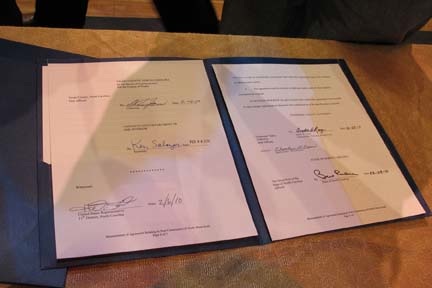
Four signatures brought an end to a long-running dispute over a "Road to Nowhere" in Great Smoky Mountains National Park. Danny Bernstein photo.
It promised to be the biggest event in Western North Carolina in 67 years – bigger certainly than when Eric Rudolph was caught dumpster diving in Murphy. The North Shore Road controversy in the Great Smoky Mountains National Park was over. Swain County was going to get its $52 million over 10 years -- an amount that was calculated as the present value of the road that was flooded in 1943 to create Fontana Lake and Fontana Dam.
This past Friday, February 5, Swain County Board of Commissioners voted 4 to 1 in favor of the agreement. Under the terms of the agreement by the Department of the Interior, Swain County, North Carolina, and Tennessee Valley Authority (TVA), the federal government will pay up to $52 million into a trust fund established for the county. Only the interest earned on that trust can be spent. The county was one of the four signatories of the original 1943 agreement. In fact, the two principals in the negotiations were the county and the Department of the Interior.
On Saturday, a day that dawned as forecast -- wet, cold, and icy -- a signing ceremony was held at Swain County High School. Interior Secretary Ken Salazar was scheduled to attend, but the snowstorm in Washington kept him away. This omission did not dampen the audience’s enthusiasm. This day was about Swain County and Congressman Heath Shuler, the hero, coming back to Swain County High School where he played football.
When I arrived at Swain County High School quite early, the parking lot was packed. I was impressed but soon found out that most of the cars were for people attending a basketball game, not the signing ceremony. Swain County is one of the poorest counties in North Carolina, partly because 85 percent of the land is either owned by the Smokies, the Eastern Band of Cherokee Indians, or is under water covered by Fontana Lake.
Leonard Winchester, president of the Citizens for the Economic Future of Swain County and a retired Swain County education administrator was elated. “It’s a historic day. We’ve already received $4 million and will receive another $8.8 millions in 120 days. We have to continue working to make sure that we get the rest. But now we can ask our two senators to help because there’s only one option.”
Ted Snyder has been working on this issue since the 1960s. Mr. Snyder, a retired lawyer from South Carolina and former national president of Sierra Club, believes the agreement “does something for the parks, the plants and the animals.” Next, he plans to work on wilderness status for the Smokies. “Wilderness status is feasible, but the locals won’t support wilderness status until they get all their money," he said.
Pro-road supporters also attended the ceremony, some wearing their “Build the Road” hat. Mike Clampitt, a sixth-generation mountaineer, said “I think this is two steps backwards. The new agreement says less than the old one. There’s no guarantee that we’ll get the $52 millions.” He was also concerned about what wilderness status for the park would mean. Helen Vance, who graduated in 1943 from the last senior class at Proctor High School before the road was flooded and who helped organize the first cemetery reunions, said she was disappointed that the road was not finished. “The time has come that we have to accept it and move on. My concern, now, is that the cemetery trips continue”.
Glenn Jones, chair of the Swain County Board of Commissioners, proclaimed that, “It took us 67 years to reach this point. The journey has not been easy. People have made sacrifices but these sacrifices are going to make the future easier. Every citizen in Swain County will benefit from this cash settlement.”
He praised U.S. Rep. Shuler, a Swain County graduate who played quarterback for the Swain County Maroon Devils before receiving national recognition in college as quarterback of the Tennessee Volunteers and later recording a short-lived NFL career. Mr. Jones instructed the pro-road people to put their protest signs away, but they stayed, quietly, while hoisting their “Build the Road” signs.
Great Smoky Mountains Superintendent Dale Ditmanson, representing the Interior Department, recapped the federal government’s involvement in the Environmental Impact Statement (EIS) that examined building the road. There were 75,000 comments on the DEIS and it was determined that the road would not be built.
“No one has worked as hard over the last three years on the monetary settlement as Congressman Shuler. The National Park Service will continue to provide transportation to the cemeteries," said the superintendent, adding that Secretary Salazar considered “the settlement is good for the people of Swain County because it generates much needed revenue; good for the department, because it protects one of America’s most-treasured parks; and good for the American taxpayers, since building the road would have cost several times more than the settlement.”
Finally it was Congressman Shuler’s turn at the podium. He recalled that “growing up, I saw both sides of the issue. Its divided this community. Our next generation can grow up with better education. It’s time to let go of something in our past that divided us. My roots are here. My foundation is here.”
Then the signing. Three of the four parties had already signed the historic document. The last, Glenn Jones for the Swain County Board of Commissioners, signed and it was witnessed by Congressman Shuler. This truly was a historic day and I was thrilled to be there.
Story Categories:
A copy of National Parks Traveler's financial statements may be obtained by sending a stamped, self-addressed envelope to: National Parks Traveler, P.O. Box 980452, Park City, Utah 84098. National Parks Traveler was formed in the state of Utah for the purpose of informing and educating about national parks and protected areas.
Residents of the following states may obtain a copy of our financial and additional information as stated below:
- Florida: A COPY OF THE OFFICIAL REGISTRATION AND FINANCIAL INFORMATION FOR NATIONAL PARKS TRAVELER, (REGISTRATION NO. CH 51659), MAY BE OBTAINED FROM THE DIVISION OF CONSUMER SERVICES BY CALLING 800-435-7352 OR VISITING THEIR WEBSITE. REGISTRATION DOES NOT IMPLY ENDORSEMENT, APPROVAL, OR RECOMMENDATION BY THE STATE.
- Georgia: A full and fair description of the programs and financial statement summary of National Parks Traveler is available upon request at the office and phone number indicated above.
- Maryland: Documents and information submitted under the Maryland Solicitations Act are also available, for the cost of postage and copies, from the Secretary of State, State House, Annapolis, MD 21401 (410-974-5534).
- North Carolina: Financial information about this organization and a copy of its license are available from the State Solicitation Licensing Branch at 888-830-4989 or 919-807-2214. The license is not an endorsement by the State.
- Pennsylvania: The official registration and financial information of National Parks Traveler may be obtained from the Pennsylvania Department of State by calling 800-732-0999. Registration does not imply endorsement.
- Virginia: Financial statements are available from the Virginia Department of Agriculture and Consumer Services, 102 Governor Street, Richmond, Virginia 23219.
- Washington: National Parks Traveler is registered with Washington State’s Charities Program as required by law and additional information is available by calling 800-332-4483 or visiting www.sos.wa.gov/charities, or on file at Charities Division, Office of the Secretary of State, State of Washington, Olympia, WA 98504.


National parks and their natural resources belong to you. The National Parks Traveler works to ensure you know how these essential places are being cared for.
Sign Up For Our Weekly Newsletter
Unsubscribe at any time.
INN Member

The easiest way to explore RV-friendly National Park campgrounds.

Here’s the definitive guide to National Park System campgrounds where RVers can park their rigs.
Our app is packed with RVing- specific details on more than 250 campgrounds in more than 70 national parks.
You’ll also find stories about RVing in the parks, tips helpful if you’ve just recently become an RVer, and useful planning suggestions.


Comments
Obviously this is good for that county, but is it good that the government is yet again throwing money at something else? And as far as being a poor county, they're bordered by the most popular National Park in the country and a beautiful lake. Most places would kill for that.
It was not only the road to nowhere; it seemed to be the road that wouldn't die. Thanks to Congressman Shuler and the leadership of NPS and DOI for working out this settlement. As long as the 1943 agreement was unfulfilled, it was a club any local faction could use to harass the national park. The new agreement ends a long-standing threat to the wild landscape of the Great Smokies, and it saves the Treasury a lot of money. In 2007 the EIS for the "north shore" road estimated the cost as $729 million. Way back in 1965 the National Park Service proposed to satisfy the agreement by building a second trans-mountain road. That was killed by Secretary of the Interior Stewart Udall, after lovers of the Great Smokies all over the country rose in defense of the park.
This article said it all! The family's screwd over by the tva & then the department of the interior are screwed again! It was all about swain county & Rep. Shuler when it should be about the land that was stolen from my family. What will happen in the future to my family's cemetery? Disabled will I have to hike to visit it? Wouldn't that land serve the public better with the road? That land would be accessable to a lot more people if it were put in instead of only being used by a few hikers.
I am a direct descendant of Nathan Moses & Rutha West Pilkington. Both buried in a family cemetery with other family members at Pilkey's creek on the North Shore of Fontana Lake. My family has been in North Carolina since this nation was a nation & fought in every war since the Revolutionary War. Please put yourself in our shoes for just one moment & then tell me what you think. For some it is all about the money for others its all about righting an injustice to our ancestors & family's.
Eminent domain is enacted in this country if there is a clear cut reason what is taken will benefit the many. Fontana Dam was needed to help the United States out produce Hitler & his henchmen. I have never heard anyone say different about the dam. The land around what would become the lake was made residential a long time before the lake was ever thought about. That land should have never been taken & serves not the public being used as it has been since it was taken. Today for instance if a lake or hydro project is brought to fruition only the land needed for water storage is taken. The land where the lake ends still belongs to whom ever owned it. The amounts paid at the time for the land was a joke. The government paid some for a thousand acres what wouldn't buy a hundred acres in adjoining county's. God forbid if you were behind on paying your taxes when the government wanted the land because then they paid you nothing & simply kicked you off. If you didn't like the government's offer or didn't want to sell then that was to bad because they would deposit what they wanted you to have. I have never seen one document where the government paid what would have been fair market value.
If you own land today & want to be buried on it you can. If the land is sold whom ever buys it has to allow the family of the deceased access to visit the cemetery. They can not dig up the deceased from there earthly resting place & just move them. Those people had several thriving community's & worked hard for what they had. So why is it ok yesterday or today to take what those people worked so hard for? How can it be ok to even consider moving them? If we allow them to take this from us with out it being used for the betterment of all then whats to keep them from taking what you have for no reason? If we continue to bury people sooner or later there will be no land for the living right? So why not just dig up all the dead now & cremate them? Sound crazy? Just as crazy to me as someone wanting to move my family for no reason.
Home of the free, Land of the Brave... I knew a man who was born, raised & lived next to Pilkey Creek on the north shore. His family had a small grist mill & they worked hard for little. He was a strapping young lad in the forty's that knew as so many others, not only what this country but the world was up against. He left his boyhood home, family & all he knew to join the armed services to fight the scourge known as Hitler. Being a part of the "greatest generation" he stepped up putting his life as so many others on the line day after day to make sure you & I today could be free. When the war was over he was honorably discharged from the armed services. Upon his return from Europe imagine his surprise coming home to find out that he had no home. While he was gone the very people & government he served so honorably took his home, land & all he knew. It wasn't under the lake it sat above the high water mark. Kicked off his land he was then told he would be granted at very least a way for him to visit the family that was buried on the family land. The forty's passed, The fifty's pass, Sixty's, Seventy's & into the Eighty's before there was a way made for him to visit his Mother, Father, Brother, or a Uncle who fought in the Civil War once a year. That's not really fair because if he wanted to he could hike more than seven miles to have seen his family anytime he liked. On to the ninety's & a new millennium but a simple promise made to him was never kept. I was told he recently passed away never seeing the promise made to him by a government he served honorably & respected fulfilled. If that man could do what was honorable & right why can't a government that profess' to be his? How is this Rep Shuler & this was your big day eh? I'd bet you will not get the full amount promised to you in another 67 years. lol You fought for the county to get money really? Honorable? Decent? Right?
The governments involved have waited out those they made the promise to. The family's have since long ago gone on with their lives. The ones who made the promise hope that as time goes by the direct descendants who were alive would pass away. Thus other generations would not know or forget those who were buried on the old family plots. I live currently in Georgia. I never knew about the injustice done to my family until a few years ago. I wish I had been able to be more involved in the process to bring the road for my children to be able to know more & understand more about there ancestors & how they lived. Wouldn't this be a much better use for the land serving more people?
When the road was promised to be replaced it wouldn't have cost $600 million. I seriously doubt that it would cost that today. Although it would affect some streams & land there are no endangered species to consider. There are hundreds of miles of road thru the smokey mountain park. Is there anyone who really believes that replacing a road that was once there would really do any harm to the park? It would only serve to make more of the park accessible to the general public (Which is what public lands are suppose to be for) but more importantly to those who have family who are buried there. Let's not forget the hikers. The Appalachian trail covers a lot of miles & I have never heard anyone say that because they had to cross a road that it made the hike any less beautiful or challenging.
Swain county should be the LEAST of any to receive any monies period! They owned none of the land taken. Yes it is true they lost some tax revenue but it was only for years after the government took the land & kicked the residents off. They collected taxes for the years family's owned & lived on the land. Why should the federal government pay Swain County? If they wanted to have a larger tax base why didn't they stop the project or keep the lands around the lake privately owned? So the answer is pay swain county a few million (that they can not spend if you cant spend it do you really have it?) the families nothing & everyone goes on about there way? Is that really fair or right? Didn't the people who worked & lived in those community's already pay for that road? So how is it the people who had there hard earned property taken for little or nothing still get nothing?
What ever happened to honoring your word, the dead or respect? I would bet if there was anyone else out there that the government made a promise to you would do your best to hold them to that promise right? Did you over pay on your taxes last year? Would it be ok with you if the government just kept your refund? Is its ok for the government to take & keep something that is yours then not use it for the greater public benefit? If you think this is wrong & the federal government should honor there word to the citizens you have no other choice than to be with the family's!
We have not because we ask not. The world use to be a better place because men honored & respected themselves. Then expected others to do the same. Our government can give Afghanistan & other countries millions upon millions for nothing at all. Then there is "pork barrel" spending every year into the billions but they can't keep there word given to the very citizens that made this country & the modern world what it is today...
The promises made kept, The road put in & the land taken should be used by everyone conforming to the definition of eminent domain. No one should be able to sign any agreement but those involved. IE The federal Government & those family's who's land was taken. Where there are family cemeteries a placard of some kind placed & all descendant's should be allowed easy access to use the land at any time for no fees.
What are we if not the collective lives of all those who come before us? Do we not owe them our very lives?
Thank you,
Brian Lane Pilkington
Descendant of Nathan Moses & Rutha West Pilkington
Buried in the Pilkington Family Cemetery, Pilkey Creek