
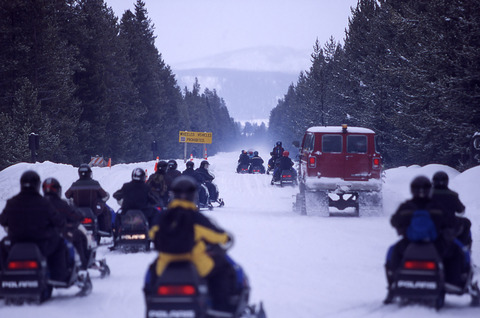
More snowmobile studies on tap for Yellowstone, Grand Teton national parks.
With a new administration in Washington, the pendulum on snowmobile use in Yellowstone National Park is swinging back towards fewer machines. Interior Secretary Ken Salazar on Thursday directed the National Park Service to follow a course that could limit recreational snowmobile use in Yellowstone to 318 machines per day for each of the next two winters.
Specifically, the Interior secretary told the Park Service to reopen the public comment period on a proposed interim winter-use plan that would cap daily snowmobile use in Yellowstone to 318 machines, and limit commercially guided snowcoach tours to 78 machines per day. If the interim plan is implemented, the secretary added, it would remain in effect for two winters while the Park Service makes another attempt at crafting a viable winter-use plan for Yellowstone and Grand Teton national parks.
Snowmobile use in Yellowstone arguably has been the most partisan and contentious issue in the entire National Park System the past decade. While the Clinton administration at the very end of its term in office moved to ban recreational snowmobile use in the park, the incoming Bush administration quickly blocked that ban and sent the issue down a prickly, and expensive, legal course. More than $10 million in environmental studies were conducted on the issue during the past decade, and all pointed to the phase-out of snowmobiles as the best environmental alternative for Yellowstone. Despite those studies and former Interior Secretary Dirk Kempthorne's pledge that science would rule the day in the National Park System, strings pulled from not just the Interior Department but as high up as former Vice President Cheney's office handcuffed the Park Service.
The Park Service under the Bush administration continually opted not to go with the environmentally preferable alternative. In November 2007, after the latest round of studies, the agency decided to allow up to 540 snowmobiles and 83 snowcoaches into the park on a daily basis. But the predicted legal challenges to that decision resulted in a federal judge scolding the agency last September for ignoring science and running from its conservation mission.
In his 63-page ruling, which was stinging at times in its criticism of the Park Service's interpretation of its own Organic Act, U.S. District Judge Emmet Sullivan held that while the Organic Act does call for public enjoyment of the national parks, "(T)his is not blanket permission to have fun in the parks in any way the NPS sees fit."
"As plaintiffs articulated at the hearing, the 'enjoyment' referenced in the Organic Act is not enjoyment for its own sake, or even enjoyment of the parks generally, but rather the enjoyment of 'the scenery and natural and historic objects and wild life' in the parks in a manner that will allow future generations to enjoy them as well," wrote Judge Sullivan. "NPS cannot circumvent this limitation through conclusory declarations that certain adverse impacts are acceptable, without explaining why those impacts are necessary and appropriate to fulfill the purposes of the park."
Furthermore, he noted, "According to NPS's own data the (winter-use plan) will increase air pollution, exceed the use levels recommended by NPS biologists to protect wildlife, and cause major adverse impacts to the natural soundscape in Yellowstone. Despite this, NPS found that the plan's impacts are wholly 'acceptable,' and utterly fails to explain this incongruous conclusion."
While Judge Sullivan tossed that winter-use plan, thus seemingly leading the Park Service back to the drawing board, from which it quickly proposed the interim rule of 318 snowmobiles and 78 snowcoaches per day, another federal judge, Clarence Brimmer in Wyoming, trumped his Washington, D.C., colleague. While Judge Brimmer noted that he couldn't overrule his cross-country colleague, he could direct the Park Service to revert to 2004 winter-use regulations if it couldn't come up with a new rule before the 2008-2009 winter season began. That opened the door for the Park Service to halt work on the interim rule and turn back the hands of time to 2004, when as many as 720 snowmobiles were allowed into the park on a daily basis.
Which brings us to Thursday's announcement by Interior Secretary Salazar.
“The proposed rule would allow continued access to the park in winter while ensuring the protection of this national treasure and its wildlife while we develop a new long-term plan for winter use in the park,” the secretary said, seemingly overlooking a report by Park Service wildlife biologists that no more than 250 snowmobiles a day should be allowed into Yellowstone to protect the wildlife.
Here are the latest details: The interim proposed rule would allow up to 318 commercially guided, Best Available Technology snowmobiles, and up to 78 commercially guided snowcoaches per day in Yellowstone, through the 2010-2011 winter season. It would also govern long-term snowmobile access in Grand Teton and the John D. Rockefeller, Jr. Memorial Parkway, including access along Grassy Lake Road, and on Jackson Lake for licensed anglers.
The proposed rule and an electronic form to submit written comments are available on the Internet at http://www.regulations.gov/search/index.jsp. The public can find the proposed rule by searching the “Documents Open For Public Comment” and selecting the National Park Service as the agency.
Written comments may be submitted through the above cited web site, in person, or by mail. Comments will not be accepted by phone, fax, or e-mail. All public comments on the proposed rule must be received or postmarked by midnight, Eastern Time, September 8, 2009.
The National Park Service intends to analyze the comments submitted last fall and during the next 45 days before making a decision on the proposed interim winter use plan. Depending on this process, NPS is planning to issue a final rule to implement the decision on or before November 15, 2009.
Story Categories:
A copy of National Parks Traveler's financial statements may be obtained by sending a stamped, self-addressed envelope to: National Parks Traveler, P.O. Box 980452, Park City, Utah 84098. National Parks Traveler was formed in the state of Utah for the purpose of informing and educating about national parks and protected areas.
Residents of the following states may obtain a copy of our financial and additional information as stated below:
- Florida: A COPY OF THE OFFICIAL REGISTRATION AND FINANCIAL INFORMATION FOR NATIONAL PARKS TRAVELER, (REGISTRATION NO. CH 51659), MAY BE OBTAINED FROM THE DIVISION OF CONSUMER SERVICES BY CALLING 800-435-7352 OR VISITING THEIR WEBSITE. REGISTRATION DOES NOT IMPLY ENDORSEMENT, APPROVAL, OR RECOMMENDATION BY THE STATE.
- Georgia: A full and fair description of the programs and financial statement summary of National Parks Traveler is available upon request at the office and phone number indicated above.
- Maryland: Documents and information submitted under the Maryland Solicitations Act are also available, for the cost of postage and copies, from the Secretary of State, State House, Annapolis, MD 21401 (410-974-5534).
- North Carolina: Financial information about this organization and a copy of its license are available from the State Solicitation Licensing Branch at 888-830-4989 or 919-807-2214. The license is not an endorsement by the State.
- Pennsylvania: The official registration and financial information of National Parks Traveler may be obtained from the Pennsylvania Department of State by calling 800-732-0999. Registration does not imply endorsement.
- Virginia: Financial statements are available from the Virginia Department of Agriculture and Consumer Services, 102 Governor Street, Richmond, Virginia 23219.
- Washington: National Parks Traveler is registered with Washington State’s Charities Program as required by law and additional information is available by calling 800-332-4483 or visiting www.sos.wa.gov/charities, or on file at Charities Division, Office of the Secretary of State, State of Washington, Olympia, WA 98504.


National parks and their natural resources belong to you. The National Parks Traveler works to ensure you know how these essential places are being cared for.
Sign Up For Our Weekly Newsletter
Unsubscribe at any time.
INN Member

The easiest way to explore RV-friendly National Park campgrounds.

Here’s the definitive guide to National Park System campgrounds where RVers can park their rigs.
Our app is packed with RVing- specific details on more than 250 campgrounds in more than 70 national parks.
You’ll also find stories about RVing in the parks, tips helpful if you’ve just recently become an RVer, and useful planning suggestions.


Comments
So has anyone spent millions on studies to see how the unrestricted flow of park visitors & their passenger cars impact the environment, wildlife, and soundscape during the rest of the year?
My guess is that those low emissions snowmobiles are far better maintained than the average American's car. I doubt very few of them have mufflers tied up with bale'n wire, or have fluids leaking out of them. Not to mention they don't have blasting stereo systems, or windows to throw fast food containers, pop cans, and lit cigarette butts out of.
From what I understand, the guided snowmobiles are limited to specific trailways and speeds throughout the park. I imagine the guides keep their groups in check, by not allowing them to willfully approach wildlife, or allow them into areas where they could damage other park resources and property.
Seems to me that snowmobiles are a much more eco-friendly, respectful, and pleasant, way to visit the parks than by car.
J.D., it's hard to believe, but I've seen data that indicate snowmobiles are more polluting during the winter season than the greater volume of cars, trucks, and motorcycles during the summer. Hard to believe, but that's what they say.
And the soundscape problems from snowmobiles have been well-documented. For instance, the groups that sued the Park Service over their last winter-use plan noted that the Park Service itself disclosed in a study accompanying its decision that allowing 540 snowmobiles into Yellowstone each day would dramatically expand-to 63 square miles-the portion of the park where visitors can expect to hear snowmobile noise during more than half of the visiting day. That would be a three-fold increase from the current portion of the park where noise intrudes on the visitor’s experience during at least half the day.
And there also have been instances where supposedly "guided" snowmobile trips ran into problems. Such was the case a couple of years ago when one group of snowmobilers became so split up traveling from Norris Junction to Canyon that no one noticed when one snowmobile crashed, killing a woman. And then, of course, there are the annual stories of some snowmobilers racing off into the backcountry near West Yellowstone.
All that said, there's no denying there are problems with vehicles during the rest of the year, ranging from speeding and accidents to fluid spills and wildlife issues. One solution would be public transportation, but with the park's five entrances it's not as easy to devise or operate a public transit option as the shuttle systems at Zion or Acadia or Bryce Canyon.
Jeez, I know I'm sounding like a broken record about the Bush administration, but here it is again:
Over and over again, no matter where you look, the same theme throughout. I hope even my conservative brethren are taking note as stuff like this continually surfaces (regarding this venue - forget about other social issues). If you're on this web site, you must care about the environment, correct?
On the other hand, I'm really starting to like this Ken Salazar. Maybe eight years of him (or his similarly-minded successor) will get me to finally shut up about the Bush disaster!
[Seriously, I will tone down the political comments from now on, I promise.]
J.D., your snowmobile-car comparison is very inappropriate. Cars travel the park roads in summer when food is abundant, temperatures are tolerable, and the living is good for park wildlife. Snowmobiles, on the other hand, converge on the park at the worst possible time, the cruel winter when many animals are brought to the very limits of their endurance. Just at that time, when the wintering-over animals need every tiny shred of energy they can muster, and when stress of any kind is quite literally life threatening, is when the snowmobile jockeys converge on the park. Whoeeeee! Kinda selfish, don't you think?