
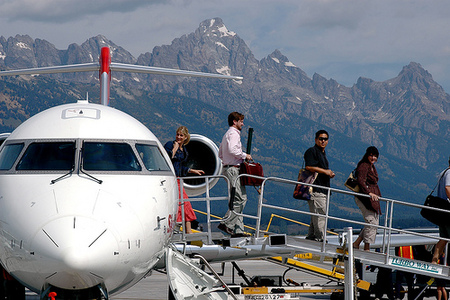
Many people believe that Jackson Hole Airport has the most beautiful setting of any small airport in the world. Photo by Flickmor via Flickr.
Several conservation NGOs insist that the National Park Service should more thoroughly consider safety issues before extending the lease that currently allows a jetport to operate within Grand Teton National Park.
Jackson Hole Airport, this country’s only commercial airport situated in a national park, currently operates under the terms of a lease (Airport Use Agreement) that is not due to expire until April 2033. That’s nearly two dozen years hence, so there should be plenty of time to work out a lease extension, right?
Well, not exactly. The key consideration is this: The spigot that pours federal subsidy dollars into a commercial airport like this one is turned off if there’s less than 20 years left on the lease under which it operates. Jackson Hole Airport currently gets around $3.3 million a year in Federal Aviation Administration (FAA) Airport Improvement Program funds. A subsidy like that would be a terrible thing to lose. Also at risk is the preponderant share of the funding for the airport's $30 million terminal upgrade. If you are the airport manager, prudence demands that you get your lease extended as soon as you can for as long as you can.
Since several years or more are needed for mandated studies, public comment, redrafting, and other routine requirements, the lease extension process currently underway was initiated far in advance of the Federal Aviation Administration’s 2013 drop-dead date for subsidy eligibility. In fact, the process that was begun in 2005 may be just about to wrap up. Having issued the draft environmental impact statement this spring, and having now nearly reached the end of the public comment period (moved back to June 15), Grand Teton officials are poised to ink an agreement to extend the airport’s lease to 2053.
Some people fear that the terms of the proposed agreement may not adequately protect the interests of the park and the public. Most conspicuously, an alliance of conservation NGOs, the Jackson Hole Conservation Alliance and the National Parks Conservation Association, has asked the park to consider the results of an ongoing airport safety study before tacking 20 more years (two more ten-year terms, to be more precise) onto the airport’s existing lease.
The alliance hastens to add that it does not seek the airport’s removal or downsizing, and is aware of the facility’s key role in the region and contributions to the local economy. We might add that there’s nowhere to build a replacement airport, anyway.
The airport safety audit that the alliance wants Grand Teton officials to incorporate into the draft EIS won’t be completed until next spring. When a 60-day comment period is added in after the report’s release, the result is a delay that would be in the neighborhood of ten months.
Given their level of concern for meeting the April 27, 2013 federal funding deadline, airport officials are leery of any delay, much less a ten-month or more delay linked to a draft environmental impact statement. Of all the National Environmental Policy Act requirements, the EIS process demands the most stringent level of analysis and is most vulnerable to procedural delays and legal challenges that can drag on for years.
The National Park Service does not seem disposed to side with the alliance on this one. Park officials have maintained that it’s not necessary to wait for the safety audit, since new safety information can be incorporated into the airport’s operation after the lease is extended.
Postscript: The safety audit currently underway at Jackson Hole Airport was triggered by a spate of accidents, including a dozen instances of aircraft running off runways in the span of just 14 months. (There were two such instances in December alone.) The worst of the accidents occurred in February 2008 when a United Airlines jet with 115 passengers and six crew members aboard slid off the runway, producing an engine fire and one minor injury.
Story Categories:
A copy of National Parks Traveler's financial statements may be obtained by sending a stamped, self-addressed envelope to: National Parks Traveler, P.O. Box 980452, Park City, Utah 84098. National Parks Traveler was formed in the state of Utah for the purpose of informing and educating about national parks and protected areas.
Residents of the following states may obtain a copy of our financial and additional information as stated below:
- Florida: A COPY OF THE OFFICIAL REGISTRATION AND FINANCIAL INFORMATION FOR NATIONAL PARKS TRAVELER, (REGISTRATION NO. CH 51659), MAY BE OBTAINED FROM THE DIVISION OF CONSUMER SERVICES BY CALLING 800-435-7352 OR VISITING THEIR WEBSITE. REGISTRATION DOES NOT IMPLY ENDORSEMENT, APPROVAL, OR RECOMMENDATION BY THE STATE.
- Georgia: A full and fair description of the programs and financial statement summary of National Parks Traveler is available upon request at the office and phone number indicated above.
- Maryland: Documents and information submitted under the Maryland Solicitations Act are also available, for the cost of postage and copies, from the Secretary of State, State House, Annapolis, MD 21401 (410-974-5534).
- North Carolina: Financial information about this organization and a copy of its license are available from the State Solicitation Licensing Branch at 888-830-4989 or 919-807-2214. The license is not an endorsement by the State.
- Pennsylvania: The official registration and financial information of National Parks Traveler may be obtained from the Pennsylvania Department of State by calling 800-732-0999. Registration does not imply endorsement.
- Virginia: Financial statements are available from the Virginia Department of Agriculture and Consumer Services, 102 Governor Street, Richmond, Virginia 23219.
- Washington: National Parks Traveler is registered with Washington State’s Charities Program as required by law and additional information is available by calling 800-332-4483 or visiting www.sos.wa.gov/charities, or on file at Charities Division, Office of the Secretary of State, State of Washington, Olympia, WA 98504.


National parks and their natural resources belong to you. The National Parks Traveler works to ensure you know how these essential places are being cared for.
Sign Up For Our Weekly Newsletter
Unsubscribe at any time.
INN Member

The easiest way to explore RV-friendly National Park campgrounds.

Here’s the definitive guide to National Park System campgrounds where RVers can park their rigs.
Our app is packed with RVing- specific details on more than 250 campgrounds in more than 70 national parks.
You’ll also find stories about RVing in the parks, tips helpful if you’ve just recently become an RVer, and useful planning suggestions.


Comments
Prior to either wholeheartedly dismissing or supporting the delay, I would think that a compromise could be included in the renewal requiring the safety audit be performed.
As for the unusually high rate of "accidents" (apparently mostly running off runways), did the findings in those instances find the problems with the airport, or simply pilot error? Weather at Jackson Hole is notoriously poor in the winter (ski season), and planes often divert to Idaho Falls. Flying in poor conditions is much harder than driving in them, and we certainly shouldn't fault the airport IF the errors lie elsewhere, and shouldn't hold up critical funding unnecessarily.
You make some very good points, Anon. It's very likely that some of the runway accidents can't be wholly attributed to deficiencies of the airport. For example, the NTSB thinks that a brake problem (cross-wiring of the brakes on one set of wheels) may have caused that United Airlines jet to veer off the runway. Nevertheless, the alliance expects (rightly so, I think) that the safety audit results will recommend improvements, such as runway extensions and better lighting, that will make the airport safer to use. The alliance has steadfastly maintained that such considerations belong in the airport lease EIS.
If there ever was an airport poorly sited, that has outlived its usefulness, THIS is IT.
Its survival is more testimony of the propensity of right-wing congresmen pumping public support (socialism ! ) to a local development that never would have survived in a world of pure capitalism. This survives because, located as it is INSIDE a national park, the airport can be sustained and subsidized by the kind of people who oppose federal support for nearly anything else.
If led properly or left to its proper rules, the National Park Service should have eliminated this ridiculous strip years ago.
Although not quite on the level of spending millions to fly mail into a handful of Montanans, this airport certainly is another slice of the pie for Wyoming. Don't you love it? With this airport you get to degrade one of the best national parks, pump money into a hole, and subsidize people who profess hostility to government waste !
Only in America.
Amen, D-2. This is pure Wyoming pork at the expense of a great national park.
Rick Smith
The Nature Conservancy has proposed that the airport start the long overdue process of "repaying" Grand Teton NP for the land it has "taken". Since 533 acres has been taken out of service, those acres should be replaced by purchasing private land. Among other things, they propose a $5 per ticket fee to go to these private land purchases to expand the real park. Sounds good to me !
While not intending to take a stance pro or con on the question of the appropriateness of the airport's location, if somehow the NPS decided it should go, where might a new airport be based in the Jackson area? There's not an awful lot of flat ground around, and that which is flat is likely privately owned.
While there might be some space on the Driggs, Idaho, side of the range, the need to traverse Teton Pass makes that location untenable. And down near Alpine, Wyoming, doesn't make sense due to the need to negotiate the Snake River Canyon to reach Jackson.
Any suggestions?