
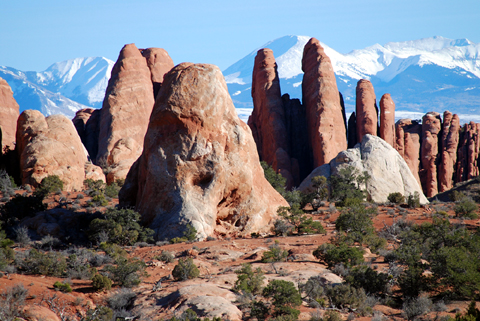
How can we best manage our public lands? The Fiery Furnace in Arches National Park. Kurt Repanshek photo.
As the end of the Bush administration nears, it's natural for many to look back on the past eight years and try to assess the sum impact. In the arena of public lands and natural resources, it's relatively easy to castigate the outgoing administration for its seemingly heavy hand on that landscape.
With that said, let's not overlook that most administrations manage to irritate some constituent group at some (or many) time during their tenure. Certainly the Clinton administration alienated many multiple-use proponents for the way it created the Grand Staircase-Escalante National Monument in Utah, a 1.9-million-acre preserve President Clinton created with a few strokes of his pen...from a seat on the South Rim of the Grand Canyon, not in Utah where the monument lies.
And yet, President Bush, who campaigned eight long years ago as a "uniter, not a divider," and promised "compassionate conservatism," is heading out the door seemingly employing a slash and burn exit strategy when it comes to public-lands management. And in the arid West, where the lands take an inordinate amount of time to heal and where there are questionable energy reserves, some of these decisions are perplexing in terms of being in the nation's best interests.
In recent weeks the administration, through the Interior and Energy departments and their underlings, as well as the Environmental Protection Agency, has:
* Decided to place 360,000 U.S. Bureau of Land Management acres in Utah up for oil and gas leasing, no matter that an estimated 50,000 of those acres sidle up to either Arches National Park, Canyonlands National Park, or Dinosaur National Monument. And no, the BLM didn't consult with the Park Service before deciding which acres to lease, although there have been talks in recent days to resolve this mess.
* Announced rules for oil-shale production that purportedly could some day wind up producing 800 billion barrels of oil from the West, never mind that the recovery technology remains to be perfected, requires lots of energy and water, and, in Canada, has proven incredibly dirty and destructive to the landscape.
* Cleared the way for geothermal energy development in the West without laying down specific protections for parks such as Yellowstone and Lassen Volcanic.
"In announcing its decision, the Bureau of Land Management was quick to note that all national parks, wilderness areas and wilderness study areas would remain off-limits to geothermal exploration," says Amy McNamara of the Greater Yellowstone Coalition.
"However, in Yellowstone’s unique case, the BLM didn’t extend protection far enough. The agency ignored reasonable requests from Greater Yellowstone Coalition and other groups to include a small 15-mile buffer around the park to protect this largest concentration of geothermal features in the world," she adds.
* Announced a 6,000-mile-grid for energy transmission lines in the West that would run lines practically past the front door to the visitor center at Arches National Park.
“These corridors, along with the Bush administration’s last-minute oil and gas leasing of land near Arches and Canyonlands National Parks, and the EPA proposal for reduction in air quality standards at these same parks, will irreparably harm the tremendous beauty of the red rock canyon country around Moab that attracts millions to southeast Utah each year,” said Phil Brueck, a member of the executive council of the Coalition of National Park Service Retirees.
“The government is making these decisions in the waning moments of their power with little thought to the wildlands they’ll ruin, the national parks and monuments they’ll damage, the expansive views they’ll degrade or the communities they’ll fracture," he adds. "It also troubles me that because these decisions are happening so fast and are mired in so much bureaucracy, that the American public isn't even aware of the thieves stealing their crown jewels!"
* Announced, in the wake of in-house opposition, a weakening of air-quality regulations that could lead to further degradation of air quality in Great Smoky Mountains and other national parks.
According to the Washington Post, The Environmental Protection Agency is finalizing new air-quality rules that would make it easier to build coal-fired power plants, oil refineries and other major polluters near national parks and wilderness areas, even though half of the EPA's 10 regional administrators formally dissented from the decision and four others criticized the move in writing.
And let's not overlook the administration's weakening of the Endangered Species Act requirements, or the federal court's recent ruling that the Interior Department granted off-shore drilling rights to Royal Dutch Shell without, ahem, closely following requirements set down by the National Environmental Policy Act.
Also impacting the public lands experience are the administration's push to allowed concealed weapons in national parks, its decided favoring of off-road vehicle enthusiasts and the extractive industries when it came time for the BLM to update six resource management plans in Utah, the decision to overlook science and public opinion on the Yellowstone snowmobile issue, and the administration's fiscal drain on not just the National Park Service but also the U.S. Forest Service.
If you want to stay on top of the administration's latest parting gifts, check this site regularly.
Here's what the Denver Post had to say about the president's exit strategy:
This last-minute rush to regulate is, we fear, a continuation of an unwelcome trend. The Bush White House complained mightily about having to deal with rules the Clinton administration passed in its waning hours.
Now the Bushies are doing the same thing. President-elect Barack Obama is going to have enough to deal with in addressing the country's troubled economy and wars in Iraq and Afghanistan — undoing ill-conceived rules rammed through at the last moment should not be among the items on his to-do list.
Unfortunately, there are several recent Bush administration actions that fit in that category.
Now, presidents certainly can do what they want, and this president hasn't made any secret of his oilman roots or his catering to the extractive industries. Just the same, some think his parting gifts to the nation are a bit much. In fact, while President Reagan saw the Sagebrush Rebellion kindled under his watch and President George H.W. Bush saw the rise of the Wise Use Movement, some believe what President Bush is doing to the environment is, in a word, historic.
Public Employees for Environmental Responsibility has kept a close tally on the Bush administration's public-lands actions. Indeed, PEER Executive Director Jeff Ruch isn't terribly surprised by these parting shots at the environment. But he is concerned about the ramifications they'll deliver if not altered.
"To the extent that the Bush policies (both midnight regulations and the entire eight years of deregulation) have hastened or worsened climate changes, the effects are profound and lasting," says Mr. Ruch. "From another perspective, even where some of the changes are localized, the cumulative effect becomes significant and national. For example, the Endangered Species Act regs will allow highway, military and other federal projects to proceed with less regard for wildlife (listed or not) effects. These negative consequences may affect local animal and plant populations, but when multiplied by project after project, year after year it, too becomes, serious and national in scope."
At the Coalition of National Park Service Retirees, Bill Wade shares PEER's concerns.
"In my judgment, a number of (the Bush administration decisions) are very grave, in terms of their impacts to the resources and visitor enjoyment in national parks. Certainly the guns issue is one and the roll-back of the air quality standards is another," said Mr. Wade, who chairs the group's executive council. "The snowmobile issue is important because of its precedent-setting implications, in addition to the impacts in the world’s national parks."
At the National Park Conservation Association's Southwest Region Office in Salt Lake City, Program Manager Karen Hevel-Mingo is straightforward when she says that, "what’s happened under the Bush administration is fairly unprecedented."
And while President Bush once portrayed himself as a "uniter, not a divider," in fact during the past eight years his policies and actions have very clearly divided Americans on many things, including public lands management, she said.
"Things have been very polarized in this country. And I think when you have one side that has sort of refused to even look at that middle ground, and that’s your government, then I think it really does polarize your citizenry,” said Ms. Hevel-Mingo.
NPCA, understandably, is particularly disappointed with the administration's energy exploration plans for Utah.
“There are some places where it’s appropriate for energy development, there are some places where it just is not appropriate," said Ms. Hevel-Mingo. "For example, if you look at Utah, the BLM already has a lot of oil and gas leases that are out there and have never been put into production. So I don’t think opening up more lease parcels, some of which sit on the boundaries of a national park, are an appropriate place for energy development. We’ve set those places aside because they’re unique.”
Of course, the trick for the Obama administration is not to swing too far left and, in doing so, do a similar job of alienating Americans. What's needed, quite a few folks believe, is some moderation coming out of Washington, D.C.
"I agree with you about 'extremes' and 'moderately' may be applicable to the way we should manage some resources and some public lands, but we simply cannot 'moderately' manage the country’s national parks," points out Mr. Wade.
At PEER, Mr. Ruch is hopeful the political landscape is changing: "Over time, what is the political 'center' shifts. The younger generation is much more environmentally conscious than its predecessors. In addition, concerns about shortages of usable water, desertification, changing weather patterns, etc. are starting to occupy more of the public's mind. And, these issues are globalizing, moving beyond domestic dynamics. As a consequence, attitudes are changing past old fault lines on what constitutes proper 'management' of natural resources and the human footprint on the planet."
Of course, in light of the country's dire economic condition and the challenge presented by climate change, how many resources will the incoming administration be able to marshal to address public lands issues?
"As a practical matter," believes Mr. Ruch, "the Obama administration will likely place a lower priority on the Interior suite of concerns and more on climate change and the EPA suite. So, issues like mining reform may be shelved to win support of Western Democrats on issues like greenhouse gas regulations."
Now, whether the Obama administration will be able to blunt some of President Bush's outgoing orders is difficult to tell.
"As with the Bush administration, the Obama administration should change what it needs to in order to accomplish its objectives," said Mr. Ruch. "One key difference, is that the Obama administration may be acting with much higher congressional and public support than the current administration."
Story Categories:
A copy of National Parks Traveler's financial statements may be obtained by sending a stamped, self-addressed envelope to: National Parks Traveler, P.O. Box 980452, Park City, Utah 84098. National Parks Traveler was formed in the state of Utah for the purpose of informing and educating about national parks and protected areas.
Residents of the following states may obtain a copy of our financial and additional information as stated below:
- Florida: A COPY OF THE OFFICIAL REGISTRATION AND FINANCIAL INFORMATION FOR NATIONAL PARKS TRAVELER, (REGISTRATION NO. CH 51659), MAY BE OBTAINED FROM THE DIVISION OF CONSUMER SERVICES BY CALLING 800-435-7352 OR VISITING THEIR WEBSITE. REGISTRATION DOES NOT IMPLY ENDORSEMENT, APPROVAL, OR RECOMMENDATION BY THE STATE.
- Georgia: A full and fair description of the programs and financial statement summary of National Parks Traveler is available upon request at the office and phone number indicated above.
- Maryland: Documents and information submitted under the Maryland Solicitations Act are also available, for the cost of postage and copies, from the Secretary of State, State House, Annapolis, MD 21401 (410-974-5534).
- North Carolina: Financial information about this organization and a copy of its license are available from the State Solicitation Licensing Branch at 888-830-4989 or 919-807-2214. The license is not an endorsement by the State.
- Pennsylvania: The official registration and financial information of National Parks Traveler may be obtained from the Pennsylvania Department of State by calling 800-732-0999. Registration does not imply endorsement.
- Virginia: Financial statements are available from the Virginia Department of Agriculture and Consumer Services, 102 Governor Street, Richmond, Virginia 23219.
- Washington: National Parks Traveler is registered with Washington State’s Charities Program as required by law and additional information is available by calling 800-332-4483 or visiting www.sos.wa.gov/charities, or on file at Charities Division, Office of the Secretary of State, State of Washington, Olympia, WA 98504.


National parks and their natural resources belong to you. The National Parks Traveler works to ensure you know how these essential places are being cared for.
Sign Up For Our Weekly Newsletter
Unsubscribe at any time.
INN Member

The easiest way to explore RV-friendly National Park campgrounds.

Here’s the definitive guide to National Park System campgrounds where RVers can park their rigs.
Our app is packed with RVing- specific details on more than 250 campgrounds in more than 70 national parks.
You’ll also find stories about RVing in the parks, tips helpful if you’ve just recently become an RVer, and useful planning suggestions.


Comments
Folks, just 57 odd day's left until this crazy lunatic leaves office. You can sure bet he will make Obama's administration cringe and crawl to clean up his environmental mess: From the polluted waters of America, to the mined and stripped field's of the Appalachian Mountains, and to the beautiful Canyonlands of Utah. Yap, more of Bush's in your face with rape, greed and pillage before he leaves his throne of sadistical power. Such a small man with a huge and cruel appetite for environmental destruction. All of his life, the good folks have been picking and cleaning up after his mess. This time, it will take years to undo his macabre anti-environmental regulations, and to fix and mend are tattered chewed up landscape. Meanwhile, while he retires to Crawford Texas in glee...Bush is laughing in his beer about all this.
Oh for crissakes...Looks like Anonymous above has a VERY BAD case of BDS (Bush Derangement Syndrome). He needs to take some meds for that....
Yap, with heavy fire in the belly until the little man leaves office. Not medicine Roger...just get rid of the cancerous tumor that has been ruining this country for the past eight years. I'm sure a lot of us will feel whole better as well. The sooner the better! Where's your passion or compassion for the environment...around a oil rig next to the National Parks!?
Annonymous needs to chill and understand that technology now permits an oil rig next or miles from a park...with minimal impact. Annonymous uses electricity, drives a car, watches TV, goes to the grocery store, etc. but it is someone else's fault for the environment's problems. Since he doesn't want to take responsibility himself/herself he blames Bush. I'll bet Annonymous is driking coffee at Starbucks, connected to internet via WiFi, reading the NY Times, and getting ready to protest the 2nd Amendment.
Chill Annonymous. volunteer for a summer on a National Park Fire crew, be a volunteer in a park, try to understand the real problems the parks face and stop spreading your uninformed elitist BS.
Kurt, thanks for giving reference through your comment "check this site" which provides us with the prestigious Pro Pubica (journalism in the public interests). A good source for up-to-date information regarding many of are pertinent and grave issues facing this country today.
Pappt:Try to read between the lines in what Kurt has written here. It's easy for you to attack me without commenting on some of the truthful facts that Kurt presents here...with his blog. Believe it or not, I do volunteer for many environmental causes and have done much volunteer work for the U.S. Forestry Service...yes, planting trees. And, I'm not afraid to admit that I'm a professional tree hugger as well. Sounds to me Pappyt your some pseudo mouth piece for more drilling in our National Parks. Kurt, has produced prime examples what has happen from extensive oil drilling close to our National Parks: The ugly visual stacking of oil rigs so many miles apart, the water contamination in the ground water table, and of course, the horrible scaring of the landscape. Not a pretty picture to view from the National Parks perspective...is it? In regards to my lifestyle, I practice the art of permaculture (a form of conservation gardening) and drive a relatively old truck that carry's my horticulture work, and at least try to "live green", that I'm sure infuriates the living hell out of the right wing nuts. Yes, I even make my own coffee! What's your excuse for polluting?
Kurt, while I appreciate and understand fully you obligation to temper these political reports while trying to remain at least some bit objective, I, not maintaining any affiliation with the press, and thereby not making any effort to maintain neutral, have just a few issues with the above article.....
1)it's relatively easy to castigate the outgoing administration for its seemingly heavy hand on that landscape.
Seemingly heavy-handed? How 'bout brass-knuckled, or horse shoe in the glove?
2)Now, presidents certainly can do what they want, and this president hasn't made any secret of his oilman roots or his catering to the extractive industries
And THIS is exactly what's wrong with the system as it currently is managed. Pandering is a crime in most states, but in politics is "business as usual". Double standards are meant to be corrected, not tolerated.
3)Also impacting the public lands experience are the administration's push to allowed concealed weapons in national parks, its decided favoring of off-road vehicle enthusiasts and the extractive industries when it came time for the BLM to update six resource management plans in Utah, the decision to overlook science and public opinion on the Yellowstone snowmobile issue, and the administration's fiscal drain on not just the National Park Service but also the U.S. Forest Service.
Speaking of pandering..........
4)"One key difference, is that the Obama administration may be acting with much higher congressional and public support than the current administration."
Who cares, if as you say, the president isn't beholden to anyone anyway?
5)"Things have been very polarized in this country. And I think when you have one side that has sort of refused to even look at that middle ground, and that’s your government, then I think it really does polarize your citizenry,"
Not polarized enough to get the typical spineless, lethargic American off their arse and actively seeking the type of change the system needs to be serviceable in the 21st C. Big problem here in America today. We believe our own propaganda. We still are operating under the illusion that we are the world leaders, the best in everything, which hasn't been true for going on 50 years now. We've become complacent in our lives and our system of government. The downfall of our attitude is that with complacency comes stagnation, and with stagnation comes decay. Our elected officials recognize this, and feed the complacency knowing that in so doing, the public is effectively removed from inflicting any dangerous thought or suggestion concerning modification of the power base. Throwing the dog a bone, as it were, is the most sure-fired method of maintaining total control over the masses. The economy in the toilet? Throw the dog a bone, a rebate check which by the way, you'll owe half of the sum back come next April 15. Save the banking and auto industries, with taxpayer funded bailouts. Cut interest rates and restrict credit availability such that you're screwed if you try and place money into savings accounts or instruments, the stock or bond markets, or virtually anything save overseas investments, but on the OTHER hand, nobody can borrow money at today's low interest rates to stimulate the economy unless you have an absolutely spotless credit history, which means you really don't need to borrow money for much anyway.
Just remember folks, BOTH you're ever-lovin' political parties created the current situation. An elephant may be currently in the head office, but the company board is a jack-ass majority, who in essence have the final say over matters of the day. Back one or the other and you're part of the problem, NOT the solution.
But we in this country don’t seem to have the desire or ability to learn the easy way.