
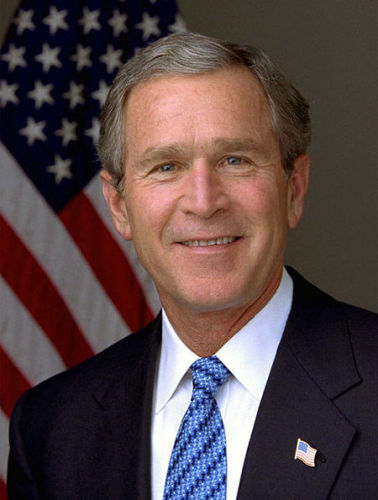
Hurry, hurry, hurry! Eric Walker photo via Wikipedia.
Fearing that Democrats may win the White House as well as strengthen their control of Congress, our lame duck president is rushing to eviscerate as many environmental protection laws as he can before the moving trucks arrive. There is an almost palpable sense of urgency.
Those of us who advocate for cleaner air, cleaner water, healthier wildlife habitat, more wilderness protection, and other environmental values are justifiably upset. But even though the methods Bush and his appointees are using are undemocratic and unethical, they are quite legal. In fact, they have been used by presidents before him, including Bill Clinton.
What’s the big rush? To understand the sense of urgency pervading the scene, you need to turn the clock back 16 years. Bill Clinton won the presidential election in November 1992. When he took office in January 1993, he taught the Republicans a lesson they will never forget. During its last days, the George H.W. Bush administration had made a whole bunch of rulings and issued many directives that Democrats didn’t like. But in making their end-run around Congress (which never got the chance to vet the decisions) the Bush ’41 administration apparently forgot the extremely important fact that 60 days must elapse before new federal regulations take effect. Upon taking office on January 20, Clinton simply reversed them, dumping them unceremoniously into the dustbin of history. (Clinton made sure that his own end-arounds went into effect more than 60 days before the next presidential inauguration. A prime example is his highly controversial proclamation of Grand Staircase-Escalante National Monument, which was dated September 18, 1996. The fact that Clinton was reelected did not diminish the worth of the tactic.)
Republicans were dismayed at Clinton’s destruction of their handiwork in January 1993, and they vowed that it would never be allowed to happen again. Fast forward to Fall 2008. Time is running out for the Bush administration to achieve its long-held goal of weakening environmental protection laws in order to create a climate more favorable to resource exploitation and wealth creation. Polls confirm that the public does not want weaker environmental protection laws, and that’s a problem. Democrats control Congress, and that’s a bigger problem. Barrack Obama seems poised to defeat John McCain in the presidential election on Tuesday, and though that is far from a done deal, it is the biggest problem of all.
Surprisingly, none of this really matters in the odd metric of the American legal system. If you are the president of the United States, even if you are as unloved as George W. Bush, you and your appointees can render decisions that alter or negate federal laws without violating the constitution. Whether gutting the Endangered Species Act, weakening the Clean Air Act and the Clean Water Act, or whatever, the decisions and directives are legally binding unless revoked within 30 days. There is no public input and no Congressional vetting -- just a sneaky end-around that scarcely pays lip service to the democratic process. What an odd way, you might say, for a democracy to conduct its business.
Bush's systematic weakening of environmental protection laws has been across the board, but especially vigorous in the direction of the Endangered Species Act, a law that developers hate with an extra measure of passion. Earthjustice has summed it up rather nicely (August 11, 2008):
With only months to go before leaving office the Bush administration took the wraps off its latest plan to weaken environmental laws. Dale Hall, head of the US Fish and Wildlife Service, announced the administration is proposing changes in current federal rules to allow any government agency the authority to approve projects that could harm rare and threatened wildlife or their habitat. The proposed rule change would replace 35 years of mandatory review by independent federal scientists. The proposed change in wildlife protection rules echoes a similar effort the Bush administration embarked on a few years ago which was stopped by order of a federal court. In that case, the administration gave EPA the authority to approve deadly poisons without first seeking the expert advice of the US Fish and Wildlife Service or the National Marine Fisheries Service.
George Bush is certainly no dummy. He understands that time is the most precious sort of capital, and that he is fast running out of it. You can count on him and his appointees to trash as many environmental protection laws and regulations as they can as fast as they can, making sure that they beat the 30-day deadline preceding the next presidential inauguration. That's slated for January 20, 2009, so there are less than two months left. The pace will soon accelerate; you can count on it.
To his Republican base, and especially the powerful interests to whom he is beholden, George Bush is saying, “I have fought the good fight to get rid of those ridiculous constraints on economic development.” To the rest of us he is saying: “Put that in your hookah and smoke it, you tree-hugging, bunny-loving, eco-freaks!”
What all of this portends for our national parks remains to be seen, but the damage could be severe and long-lasting. Environmentally harmful rules-making is a process that impacts environmental quality in a broad scale way, affecting the parks directly, indirectly, and chronically. For more details about the nature of Bush administration threats to the parks, see the Grijalva report entitled "The Bush Administration Assaults on Our National Parks, Forests and Public Lands (A Partial List)."
Traveler trivia, no extra charge: If John McCain wins this election, it will reset the clock. The last time the Republicans won a presidential election without a Nixon or Bush on the ticket was in 1928.
Story Categories:
A copy of National Parks Traveler's financial statements may be obtained by sending a stamped, self-addressed envelope to: National Parks Traveler, P.O. Box 980452, Park City, Utah 84098. National Parks Traveler was formed in the state of Utah for the purpose of informing and educating about national parks and protected areas.
Residents of the following states may obtain a copy of our financial and additional information as stated below:
- Florida: A COPY OF THE OFFICIAL REGISTRATION AND FINANCIAL INFORMATION FOR NATIONAL PARKS TRAVELER, (REGISTRATION NO. CH 51659), MAY BE OBTAINED FROM THE DIVISION OF CONSUMER SERVICES BY CALLING 800-435-7352 OR VISITING THEIR WEBSITE. REGISTRATION DOES NOT IMPLY ENDORSEMENT, APPROVAL, OR RECOMMENDATION BY THE STATE.
- Georgia: A full and fair description of the programs and financial statement summary of National Parks Traveler is available upon request at the office and phone number indicated above.
- Maryland: Documents and information submitted under the Maryland Solicitations Act are also available, for the cost of postage and copies, from the Secretary of State, State House, Annapolis, MD 21401 (410-974-5534).
- North Carolina: Financial information about this organization and a copy of its license are available from the State Solicitation Licensing Branch at 888-830-4989 or 919-807-2214. The license is not an endorsement by the State.
- Pennsylvania: The official registration and financial information of National Parks Traveler may be obtained from the Pennsylvania Department of State by calling 800-732-0999. Registration does not imply endorsement.
- Virginia: Financial statements are available from the Virginia Department of Agriculture and Consumer Services, 102 Governor Street, Richmond, Virginia 23219.
- Washington: National Parks Traveler is registered with Washington State’s Charities Program as required by law and additional information is available by calling 800-332-4483 or visiting www.sos.wa.gov/charities, or on file at Charities Division, Office of the Secretary of State, State of Washington, Olympia, WA 98504.


National parks and their natural resources belong to you. The National Parks Traveler works to ensure you know how these essential places are being cared for.
Sign Up For Our Weekly Newsletter
Unsubscribe at any time.
INN Member

The easiest way to explore RV-friendly National Park campgrounds.

Here’s the definitive guide to National Park System campgrounds where RVers can park their rigs.
Our app is packed with RVing- specific details on more than 250 campgrounds in more than 70 national parks.
You’ll also find stories about RVing in the parks, tips helpful if you’ve just recently become an RVer, and useful planning suggestions.


Comments
Here we have yet another example of tax-payer funded liberal slant, just two days before we elect a new president ("Traveler trivia"?). Congratulations, Mr. Janiskee, you have destroyed my enjoyment and participation in an otherwise fairly informative feed.
Why is it a liberal slant? Can't you just leave a little room for doubt that Bush might just be doing what tha article says. It's pretty easy to check.
Let me make sure I understand you, Bentley, because you certainly have not made yourself clear. Are you saying that the Bush administration is not rushing to weaken environmental protection laws and regs, or are you saying that it's OK for him to do that? And what on earth do you mean when you say "taxpayer-funded"?
Originally posted on 11/2 but edited on 11/3 to insert a missing word without realizing it would change the location of the post.
Bob,
I share with you the dismay about the power of executive orders and think that perhaps in most cases they should not have the force of law. That said, I do take issue with the tenor of your post.
My issue with your post is not the statement of facts (it seems fairly clear that the Bush administration is rushing to weaken environmental protection laws and regs), but in
1) the presumption that you know all the motivations of the Bush administration, perhaps best illustrated by
To his Republican base, and especially the powerful interests to whom he is beholden, George Bush is saying, “I have fought the good fight to get rid of those ridiculous constraints on economic development.” To the rest of us he is saying: “Put that in your hookah and smoke it, you tree-hugging, bunny-loving, eco-freaks!”
2) the assumption that any weakening of environmental protection laws and regs is a bad thing. Sometime laws and regs are a good idea at the time and at a later time are no longer needed. Sometimes laws are bad to begin with. I want "cleaner air, cleaner water, healthier wildlife habitat (although the last not at the expense of human habitat), but that doesn't mean that I believe the every environmental law and reg is a good thing. It seems to me that frequently once you involve law and an unthinking bureaucracy, things have to be done whether they make sense or not.
Mark
Bob,
Apparently Kurt's hoarding all those tax subsidies NPT gets and not telling you about them!
I was going to call you out on the 1928 trivia until it occurred to me that Nixon was on the Eisenhower tickets. Nice stat.
I'm with Bentley. I love national parks and I've enjoyed Kurt's posts, but you've poisoned the feed. Goodbye.
Bob, your right on target with Bush's slash and burn environmental policies...rape,pillage and greed till the end! Hopefully, we can salvage are natural resources and heritage from Bush's macabre environmental policies. May the next president of this great country of ours have the wisdom, the tools and courage to do so. Keep hammering at the truth Bob. Wake up and smell the coffee Bentley!!! Take a real hard look at Bush's destructive mechanism in destroying are natural resources and national parks...which is carefully crafted to do such...breed more rape, pillage and greed!!!!
This is ridiculous. There are also those of us who love the amazing natural beauty that our country has been blessed with, but do not buy into this liberal political ideology of big government controlling our lives and our businesses in the name of protecting our resources. I didn't join this feed to hear this kind of bias, so I'm also leaving the feed because of this article.
Wake up people. If the government doesn't protect the environment and our great national lands, who will ? Big business just wants to exploit them for all the money they are worth without ever thinking about the consequences !
Thank you Bob. As long as some of us care, there is a chance !
To those who found this post politically offensive, I think it should be pointed out that it also notes that President Clinton wielded his power much the same way as the current president.
Indeed, there are more than a few folks in Utah still steamed that President Clinton resorted to his authority under the Antiquities Act to create the Grand Staircase-Escalante National Monument. That move was do despised in Utah -- the president didn't bother to consult with the state's GOP congressional delegation -- that President Clinton announced the designation from the South Rim of the Grand Canyon!
Had this post gone at the issue (which is how presidents misuse their authority for political expedient purposes) from a different tack, by castigating President Clinton for his environmental handiwork, would those who criticize the story in its current form have applauded?
As for the post being biased or slanted, the facts speak for themselves. Whether you look at the ESA or the Clean Air Act or the Healthy Forests Initiative , the Bush administration has not been environmentally friendly on the whole. The track record is well-documented at this site, this site, this site, and this site. Indeed, Google "Bush environment" and you'll get 28.2 million hits in less than a third of a second.
And really, since when do "liberals" (a label that sadly has been turned into a pejorative despite its true definition) have the market cornered on being environmentally conscious? Have you visited the website of Republicans for Environmental Protection?
What's truly sad is that there are segments of society (and the political establishment) that are so politically extreme -- on both sides of the aisle -- that some have forgotten how to compromise.
To those who say they are abandoning the Traveler, that's certainly your prerogative, although you could do more good by sticking around and more fully explaining your point of view on issues that are so important to the future of the National Park System.
Anything that can be done to weaken the strongest lobby in the USA...the EPA...is welcome news. The EPA controls too much is the USA now. It has power beyond its usefulness. I like the National Parks and enjoy going to many of them. This does not mean that the environmentalists are always right in what they do...like THEY think they are. So GOOD for Bush.
sorry mr. Janiskee I don't agree with you, I think you are off! the mark! But democracy is a beutiful thing! "TO EACH HIS OWN"
What democracy John K.? That's something that the Bush administration has tried hard to do away with. Remember our ill-famed former attorney general Mr. A. Gonsalves and his continuing stonewall white lies for Mr. Bush and company. Without the EPA are national environmental picture would look rather tragically bleak...and it's getting there. No doubt! These past eight years under the Bush & Cheney regime are national parks are starting to look pretty scuff up (to put it mildly) from the lack of substantial monetary input from this lame duck administration. Just ask any national park superintendent.
The foregoing emails make it abundantly clear that there's no constructive, much less rational and fair-minded, discourse with today's
Republicans. Even after 8 long years of the most destructive, disastrous regime in our living history, most Republicans see very little
wrong with their party, its views, or actions - that could be the single most disheartening thing about America these days. That aside,
one would think that at least one purpose of the Traveler would be to advocate for the National Park Service. Simply stating the publicly
proven facts about the horrendous conduct of our current "leaders" seems to touch a nerve among some right-leaning park users. It's
only the truth, people - something we're not given much of these days. If the truth hurts, the only people you can logically blame are
Bush and Cheney. But I guess that's far too accountable for this administration.
One day all that we will have is concrete streets, buildings, factories, city skylines... all of these beautiful things that make up "human habitat"! When you wake up in the morning you will be able to walk outside, take a deep breath of not-so fresh air and ponder how much better off we are without all that awful wilderness getting in the way, just look at China! By all means, keep your blinders on... and stumble right off the face of the Earth!
Editor's note: This comment was edited to remove a gratuitous insult.
Mark: Most environmental protection laws could use some tweaking, including adjustments that loosen unnecessarily restrictive provisions. But let's demand that our federal, state, and local governments make these adjustments the right way, not by hasty administrative fiat that ignores science, violates the public trust, and in the worst examples, flagrantly breaks the law of the land. I reserve a special kind of contempt for public officials that behave that way, and I suppose that's why I deserve no better than a blue star for the tenor of my remarks.
Mr Janiskee, do you think an Obama administration will be any better, guess what "it'll be worst," then you'll be wishing for somebody else. its easy to pick on George Bush, but nobody remembers his leader ship during 9/11 and afterwards. President Bush has done plenty for this country and the environment and our national parks which i greatly cherish, lets look beyond the negetive and quite gripping. and be appreciative! for what we have.
Frank C., yes we have a Constitutional Republic (federal republic) that operates on the liberal principal of a "liberal democracy", a formal Constitution installed with free elections (do we?) protection of civil rights (do we?) and the separation of powers between the executive, legislative and judicial branches of government. Under the Bush regime it's a form of government that cuts between oligarchy (ruled by few) or theocracy and some say even bent on fascism...and not much on democracy! Hardly a form of government that aids or meets the needs of the general populace and the environment. Just remember Katrina, remember A. Gonsalves, remember Enron, and now the potential economic collapse of the U.S. economy. Bush & Cheney, the two man wrecking crew, now has plans to bury this country in a potential environmental quagmire to cripple the next presidential candidate from installing sane and intelligent guidelines to protect the environment. Is this tailored to benefit the multinational corporations that have total disregard for are long and hard fought environmental laws. Categorically yes!
Bob, I'm giving you a gold star for candor and truth. Keep hammering at the truth "for the pen is mightier then the sword"!
It's unfortunate that raising concerns about environmental issues is so quickly cast by some as a liberal vs. conservative or a partisan issue. As pointed out above, administrations of both parties have used their final months in office to push through whatever fits their agenda. That may be a reality of our "system," but I don't think it makes for good public policy.
Whether or not you object to the current rush to modify public land policies and regulations probably depends largely upon your view of government regulation in general. It doesn't require a detailed analysis of history to confirm that little or no regulation has often resulted in serious harm to the environment, human health and our quality of life. It's also easy for the regulators to get out of hand. The difficult trick is finding an appropriate balance.
I agree that environmental (and other government regulations) can often use some adjustments, but logical and responsible decisions on complex issues will rarely result if they are based solely on the ideology of the "party currently in power," and if they are rushed through to meet a deadline based on political expediency.
If the current changes that have suddenly emerged on the scene in recent months are so critical, I have to wonder why they weren't brought to the table in the first year of the administration instead during of the final months. Perhaps the answer is that in at least some cases, they simply can't withstand reasoned analysis - or they would be seen as a political liability for someone running for reelection.
One of my greatest concerns with the current administration has been the way it has made a mockery of the public comment process. A case in point is the current "review" of public comments on proposed changes to the Endangered Species Act.
According to news reports from the AP and other sources, Interior received about 200,000 comments on this proposal. If public input is to have any meaning in our system of government, a reasonable analysis of those comments should be made as part the decision-making process. However, the agency reportedly intended to complete the review of those comments with a team of 15 people working over a 4 day period of presumably 8-hour government work days.
Several commentators have noted that this effort by Interior would require about 6,250 comments to be reviewed every hour. That means that each member of the team would be "reviewing" at least seven comments each minute, or as one observer put it, just about long enough to slide each paper across the reviewer's desk and into the trash can.
Yes, some of those comments are form letters, and can be categorized as "for" or "against" fairly quickly. Others, however, include thoughtful and detailed material which deserves at least an honest reading.
Whether you agree with the proposed changes or not, if our system of government that supposedly grants "power to the people" is to function in a healthy way, those who are elected or hired to act in the best interests of the people need to perform those duties in a manner worthy of their hire. Sadly, I don't see that happening in situations such as the one I've just described.
Yea for President Bush... these laws should have been gutted years ago. GO President Bush, slash, slash away...
No matter whether you think that Obama or McCain ought to be the next president, let's all get out to vote tomorrow. No one can bitch who doesn't.
Rick Smith
I'm an independent who is sick and tired of politically based misrepresentations by democrats and republicans alike. My 6th grade teacher taught me "Figures don't lie, but lier's figure". I'm thinking you and your partner, Repanshek, are figuring you have a gullible readership. Your article cites the Grijalva report and links to an article wherin several allegations of said report are reprinted. Let's look at Democratic congressman Grijalva's first allegation (that's all that's needed to prove we can't trust anything he states):
Grijalva states "The Bush Administration has presided over the largest slaughter of bison since the Great Plains herds were slaughtered nearly to extinction by unscrupulous buffalo hunters in the late 1800s. "
What Grijalva doesn't mention are these facts which are attained from various websites of Buffalo advocacy groups and from the New York Times (hardly friendly to the Bush Administration)*:
1) In 1996 (during Bill Clinton's reign) about 1000 Yellowstone buffalo were "slaughtered"*. That means, until 2008, the Clinton Administration "presided over the largest slaughter of bison since the Great Plains herds were slaughtered nearly to extinction by unscrupulous buffalo hunters in the late 1800s." The 2008 numbers were a wee bit larger, so Grijalva's point isn't a lie depending on what you mean by "presided over". I can't help but wonder if Grijalva, Repanshek, and other democrats, were denouncing the Clinton Administration in 1996 for their record of slaughtering bison.
2) A rooster crows at dawn, but does that mean he's responsible for the sunrise? Or does he just "preside over" the sunrise? Neither the Clinton, nor Bush administrations, were responsible for the culling of the Yellowstone Buffalo herd, in 1996, 2008 or any other year. The herds are adminstered over jointly by a group of federal and state organizations, but it is the state of Montana that has authority for the culling of the Yellowstone herd.
3) Buffalo are only killed if they leave the park. No Buffalo are killed within Yellowstone. There are fears that the Buffalo will not only damage rancher's fences and other property, but also spread Brucellosis to the rancher's cattle herds. Buffalo advocates say these are unrealistic fears, but in the past many of the park's buffalo have tested positively for Brucellosis. Brucellosis in humans is known as undulent fever. While it is unlikely to be spread from Buffalo to humans, even through a cattle intermediary, it is still cause for concern among the ranchers surrounding the National Park and also the states in which they reside. To ship cattle out of state, the state (without expensive testing) much have a "brucellosis-free" status indicating that brucellosis has been eliminated from it's cattle. Foreign countries can refuse to accept American beef, if they fear it might be contaminated, or use contamination to excuse protectionism against American beef imports (it's happened). Montana spent an estimated $30 million between 1985 and 1997 to maintain their "brucellosis-free" status. A rancher must slaughter any of his cattle infected by brucellosis and cannot use, or sell the meat. Anyone that has traveled in Montana, or Wyoming, knows that they have small economies relative to a state like California and those economies are highly dependent on cattle. So, not only does an individual rancher have fears of his livelyhood being decimated, his state also has fears of huge financial hardship. Unrealistic fears aren't so unrealistic when there are big consequences to yourself.
4) The Buffalo are not being slaughtered to the point of extinction as Grijalva would like you to believe. He knows he's planting that thought, when he uses words like slaughter and extinction in his false accusation. There are an estimated 250,000 buffalo in the United States (from various sources including the N.Y. times. PBS estimated only 200,000 plus). They are mostly located on private ranches, but there are large herds in many Federal and State Preserves. I've personally seen herds, in excess of several hundred buffalo, in The National Bison Range in Western Montana, Theodore Roosevelt National Park in N. Dakota and Custer State Park in S. Dakota.
5) Meat from culled brucellosis-free Yellowstone buffalo is donated to local tribes and food kitchens. Custer State Park (one of the best parks in North America for viewing wildlife) has funded a lot of it's costs by auctioning excess Buffalo (more than the park can maintain) from it's herd.
6) The reasons why Buffalo stray across Yellowstone N.P. boundaries, leading to their culling by the state of Montana, is that the Yellowstone Park ecosystem, is not able to maintain a herd of more than a thousand, or so, year round. In a bad winter, hundreds, perhaps a thousand buffalo can freeze to death or die of starvation. In one year, it's reported 850 died. I don't know if that was a modern record, exceeding "all since the frozen buffalo records established by the plain's Indian administrations of the 1700's and 1800's."
Conclusion: Based on this one issue: A) Grijalva is not to be trusted. But he is a partisan politician and his "report" probably earned a lot of good donations from "concerned environmentalists". Do some investigating of your own and see if you can debunk a few more of his allegations B) This websites authors are probably "concerned environmentalists" (aren't we all?), but accepted Grijalva's partisan "report" hook line and sinker. Instead of a "them against us" mentality, true environmentalists should strive to build coalitions with hunters, ranchers, fiscal conservatives etc etc. to build a broad based consensus on preservation. That means compromise and the end of misrepresentations.
* See New York Times article ("Shooting and Harsh Weather Take a Toll")
John K asks me if an Obama administration would be any better. I don't know, nor can I say whether McCain would do any better either. What I can say is this: no matter who occupies the oval office, we'll be carefully monitoring his environmental stewardship -- especially as it regards the national parks -- and we'll hold his feet to the fire if he uses unethical tactics to undermine the laws Congress has enacted to protect environmental quality.
G. Pinson uses the example of the Yellowstone bison management controversy to seal his argument that critics of the Bush administration are not to be trusted where matters of environmental stewardship and national park management are concerned. I think that Traveler readers are sharp enough to realize that a body of evidence is the sum of its parts, not any individual part (as the instructions to juries make abundantly clear). An overwhelming body of evidence supports the conclusion that systematic weakening of environmental protection laws has been an identifying trait of the Bush administration, and that the pace of the activity has accelerated dramatically in recent months. No amount of bobbing and weaving is going to change that. I've predicted that the pace will become even more frantic in the weeks to come, and I cordially invite G. Pinson and anyone else to monitor the relevant events and heap ridicule on me if I'm proven wrong.
Thanks for the begrudging recognition that Congressman Grijalva (upon whose statements your article was based) misrepresented the Yellowstone bison management issue. Your thesis seems to be that Grijalva made many accusations, so what difference does it make if one is falacious? We have all the others to mindlessly believe! My view is why should I trust anything a proven liar says, until it's proven to be true. I only pointed out one of Grijalva's faulty claims ("Buffalo" Bush, the Bison exterminator), but we can go on to others, if you like, thus diminishing the believability of the "overwhelming body" of Grijalva statements. That wouldn't be necessary if you'd document "the overwhelming body of evidence" that you claim "supports the conclusion..." you'd like us to believe. And instead of interpreting said evidence, from one viewpoint, why not get an opinion from the Bush administration for their motivation in their alleged action (assuming they took such action). If they can't come up with a valid reason for their acts, we, the Traveler readers, are smart enough to catch them in their prevarifications.
I really don't see myself as an apologist for the Bush administration, nor the Clinton administration, nor the upcoming Obama admistration. However, when people from either political extreme, or extreme of one issue, disseminate false and inflamatory information it fuels a bitter polarization that is counterproductive to achieving goals supported by the overwhelming body of the American public. Accusations aren't a body of evidence. We, the Traveler readers, want facts from unbiased sources, and we'd like both sides of the story.
Lame.......a term never more appropriately used than when in description of politicians. We've been saddled with nothing short of lame for more years than I can remember, dating back to 40's. Bush's leadership post-9/11??? THAT'S your idea of leadership??? I thought leading is defined as an ability to direct or manage for the betterment of the common good or specific to the group being "lead"? Pardon me while I regurgitate over the quality of our leadership.....
Did I misinterpret on an above post or was someone actually trying to blame the current administration for the Enron debacle? How naive the general public these days.
I agree with the intent Rick, but Beamis is right. Whether "we, the People" cast our ballots or not, certain factions of the governmental system are beyond the scope of the electoral process, at least as they pertain to an ability to effectively "change" with one electoral process. And the most ridiculous notion put forth that the gullible, ever-ignorant American public has swallowed hook, line and sinker is this absurd rhetoric purporting CHANGE by the Jackass Party. OF COURSE there will be change, but only due to that fact that a new family is moving into the Pennsylvania Avenue address. Politically speaking, that's change, and thereby no lies were made nor people hurt in the production of their commercial. The problem is that what the system needs isn't CHANGE......its REFORM. A does not equal B, and the differences between these two terms is not at all insignificant, but since most of the general public can't even speak or write proper English, put together a coherent sentence or comprehend the nuisances of the language (color and national origin be damned), or even grasp the simple yet subtle differences between the terms "democracy" and "republic", the public gets what it deserves. Maybe that's why funding for education is so hard to come by in this "great nation". If the masses actually understood the processes, reform would be the buzz-word, not some useless conceptual nonsense as "change". But the theory goes that if you use small words with multiple inferences, you can say many things without actually specifically saying anything meaningful. Ah the government practices of business as usual. But just as they promised, we sure got our change, didn't we?
The most accurate slogan for this election WOULD have been:
BLACK OR WHITE, NEITHER'S RIGHT
EVEN GREEN'S A BETTER OPTION
TUSKS AND MULES ARE FOR FOOLS
REFORM THE ORGANIZATION
Ok, so the pentameter is off a bit, sorry.
GO OBAMA.....GO McCAIN.....and take the rest of the bastards with you!
Maybe that should have been the slogan.
Lone Hiker: If I'm not mistaken, regarding the Enron collapse, there is various White House memos that suggest that Dick Cheney was involved indirectly to the scandal. Kenneth Lay and Dick Cheney did have a meeting in April 2001 regarding Enron's wishes to refrain the federal authorities for imposing price caps to stabilize runway electrical prices in California...and which eventually made into Cheney's energy plan. The memo states: "The administration should reject any attempt to re-regulate wholesale power markets by adopting price caps or returning to archaic methods of determining the cost-base of wholesale power". The intent was to mitigate higher electrical prices to enhance and increase private investment. Perhaps the White House did not have a indirect input to the Enron scandal but the inference is there regarding some meddling into the energy shenanigans. This is nothing new here regarding the Bush & Cheney loosey goosey policies regarding hands off on big business to exploit illegal profiteering.
Question, why do mock those that try there best to express there opinions in the best way possible on NPT. Perhaps it's not in the best way grammatically or intelligently but they have a voice. Maybe it doesn't quite meet up to your standards of higher learning or reflect a lofty ivory tower of mentality with a Ph.D. If I'm not mistaken, your the one that has the background in chemical engineering. No!? Not all of us have been bless to live by the slide ruler. Anyway, your opinions are much enjoyed to read.
Whew! Talk about a polarized thread!
I fully agree with this statement, as the division between the factions grow wider each year:
And don't forget Fishermen, ORV Enthusiasts, Snowmoblilers, Mountain Bikers, and any other folks that love our national lands and wish to preserve them, regardless of their chosen mode of transportation, political leanings or the lack thereof.
Lone Hiker, I couldn't agree with you more! I had hoped that this day would come...
And reform needs to happen at all levels, but nowhere does it need to happen more than at the congressional level, where the true devils reside.
In reply to the latest Anon---
Thanks but my background is biochemistry and biotechnology, not engineering. Part and parcel of the biochem is a specific background in physics, solely pertaining to the properties of gasses, light and light energy as they are utilized in my field for diagnostic purposes. But the properties that we make everyday use of are quite similar to the technologies relating to solar cells and the compressed air vehicles now in production in France. But I digress, again. So in those instances when the topics turn to alternative energy, the overdone global warming discussions, the evils of fossil fuels, and the like, yes, I do tend to get my shorts in a knot reading the postings that were in my opinion, based in no small part by media disinformation and further misinterpretation or complete misunderstanding of data by the general Joe Poster on this and other sites.
Insofar as the Enron situation, those responsible were the group of idiots who attempted to run an energy supply conglomerate who in reality had absolutely NO idea how to manage a power grid, and probably had difficulty understanding how to operate a light switch as well. Most people tend to point out that the rolling blackouts that many citizens of California were forced to suffer through were rooted in a lack of "cooperation" amongst utility companies, the lack of a national power grid that could serve to backup any portion of the system by diverting supplemental power sources and some justifiable environmental concerns and fears surrounding nuclear facilities in and around the state for obvious reasons. The statement you make about greed and profiteering is all well and good, but cutting to the chase, had Enron not bankrupted PG&E and forced the only experienced and legitimately knowledgeable power management professionals to find other suitable employment, then mismanaged the entire west coast network due solely to their own ineptness, in all likelihood the entire episode would have been avoided. The profiteering, as it was called, never actually materialized beyond the executive levels of the company as was discovered by a federal audit of the corporate ledgers. That's not profiteering, that's grand larceny or grand theft, I always get those two mixed up, or more appropriately, strong armed robbery. The ignorance at the corporate levels (excluding the accountants, whom I would like to do my books sometime) that created the whole problem in no way can be attributed to the nightmare that is Bush / Cheney. And didn't Enron actually receive their corporate charter under the Wet Willie Clinton / Green Al Gore holocaust?
And I'm not now casting dispersions on anyone or their right to their opinion. Or ever. Under any circumstance.
My point was (and is) that the gullibility factor needs a drastic reduction in order for the nation to achieve a better understanding of the issues that cause us ALL daily grief. And those cute little plays on words and flat out misnomers that are "politic-speak" need to be CLOSELY scrutinized before becoming part of one's own everyday dialect. Otherwise, you begin to sound just like the goofs that uttered the phases in the first place. And we have enough of those people already.
And I NEVER criticize typos!!! Just what seems (to me) to be emotion over substance.