
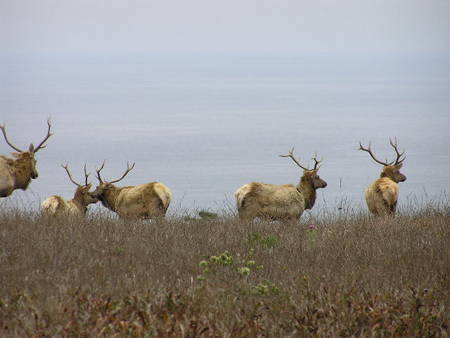
Tule elk at Tomales Point in Point Reyes National Seashore. Barbara Polk photo.
Point Reyes National Seashore plays a vital role in maintaining healthy biodiversity. A prime location and key physical factors have combined to make the park, which marks its 46th anniversary September 13, one of the six most biologically significant areas of the United States. The variety of life found there is astonishing.
Point Reyes’ location, habitat variety, and size are all conducive to biological diversity. The park’s situation, or relative location, is a key element of its biodiversity success story. Point Reyes is a rugged peninsula sandwiched between low coastal mountains and the Pacific Ocean near the middle of the California coast and close to San Francisco Bay and its Golden Gate entrance.
These locational factors position the park ideally to serve the nesting and resting needs of a wide variety of migratory or widely ranging species. Thus, in addition to the great number of resident species, there are numerous seasonally or intermittently present species that are just passing through, biding a while to reenergize, or staying long enough to reproduce.
The natural occurrence of many different kinds of habitat has a lot to do with the variety of life that visitors (of which there were 2.2 million last year) can see at the park. Within the park’s boundaries and along its edges are open ocean, rocky shorelines and points, sandy beaches, rocky cliffs, coastal dunes, coastal scrub, inlets, bays, spits, estuaries, intertidal zones, salt marshes, tide pools, mudflats, creeks, lagoons, riparian corridors, freshwater wetlands, brushy canyons, coastal grasslands, maritime forest, bishop pine forest, Douglas-fir/mixed evergreen forest, and other kinds of habitat.
Largely as a consequence of this rich habitat variety, the inventory of plants and animals species at Point Reyes includes 750 species of plants (including nearly 20% of California’s native plants and flowering plant species), nearly half of North America’s bird species (over 400 in all), and at least 23 federally listed threatened and endangered species.
Land mammals number about 37 species, including black-tailed deer, mule deer, two non-native deer species (fallow deer and axis deer), tule elk, and even an occasional mountain lion or black bear.
About a dozen species of marine mammals use this part of the California coastline, including sea lions, elephant seals, and harbor seals. In managing the marine animal and bird species, Point Reyes cooperates with the adjacent Gulf of the Farallones Marine Sanctuary.
The large size of the park, about 111 square miles, is a very important asset. To maintain healthy populations, many resident species need plenty of room for individuals to find food, breeding grounds, nesting areas, and escape cover. Having a larger protected area also increases the likelihood that there will be enough genetic variety in species populations as well as buffering against undue stress. In locales where plant and animal populations have lots of room to spread out instead of being confined to small islands of habitat, there is a greatly reduced likelihood that diseases, insect infestations, excessive predation, and similar stresses will become unduly disruptive.
Many visitors are surprised to learn that some areas of Point Reyes are sufficiently large and pristine to qualify for protected wilderness status. Congress placed a 25,370-acre tract of the park into the category of federally protected wilderness in 1976, and by 2007 designated wilderness in the park totaled some 33,000 acres. An additional wilderness area will be established (at Drakes Bay/Estero) by 2012, the Congressionally mandated deadline.
Hearty Traveler best wishes to 46-year old Reyes National Seashore, a treasure trove of biodiversity.
Story Categories:
A copy of National Parks Traveler's financial statements may be obtained by sending a stamped, self-addressed envelope to: National Parks Traveler, P.O. Box 980452, Park City, Utah 84098. National Parks Traveler was formed in the state of Utah for the purpose of informing and educating about national parks and protected areas.
Residents of the following states may obtain a copy of our financial and additional information as stated below:
- Florida: A COPY OF THE OFFICIAL REGISTRATION AND FINANCIAL INFORMATION FOR NATIONAL PARKS TRAVELER, (REGISTRATION NO. CH 51659), MAY BE OBTAINED FROM THE DIVISION OF CONSUMER SERVICES BY CALLING 800-435-7352 OR VISITING THEIR WEBSITE. REGISTRATION DOES NOT IMPLY ENDORSEMENT, APPROVAL, OR RECOMMENDATION BY THE STATE.
- Georgia: A full and fair description of the programs and financial statement summary of National Parks Traveler is available upon request at the office and phone number indicated above.
- Maryland: Documents and information submitted under the Maryland Solicitations Act are also available, for the cost of postage and copies, from the Secretary of State, State House, Annapolis, MD 21401 (410-974-5534).
- North Carolina: Financial information about this organization and a copy of its license are available from the State Solicitation Licensing Branch at 888-830-4989 or 919-807-2214. The license is not an endorsement by the State.
- Pennsylvania: The official registration and financial information of National Parks Traveler may be obtained from the Pennsylvania Department of State by calling 800-732-0999. Registration does not imply endorsement.
- Virginia: Financial statements are available from the Virginia Department of Agriculture and Consumer Services, 102 Governor Street, Richmond, Virginia 23219.
- Washington: National Parks Traveler is registered with Washington State’s Charities Program as required by law and additional information is available by calling 800-332-4483 or visiting www.sos.wa.gov/charities, or on file at Charities Division, Office of the Secretary of State, State of Washington, Olympia, WA 98504.


National parks and their natural resources belong to you. The National Parks Traveler works to ensure you know how these essential places are being cared for.
Sign Up For Our Weekly Newsletter
Unsubscribe at any time.
INN Member

The easiest way to explore RV-friendly National Park campgrounds.

Here’s the definitive guide to National Park System campgrounds where RVers can park their rigs.
Our app is packed with RVing- specific details on more than 250 campgrounds in more than 70 national parks.
You’ll also find stories about RVing in the parks, tips helpful if you’ve just recently become an RVer, and useful planning suggestions.


Comments
Oh my God, are you completely kidding me?
When I went to Point Reyes, all I could think of was "what a ruddy sh*thole!"
Sure, maybe there is some tidal pool goodness, but the island itself is an over-farmed mess. I was completely appalled at the bad farming practices as I drove through it. I did stop to see the elk, and walked to the lighthouse, but I cancelled my planned hike on the southern tip of the island and left.
I don't know if the NPS should encourage sustainable dairy practices on the island, but the farmers in question should learn anyway. I grew up around dairy farms, and know such places can be run a LOT better. I couldn't wait to get out of the place.
It was one of the most appalling things I've ever seen on my trips through the National Park System.
==============================================
My travels through the National Park System: americaincontext.com
Thank you, Barky - I was going to be 'nice'! ;-)
The entire Point Reyes area is a run-down & then abandoned dairy farm complex. It was given over for recreational purposes only after the main portion of the commercial operation was no longer profitable. (Pt. Reyes hauled milk products for many decades to San Fransisco, on the water - a serious competitive angle. With better-developed land-transportation, better-resourced inland dairy districts out-hussled them and they (largely, not entirely) tossed in the towel.)
Pt. Reyes is a very charming area, especially if you like open farm-land (which I do!).
... But wilderness?! My achin' hind quarter! ;-)
Here is some background for the comments that Barky and Ted made. I hope you'll find them useful. Bear in mind that this national seashore is a 111-square mile area, only part of which is occupied by dairy farms. Also recall that the article I wrote focused on biodiversity, not scenic values or recreation opportunities, per se. Point Reyes is a marvelous place by any reasonable measure. It has long been, and will remain, one of my favorite national parks.
The Point Reyes peninsula has been used for cattle grazing since the Spanish colonial era. During Spanish rule, three “Lords of Point Reyes” -- James Berry, Rafael Garcia, and Antonio Osio – operated ranches on the peninsula under authority of Spanish land grants. Later, a single family -- the Shafters and their in-laws, the Howards -- owned the entire peninsula.
When the park was created nearly a half-century ago, the enabling legislation ensured the continuation of pastoral activities by providing that ranchers who sold their property to the federal government would be given renewable leases. The areas and structures used for grazing activities comprise the park’s Pastoral Zone.
Today, there are about 30 private beef and dairy cattle operations in the Pastoral Zone. These livestock operations operate under the terms of leases and related agreements with the Park Service.
Point Reyes National Seashore has many interesting historic structures related to cattle ranching. Many of the structures related to the grazing industry are historically significant. The historic Pierce Ranch dates back to the time of the Spanish land grants, and many buildings in the ranch complex were constructed in the 1860s. The Historic C Ranch was established in 1859.
Very nice background, Bob - thanks!
I have not determined - is the 'open-scrub' ecology there a natural feature? That's what drew the original Spanish settlers - 'open fields' they could see from the water?
Are the majority of the shoreline contexts open to visitors - I wanted to go down the rough bluffs to the tantalizing beaches, but had others along and stuck to the upland trails. We did not visit working dairy farms, but did see & inspect historic barns etc. (I too, Barky, have dairy-background from the grandparents farm.)
Yes, it is called a "Seashore", not (mostly) "wilderness" ... but I remain curious about the natural heritage of the 'uplands', whether the original flora-complex survived & recovered ... or is what we see growing just the 'weeds' that took over by default?
(I noted similar but much smaller patches of open terrain along the Lost Coast/Kings Range, to the north - and they appear to be "grasslands".)
Grasslands and "open scrublands" that have been grazed for several centuries are anything but natural. To get the best grazing for cattle, you artificially hold the ecosystem in the early, fast-growing stage of ecological succession that many call the "weedy" stage. My guess is that, if all the cattle were removed, the grassy/scrubby vegetation would be replaced eventually with a more richly diversified ecosystem with fewer grasses and more shrubs and trees. You'd have to ask an ecologist or botanist about that, and I'm not one of those. As for getting to the shore, there are some good places to get to beaches, if that's what you want. Drakes Beach (sand and muddy sand) is a popular, easy to get to spot. McClures Beach is gorgeous (sea stacks). There are others (check the PORE website).
Now if they could only keep the pot-growers out of Point Reyes...
You want diversity in a small area? Try Indiana Dunes National Lakeshore. Only 15,000 acres with more than 1400 species of plants, including more than 30 species of native orchids, and 46 species of mammals. I wager no other NPS area has so much in so little space.
Yes, I agree that Indiana Dunes has received less attention than it deserves in Traveler. I'll try to remedy that at some early opportunity.