
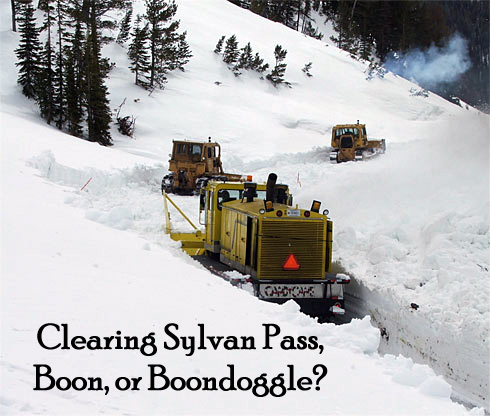
Despite internal concerns for safety and high costs for a small number of people, the National Park Service has agreed to provide winter access across Sylvan Pass in Yellowstone National Park. However, conditions tied to that access could make it easy for the pass to stay snow-bound as Yellowstone officials initially wanted.
Intermountain Regional Director Mike Snyder today signed the amended "Record of Decision" that is to guide winter-use in Yellowstone and Grand Teton national parks. The key amendment calls for over-snow travel across Sylvan Pass. However, the added language specifies that the pass will only be open between December 22 and March 1 and then only if weather allows, if safety can be maintained, if equipment is available to groom the route, and if the Park Service can afford to maintain the pass.
Last fall when Yellowstone officials signed off on their latest Environmental Impact Statement on snowmobiling in the park, their preferred alternative was to shut down winter traffic over the pass. Why? Because, those officials said, they couldn't afford the requisite winter maintenance there and it wasn't safe for employees or park visitors under current conditions. That safety concern stems from 20 avalanche chutes that tower over the pass.
But during the course of six months of meetings Yellowstone Superintendent Suzanne Lewis eventually bought into the Wyomingites' arguments that she somehow could afford to keep the pass open for the relative handful of snowmobilers and cross-country skiers who enter the park through its east entrance, which lies but 53 miles west of Cody.
How much of a fiscal burden will it be to Yellowstone to keep the pass open?
The park's FY2008 budget reflected an increase of about $1 million over its 2007 budget. Under the decision Regional Director Snyder has approved, it could cost Yellowstone nearly $4 million to provide safe wintertime passage across Sylvan Pass if all Occupational Safety and Health Administration concerns are addressed. That total includes $3.46 million in one-time costs and $456,216 in recurring annual operational costs that no doubt will be driven up by inflation.
In other words, the preferred Sylvan Pass plan endorsed by the Park Service is four times Yellowstone's 2008 budget increase.
Last winter 463 people traveled over Sylvan Pass from Cody. At that rate, based on the nearly $4 million Yellowstone soon could find itself spending to keep Sylvan Pass safe, the cost would equate to $8,470.76 per person.
As for safety, Park Service officials say a combination of avalanche mitigation techniques might be used on Sylvan Pass, including forecasting and helicopter and howitzer dispensed explosives, as well as techniques that may be available in the future. It is the intent of the agency to review and update the previous Occupational Safety and Health Administration and Operational Risk Management Assessment safety evaluations, and to evaluate additional avalanche mitigation techniques in order to further improve safety and visitor access.
In a release issued today Park Service officials say avalanche management at Sylvan Pass may necessitate unscheduled, temporary closures of the road segment through the pass. Management of the avalanche risk cannot guarantee the pass will be open every day of the winter season.
Now, as for the rest of Yellowstone, if the approved winter-use plan withstands court challenges, beginning this winter 540 "Best Available Technology" snowmobiles and 83 snowcoaches will be allowed per day in Yellowstone, during a winter season which starts on December 15 and ends March 15 each year, weather and snow conditions permitting.
Thirty BAT snowmobiles and two snowcoaches will be allowed per day through the park’s East Entrance during the core season of December 22 through March 1.
All snowmobiles and snowcoaches will continue to be 100 percent commercially guided, and may travel only on existing park roads groomed for their use. Trail and off-road use of snowmobiles and snowcoaches has always been, and will continue to be, prohibited.
Story Categories:
A copy of National Parks Traveler's financial statements may be obtained by sending a stamped, self-addressed envelope to: National Parks Traveler, P.O. Box 980452, Park City, Utah 84098. National Parks Traveler was formed in the state of Utah for the purpose of informing and educating about national parks and protected areas.
Residents of the following states may obtain a copy of our financial and additional information as stated below:
- Florida: A COPY OF THE OFFICIAL REGISTRATION AND FINANCIAL INFORMATION FOR NATIONAL PARKS TRAVELER, (REGISTRATION NO. CH 51659), MAY BE OBTAINED FROM THE DIVISION OF CONSUMER SERVICES BY CALLING 800-435-7352 OR VISITING THEIR WEBSITE. REGISTRATION DOES NOT IMPLY ENDORSEMENT, APPROVAL, OR RECOMMENDATION BY THE STATE.
- Georgia: A full and fair description of the programs and financial statement summary of National Parks Traveler is available upon request at the office and phone number indicated above.
- Maryland: Documents and information submitted under the Maryland Solicitations Act are also available, for the cost of postage and copies, from the Secretary of State, State House, Annapolis, MD 21401 (410-974-5534).
- North Carolina: Financial information about this organization and a copy of its license are available from the State Solicitation Licensing Branch at 888-830-4989 or 919-807-2214. The license is not an endorsement by the State.
- Pennsylvania: The official registration and financial information of National Parks Traveler may be obtained from the Pennsylvania Department of State by calling 800-732-0999. Registration does not imply endorsement.
- Virginia: Financial statements are available from the Virginia Department of Agriculture and Consumer Services, 102 Governor Street, Richmond, Virginia 23219.
- Washington: National Parks Traveler is registered with Washington State’s Charities Program as required by law and additional information is available by calling 800-332-4483 or visiting www.sos.wa.gov/charities, or on file at Charities Division, Office of the Secretary of State, State of Washington, Olympia, WA 98504.


National parks and their natural resources belong to you. The National Parks Traveler works to ensure you know how these essential places are being cared for.
Sign Up For Our Weekly Newsletter
Unsubscribe at any time.
INN Member

The easiest way to explore RV-friendly National Park campgrounds.

Here’s the definitive guide to National Park System campgrounds where RVers can park their rigs.
Our app is packed with RVing- specific details on more than 250 campgrounds in more than 70 national parks.
You’ll also find stories about RVing in the parks, tips helpful if you’ve just recently become an RVer, and useful planning suggestions.


Comments
This is ridiculous. The money they will use for this initiative could be better spent helping the bison and elk herd.
If the money from that were spent "helping" the bison and elk herds the way they've been "helping" the bison herds in the past winters - with all the slaughter; then no thank you.
However, yes, this is completely ridiculous - from the point of view of direct public involvement in the process but most especially in what they're doing in bombarding Yellowstone to keep this pass open to a few privileged people during winter.
Jim Macdonald
The Magic of Yellowstone
Yellowstone Newspaper
Jim's Eclectic World
Man, Over 8,000 per smowmobiler. In todays society that is an incredible waste. I am glad I stopped machining a few years ago. I couldn'd see my pleasure ruining the future of others. Stop this maddness.
Kurt took some flack for fingering Cheney on this decision (see this); now the Associated Press is fingering Bush and Cheney as getting involved.
Kurt, are you writing about this? Very cool that someone is following up on what seemed to be a plausible conjecture given the players involved and how this decision was reversed.
Jim Macdonald
The Magic of Yellowstone
Yellowstone Newspaper
Jim's Eclectic World
Ok, so how do they come up with almost 4 million in costs. In the past it's only ever cost about $300,000 to keep the pass open??? Interesting.
Irregardless of the actual costs to keep this route open for winter travel, it's a shame that much or all of a badly needed budget increase for the park will be diverted to this one project.
Here's a key to the bottom line: A 2008 Wyoming travel guide has a full page color ad on the back cover. The "headline" for the ad reads, "Cody has a nice city park. It's called Yellowstone."
It's all well and good for local communities to receive economic benefits from the spending by visitors to nearby national parks, but when local economic benefits become the driving force for decisions on park operations, park resources and values often suffer.
YeeeeeeeHawwwwwwww!!
Gettin' my sled ready!
By the way, following up on Cheney's involvement, Cheney admits himself that he was involved. See this interview from this weekend: http://www.casperstartribune.net/articles/2008/12/28/news/wyoming/bbaf7b...
Jim Macdonald
The Magic of Yellowstone
Yellowstone Newspaper
Jim's Eclectic World