
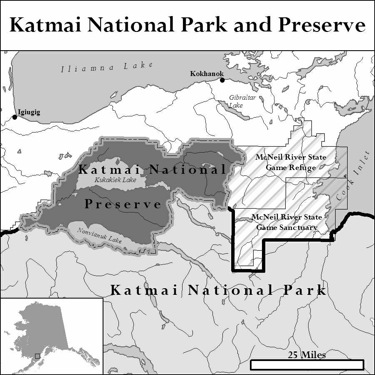
This map shows the geographically close relationship between the National Park Service managed areas of Katmai National Park (where hunting is illegal) and the Katmai National Preserve (where hunting is regulated by the state of Alaska). For better image detail, click here.
Starting October 1, 2007, the annual fall brown bear hunting season will open for three weeks in Alaska’s Katmai National Preserve. The state of Alaska has set no limit on the number of bears that can be harvested—putting the park’s bear population at risk from over-harvesting.
I bet you’re surprised. Brown bear hunting in a national park site?! Yep, here in Alaska national preserves are just like national parks with one exception: sport hunting is allowed. And in Katmai National Preserve, that hunting includes big, brown bears. Congress recognized that sport hunting should continue in this area when it established the park site as a national preserve. Current hunting regulations allow hunters to take as many bears as they want during the three-week fall hunting season.
But nearly three years ago, I became aware that something was amiss with the brown bear population in Katmai National Preserve. My bear-viewing guide friends in Homer, Alaska, were seeing fewer and fewer bears each year—which are a huge attraction for visitors. The National Parks Conservation Association investigated and found an almost 100% increase in the number of brown bears harvested since 2003 as the probable culprit. Specifically, we found:
- There has been an observable decline in the number of bears seen in Katmai National Preserve. Bear viewing guides today are seeing one-third the number of bears they were observing 10 years ago.
- In 2003, Alaska Department of Fish & Game estimated a sustainable harvest for Katmai Preserve at 14 to 18 bears per hunting season (fall and spring hunt combined).
- Bear harvest was fairly steady until the fall 2003/spring 2004 hunting season when the number of bears harvested doubled to 34 bears, with 35 bears again harvested in the next hunt which occurred in fall 2005/spring 2006.
The National Park Service is directed by Congress to ensure that any hunting that occurs doesn’t negatively impact park resources, such as wildlife. And Congress was very clear that the Park Service was to manage Katmai for “high concentrations” of brown bears. That’s the language included in the Alaska Lands Act that expanded Katmai and created the preserve.
Alarmed by the research that revealed over-harvesting at Katmai, local bear-viewing guides, photographers, the Park Service, and conservation groups, including NPCA, all provided comments on proposals at the Alaska Board of Game’s meeting in March 2007 to reduce the number of bears harvested during the hunting season.
At this meeting, the Park Service suggested a couple of ways to get a handle on the bear harvest: reduce the season and/or limit the number of hunters. Since the state of Alaska issues the hunting licenses, it would be pretty difficult for the Park Service to limit hunters through any kind of permit system tied to a license, but they can certainly shorten the season as a strategy to reduce the number of bears killed.
But the Board of Game ignored all of our proposals for action in Katmai National Preserve. Is this good park management? We don’t think so.
So today, NPCA, bear-viewing guides, former Board of Game members, and others sent a letter to the Alaska regional office of the Park Service [PDF] asking it to do nothing more than the agency already asked of the state of Alaska in March.
Of course, we’re not holding our breath. Even though the Park Service recognized a problem and wrote detailed comments to the Board of Game asking that the hunting levels be reduced, they are now reluctant to buck the state of Alaska.
Moreover, the Park Service has told us that there isn’t enough scientific data to show that 1) There is a problem and, 2) Hunting is the cause. This graph illustrates our concern. But something is clearly amiss and the Park Service should take a precautionary approach to managing Katmai Preserve bears. We feel it is incumbent upon the Park Service to do something about the harvest this fall.
What comes after this fall? We’ve also asked the Park Service to begin a collaborative management plan with the state of Alaska that defines “high concentrations” of brown bears and then tightly manages the bear hunt to ensure that high concentrations continue. The state has developed a bear management plan for Kodiak Island that serves as a good model for how to manage for specific population goals. In the meantime, however, the hunt continues at Katmai and we can only hope that the localized brown bear population doesn’t get hammered any further while the Park Service tries to figure out what it can do.
Jim Stratton
Senior Director, NPCA Alaska Regional Office

Story Categories:
A copy of National Parks Traveler's financial statements may be obtained by sending a stamped, self-addressed envelope to: National Parks Traveler, P.O. Box 980452, Park City, Utah 84098. National Parks Traveler was formed in the state of Utah for the purpose of informing and educating about national parks and protected areas.
Residents of the following states may obtain a copy of our financial and additional information as stated below:
- Florida: A COPY OF THE OFFICIAL REGISTRATION AND FINANCIAL INFORMATION FOR NATIONAL PARKS TRAVELER, (REGISTRATION NO. CH 51659), MAY BE OBTAINED FROM THE DIVISION OF CONSUMER SERVICES BY CALLING 800-435-7352 OR VISITING THEIR WEBSITE. REGISTRATION DOES NOT IMPLY ENDORSEMENT, APPROVAL, OR RECOMMENDATION BY THE STATE.
- Georgia: A full and fair description of the programs and financial statement summary of National Parks Traveler is available upon request at the office and phone number indicated above.
- Maryland: Documents and information submitted under the Maryland Solicitations Act are also available, for the cost of postage and copies, from the Secretary of State, State House, Annapolis, MD 21401 (410-974-5534).
- North Carolina: Financial information about this organization and a copy of its license are available from the State Solicitation Licensing Branch at 888-830-4989 or 919-807-2214. The license is not an endorsement by the State.
- Pennsylvania: The official registration and financial information of National Parks Traveler may be obtained from the Pennsylvania Department of State by calling 800-732-0999. Registration does not imply endorsement.
- Virginia: Financial statements are available from the Virginia Department of Agriculture and Consumer Services, 102 Governor Street, Richmond, Virginia 23219.
- Washington: National Parks Traveler is registered with Washington State’s Charities Program as required by law and additional information is available by calling 800-332-4483 or visiting www.sos.wa.gov/charities, or on file at Charities Division, Office of the Secretary of State, State of Washington, Olympia, WA 98504.


Comments
All this diatribe is, is an anti-hunter statement. If the state must issue a permit for a bear, that in itself is a limit to how many bears will be harvested. Of course the tree-hugging writer cannot fathom this and states there is "no limit" on the amount of bears that one can harvest. I could conclude from the writer's statement that as long as I had a permit, I could harvest as many bears as I could-- kind of like maybe going squirrel hunting on the back forty........Pure rubbish!!!!
Mike:
I have been an avid hunter in the state of Alaska for over 40 years. The meat that I harvested for my family helped sustain us over the years and I greatly appreciate the fact that I have been allowed to do so. I, however like so many other true hunters and outdoorsmen am soundly against the killing of any and I mean any wild animal that cannot be or will not be consumed.
The thought of taking of these big brown bears for trophy purposes only turns my stomach and it should yours too.
I believe that the statements are not anti-hunting, but are against unethical hunting. I would guess that ethical hunters enjoy hunting because it provides meat for sustenance and a challenge for the mind and body. What joy or purpose is there in a hunt when the "prey" animals will walk within a few dozen feet of the hunter, totally uncaring of the hunter's presence, and when the hunter leaves the meat behind?
I think rather than anti-hunter, it's a pro-bear statement. Jim is speaking specifically about hunting bears in a Park Service managed area that was protected in-part to protect bears and bear habitat. As is pointed out in the article, the state of Alaska estimates that the harvest should be between 14 and 18 a year, but that the state has no problem giving out permits for 34, then 35 the next season. When the state doesn't follow their own guidelines, and when the land manager (Park Service) doesn't have the ability to protect a national resource (the bears), as a national park advocate, wouldn't you agree that this is a problem?
Shouldn't the salmon population and general availability of food determine the bear population in a balanced ecosystem? Granted, the mere presence of people in the area has thrown the ecosystem out of whack to some degree, but it seems the number to be KILLED should be adjusted to the actual population trends, not the human demand for KILLING a bear for sheer pleasure or selling fuzzy hats.
And who on earth came up with the term "harvested" to describe the act of KILLING a 700-pound, fairly intelligent animal...? It's not like you're picking an ear of corn or gathering strawberries in a basket. So I suppose if people decide to use the term "murder" to describe bear hunting, that's no worse than using "harvest" -- pick the term that suits your agenda, eh?
I'm not totally against hunting although I'm sure you'll disagree. But at least call it what it is. I'd give the hunters a little more slack if they were out there with atlatls, spears, and bows & arrows giving the bear some sort of sporting chance, but most humans are too chicken to attempt that. And rightly so.
-- Jon
Snowbird06
Sporting chance is right! Yeah, out of those spotter planes and hit the ground and hump the brush with a Ben Pearson bow...now that's giving the bear a fighting chance. I can remember once reading a bumper sticker in back of a pickup truck which read: "a huge gut pile is a happy hunter"....hopefully, the guy was a poor shot. Good points Merryland!!
Reminds me of one of Ed Abbey's famous quotes:
If people persist in trespassing upon the grizzlies' territory, we must accept the fact that the grizzlies, from time to time, will harvest a few trespassers.
Like Merryland, I've always had a bit of a problem when land managers use the word "harvest" when it comes to big game hunting. A bear is not a blackberry. And elk is not an eggplant. A moose is not a mango. Subsistence or sport hunting (or sportfishing, in fact) for food is one thing. Do so just to hang a dead aminal trophy on the wall is entirely another.
I'm not an expert in game management, but the state of Alaska should be. What I think is so surprising about this story, is that the state is going against its own guidelines for the bear hunt. If they have decided that 18 should be the upper limit of bears hunted/harvested/killed/, then why would they give out permits for twice that number? What's worse is the Park Service can't do anything about it, even though it impacts a park resource they are supposed to be managing. The ANILCA is complicated, but it's also 25 years old. Why not refine the legislation and remove hunting from Park Service manage lands altogether? I'm not sure how we can claim we are preserving and protecting bears when we allow them to be killed as trophies on park land.
Jeremy, right off hand do you know if illegal bear poaching is a serious problem in Alaska. Some years ago there was quite a bit of bear poaching in the upper regions of Northern California. I'm not sure if there is a huge demand for bear parts (paws & penis organs...etc.) these days, which pays very well for it's aphrodisiac effects...so said by certain Asian communities. This is a deadly business which law enforcement has extreme difficulty controlling. Definitely not legal harvesting by any means.
Off hand ... I don't know, although, it may be worth checking into. I do know that 2/3 of the acreage for the entire National Park Service is held in Alaska's parks, more than 55 million acres. We've covered stories in the past about the challenges the parks face having to patrol that much acreage, but I couldn't find anything specific to poaching with a quick search of our archives.
Interesting related story from the policy standpoint in today's Casper Star-Tribune. This talks in general about the Bush Administration policy toward hunting on public lands and not to Alaska in particular - but certainly relevant.
See President orders hunting focus (by Brodie Farquhar)
Jim Macdonald
The Magic of Yellowstone
Yellowstone Newspaper
Jim's Eclectic World
Jim, thanks for sharing the Casper Star-Tribune article on: President orders hunting focus. I think this article will relate very well with Alaska's fish and game policies. I can now see these sporting trek outfits licking there chops over this article...$$$! Anything that relates to Gale Norton and her former administrative policies, I smell a rat in the hole. What we really need is more bioregional wildlife land expansion (with inter-connecting corridors) were wildlife cannot be fragmented and slivered into micro parcels of land. Now, that's where game mangement (with ample manpower and critical oversight) should really begin...not more guns and bullets towards wildlife!
The state of Alaska seems to be managing their bear population as if they have too many bears. One huge problem with that is people visit Alaska not only to hunt but also to view the bears. So for the sake of an extra 20 to 30 successful hunters a year now, the are starting to sacrifice a much more sustainable recreational viewing industry that could easily bring more dollars into the state than the hunting does.
The brown/grizzly bear is a long lived slow reproducing animal. Intensive hunting can decimate the populations. The females take up to 6 years to become sexually mature and may produce 1 to 3 offspring every 2 to three years. That is very slow population recruitment. Especially considering how many cubs will survive to breeding age. Take out an excessive number of bears for several years and you will depress the population for decades.
The state of Montana in the 80's, while grizzlies were endangered in that state still had a public hunt. The total limit on takings was small statewide. Especially important in recovering the bear was that the hunt would be stopped if and/or when a certain number of female bears were killed from any cause. The female numbers are the key to the long term population of slowly reproducing animals.
To me it looks like the State of Alaska manages it's predator population mainly for the benefit of the "sportsman" and is repeating the mistakes of predator management made in the lower 48.
In this ever-evolving world of political correctness, it was deemed the term "killing" gave the NRA-supported hunting lobby a bad image, so it was they who placed the moniker of "harvesting" animals, acceptable due to the portion of hunting that was engaged in during the fall season. Talk about glossing over the truth.........
I've seen mention of concentrating more on particular species that breed rapidly, so that proper numbers could be maintained for hunters and for the animal to provide it's normal function in the wild. I'll bet anything these same people are going to find it rather difficult at best and unappealing at worst to "harvest" gerbils.......
Is hunting baby deer legal?
In my youth I was an avid hunter and I can attest to the attraction of the
sport. The tracking, the beauty of the woods, finding the animal and making
a clean kill. These things can be challenging and take skill, especially when
done with a bow. The animal populations being hunted knew they were being
hunted which further extended the challenge. The slaughter at Katmai in no way resembles anything that my riends and I would term hunting. This is
similiar to black bears at a dump or deer at a salt lick. I can't help but wonder
how many clean, one shot kills can be made from a helicopter.
As for the shooters; I hope none of them have the temerity to refer to their
kills as trophies. Trophy implies some sort of special achievement and killing
a bear that is oblivious to your presence can hardly be worthy of merit.
With the numbers of the bears dwindling from year to year this population
must be considered at risk and who benefits from further endangering or
eliminating them altogether? Certainly not our children or grandchildren.
Certainly not the state. Eliminate the bears and an entire revenue stream
ceases which in turn will threaten the continuation of other wildlife projects
and jobs.
Though I have not hunted in decades I am not anit-hunting (in the right conditions) nor am I anti gun ownership, but I am anti callous stupidity.
i am no expert on hunting animals but i believe that it is flatly cruel. It is the major reason for the extinction of many animals and it also the reason we dont have variatio of animals any more as to prevent animals from extinctiont they are selectively breed.
I do not support hunting of bears. It is like if we have superiors over us , are we happy to be just killed and be hunted???? Hunting lower species is a pure sign of weakness. So rubbish....it's not a sport anyway.
Let me start by saying that I consider myself a hunter. I have no problem with well managed and regulated hunting taking place in national preserves in Alaska, so long as it is in keeping with the stated mandates and intent of ANILCA. I agree with Jim Stratton insofar as the need for the National Park Service to take a greater role in setting bag limits and general management of the KNP bear population. It is interesting to note the fairly rapid increase in bear harvests in the preserve coincides with growing incursions of all-terrain vehicle (ATV) into the preserve. Prior to 1990, ATV incursions into the northern preserve were extremely rare and actively discouraged by the park. This policy was largely abandoned after this time, and ATVs became increasingly common. Most incursions originate north and west of the preserve boundary. ATV access allows bear hunters to travel well beyond the confines of lakes and rivers. Hunters on foot rarely walk more than a mile from their basic means of transportation in search of game. Traveling via ATV tremendously extends their effective hunting range and opens areas previously largely untouched. As the data suggests, bear the size and make up of the affected bear population is being affected. It is also possible that bears may be avoiding traditional concentration sites. In addition to changing the timing of the hunt and possibly setting lower harvest limits, management should consider the possibility of placing limits on motorized access for certain areas during the hunting season. A 2-to-4 mile radius around key bear concentration sites might help to rebuild bear populations and increase opportunities for bear viewing. This would not prevent hunters from walking or even paddling into such zones in search of bears.