
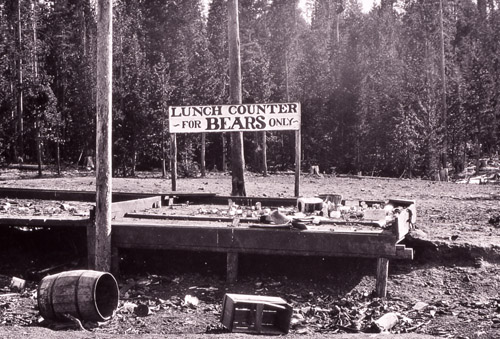
It used to be accepted practice to feed bears in parks like Yellowstone, but no more. Yellowstone National Park photo.
A press release from Grand Teton National Park slipped quietly into my in-box this morning, informing me that a 6-year-old female black bear had been put down because it had become habituated to human food. While the release gave a pretty good history of the bear's short life, it never mentioned how many tickets have been written to park visitors and employees for making food available to bears in the park.
There is plenty of literature in parks such as Grand Teton, Yosemite, Sequoia, Yellowstone and Great Smoky Mountains, just to name five, about bears and the dangers of leaving food that they can get into. So you'd think rangers would focus on writing citations, not warnings, when they encounter poorly stored food.
And, sadly, more than a few visitors and even those who work in the parks are guilty of contributing to the deaths of bears that have to be put down. It was little more than a year ago when another black bear had to be euthanized in Grand Teton. I posted about it then, making an effort to point out the incredibly poor efforts being made by Grand Teton Lodge Company employees to keep the Colter Bay area "bear clean."
And some years ago during a trip to the Northwest that took me through the Carbon River entrance to Mount Rainier and a night in a campground there, I was dismayed to see folks in an RV store their garbage under their rig's steps.
Now we have today's news about the 6-year-old bear being put down on Wednesday.
According to Grand Teton officials, during the past week the 200-pound bear "exhibited bold and persistent behavior toward campers and their food sources in the Colter Bay Campground. Repeated food rewards, habituation to people, and its increasingly bold behavior led park officials to make the difficult decision to remove this black bear from the population, thereby eliminating future threats to visitors’ safety."
"A concerted 'bear aware' campaign has also been in place to educate campers about the importance of proper food storage in bear country. Multiple posters, educational literature, and table cards alert campers and picnickers to their responsibilities while visiting bear country," the release adds. "Park rangers patrol the campgrounds to monitor food storage compliance, and to educate and/or cite people for food storage violations. Nonetheless, visitors have continued to violate food storage requirements; as a consequence, this bear became completely food-conditioned and eventually aggressive in her persistence to obtain food from people."
I have a call in to park officials to see if they tally the number of citations issued to those who don't properly store food. I think it could be a telling number. I'd also be curious to learn how many similar citations are issued in the other parks I mentioned.
Story Categories:
A copy of National Parks Traveler's financial statements may be obtained by sending a stamped, self-addressed envelope to: National Parks Traveler, P.O. Box 980452, Park City, Utah 84098. National Parks Traveler was formed in the state of Utah for the purpose of informing and educating about national parks and protected areas.
Residents of the following states may obtain a copy of our financial and additional information as stated below:
- Florida: A COPY OF THE OFFICIAL REGISTRATION AND FINANCIAL INFORMATION FOR NATIONAL PARKS TRAVELER, (REGISTRATION NO. CH 51659), MAY BE OBTAINED FROM THE DIVISION OF CONSUMER SERVICES BY CALLING 800-435-7352 OR VISITING THEIR WEBSITE. REGISTRATION DOES NOT IMPLY ENDORSEMENT, APPROVAL, OR RECOMMENDATION BY THE STATE.
- Georgia: A full and fair description of the programs and financial statement summary of National Parks Traveler is available upon request at the office and phone number indicated above.
- Maryland: Documents and information submitted under the Maryland Solicitations Act are also available, for the cost of postage and copies, from the Secretary of State, State House, Annapolis, MD 21401 (410-974-5534).
- North Carolina: Financial information about this organization and a copy of its license are available from the State Solicitation Licensing Branch at 888-830-4989 or 919-807-2214. The license is not an endorsement by the State.
- Pennsylvania: The official registration and financial information of National Parks Traveler may be obtained from the Pennsylvania Department of State by calling 800-732-0999. Registration does not imply endorsement.
- Virginia: Financial statements are available from the Virginia Department of Agriculture and Consumer Services, 102 Governor Street, Richmond, Virginia 23219.
- Washington: National Parks Traveler is registered with Washington State’s Charities Program as required by law and additional information is available by calling 800-332-4483 or visiting www.sos.wa.gov/charities, or on file at Charities Division, Office of the Secretary of State, State of Washington, Olympia, WA 98504.


National parks and their natural resources belong to you. The National Parks Traveler works to ensure you know how these essential places are being cared for.
Sign Up For Our Weekly Newsletter
Unsubscribe at any time.
INN Member

The easiest way to explore RV-friendly National Park campgrounds.

Here’s the definitive guide to National Park System campgrounds where RVers can park their rigs.
Our app is packed with RVing- specific details on more than 250 campgrounds in more than 70 national parks.
You’ll also find stories about RVing in the parks, tips helpful if you’ve just recently become an RVer, and useful planning suggestions.


Comments
This "putting down" of a Teton bear is not an isolated incident, but has a long history that has seen a variety of attitudes over the decades. In fact, questioning the Park Service's enforcement of food storage regulations is a significant development in that history. For a very interesting and readable account of this history of bears and people in the national parks (Yellowstone in particular), I recommend "Do (Not) Feed the Bears: The Fitful History of Wildlife and Tourists in Yellowstone" by Alice Wondrak Biel.
It appears as though our four-legged friends just can't win. Hiker strays into backcountry, is accosted by mountain lion, lion is tracked and put down. Campers wittingly or otherwise subsidize bear's diet, bear is put down. Wolves try and re-establish packs (with government approval and assistance), carry out a few successful hunts involving "free range" (i.e., government sponsored land grant) cattle, sheep or the like, wolves are put down. Condors living in areas of the west almost exterminated by pesticides. Ranchers complaining that prairie dog burrows are responsible for broken legs on their precious methane-producing herds, prairie dogs are poisoned. No, I'm not an advocate of exclusion theories. People can and will continue to explore well beyond the limits of civilization, and I am as guilty as anyone in that aspect. It just seems to me an inexcusable sin that others suffer through our own ignorance, or in most cases our arrogance. It is most unfortunate that national park passes do not ensure that the human visitor has any basic knowledge of safety and environmental protocol, both ours and those who call these places home. It would take so little behavioral modification on our part to assure that these incidents are completely erased.
And the onus is definately on us, unless one is willing to concede that we are the less evolved species. Incidents like this leave me wondering how socially evolved we are, in as much as we of the 21st C have yet to really master, let alone tame our environment. Our "place" is where we continue to go, which is just about everywhere. I'm not suggesting that our exploration, scientific or recreational be limited. But I see nothing wrong with advocating just a bit of common sense when entering these domains. It could save lives, and one of them might be yours or one of your loved ones. Remember a family camping trip in the Wasatch earlier this year? No food that we know of left open at that particular campsite, but the results were tragic.
Just back from a YELL/GRTE/DETO/BADL/JECA/MORU trip with my son. We had a black bear and cub attempting to raid the dumpster at the Canyon village campsite just a few days ago.. I couldn't help wondering how long before that bear (and cub) get euthanized or perhaps relocated. It's a shame. But on the bright side -- the bear couldn't get anything out of that dumpster and perhaps that means people are putting things there like they should. But how long before that same bear breaks into the convertible top of someone's Mustang to get that bag of Doritos?
As an aside, I was also treated to parents taking their kids behind a bush to poop on the Mammoth Hot Springs (no cleanup, just walked away like it never happened) and just earlier today saw some bozo urinating in plain sight of everyone at one of the viewpoints at Badlands. If this is what the National Parks have to contend with, things like expecting 100% participation and support of bear awareness concepts are a hopeless cause.
-- Jon Merryman
Brings back "fond "memories of fighting with people trying to feed marmots at the Sheepeater Cliffs and very aggressive chipmunks at Gibbon Falls. No one of the stupid tourists could figure out why the chipmunks were attacking them when they kept dangling out Doritos and other crap and would get mad at them. So, that set me off.
It isn't as though "no trace" though was what happened before Yellowstone was a national park, or else there wouldn't be so many archaeological sites. I think the difference is that we've got a lot of other messes that make this idea so important; in a world of mass consumption, we can be capable of such mass disruption. That's definitely being shown with a lot of studies related to the effect of elk on Yellowstone's northern range. If it's too bad that elk populations got way out of control, it's certainly too bad for us that our population as humans has gotten way out of control. Any of our natural instincts (eating, pooping, and having children) have so many consequences. I'm about to have a child myself within the next month, and there are so many conflicted mixed feelings about the whole thing, though joy certainly is the most common feeling. Yet, it's sad how "progress" and industrialization have forced us into behaviors and attitudes that can be so unnatural. "No trace", not feeding and relating with animals, all that stuff really are unnatural, but of course it's just as unnatural to be so big, travel thousands of miles to see animals, and feed them Doritos. I mean, we have to start somewhere, and I would agree that I would rather see us not make animals sick (and choose that way of being unnatural) than to go with our urges to piss all over the place.
Jim Macdonald
The Magic of Yellowstone
Yellowstone Newspaper
Jim's Eclectic World
It would appear that, opinions to the contrary regarding Darwin's hypothesis, evolution is indeed strictly a physiological phenomenon. It also is evident that behavioral, or intellectual evolution is lagging well behind in the human species. The instances sited by Merryland and Jon are unfortuantely not unique, and there is a growing attitude by many to "piss on the environment", consequences be damned. By the same notion, in all fairness, thankfully these exhibits are not the norm either. But I cannot find fault in the children's actions when sanctioned by their very own allegedly responsible caretakers. But I'm afraid that as time goes on and they relate tales of their NPS adventures to their children, that specific instance is the one experience that remains the enduring memory from their excursion into the "wild". As for the buffoon at Badlands, bad taste knows no bounds, and as a card-carrying member of our society, he does indeed have the same right to place himself in this geography as do the rest of us. Personally, I believe that at this point a person's rights terminate. If you cannot modify your behavioral urges to comply with the decency of your fellow travellers, PLEASE stay away. We all know that in vitrtually no instance do these human "urges" develop instantaneously. I'm aware that certain medical conditions exist, as I've personally experienced after a recent surgical procedure has altered my life-long rhythms, but you make the required adjustments and move forward. I'm curious how many malted beverages contributed to this immediate need for relief. But I offer no excuse to anyone, as I have managed to experience these many of our parks with the four youngest of my six and still avoided these trapping of immediate convenience. I do disagree about being "forced" into attitudes and behaviors that are deemed unnatural. It's a choice that individuals consciously make, and there is a tremendous lack of thought, caring, or as I refer to it, COMMON SENSE that enters the decision making process. It leaves me questioning what form of life actually represents the most evolved species in this world.
Why couldn't the bear be relocated or placed in a refuge? The Smoky Mountains National Forest has a bear refuge for such bears...this "put down" was murder...just plain wrong, wrong, wrong. How can they do such a horrible thing when so many alternatives are available?