
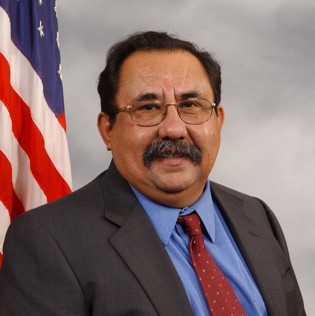
Raúl Grijalva, an Arizona Democrat who chairs the Subcommittee on National Parks, Forests and Public Lands
In a move that can be expected to generate some attention from the White House, two prominent members of the House of Representatives have introduced a billion-dollar centennial funding bill for the national park system. Two big differences from President Bush's initiative: no private matching funds are required, and this package has an identified funding source.
The legislation, which was unceremoniously announced this afternoon by Representatives Nick Joe Rahall and Raul Grijalva on the House Resource Committee's website with absolutely no fanfare, calls for $100 million a year to be used for National Park Service centennial projects each year from 2008 through 2017.
As it's currently written (you can find a PDF of the legislation at the bottom of this post), each administration would be required to submit to Congress a list of projects proposed for funding. Any unspent money would then be dispersed for projects directly related to education in the parks (30 percent), capital improvement needs (30 percent), enhancing diversity both in the National Park Service and in the parks (10 percent), Park Service professional development (10 percent), environmental leadership (10 percent), and natural resource protection (10 percent).
Under the president's proposal, the Interior secretary, not Congress, would pick and choose which projects he/she wanted funded.
“This centennial is an opportunity to recommit ourselves to passing on our National Parks to future generations in even better shape than we found them,” says Rep. Grijalva, an Arizona Democrat who chairs the House subcommittee on national parks, forests and public lands. “The initiatives funded though this legislation, especially those which will use our Parks as classrooms for young people, will create new generations of stewards to safeguard our National Parks for the next 100 years.”
Under their proposal, $100 million a year for the park system would be generated over the next decade through fees on commercial activities on public lands. Shrewdly, the legislation leaves it up to the Interior secretary to identify those fees.
Not later than 90 days after the date of the enactment of this Act, the Secretary shall promulgate regulations to establish new fees or fee increases for commercial activities, including leases, on Federal lands administered by the Secretary. Such fee or fee increases shall apply to any commercial activity, including leases, in effect on the date final regulations are promulgated under this subsection or thereafter.
The way Rep. Rahall touts the bill, you'd think it was a "do-everything measure" for the parks.
“Our National Parks tell the story of America, but over the past six years, the Bush Administration’s budget priorities have been an ongoing tale of severe underfunding for our Parks,” he says. "This bill will provide the funding increase our parks deserve, and will equip the National Park Service with a host of new tools to inspire young people, encourage diversity and professional development, respond to climate change, and lead conservation efforts by example.”
That's a nice intent, but in light of the Park Service's current financial woes, $1 billion isn't going to go very far. But at least it's a step in the right direction.
At the National Parks Conservation Association, Blake Selzer tells me his organization is happy to see the proposed legislation.
"On first blush, it looks like something we could definitely support," he says.
And while the measure does not require a private match, Mr. Selzer says that might be a good thing.
"It also doesn't discourage it," he points out, adding that, "You could argue that one of the things it can help with is the problem that a match might have on the have- and have-not parks. Some of the have-not parks don't have the big partners."
Too, Mr. Selzer notes that under this legislation the Park Service would definitely get an extra $100 million a year for the next decade, whereas under the administration's proposal how much funding would be provided depends directly on how much charitable giving is received. "If this bill were enacted, you'd have $100 million every year. You wouldn't have 'up to' $100 million (in federal funding)," he said.
Of course, under the president's proposal if the private sector contributed, for instance $60 million in one year, the government would match that for a total of $120 million. Conversely, if private giving only reached $40 million, the parks would only get $80 million that year.
Here's another nice little aspect of the legislation: It specifically states that this funding shall supplement, not replace, the Park Service's annual budget appropriation, and that full-time NPS employees can't be displaced by funded projects.
Amounts made available from the Fund shall supplement rather than replace annual expenditures by the National Park Service, including authorized expenditures from the Land and Water Conservation Fund and the National Park Service Line Item Construction Program. The National Park Service shall maintain adequate, permanent staffing levels and permanent staff shall not be replaced with non-permanent employees hired to carry out this Act or Projects carried out with funds provided under this Act.
What will be interesting to see is not only whether this bill gains traction in Congress, but what America's charitable community thinks of it. After all, the president wants to use a $1 billion carrot to entice $1 billion in charitable giving to the parks. If the Rahall-Grijalva bill passes, will that discourage private giving, or will the dollars pour in just the same?
Also interesting to see is what the president thinks of it. He's been known to loathe measures that aren't just as he envisions them.
Here's one final interesting tidbit: on August 2 a Senate hearing is scheduled for the administration's centennial initiative proposal ... as well as a House hearing on this bill.

Story Categories:
A copy of National Parks Traveler's financial statements may be obtained by sending a stamped, self-addressed envelope to: National Parks Traveler, P.O. Box 980452, Park City, Utah 84098. National Parks Traveler was formed in the state of Utah for the purpose of informing and educating about national parks and protected areas.
Residents of the following states may obtain a copy of our financial and additional information as stated below:
- Florida: A COPY OF THE OFFICIAL REGISTRATION AND FINANCIAL INFORMATION FOR NATIONAL PARKS TRAVELER, (REGISTRATION NO. CH 51659), MAY BE OBTAINED FROM THE DIVISION OF CONSUMER SERVICES BY CALLING 800-435-7352 OR VISITING THEIR WEBSITE. REGISTRATION DOES NOT IMPLY ENDORSEMENT, APPROVAL, OR RECOMMENDATION BY THE STATE.
- Georgia: A full and fair description of the programs and financial statement summary of National Parks Traveler is available upon request at the office and phone number indicated above.
- Maryland: Documents and information submitted under the Maryland Solicitations Act are also available, for the cost of postage and copies, from the Secretary of State, State House, Annapolis, MD 21401 (410-974-5534).
- North Carolina: Financial information about this organization and a copy of its license are available from the State Solicitation Licensing Branch at 888-830-4989 or 919-807-2214. The license is not an endorsement by the State.
- Pennsylvania: The official registration and financial information of National Parks Traveler may be obtained from the Pennsylvania Department of State by calling 800-732-0999. Registration does not imply endorsement.
- Virginia: Financial statements are available from the Virginia Department of Agriculture and Consumer Services, 102 Governor Street, Richmond, Virginia 23219.
- Washington: National Parks Traveler is registered with Washington State’s Charities Program as required by law and additional information is available by calling 800-332-4483 or visiting www.sos.wa.gov/charities, or on file at Charities Division, Office of the Secretary of State, State of Washington, Olympia, WA 98504.


National parks and their natural resources belong to you. The National Parks Traveler works to ensure you know how these essential places are being cared for.
Sign Up For Our Weekly Newsletter
Unsubscribe at any time.
INN Member

The easiest way to explore RV-friendly National Park campgrounds.

Here’s the definitive guide to National Park System campgrounds where RVers can park their rigs.
Our app is packed with RVing- specific details on more than 250 campgrounds in more than 70 national parks.
You’ll also find stories about RVing in the parks, tips helpful if you’ve just recently become an RVer, and useful planning suggestions.


Comments
I like the part where they bother to spell out how any "unspent money" will be distributed. Are they kidding? They could spend $100 million in a heartbeat. Uparmoured horses for the National Capital park rangers! :-)
-- Jon Merryman
There's more than a little bit of brilliance written into this bill. The deeper one looks, the more thoughtful it becomes.
Of course the President won't be able to support it. HR 3094 is a sharp stick in eye of those special interest groups who have been working with the Administration to create the Centennial Celebration boondoggle as it currently is envisioned. The funding mechanism written into the new bill, is anathema to this administration. The funding mechanism in HR 3094 is entirely appropriate .... and is one I support fully.
HR 3094 is honest and yet it is also clever. It threatens to transform the President's destructive fraud into something worthwhile. So of course Bush and the recreation/tourism industry leaders who created the President's alternative to HR 3094 will loathe this new bill.... though they will need to be extremely careful in the language they use in opposing it. HR 3094 puts them in a very difficult position. It puts NPCA in a difficult position. It would put the National Park Foundation in a difficult position if they were anything more than industry's pawns --- which they are not.
As a consequence of HR 3094's introduction I expect that, for the first time, a genuine discussion about the Centennial will start to develop. I look forward to that discussion and, for the sake of the parks, I hope HR 3094 passes and that the President signs it into law.
Just watch the President's gang of clowns attach all these midnight riders to the bill (HR3094), which will make it impossible to pass. Just wait and see!
That the legislative impulse to fund the parks in the first place stems from a silly anniversary date is even more absurdly strange than any language inserted into a Congressional spending bill and just points, once again, to the folly of our national treasures being mere political footballs for the crooks in DC to kick around on Capitol Hill.
It's time that the nation begin to look at other ways to run many, maybe not all, of our national parks. A good start would be a non-partisan commission to look at many of the smaller historical parks and urban recreation areas to see if they could be transitioned to cooperating associations or other site specific, community based organizations. Is the Boston Navy Yard truly a national treasure? Or would it be safe to say that it became a park through cunning politicians who wanted a little park service pork in their district created out of surplus military land? Do most Bostonians swell with pride when they think of their "crown jewel" of a Navy Yard? Does it rank up there with Fenway Park and the Old North Church? What about the park that commerates our "copper smelting heritage" (Keeweenaw) in the upper peninsula of Michigan? Is that even a "treasure" to the people of Michigan? Most of it was a Superfund site when it was originally created. That it was an economic development project created to drum up tourism in a very depressed area of the Great Lakes is a well established fact. What about Steamtown, old cloth mills in Massachusetss and urban parks in Cleveland, NYC and the San Francisco Bay Area? The list could go on and on. Is this what the founders of the NPS envisioned 100 years ago? A park in every Congerssional district?
Until the politics is removed, as well as many unworthy individual units, the NPS is doomed to failure by the very institutions that are supposed to prop it up and "support" it. It's time after a century to try a new way and forge a different path. The current system is clearly broken.
Here's another national "treasure":
Bill would make site of WWII explosion into a national park.
A blast site? Are you kidding me? There are thousands of acres of unprotected redwoods and the feds want to spend money on a VC and educational rangers for a blast site???
"... Americans ought to be able to ... visit the historic site, and to know that it will be properly maintained for generations to come."
Come on, this is the NPS. "Properly maintained"? What a joke!
The NPS can't even take care of what it has. Why is it adding new and trivial sites? Beamis is right: It's all about the pork. I can't believe anyone still supports the pigs.
Time to privatize...the parks need to be run more like businesses. The public will be amazed at how much better they will be managed!