White Sands National Park in New Mexico is home to the largest gypsum sand dune the world. Not only that, but this landscape exhibits some unique geologic features that includes fossilized footprints known as trace fossils left by both wildlife and people tens of thousands of years ago, indicating a cooler, wetter environment from what we see now in the Tularosa Basin.

According to The Geology of Southern New Mexico’s Parks, Monuments, and Public Lands by the New Mexico Bureau of Geology and Mineral Resources:
The park not only contains the large dune field but also a saline mudflat called Alkali Flat, a smaller ephemeral salt lake (or playa) named Lake Lucero, parts of the gypsum-dust plains east of the dune field, and alluvial fans from the surrounding mountains.
This landscape’s unique geology begins some 280-250 million years ago, when what is now the state of New Mexico was covered in a warm, shallow sea within which layers of gypsum and other dissolved minerals were deposited. Over the tens of millions of years, the sea disappeared, mountains were formed, and the climate eventually became warmer and drier.
White Sands National Park is located within the Tularosa Basin, a down-dropped part of the Rio Grande Rift (a linear zone where the Earth's crust is being pulled apart). This basin has no surface water discharge, meaning there are no rivers or streams leading out of the area. All of the water that collects there either evaporates or seeps into the ground and leaves the basin via underground movement.
During the Ice Age (2.58 million years – 11,700 years), a huge lake formed in the southwestern portion of Tularosa Basin. This was Lake Otero. Around 15,000 years ago, as the basin dried up, Alkali Flat and the playa Lake Lucero took shape, a remnant of evaporating Lake Otero.
According to Park Staff:
As Lake Otero’s water disappeared, selenite gypsum crystallized on Alkali Flat. Strong 17 mph winds carried the smaller pieces, further breaking down the crystals into small grains and polishing them into a brilliant white color.
Constantly pushed to the northeast by strong winds, the sand accumulated into larger dunes, which moved several feet over a windy day or night eventually forming the famous white dune field visitors see today. Selenite gypsum continues to form within Lake Lucero, the remnant of the larger Lake Otero. A playa (intermittent lake), Lake Lucero dries, leaving these crystals to weather from the elements and replenish the park’s bright, white sand dunes.

Other Features
Pedestals
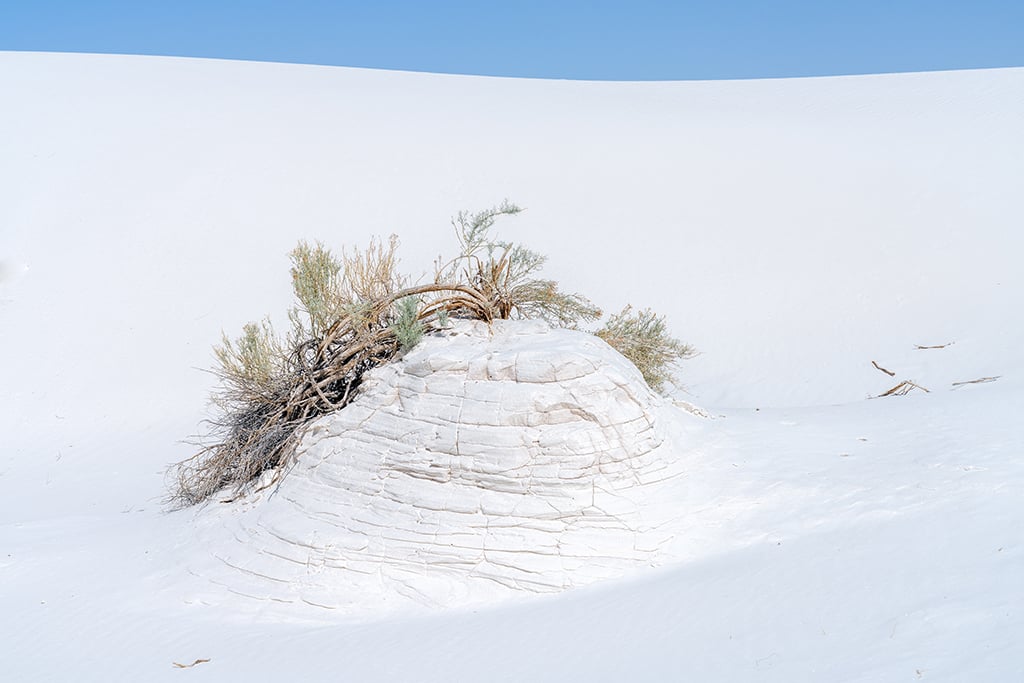
While hiking the dunes, you may come across a pile of hardened sand topped by a plant or shrub. This is a pedestal and occurs when the plant/bush binds the sand around their roots. The water table at the park is shallow (1-3 feet / 0.31-0.91 meters) and the roots draw that water upward, hardening the sand. So, when the loose dune sands blow away, what is left is a plant-topped pedestal standing above the ground. Pedestals range in size, some of them becoming as tall as a two-story building.
Yardangs

According to the 2012 White Sands National Monument Geologic Resources Inventory Report:
White Sands is a premier U.S. site for erosional ridges called yardangs, which can be up to 20 feet (6 meters) high and 130 feet (40 meters) wide. The sands are cemented well enough to support steep aerodynamic forms, but not so much that the wind is unable to erode them.
If you look at the side of a yardang, it looks like a pedestal sliced in half, shaped sort of like the prow of a boat.
Scrollwork Ridges

Interdunes are the flat areas between sand dunes. On the floor of these interdunes are baroque patterns of hardened gypsum sand. According to The Geology of Southern New Mexico's Parks, Monuments, and Public Lands, this patterning is called "scrollwork." Those hard, curvy lines represent preserved "toes" of former barchan dunes that have been removed by the constantly-blowing wind. The "toes" remain because of capillary action of water moving upward in a dune between the sand grains. Gypsum is soluble to an extent, so the water acts as an adhesive to bind together the bottom portion of dune edges, hardening the gypsum and preventing that bottom edge portion of the dune from blowing away. Each scrollwork line shows you the last known position of that barchan sand dune.
Fossil Footprints

Featured In The National Parks Traveler
Ancient Human Presence Revealed At White Sands National Park
Humans arrived in North America thousands of years earlier than previously accepted, according to groundbreaking research tied to a series of human -- and animal -- footprints preserved in fossilized sand within today's White Sands National Park.
Three years after scientists revealed the existence of human footprints and those of a giant, razor-clawed ground sloth that led them to believe the humans were hunting the sloth, on Thursday the scientists announced in the journal Science that the tracks were laid down between 21,000 and 23,000 years ago. At the time, the landscape contained a prehistoric lake, Palaeo-lake Otero, that ebbed in size with groundwater supplies and precipitation, according to the scientists. Most of the tracks were laid down on the eastern shores of this lake, they noted.
At the time, according to the National Park Service, the climate was wetter with much more vegetation than is seen today.
To read more about this, head over to this page.
National Parks Traveler Podcast Episode 245: Footprints In Time
As you walk through the white gypsum sands of White Sands National Park in southern New Mexico, your footprints will likely be quickly erased by shifting winds. So it’s somewhat of a phenomenon of nature that the oldest footprints ever discovered in North America are not only found here — in perfect form, having withstood time and weather — but show that ancient humans lived here much earlier than previously believed.
The Traveler’s Lynn Riddick talks with key researchers from the U.S. Geological Survey team about their initial analysis of the footprints as well as their follow-up study that confirmed the age dating…and what it all means to our long-sought understanding of human colonization on this continent.
To listen to this podcast episode, click here.
- By Rebecca Latson - July 14th, 2025 8:05am