Would you like to see some of what lives beneath the ocean water without completely immersing yourself in the briny depths? You can do that at Channel Islands National Park off the California coast by checking out the tidepools, considered some of the best within Southern California because of their isolation and protection from both the elements and crowds.
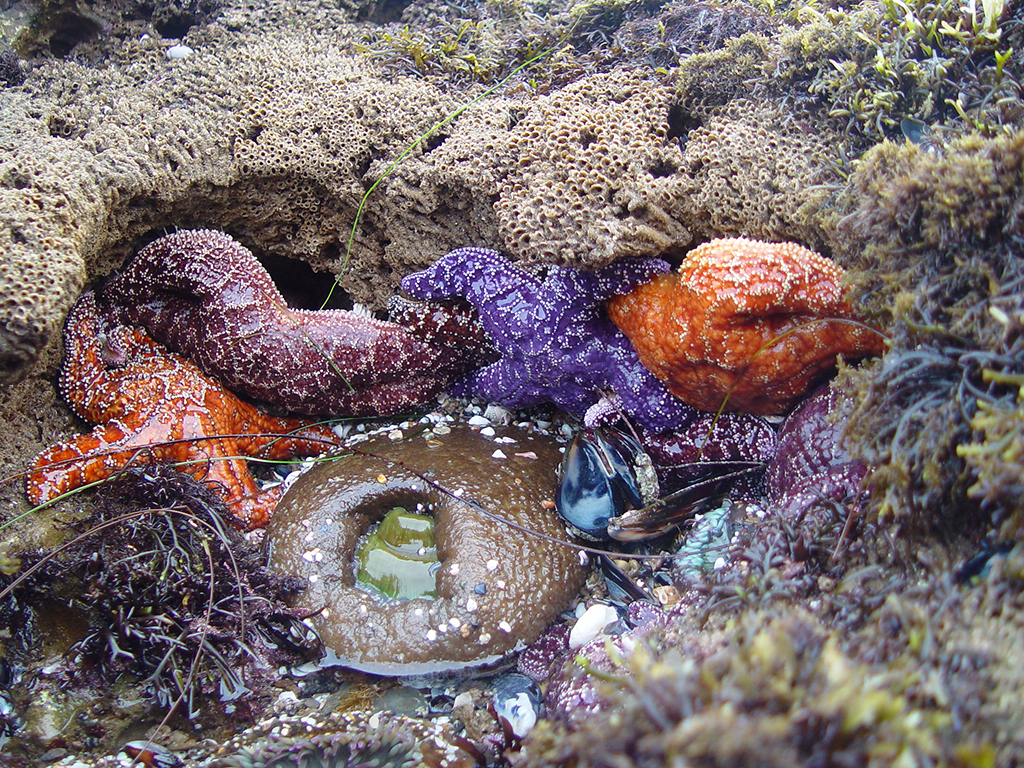
Tidepools are shallow pools of seawater contained within rocky depressions after the tide has gone out. Stuck within these waterfilled depressions are sea creatures that either live there permanently or are trapped temporarily until the tide returns. This area between land and sea is a transition zone known as the intertidal zone. In turn, the intertidal zone is divided into four subzones.
According to NOAA’s National Ocean Service these four subzones are:
- The Spray/Splash Zone: Dampened by ocean spray and high waves. It is only submerged during severe storms or the highest tides, meaning it acts mostly as a terrestrial habitat.
- The High Intertidal Zone: Floods during daily high tides but remains dry for long stretches. It is inhabited by hardy, adaptive life like barnacles, marine snails, and crabs that can withstand heat, dryness, and pounding waves.
- The Middle Intertidal Zone: Experiences the most frequent disturbance, ebbing and flowing twice a day. It features a diverse mix of plants and animals, including mussels, sea stars, and anemones.
- The Low Intertidal Zone: Only exposed to air during the lowest spring tides. Because it is virtually always underwater, it acts as a much more stable marine environment and has the greatest biodiversity.
Look into these pockets of water and you’ll discover intertidal life such as colorful sea urchins, sea stars, anemones, chitons, mussels, limpets, and marine vegetation, all of which have adapted to the constant back-and-forth of seawater and open sunlight.
Where can you find tidepools?
According to park Staff:
The most accessible sites include Frenchy's Cove on Anacapa Island; Smuggler's Cove on Santa Cruz Island; Becher's Bay at the pier, Southeast Anchorage, East Point on Santa Rosa Island; eastern end of Cuyler Harbor on San Miguel Island.
While tidepooling is considered a low-risk activity not requiring expensive gear, you should still be mindful of the following:
- Watch your step. The rocks can be very slippery and there may be small animals on the rocks.
- Keep an eye on the waves. The surge can sneak up on you and it’s strong enough you might fall on the sharp rock edges.
- Do not collect anything! Not only is it unlawful, but if animals and shells are taken, there may be nothing left for others to enjoy.
- If you pick up an animal to observe, please place it back where it was found. That particular spot is its home territory.
- By Rebecca Latson - June 8th, 2026 4:05pm