
During the 1930s, national parks and other protected lands around the nation received a boost to trail creation and maintenance, landscaping, road building, and facilities construction thanks to the Civilian Conservation Corps (CCC / 3 C’s / Corps) and the young men who labored within the program. Rocky Mountain National Park in Colorado was one such park on the receiving end of the CCC’s work contributions.
The CCC
According to the National Park Service:
As part of the New Deal Program created to help lift the United States out of the Great Depression, Franklin D. Roosevelt established the Civilian Conservation Corps in 1933. The CCC or C’s as it was sometimes known, allowed single men between the ages of 18 and 25 to enlist in work programs to improve America’s public lands, forests, and parks.
For many, just the prospect of three meals and a bed were enough to get young men to enroll. As jobs and income were incredibly scarce, the CCC for a lot of these young men was their first job. Enlisters would make $30 a month, $25 of which would be sent straight to their families, while the other five was for the worker to keep. Meals and lodging were provided in military camp fashion.
Education opportunities were an added bonus of joining the C’s. In fact, many completed their high school education while serving. Leadership advancement positions with an increase in pay were also offered to hard-workers.
While no program is perfect, the CCC’s stated intentions were successful more often than not. During the Great Depression, the ranks of unemployed young men had swelled to over 2 million, and the public worry was the potential for jobless youths to create a “menace to society” and possibly becoming “kindling for a revolution.” The aim of the CCC was “to corral potentially reckless unemployed boys and transform them into responsible men,” according to the National Park Service’s history of the CCC at Rocky Mountain National Park. In addition to their monthly salary to help jumpstart a stumbling economy, the CCC program provided meals, clothing, shelter, education, job training, and discipline to this young generation. President Roosevelt also firmly believed hard work in an outdoor environment away from the traffic, smog, and overcrowding of urban areas was beneficial for physical and mental health in addition to boosting morale.
Granted, not all enrollees were content with their circumstances. Some appreciated the regimented nature and opportunity for stable employment as well as education and job training opportunities. Others, however, left the CCC before their assigned time expired. Some were not interested in taking any of the education/training courses offered at their camps, and some were discharged by camp administration to punish disobedience, recreant attitudes, and to serve as a lesson to other enrollees who may have had wayward tendencies. Sometimes, the enrollees had legitimate grievances but this was not always met with compromise or even consideration of those complaints. There were also instances of insufficient equipment for the job and inadequate supervision as well as lackadaisical attitudes by camp administrators.
Despite these issues, the Corps succeeded in its overall mission and national parks and other public lands reaped the benefits of the young men’s labor.
The CCC at Rocky Mountain National Park

According to the National Park Service:
Because Colorado natives made up seventy-five percent of the enrollees in their own state camps, it is important to understand the impact of the CCC there. Colorado was similar to many other western states during the Great Depression in that its economy was struggling even before the stock market crash of 1929 … Federal programs stepped in to supplant the efforts of state-based relief in 1933, and the citizenry of Colorado welcomed the aid … The CCC was one of the largest and longest of these programs in the state and arguably the most popular. In its nine years, there were a total of 164 camps throughout Colorado, working for Departments of Interior and Agriculture agencies such as the Bureau of Reclamation, the Soil Conservation Service, the Division of Grazing, the Forest Service, and, of course, the National Park Service. Enrollees worked on a variety of projects in conjunction with these agencies.
Ultimately, the CCC meant an additional $56,000,000 for the Coloradan economy; the camps also provided work for much of the state’s youth, as well as for older skilled workers who were hired by ECW [Emergency Conservation Work] funds as Local Experienced Men (L.E.Ms). And the Corps invigorated the state’s tourist economy, including that of Rocky Mountain National Park, which became a viable economic unit in the 1930s. For Colorado, the CCC was an important tool for public relief.
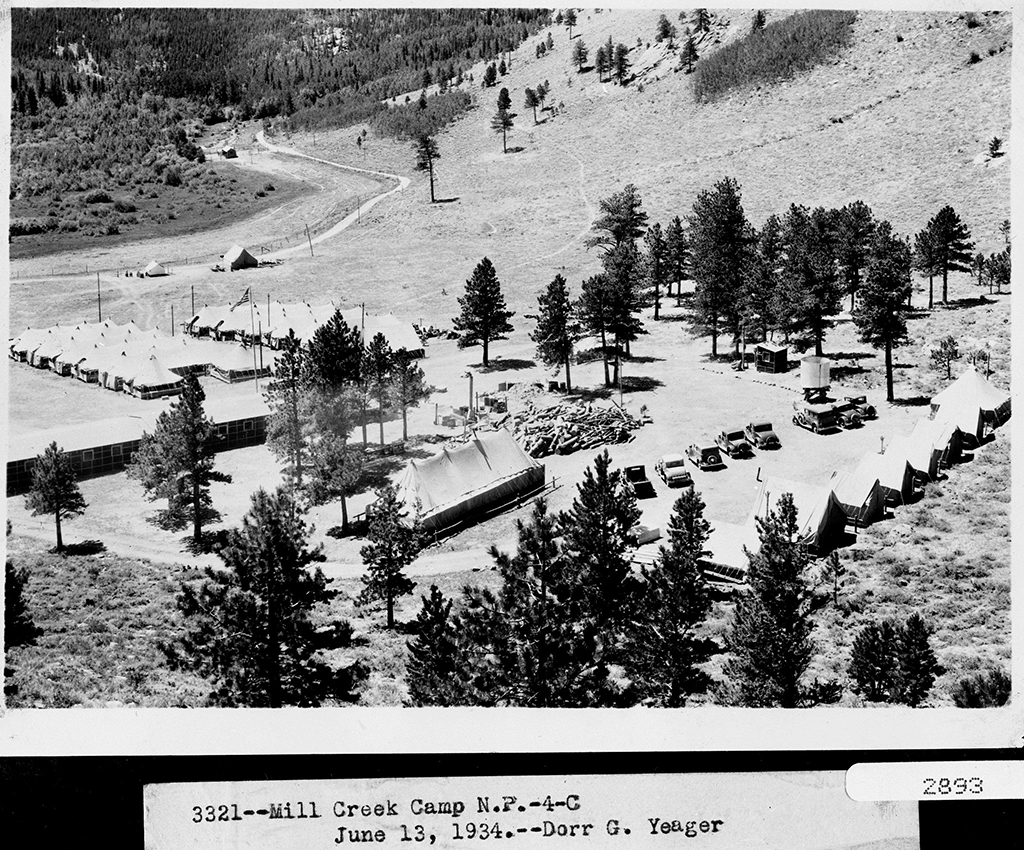
The CCC was active within the park for the entire life of the program, 1933 – 1942 and there were at least six camps within and around Rocky Mountains National Park, including Little Horseshoe Park, Hollowell Park, and Kawuneeche Valley:
- NP-1: Located in Little Horseshoe Park on the eastern side of the park.
- NP-3: A temporary tent camp located in Phantom Valley, north of Grand Lake.
- NP-4 and NP-11: These camps were located together in Hollowell Park on the eastern side of the park along Mill Creek. NP-4 was the first permanent camp.
- NP-7: Situated in the Kawuneeche Valley on Beaver Creek, west of the Continental Divide.
- NP-12: Located south of Grand Lake, also west of the Continental Divide.
Army administrators ran the camps in military fashion, implementing work and rest schedules as well as controlling disciplinary measures. A CCC worker’s day was regimented from the time they awoke at 6:00 a.m. each weekday to lights out at 10:00 p.m. An emphasis was placed on punctuality, cleanliness, and order. Work began at 9:00 a.m., stopped at noon for lunch, then continued work until 4:00 p.m. Corps members were expected to shower and be ready at 5:00 p.m. for the evening meal. After that, they had a four-hour free period to engage in coursework or recreational activities. Daily barracks inspections of both barracks and men’s appearances were implemented and each barrack was kept on a graded point system where individual members determined the overall evaluation of the group.
What did CCC workers do in Rocky Mountain National Park? Building new trails and maintaining existing trails were a priority, since the mainly middle- and upper-class tourists desired more ingress to park interiors. When the park was established in 1915, there were 128.5 miles (207 kilometers) of trails. When CCC occupancy of the park ended, there were 300 miles (483 kilometers) of trails, although regular park trail crews and Public Works employees constructed some of these trails.
To accommodate the growing tourist numbers wishing to camp, and especially those arriving by automobile campers, development of new campgrounds and rehabilitation of existing campsites were a priority as well.
Fishing was a popular pastime resulting in waters with depleted fish populations due to unregulated catches. To increase the park’s popularity and ensure fishermen didn’t leave with empty buckets, CCC workers stocked lakes and created fish rearing ponds.
To keep the gateway community economies of Grand Lake and Estes Park from suffering during the winter when park visitation slowed, The Corps developed the interior lands with the focus on skiing, sledding, skating, and snowshoeing.
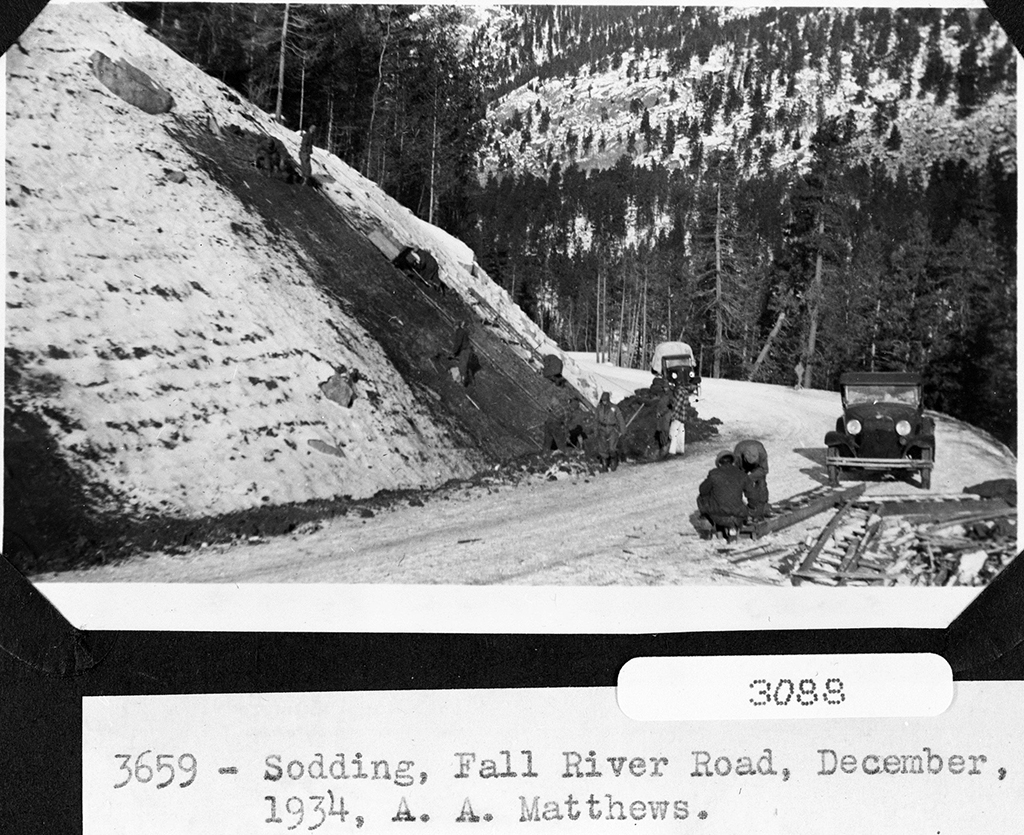
To accommodate the public’s increasing demand for facilities as well as education regarding what they saw and experienced during their visit to the park, the CCC built such facilities and infrastructure as toilets, a water system, parking areas, a museum, a curio shop, a coffee house, amphitheaters, an outdoor theater, and exhibits like a Native American teepee, dog travois, and willow backrest. CCC members also staffed information desks, gave exhibit tours, and oversaw most of the photography and dark room image development. The Corps constructed residences for park employees, installed utilities, and built the Fall River Ranger Station, barn, and garage. New roads were built, old roads were rehabilitated and landscaped with wildflowers and native grasses, and workers planted aspen, birch, pine, juniper, and spruce trees in addition to wild sage. In addition to the seeding, sodding, and sloping of road areas, the CCC removed non-native plant species.
The gateway towns of Grand Lake and Estes Park were appreciative of Corps members visiting and spending their money at arcades, taverns, and movies.
According to the National Park Service:
The interests of the villages and of the Park were so intertwined that to open the Park to increasing tourism meant a boost for the local economies. Estes Park and Grand Lake, therefore, had plenty of reason to celebrate and aid the CCC program. Groups such as the Woman’s Club of Grand Lake and individual members of the community rallied and held donation drives to gather recreational equipment for the enrollees, which were always successful. The Rotary Club, the American Legion, the Chamber of Commerce, and other civic organizations also held dinners and dances in honor of the Corps. When the CCC first arrived in Estes Park, for instance, the chamber of commerce held a barbecue and provided music, dancing, and wrestling and boxing matches for entertainment.
You can read about CCC enrollees’ experiences within the park as well as a more detailed explanation of the CCC’s role there via the National Park Service’s online history of the CCC at Rocky Mountain National Park.
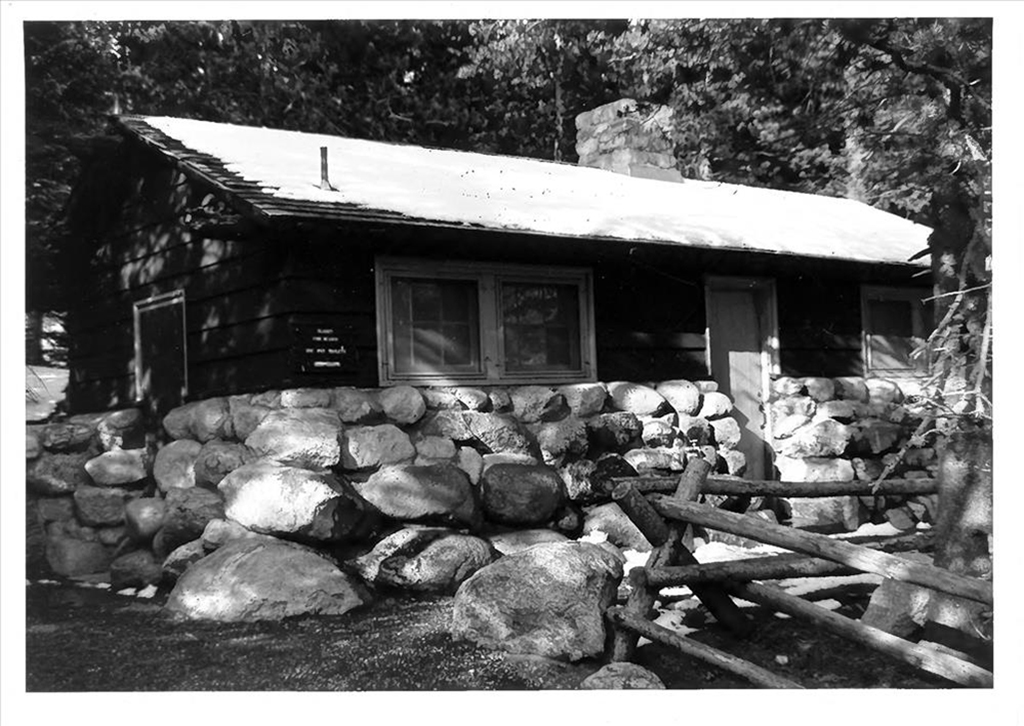
During a visit, you will see facilities built by the CCC including the Bear Lake Comfort Station, Shadow Mountain Lookout, and various buildings within the Rocky Mountain National Park Utility Area Historic District, as well as three amphitheaters at Aspenglen Campground, Moraine Park Museum, and Glacier Basin Campground.
- By Rebecca Latson - July 14th, 2025 8:05am





