

Editor's note: This article was written by Watershed Stewards Program Corpsmembers Justin Jang and Valentin Kostelnik.
As part of restoring the Bolinas Lagoon watershed, the Watershed Stewards Program, San Francisco Bay Area Inventory & Monitoring Network, Point Reyes National Seashore, and Audubon Canyon Ranch partnered for a volunteer event at Volunteer Canyon Creek. With over a dozen volunteers we removed hundreds of pounds of invasive Cape ivy from the banks of the creek, a sensitive tributary of Bolinas Lagoon.
Bolinas Lagoon, a Wetland of International Importance, supports large numbers of harbor seals and migratory birds, and has served as the heart of surrounding communities for thousands of years. It also connects the salmon-bearing Pine Gulch Creek with the ocean. In fact, the impetus for restoring a tributary of the Lagoon came from the recently recovering salmon run on Pine Gulch Creek.
After years of extirpation, coho salmon have returned to Pine Gulch Creek in greater numbers in the last five years. Along with the winter of 2021-22, this past winter of 2024-2025 marked the most successful return in at least 20 years. This points to the possibility of salmonids recolonizing other streams feeding the Lagoon. Bolinas Lagoon has over a dozen streams flowing into it, mostly on the eastern side, such as Volunteer Canyon Creek.
Cape ivy (Delairea odorata) is a fast-growing vine native to South Africa. It was introduced to California in the 1950s as a common house plant. However, it fell out of popularity because of its ability to grow rapidly yet difficult to eradicate from gardens once planted. On the West Coast, it successfully invaded disturbed areas that contained year-round moisture. For example, from 1987 to 1997, the Cape ivy coverage expanded in the Marin Headlands by over 700%. It is able to reproduce from stem fragments as small as 0.5 inches, which are easily spread through waterways, wildlife, and humans.
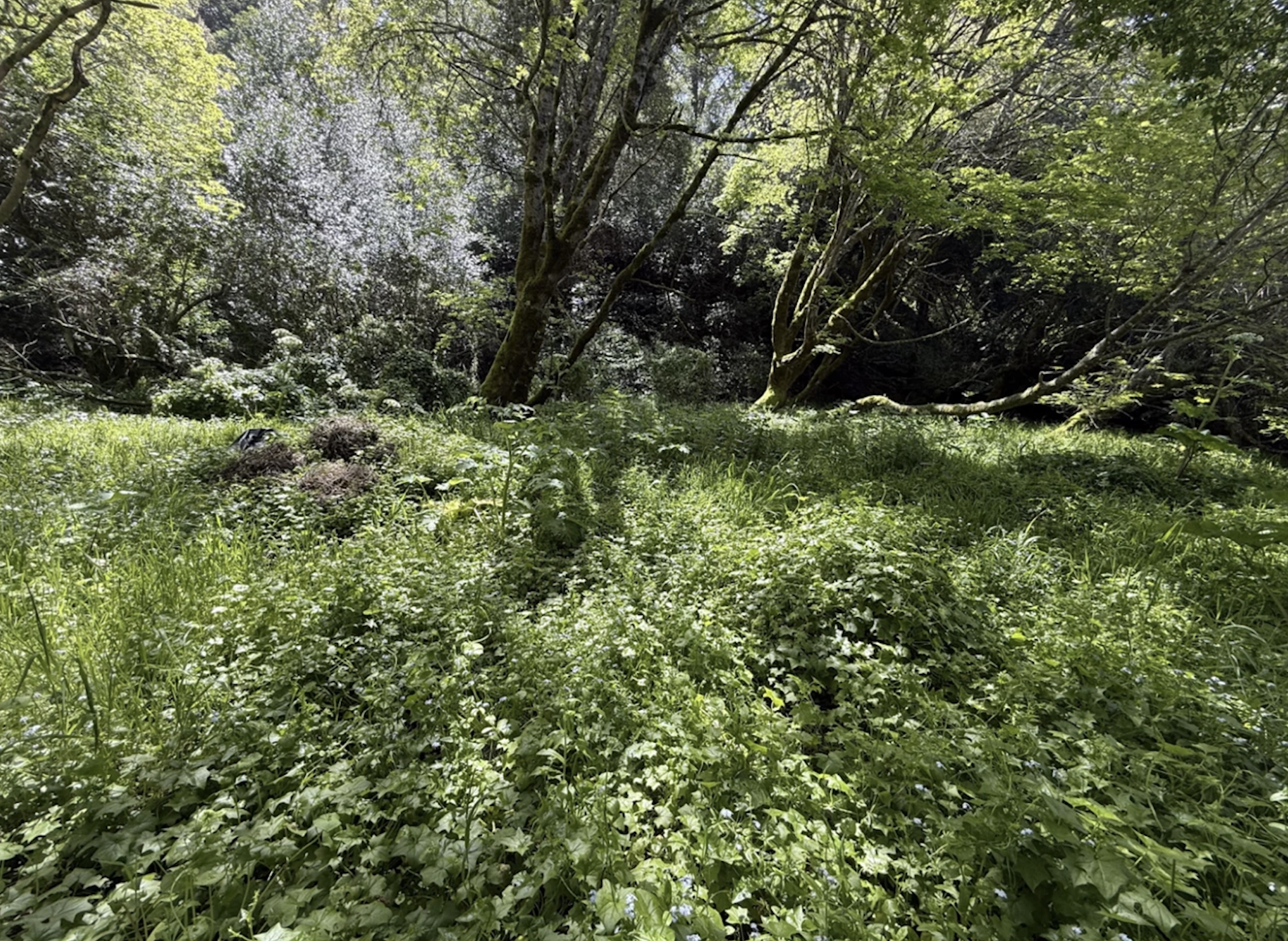
Where it takes root outside of South Africa, Cape ivy is uniquely harmful in many ways. It’s able to form dense mats that block out light and smother native vegetation. It also has a shallow root system, contributing to soil erosion on hillsides and impacting flood control functions along streams. On top of that, Cape ivy produces strong chemical compounds (pyrrolizidine alkaloids and xanthones) which are toxic to mammals, spiders, and aquatic macroinvertebrates, and may also decrease fish survival.
The volunteers removed hundreds of pounds of Cape ivy from the banks of Volunteer Canyon Creek, making room for native stream-side species to thrive. On several occasions we pulled down large clumps of Cape ivy only to discover a bent coffeeberry bush, alder sapling, or other native species at the center. Now these formerly-choked riparian plants have the chance to regrow, stabilize sediment, and provide wildlife with food and habitat for years to come. And perhaps these habitat improvements will help adventurous salmon and steelhead to eventually recolonize the creek.
The Watershed Stewards Program holds two restoration events each year between January and July. Learn more by emailing Brentely McNeill at [email protected]. Some events involve planting native trees and shrubs, while others involve removing invasive species. All are focused on restoring local watersheds for salmonids.
Story Categories:
A copy of National Parks Traveler's financial statements may be obtained by sending a stamped, self-addressed envelope to: National Parks Traveler, P.O. Box 980452, Park City, Utah 84098. National Parks Traveler was formed in the state of Utah for the purpose of informing and educating about national parks and protected areas.
Residents of the following states may obtain a copy of our financial and additional information as stated below:
- Florida: A COPY OF THE OFFICIAL REGISTRATION AND FINANCIAL INFORMATION FOR NATIONAL PARKS TRAVELER, (REGISTRATION NO. CH 51659), MAY BE OBTAINED FROM THE DIVISION OF CONSUMER SERVICES BY CALLING 800-435-7352 OR VISITING THEIR WEBSITE. REGISTRATION DOES NOT IMPLY ENDORSEMENT, APPROVAL, OR RECOMMENDATION BY THE STATE.
- Georgia: A full and fair description of the programs and financial statement summary of National Parks Traveler is available upon request at the office and phone number indicated above.
- Maryland: Documents and information submitted under the Maryland Solicitations Act are also available, for the cost of postage and copies, from the Secretary of State, State House, Annapolis, MD 21401 (410-974-5534).
- North Carolina: Financial information about this organization and a copy of its license are available from the State Solicitation Licensing Branch at 888-830-4989 or 919-807-2214. The license is not an endorsement by the State.
- Pennsylvania: The official registration and financial information of National Parks Traveler may be obtained from the Pennsylvania Department of State by calling 800-732-0999. Registration does not imply endorsement.
- Virginia: Financial statements are available from the Virginia Department of Agriculture and Consumer Services, 102 Governor Street, Richmond, Virginia 23219.
- Washington: National Parks Traveler is registered with Washington State’s Charities Program as required by law and additional information is available by calling 800-332-4483 or visiting www.sos.wa.gov/charities, or on file at Charities Division, Office of the Secretary of State, State of Washington, Olympia, WA 98504.


National parks and their natural resources belong to you. The National Parks Traveler works to ensure you know how these essential places are being cared for.
Sign Up For Our Weekly Newsletter
Unsubscribe at any time.
INN Member

The easiest way to explore RV-friendly National Park campgrounds.

Here’s the definitive guide to National Park System campgrounds where RVers can park their rigs.
Our app is packed with RVing- specific details on more than 250 campgrounds in more than 70 national parks.
You’ll also find stories about RVing in the parks, tips helpful if you’ve just recently become an RVer, and useful planning suggestions.

