
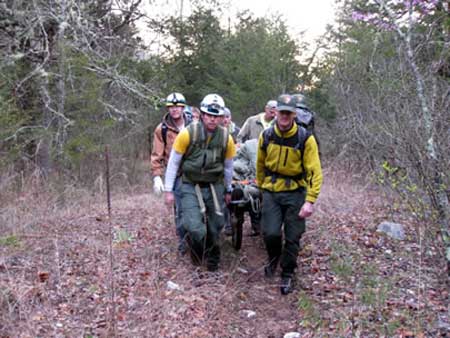
Rescuers have reached an easier part of their 2.5 trip hike to carry the victim to a waiting helicopter. NPS photo.
It must have seemed like a good idea at the time, but a visitor to the Buffalo National River probably has second thoughts about an ill-advised attempt to jump from a bluff to a nearby tree. The man likely owes his life to a combination of good training and hard work by local rescue teams and modern technology.
The Buffalo National River in the Ozarks of northern Arkansas includes some dramatic bluffs along one of the premier canoeing rivers in the country, but that rugged terrain can pose some serious challenges for rescuers when things go awry.
Awry would be an understatement in describing the misadventures of a 22-year-old man who was visiting the park last week.
Just before midnight on April 3, 2009, rangers at the Buffalo National River were notified that a man had been injured in a fall from a bluff in the vicinity of Hemmed-In-Hollow Falls. Known as “the tallest waterfall between the Rockies and the Appalachians,” the area is also the site of numerous past search and rescue incidents. According to a park report,
Rangers, other park staff, park volunteers, local first responders, and AirEvac medics assembled at the Compton Trailhead. Two search teams headed down the trail with a wheeled litter and other rescue equipment and located the victim, Tyler Kerr of Bedford, Indiana.
Kerr had fallen approximately 50 to 75 feet after attempting to jump from a bluff to a nearby tree and had suffered a broken arm, broken elbow, dislocated hip, broken hip socket, bruised heart, and bruised lung. He also had several deep lacerations causing a significant loss of blood.
The rescue teams packaged Kerr in the wheeled litter and transported him toward a suitable landing zone. The trail accessing the falls drops more than 1000 feet and extrication via the trial was impractical.
I've made that hike myself, and will second that conclusion. An outdoor activity website describes the hike into Hemmed-in-Hollow as "a quick trip down hill but the hike out will be a real test for the greatest of hikers." A second site calls the hike out "difficult and exhausting..."
Even via an alternative route, transporting the victim "toward a suitable landing zone" was far from easy in this terrain.
During the transport, low-angle belays were used to traverse the steep and narrow trails. The AirEvac helicopter landed in a deep ravine approximately two-and-a-half miles from the falls, the closest suitable location for a landing. Kerr was transported to the Washington Regional Medical Center in Fayetteville, Arkansas, for treatment.
Over 25 people responded to assist with the rescue. Rangers and other SAR team members had completed a three-day swiftwater rescue course the afternoon before the rescue. The course was instructed by Rick Brown, retired NPS assistant chief ranger and chief of field operations at Great Smokies. Brown, who had worked at the Buffalo in the early 1980’s, assisted in the rescue.
Modern technology also played a big role in this successful rescue. In addition to the evacuation by helicopter, good communications with the aircraft and various team members was a major plus. The rugged terrain and remote nature of the area pose a major challenge for radio systems, and not very many years ago that communication wouldn't have been possible.
Buffalo National River recently upgraded its radio system, adding several new repeater sites, upgrading both portable and mobile radios, and converting from analog to digital. During the incident, radio communications were exceptional and played a pivotal role in the overall success of the incident.
Here's one example of "your tax dollars at work" that paid off, and both visitors and the park staff will continue to benefit from that investment in the years ahead.
Story Categories:
A copy of National Parks Traveler's financial statements may be obtained by sending a stamped, self-addressed envelope to: National Parks Traveler, P.O. Box 980452, Park City, Utah 84098. National Parks Traveler was formed in the state of Utah for the purpose of informing and educating about national parks and protected areas.
Residents of the following states may obtain a copy of our financial and additional information as stated below:
- Florida: A COPY OF THE OFFICIAL REGISTRATION AND FINANCIAL INFORMATION FOR NATIONAL PARKS TRAVELER, (REGISTRATION NO. CH 51659), MAY BE OBTAINED FROM THE DIVISION OF CONSUMER SERVICES BY CALLING 800-435-7352 OR VISITING THEIR WEBSITE. REGISTRATION DOES NOT IMPLY ENDORSEMENT, APPROVAL, OR RECOMMENDATION BY THE STATE.
- Georgia: A full and fair description of the programs and financial statement summary of National Parks Traveler is available upon request at the office and phone number indicated above.
- Maryland: Documents and information submitted under the Maryland Solicitations Act are also available, for the cost of postage and copies, from the Secretary of State, State House, Annapolis, MD 21401 (410-974-5534).
- North Carolina: Financial information about this organization and a copy of its license are available from the State Solicitation Licensing Branch at 888-830-4989 or 919-807-2214. The license is not an endorsement by the State.
- Pennsylvania: The official registration and financial information of National Parks Traveler may be obtained from the Pennsylvania Department of State by calling 800-732-0999. Registration does not imply endorsement.
- Virginia: Financial statements are available from the Virginia Department of Agriculture and Consumer Services, 102 Governor Street, Richmond, Virginia 23219.
- Washington: National Parks Traveler is registered with Washington State’s Charities Program as required by law and additional information is available by calling 800-332-4483 or visiting www.sos.wa.gov/charities, or on file at Charities Division, Office of the Secretary of State, State of Washington, Olympia, WA 98504.


National parks and their natural resources belong to you. The National Parks Traveler works to ensure you know how these essential places are being cared for.
Sign Up For Our Weekly Newsletter
Unsubscribe at any time.
INN Member

The easiest way to explore RV-friendly National Park campgrounds.

Here’s the definitive guide to National Park System campgrounds where RVers can park their rigs.
Our app is packed with RVing- specific details on more than 250 campgrounds in more than 70 national parks.
You’ll also find stories about RVing in the parks, tips helpful if you’ve just recently become an RVer, and useful planning suggestions.


Comments
My tax dollars at work? Personally I have been burned out risking my own life to save the lives of idiots who make what should be life ending choices. A little chlorine in the gene pool; otherwise this idiot may live to breed. Sorry. ...Well not really.
This speaks volumes about the rescue workers! As for the victim, well maybe just maybe he learned his lesson. I do hope he is OK.
I agree with K. Sender. What are these idiot tourists thinking? You sure don't ever hear of a local person doing something stupid like thhis! And people call us dumb hill folks!!
I just found this good article and felt impelled to comment. Please forgive the introductory dialogue, but it helps explain a 180 degree perspective on this terrible accident. I happened to be in those woods that night and provided 911 the location information they were seeking. I have copied here a message I sent to a close friend:
We had fun sort of. The trip was full of “challenges”. We got a late start Friday, but got to the trail head in time to be on schedule by Sunday. This means we still had plenty of time to hike 10.8 miles by Sunday, camping anywhere each night that looked good to us.
The plan was to drop off both mules and all packs (people backpacks and mule packs) at the starting point, then 3 out of 7 of us took the two vehicles to the end point to drop off one truck and horse trailer at the end, returning in the other truck to the starting point. By road, the end point was only 5.3 miles from the starting point. But that 5.3 mile road had a horribly wet, muddy, steep hairpin turn going downhill toward the end point. We got the vehicles to the endpoint, but had to drive an hour on other roads back to the starting point because the 5.3 mile road was not passable going uphill, even with 4 wheel drive.
So, we hit the trail much later than expected. We camped about 1 mile down the trail and finished dinner about 11pm. Right after that someone started yelling at us from out in the woods. After some very hesitant yelling dialogue, we found that it was a young man (early 20’s) alone with a prosthetic leg, totally lost. He didn’t have a map and didn’t even know what river and park he was in or near. He was very fear stricken. He had been with 8 other people way down the mountain from where we were at some water falls when one of his friends fell 70 feet out of a tree. The other 7 people were still with the victim, with no cell service down there. After some discussion, we figured out they were at the Hemmed-In Hollow Falls. There was cell service at our location and he called 911 and I gave him all the information on his current location and the location of his friends. Then, Doyle and I walked him up to a trail junction and showed him which way to go to get back to the trail head where he and friends had parked and where the emergency services were going. Soon after, a large helicopter made two passes over Hemmed-In Hollow with a bright slight shining down into the woods, below us down the mountain. We saw no more activity. I don’t know what time it was by then.
At about 4am, I woke up and for some reason realized I didn’t remember locking my truck at the trail head. I checked and couldn’t find my keys. I woke up my 16 year old son who was in a one-man tent and asked him to go back to the trail head with me to check on the truck. So, we hiked the mile back up to the truck and the parking lot was full of emergency vehicles – police cars, park ranger vehicles, EMT’s, volunteers. Someone met us as we came out of the woods. There were 21 men down at Hemmed-In Hollow and they had the victim “packaged” and ready for evacuation. They were taking him to Henderson House down by the river for pickup by helicopter after day break. Bringing the victim back up hill, total of 3.7 miles of trail would have been nearly impossible because some parts are difficult when carrying nothing.
Oh, we did find my truck unlocked with the keys in the ignition!
We slept until 9am Saturday, a breakfast of pancakes and sausage, packed up, and headed out a little after noon. We had already made plans to shorten the overall hike from 10.8 miles to about 8 miles by using a different trail toward the end. The mules did great! We had an older one that is very calm and a young one off the farm for the first time, but she is typically very sweet and calm and well rehearsed with the packs. She did great until we got on a half mile dirt road to connect from one trail to another. 8-10 loud trail bikes came along. When they saw us, they stopped long enough for Doyle to lead the young mule off the road and tie her to a tree. All but one of the bikes passed slowly, but one guy couldn’t get his bike restarted at first. When he finally got it started, it revved WAY up. Foxy, the older mule I had, jumped a little, but relaxed. The young mule Doyle had tied to the tree jumped about a foot into the air when the engine revved, but was OK and very scared. After the traffic was gone, Doyle untied her and as he started to return to the road, they both got tangled in a vine and Doyle tripped. The mule panicked and took off in a dead run down the road toward myself and Foxy. I lead Foxy right in front of her and she came to a screeching halt and let me take her lead rope. She was fine after that, but nervous.
We had plans to camp that night on the last trail leading to our end point. When we got to that trail, it was marked with a “no camping” sign. So, since it was almost dark, we got on the road and hiked straight to the endpoint. By the time we did the hour drive back to the starting point to get my truck, then back to the endpoint to pick up the rest of the guys and packs, then drove home, we got to my house at 1am and Doyle got home with the mules about 2am. We ended up hiking 7 miles (two of us had 9 miles in).
Sunday morning, we were all glad we weren’t picking up a wet camp in that freezing wind!
Most of us had a good time. A few had very sore feet or wet feet because the trails were holding a lot of water from recent rains and were very muddy. Doyle and I were very proud of the mules performance.
We will plan things differently and more thoroughly next time!
Mike -
Thanks for sharing some details on the incident - and for your part in getting help en route to the correct location much sooner than would have been possible if you hadn't been there. The fact that you knew enough about the area to identify the location for the emergency responders made a big difference.
Thank you for your comment. It seems that what we thought was bad luck (else we would have not been where we were) was good luck for others.
Fiftyfive years ago on a University of Chicago sponsored canoe trip our fiberglass canoe broke in two near Hidden Hollow. It was decided that two of the most skilled boaters would continue on to Henderson next day while tenderfeet would wait for rescue by 6x6 truck. We stayed at a desrted farmstead. We must have been there 3 days. Some families were started on that ill starred trip. The farm must be gone by now but there are still plenty of ignorant people to keep rescue teams busy.