

National park campgrounds, such as this one at Big Meadows in Shenandoah National Park, are the best basecamps for RV exploration of the parks/NPS
During our 20s and early 30s, we carried a pack into the woods. But after one taste of the RV life, we were hooked. Sleeping on the ground became a thing of the past once my husband and I discovered the joys of camping in spectacular settings with the option to enjoy water, electric, and sewer utilities. If you’ve ever considered doing the same, here’s what you need to know about plugging into America’s national parks with RV hookup campsites.
When Camping with RV Hookups Make Sense
We traded our backpacks for a fifth-wheel trailer in 2008, but rarely visited RV parks with hookups. “That’s not real camping!” we joked as we opted for rustic dry camping in public campgrounds. Twelve years later, we are more open to occasionally enjoying those full-hookup creature comforts. Maybe we’ve gone soft, but now we understand that connecting to RV hookups in national parks makes total sense sometimes. For example:
Why Have Full Hookups in National Parks?
- In hot weather, you can run the air conditioner. This greatly reduces the heatstroke risk for pets, infants, and the elderly.
- When cold weather strikes, you can set and forget the heater thermostat. A comfortable indoor temperature allows RVers like us to visit national parks during the off-season and reduce park overcrowding.
- Electric medical devices like C-PAP machines need a reliable power source. Electrical hookups allow medically-compromised campers to enjoy America's treasures, without emitting noisy generator power.
As a bonus, sewer connections can reduce RVers’ carbon footprints because we can stay put in one place for longer periods of time. And finally, RV hookups eliminate noisy generator exhaust from the campground.

"Dry" campgrounds in the national parks are easier to land sites at than full-hookup sites/Norris Campground, Yellowstone National Park, NPS/Diane Renkin
Where to Find National Parks with RV Hookup Campsites
Privately-owned, full-hookup RV parks and campgrounds are easily found outside national parks. So why should RVers look for spots inside the park? Because it’s the best way to enjoy an immersive national park camping experience. You’ll drive less and spend more time enjoying the natural features that drew you there in the first place.
The National Park System has 130 destinations with overnight camping. Getting a dry campsite (no hookups) in one of them is relatively easy. Unfortunately, only 13 parks have full or partial utility connections for RVs. If you’re lucky enough to reserve one of these luxury campsites, you will probably discover a more genuine, back-to-nature experience than the privately-owned RV parks located beyond park gates.
To find these campsite gems, take a look at the “Where Can I Camp” directory of camping locations in the National Park Service. You will see just five national park sites with full-hookup RV camping. Seven more provide water or electric or water and electric hookups. It all adds up to stiff competition for utilities in the following locations:

Full hookup campgrounds, such as Furnace Creek in Death Valley National Park, allow you to be self-contained and comfortable/Rene Agredano
U.S. National Parks with Full Hookups for RVs (water, sewer and electric)
Arizona | Grand Canyon National Park: Trailer Village
- 29 full-hookup sites for RV’s up to 28 feet long.
- 50 full-hookup sites for RVs up to 50 feet long.
California | Death Valley National Park
- Furnace Creek: 18 full-hookup sites. Max RV size: 36’
- Stovepipe Wells: 14 full-hookup sites: Maximum RV size: 60’
- Panamint Springs: 6 full-hookup sites: Maximum RV size: 60’
Texas | Big Bend National Park: Rio Grande Village RV Park
- 20 full-hookup sites for reservations only
- 5 full-hookup sites for walk-ups
- Max RV Size: 40-50' depending on occupancy load.
Wyoming | Yellowstone National Park: Fishing Bridge RV Park
- 346 full-hookup campsites for hard-sided RVs only. Max RV Size: 40'
Wyoming | Grand Teton National Park: Colter Bay RV Park
- 142 full-hookup sites. Max RV Size: unlimited for pull-through, 30' for back-in spots.

North Rim Campground at Grand Canyon National Park lacks full hookups, but has a dump station/NPS
U.S. National Parks with Basic Hookups for RVs (water, electric, or both)
Colorado | Black Canyon of the Gunnison National Park: South Rim Campground (electric only)
- 23 electric hookup campsites. Max RV Size: 40’
Florida/Mississippi | Gulf Islands National Seashore:
- Davis Bayou Campground (MS): 52 electric hookup campsites. Max RV Size: 40’
- Fort Pickens Campground (FL): 137 electric hookup campsites. Max RV Size: 40’
South Dakota | Badlands National Park: Cedar Pass (electric only)
- 20 electric hookup campsites. Max RV Size: 70’
Tennessee/Kentucky | Big South Fork National River and Recreation Area
- Blue Heron Campground (KY): 45 electric hookup campsites. Max RV Size: 45’
- Bandy Creek Campground (TN): 96 electric hookup campsites. Max RV Size: 51’
Florida Everglades | Flamingo Campground (electric only)
- 41 electric hookup campsites. Max RV Size: 44’
Things to Know About National Park RV Campsites with Hookups
Advance reservations are a must.
The secret is out: National park RV campsites with hookups are a good deal when compared to nearby rivately owned RV campgrounds. A 2018 National Park Campground Usage Study revealed that many national park campgrounds are near or at capacity for most of the year. Each year thousands of RVers like you and I compete for these precious few sites, so don’t plan on freewheeling without a reservation. When wanderlust strikes, give yourself at least a six-month window ahead of your desired arrival date at the park. Create a flexible plan with alternate camping dates and remember to take advantage of slower times by visiting on a weekday.
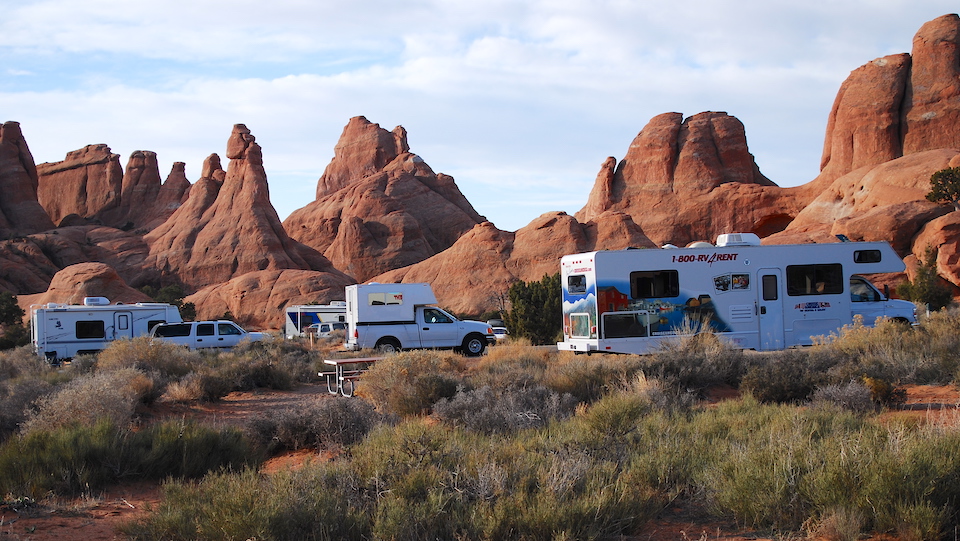
Devils Garden Campground at Arches National Park can be particularly challenging to land a spot in if you don't start far in advance/Kurt Repanshek file
The reservations process differs from park to park.
The method to reserve national park campsites is inconsistent across sites. Some vendors only reserve campsites by telephone, but most allow you to do the entire transaction online. Only a few national parks settings, like Furnace Creek at Death Valley National Park, are booked through Recreation.gov, the Internet clearinghouse for public lands recreation reservations. Otherwise, the website for your intended park destination will direct you to the right booking portal. However you reserve a stay, it’s up to you to learn the campground rules for making, changing and canceling reservations.
Know your measurements.
If your RV is on the small side, you’re in luck. Most national park campgrounds cannot accommodate larger, modern RVs over 40 feet long. Therefore, when reviewing RV campsite possibilities, pay close attention to the maximum RV size allowed. This number factors in total RV length, including a tow or towed vehicle.
You also want to consider the width and length of the parking apron. All wheels must be on the parking spot. If yours don’t fit, you will be asked to move or leave. If you don’t know the total length and size of your RV setup, head to a professional RV weigh scale with experts who can figure it out for you.
Carry the right RV supplies.
Utility hookups in national parks are usually reliable, but it doesn’t hurt to prepare for the worst. The most important RV supplies you can have onboard wherever you roam include:
- An exterior RV water filter hose attachment, to reduce the chance of heavy minerals or other contaminants getting into your water lines.
- Formaldehyde-free RV toilet chemicals, to ensure the integrity of a park’s delicate septic system.
- A surge protector for your RV power supply, to lessen the risk of plugging into outdated utility pedestal connections that can damage your electrical system.
If you’re new to RVing, you might be thinking that all the pre-planning is a lot of work. You’re correct, it is. But take it from someone who has camped in national parks from coast-to-coast: scoring a full-hookup RV campsite in beautiful parks like Big Bend or Yellowstone can make you feel as if you won the lottery. And although carrying a backpack into the wilderness, or car camping with a tent requires fewer logistics than the RV life, for campers like me who enjoy a comfortable night’s sleep on a good mattress, the privilege of setting up a temporary home in a world-famous outdoor destination always makes up for the extra steps required to get there.
Support for this reporting was provided by RVShare
Stories about:
Story Categories:
A copy of National Parks Traveler's financial statements may be obtained by sending a stamped, self-addressed envelope to: National Parks Traveler, P.O. Box 980452, Park City, Utah 84098. National Parks Traveler was formed in the state of Utah for the purpose of informing and educating about national parks and protected areas.
Residents of the following states may obtain a copy of our financial and additional information as stated below:
- Florida: A COPY OF THE OFFICIAL REGISTRATION AND FINANCIAL INFORMATION FOR NATIONAL PARKS TRAVELER, (REGISTRATION NO. CH 51659), MAY BE OBTAINED FROM THE DIVISION OF CONSUMER SERVICES BY CALLING 800-435-7352 OR VISITING THEIR WEBSITE. REGISTRATION DOES NOT IMPLY ENDORSEMENT, APPROVAL, OR RECOMMENDATION BY THE STATE.
- Georgia: A full and fair description of the programs and financial statement summary of National Parks Traveler is available upon request at the office and phone number indicated above.
- Maryland: Documents and information submitted under the Maryland Solicitations Act are also available, for the cost of postage and copies, from the Secretary of State, State House, Annapolis, MD 21401 (410-974-5534).
- North Carolina: Financial information about this organization and a copy of its license are available from the State Solicitation Licensing Branch at 888-830-4989 or 919-807-2214. The license is not an endorsement by the State.
- Pennsylvania: The official registration and financial information of National Parks Traveler may be obtained from the Pennsylvania Department of State by calling 800-732-0999. Registration does not imply endorsement.
- Virginia: Financial statements are available from the Virginia Department of Agriculture and Consumer Services, 102 Governor Street, Richmond, Virginia 23219.
- Washington: National Parks Traveler is registered with Washington State’s Charities Program as required by law and additional information is available by calling 800-332-4483 or visiting www.sos.wa.gov/charities, or on file at Charities Division, Office of the Secretary of State, State of Washington, Olympia, WA 98504.

Comments
Outstanding information ...thank you!!
You left out Mesa Verde Campground in CO. Definitely has water & electric. Awesome campground -- beautiful
This article is very confusing. According to the Yellowstone website, Fishing Bridge campground is closed until 2020 for renovations. Under the "where can I camp" it does not give any info on where to find electric sites at the parks, just what kind of camping you want to do. You also show a picture of Shenandoah and there are no sites available there with hook ups.
I don't think the author will periodically checking the website that s/he doesn't maintain. I believe at the time s/he wrote this article the website information was correct but then later got updated. And of course s/he wouldn't know there'd be covid-19 happened worldwide nor wildfires around north California.
I would like to make a correction regarding the Bandy Creek Campgrounds in Big South Fork National Forest. Those sites with hook ups have both electric and water.
Mesa Verde National Park, Morefield Campground has 15 full hookup RV sites that require reservations. I even got Wi-Fi there.
No, I disagree. It's not unfortunate that only 13 National Parks have hook ups. It's a blessing. The National Parks are their for the enjoyment of nature and all its glory. Not where's the 50 amp service and my cable connection. Enough already. Just camp outside the park, as you have seemed to have missed the whole point anyway.
i am on dialysis and having an electric hookup allows me to go camping. I require electricity for my dialysis machine.
So those of us who require hookup RV sites for medical or health issues, disabled combat veterans etc are not worthy of staying within a National park? I never realized that OUR national parks were so selective on who is allowed to stay within the park. Hmm last time I checked our Country Laws, we disabled citizens have the same rights of access. Especially families that served our country and defended our rights and freedom
relax and stop complaining. fault finding is very unkind. people are just looking for the best options.
I'm glad for you that you don't have a disability. maybe don't let your privelige and luck rain on everyone else.
You are so right Mr. Thorton. People have forgotten the reason for our National Parks just like they have forgotten why our country was started. Everyone wants everything convenient or handed to them without any effort on their part. Let's get back to BASICS and get back to NATURE.
That's unfair! It isn't necessary to primitive camp to enjoy the benefits of nature in National parks. Some people RV full-time and enjoy being able to experience the entire country. There are also various reasons people want/need electricity while camping (i.e. cpap machines, temperature control for older campers who cannot tolerate extremes, etc) and does NOT mean they are sitting in their campers watching television or not "getting it".
I need the electric hook up for medical equipment,, not cable tv. I do enjoy nature and that's why I prefer to stay in the parks, if feasible.
Thats great till your in your 60s and 70s and partially disabled,i used to hike and backpack camp and understand your point.but the attitude cuts alit of us off as we age
It's great that folks who want all the comforts of home have them on the road. The parks generally can't accomodate your needs but commercial operations nearby are eager to. Please stay there. The Park Service has enough maintenance backlog that available money should be spent on maintenance needs. I think new capitol construction for huge campgrounds is unwarrented.
Agree with Mike G. No more development in national parks.
The campgrounds already there are sufficient.
The biggest problem with national parks is not the lack of hookups since we can do without that if the weather is cool. The big problems are the sites haven't been updated since the 1960s. We have a 30 ft 5th wheel even when they say there is a space available it is impossible to access due do low hanging limbs on the roads and tight overgrown corners preventing turns. There is no organization in renting sites and usually the sites a small towed rv would fit in have a single tiny dome tent sitting in the middle of the site when plenty of tent sites are available. In Olympic NP sites that would be workable have a curb placed across the site leaving too little room to get a trailer in. Whenever we visit a NP we visit the campgrounds in our tow vehicle hoping for accessible sites but have not found one we ould get to if we did fit or large enough to fit in if we could tow to it.
Pinnacles Campground has electrical hookups. It's not a traditional national park campground, but more like a KOA style private campground. It even has a swimming pool. It used to be a private campground built near the Pinnacles National Monument entrance, but eventually NPS bought it and expanded the boundaries of the park to include the campground. The last time I visited (before the National Park designation) I paid my entrance fee at the campground office, although I'm not sure if they've built a new entrance station.
https://www.nps.gov/pinn/planyourvisit/camp.htm
https://www.recreation.gov/camping/campgrounds/234015
So after researching it, the campground office/store was turned into an NPS visitor center.
If you have to tote your house with you when you travel then perhaps the "national park experience" (whatever that is) is not for you, and you should be staying outside the parks. As I recall, vehicles with trailers or longer than 21 ft are not allowed on the Going to the Sun Road in Glacier. I think that would be a good policy in all our national parks, both in the camp grounds and on the roads (some of these BIG rigs take up 3, 4 parking spots.). Small RV's, vans, campers, sure, but not these monstrosities the size of a Grayhound bus. As for me, I camp/sleep in my Honda Element (roof top tents are now a real option, too) for 2 to 5 nights and then get a motel room for a night.
It's interesting that despite the reasons listed in the article (and the tons that weren't) that there are some people who have commented who just don't want campers - or very much of a camper - in the NPS. I've noticed this sentiment shared on other websites I've looked at recently too. My parents camped in tents when they were kids. We were in pop-ups when I was a kid. These days when the family group camps we're all in hard-sided campers. It makes a difference when you're grandmother is 94 to have a place to go when the rains and wind come. Or the heat. Or the bitter cold. Many of them will camp 2 weeks at a time at the COE campground nearby because they love sitting outside and being in nature. I don't mind taking a good ribbing from my friends that my family is "glamping". It's done in good humor and quite honestly it's the only way I can get my wife to come along when I try to expose the kids to the fun I had as a kid. There are ways to have primitive, water/electrical tent spots, and water/electrical/full hookup spots for RVs in the same park and still preserve the tent camping experience for those that want it, while at the same time allowing those that need/want a camper to experience the park too (I couldn't care less about cable/WiFi, etc. because the kids leave the electronics behind and we're outside unless the weather turns). We know families with 8 kids because they adopt. So we shouldn't allow their 35 foot RV in to experience the park? Are their tax dollars not good enough? Only those with 2-4 people that can fit into a tent or pop-up perhaps then? I'm all for preserving the natural experience of the parks. But tent camping in a park doesn't make you a good steward of the land anymore than owning an RV doesn't make me a good steward. It doesn't even get you that much closer to nature when we both could look at each other from our lawn chairs or go hiking down the same trails. Bringing the existing RV spots up to current specs for RVs, clearing out low-hanging branches, and adding some spots won't be the end of the NPS. I guess the point of this long comment is to ask that those opposed to the idea to try to stop thinking of RVs as invading the NPS (my term), and to start thinking more along the lines of welcoming your neighbors. That's what I think of when I think of my camping trips as a kid. That's what I want my kids to get out of it.
Agree. The quietest neighbors I've had in National Parks have been the big rigs. The noisiest and most intrusive have been tenters. You might even stretch the generalizations to say that those with the big rigs possibly pay more taxes to support the parks than those in tents. They usually pay more for the site at the very least. We dont have a big rig but we do have a smaller motorhome. For health reasons we would not be able to go at all if we had to do the rustic version of camping (which we did when we were younger). We support National Parks with donations as well, not just during use. The national parks are for everyone, not just those who want to sleep in soft sided 'homes' or under the stars.
I agree 100% James!!! Many ways to enjoy the parks--everyone should be allowed to camp IN the park if they want--in what ever they want.
An item of equipment that every RV camper should have would be leveling blocks. I volunteer at a state park in Texas. Our RV sites are fairly level but not perfect. You would be surprised at how many people show up without any way to level their rig and then complain that the sites aren't perfect.
Hasn't it changed now, where everyone has to wait in line for a site at the ranger check-in station for each campground?
2 comments - I'm sitting in my RV in Zion National Park plugged into their electric, so this is another park with partial hook ups.
Secondly, most, if not all, of the full hook up sites are run by concessioners. This means that Access Passes, or other passea that give 50% off camping, may or may not be accepted. It also means you may have extra person fees and taxes on top of the camping rate. This is certainly true at Big Bend.
How do you really feel?
Our laws are meant for there to be reasonable accomodations, but not unlimited accomodations. There isn't a gondola to the top of Half Dome and there shouldn't be. As far as I know there are still generator hours at most NPS campgrounds to allow recharging of power systems. But how do you suppose this will be paid? Electric hookups cost money to install and provide, and the conditions of our federal campgrounds aren't necessarily in the greatest shape because of inadequate funding.
I'm with the majority here, these nasty comments toward RV campers is just unnecessary and frankly hateful! Like others have said, those parks are for every citizen of this great nation, and NOT just tent campers. How rude and arrogant to even suggest that RV campers aren't entitled to the same enjoyment as everyone else! They pay taxes just like everyone else, which goes to support the NPS. Yet somehow, many here, are suggesting they aren't entitled to enjoy the same as tent campers. As others have suggested, there are many reasonable reasons for people to choose and RV over a tent or car camping. Some are medical reasons, some are due to age or simply preference. However, none of those matter, since regardless of what some snobby and arrogant people would like, EVERYONE is entitled to enjoy the NP's that every citizen owns and pays for through their tax dollars and fees! Don't like that, then camp in your backyard, and leave the rest of us to enjoy the beautiful NP's as we see fit.
I'm a senior. I understand that for one flat fee a lifetime pass to all national parks can be aquired. Is this true? Who do i contact if so.
Colleen, park travelers 62 and older can buy a lifetime pass for $80, or you can buy an annual pass for $20, and after four years for buying the annual pass, if you save all your receipts, you can exchange them for a lifetime pass.
Passes can be purchased at a park's entrance gate, or at other federal land management agencies (U.S. Forest Service, BLM, U.S. Fish and Wildlife Service)
The desire for electricity is so that some of us have devices that have to be plugged in can still enjoy the outdoors. I use a ventilator at night and I have an electric wheelchair.
.
just adding 20 amp service could eliminate need for generators and provide for basics, rates could be raised to provide more funds
If you take a camper to the parks just for the day can you park in the general parking area to see them? Or do you just have to drive through?
To Jim R.
The answer is genrally yes for the day, but not for overnight. Make sure you check ahead-some parks have very limited parking and may have tighter rules, other parks have designated parking areas for campers/RVs. I don't know of any parks which allow overnight parking if you don't have a campsite.
I adamately disagree with the opinion that National Park Service should discontinue building and operating RV campgrounds in National Parks. National Parks are for everyone to enjoy, including RV campers. There are 80 million+ campers in the US, including 50.9% camping in a RV, that support National Park recreational facilities with fees, concession purchases and donations that reduce the operational cost of the parks. While there may be commerical campgrounds available, they are usually very expensive if convenient to a National Park. That money is better spent supporting National Parks than going to commerical profits.