

Looking at something along the nature trail other than the geysers, Yellowstone National Park / Rebecca Latson
I recently completed a three-week road trip and move from southeast Texas up to central Washington State. All by my lonesome, in my little, loaded down, Honda Fit (ok, with the help of a moving company to transfer the big stuff later on). En route to Yakima, I visited and photographed five national parks: Petrified Forest National Park, the North Rim of Grand Canyon National Park, Bryce Canyon National Park, Grand Teton National Park, and Yellowstone National Park.
During that time, I saw plenty of things resulting from poor planning or simply not thinking on the part of the park visitor. Some things I saw made me roll my eyes, while other things really torqued my jaw (metaphorically). Thus, I felt the need to write about what I saw and to give visitors a little bit of advice on how not to be stupid. I’m pretty sure I’m going to irritate some of you. Nobody likes to be reminded of dumb things they do. At the same time, I’m sure there are many of you out there who will agree with me. I can’t please everybody with my articles. Note: These observations are my own and thus may not be the opinion of the Traveler.
1) Footwear
There are many locations within national parks where a wonderful job has been done of creating and maintaining trails suitable for everybody, including people in walkers and wheelchairs. As I write this, I’m thinking of the boardwalks and paved paths in the Upper Geyser Basin of Yellowstone National Park. Kudos to the NPS for producing these accessible routes to stunning venues. Even people wearing flimsy sandals and jogging shoes can maneuver around without too much issue.
However … there are other trails where people really need to think about their footwear choice.
I’m sure you, yourself, have noticed this. Most of the tour buses disgorging their human cargo don’t apparently delve much into detail regarding the type of shoes their passengers might need to consider when visiting a place far away from metropolitan infrastructure. Having watched the tour buses along the South Rim of Grand Canyon National Park, I know that most of those organized tours aren’t going to do more than allow for a 20-minute stop before heading on to the next sight.
Nonetheless, I can’t tell you how many people (primarily from those tours) I saw wearing Keds-type no-traction tennis shoes on the trail. Yes, I will own up to the fact that most of those particular trails are either paved or really well-maintained, but, at one point while hiking the Fairyland Loop Trail toward Tower Bridge in Bryce Canyon National Park, I saw a line of ladies holding their little umbrellas against the sun, inching carefully down a steep portion of the unpaved trail wearing nothing but no-tread trainers guaranteed to twist an ankle at some point in time.

It can get a little steep on the Fairyland Loop Trail, Bryce Canyon National Park / Rebecca Latson
Here’s another example. If you’ve ever been to the North Rim of Grand Canyon National Park, you’ll know of two small overlooks below the Grand Canyon Lodge. The trail to reach either view is unpaved and uneven in places. You must then take a short series of very uneven steps down to a short paved path to the fenced-in views, where the ground of the view area is rocky and uneven to the point that even I, in my hiking boots, must watch my step so as not to stumble.
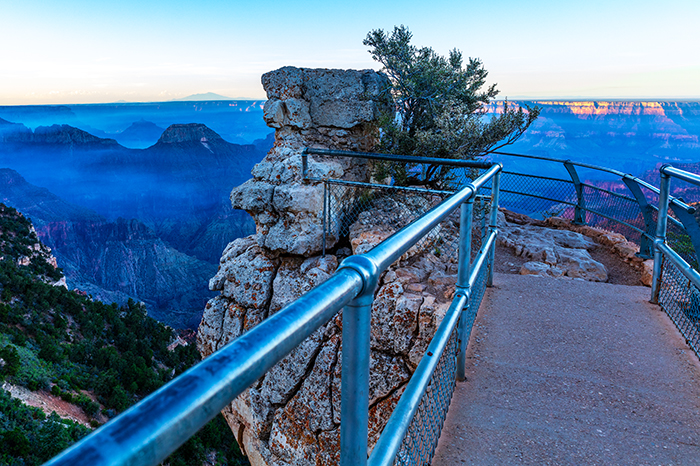
Quite a view at the North Rim, Grand Canyon National Park / Rebecca Latson
All of this is a preamble to the day I stood at one of those view areas to capture a sunrise shot. I’d set up my tripod and had my eye to the viewfinder. I heard this slow, measured “flip flip” behind me. Turning, I saw a young man wearing flip flops, slowly and carefully wending his way to where I stood. Talk about the surest way to twist an ankle.
Here’s the deal with flip flops: They have no tread, you have to keep squeezing your toes to keep them on, they have no foot or ankle support on uneven ground (even uneven paved ground), and if you lose one of them down a steep precipice or while standing in a river or the sea (and they are easy to lose), you’ve effectively littered in the park. Ditch the flip flops on a trail, people. Get some hiking shoes or boots. You are not in the city.
2.) Perfume and Aftershave
When I am out in a national park, I revel in the fragrance of fresh air filled with cedar, fir, pine or sage. My nose thanks me for those sumptuous scents. And then, I pass a woman wearing perfume or a man wearing strong aftershave. These are the people who not only invade my fresh air space, but also can’t smell anything other than their Chanel #5 or Old Spice. In case you are wondering, does self-administered fragrance affect the wildlife? A quick Google search pulled up nothing of note, but perfume and aftershave certainly affect *this* writer. Leave the perfume and aftershave for your office or an evening out.
3.) Hats
We all wear hats when visiting a national park. That sun (or rain) beats down on us and we need protection. We need a hat to keep the wind from blowing our tresses into our face; nothing worse than a mouthful of hair, believe me. I wear a hat every time I am out with my camera. But, you need to remember to affix that hat FIRMLY to your head. National parks get windy – really windy – and if you don’t have your hat tied down, it will blow off and litter the park.
The following images show you the number of hats spoiling portions of hot springs and bacterial mats in Yellowstone National Park. All that natural beauty marred by a clothing item that the wearer should have taken time (and a little thought) to tie down firmly to their head before touring the sights.
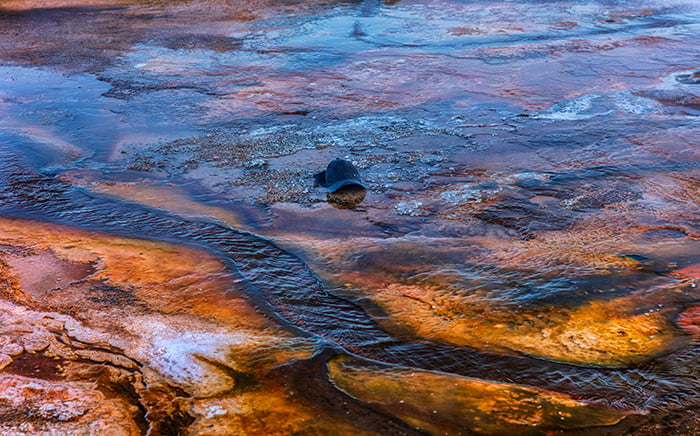
A hat in the bacterial mat, Yellowstone National Park / Rebecca Latson

A hat at Mammoth Hot Springs, Yellowstone National Park / Rebecca Latson
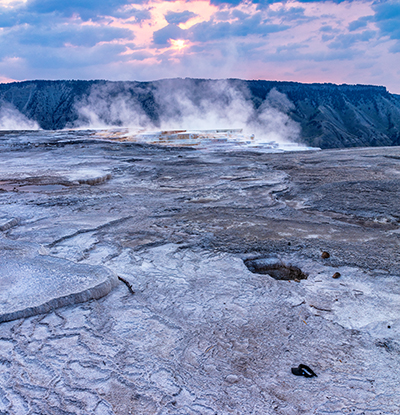
A hat near Canary Spring, Yellowstone National Park / Rebecca Latson
4.) Drive the Damned Speed Limit
The national parks I visited all had a maximum speed limit of 45mph (72 kph), and sometimes, 25mph – 35mph. They do that for a reason. You know, it’s kinda nice to drive that 45mph and admire all the beautiful scenery for which a national park is famous, but a slower speed limit is also for your safety and wildlife safety. I can’t tell you how many times a chipmunk, bunny, or deer (and even a bear, once) crossed the road in front of me. Had I been driving beyond the posted speed limit, that wildlife and my vehicle would have both been toast. I invariably saw people (usually with California license plates), pass me on the narrow road because I was going the posted speed limit and they wanted to apparently drive 65 mph or whatever speed limit du jour of the state in which they reside.
If you want to drive fast, don’t do it in a national park. Rent some time on a speedway, instead, and get it out of your system.
5.) Parking
In each of the parks I visited, there are signs all along the roads prohibiting parking in anything other than the designated parking spaces, pullouts, or specific widened road shoulders. Yet, I saw it time and time again – parking anywhere people could pull over after all the legal spaces were taken up. There are a lot of drivers unfamiliar with the route, or just plain poor drivers to begin with. As drivers park their cars or RVs on both sides of the narrow roads, then walk down the roads to the site, they don’t make it any safe for other drivers or walkers. Unfortunately, there are currently not enough rangers out there to enforce the rules. It’s encumbent upon you, the driver, to slow down to 15 mph when passing heavily-congested areas and to PLEASE park only in designated areas.
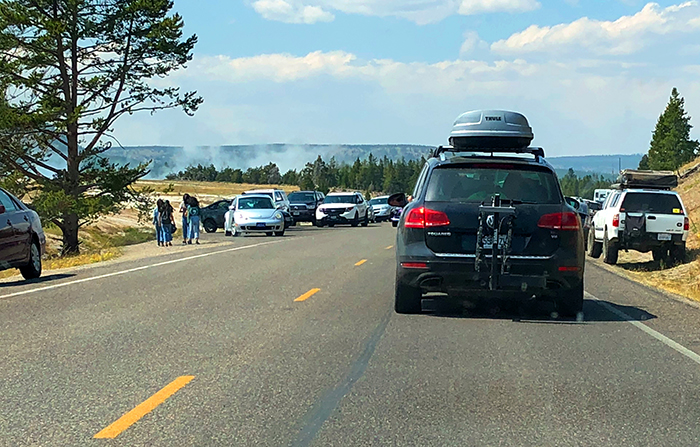
Nowhere to park at Grand Prismatic, Yellowstone National Park / Rebecca Latson
6.) Litter
There are signs all over the place to not litter. And yet, people still do it. I remember sitting on one of those benches curving around Old Faithful near the Old Faithful Lodge and discovering an empty yogurt cup and plastic spoon underneath my seat. The trash bin was just a few steps away. And yet, the eater of the yogurt was too lazy to get up, walk over, and place the cup in the trash. A robust wind might have blown that empty container off the boardwalk and onto ground beyond the boardwalk where visitors are prohibited from walking. I saw empty cups, cellophane wrappings, and paper receipts marring the bacterial mats and thermal pools. I will grant that perhaps the wind blew some un-secured trash item, but that’s even more reason to THINK and SECURELY stash your trash.

A paper cup off the boardwalk at Upper Geyser Basin, Yellowstone National Park / Rebecca Latson

Paper receipt in a runoff stream, Upper Geyser Basin, Yellowstone National Park / Rebecca Latson
Oh, and one other thing. Just because your orange peels or banana skins are compostable, that doesn’t mean it’s OK to simply throw them to the side once you are done eating In a June 19, 2018 online article, Glacier National Park officials warned that while we think of fruit peels as biodegradeable, it really takes them a long time to biodegrade (I believe their word is “rot”) and it’s dangerous for the wildlife. Litter is litter, folks. Pack out what you pack in. It’s really not that difficult to bring along a little bag in which to put your used Kleenex, food peels, etc. and then put that little bag in your purse, backpack, or photographer vest pocket.

Litter the photographer picked up at Yellowstone National Park / Rebecca Latson
I’ll bet you readers have seen some pretty stupid stuff out in the national parks (including people harassing the wildlife … and later getting arrested for it). I’d be interested to know what you’ve witnessed, and I’m sure the Traveler would, too. If you’ve experienced up close and personal the lack of planning, laziness, or unthinking stuff people have done, put that in your commentary below this article. Regardless of the fact that people don’t like to be reminded of their – er – transgressions, I’m hoping they do a better job of remembering those actions the next time they are out enjoying a national park.

Please, don't feed the wildlife, Glacier National Park / Rebecca Latson
Stories about:
Story Categories:
A copy of National Parks Traveler's financial statements may be obtained by sending a stamped, self-addressed envelope to: National Parks Traveler, P.O. Box 980452, Park City, Utah 84098. National Parks Traveler was formed in the state of Utah for the purpose of informing and educating about national parks and protected areas.
Residents of the following states may obtain a copy of our financial and additional information as stated below:
- Florida: A COPY OF THE OFFICIAL REGISTRATION AND FINANCIAL INFORMATION FOR NATIONAL PARKS TRAVELER, (REGISTRATION NO. CH 51659), MAY BE OBTAINED FROM THE DIVISION OF CONSUMER SERVICES BY CALLING 800-435-7352 OR VISITING THEIR WEBSITE. REGISTRATION DOES NOT IMPLY ENDORSEMENT, APPROVAL, OR RECOMMENDATION BY THE STATE.
- Georgia: A full and fair description of the programs and financial statement summary of National Parks Traveler is available upon request at the office and phone number indicated above.
- Maryland: Documents and information submitted under the Maryland Solicitations Act are also available, for the cost of postage and copies, from the Secretary of State, State House, Annapolis, MD 21401 (410-974-5534).
- North Carolina: Financial information about this organization and a copy of its license are available from the State Solicitation Licensing Branch at 888-830-4989 or 919-807-2214. The license is not an endorsement by the State.
- Pennsylvania: The official registration and financial information of National Parks Traveler may be obtained from the Pennsylvania Department of State by calling 800-732-0999. Registration does not imply endorsement.
- Virginia: Financial statements are available from the Virginia Department of Agriculture and Consumer Services, 102 Governor Street, Richmond, Virginia 23219.
- Washington: National Parks Traveler is registered with Washington State’s Charities Program as required by law and additional information is available by calling 800-332-4483 or visiting www.sos.wa.gov/charities, or on file at Charities Division, Office of the Secretary of State, State of Washington, Olympia, WA 98504.

Comments
Great photos and a great message, Rebecca.
But is anyone listening?
As for the perfume and after shave . . . I'd much rather have that than puanteur d'Francais. (At least all I've encountered like that have been speaking French.)
Camera tourists: If you are waiting for that perfect shot, don't block the walkway- at least set up at the edge of the path/trail. But you aren;t going to get National Geographic quality photos with your tablet's phone.
Perfumey stuff of ANY sort non-consensually assaults my nose and tastebuds. I'd much rather smell the sulphur of a natural spring than anything out of a test tube, and I don't much care how much you spent on it. Your wanting to smell like that is a personal choice and decision for elsewhere than out in the parks.
As someone who has a family member who works in one of these parks for the NPS, we get regaled with stories like these on a regular basis. The insensitivity and stupidity of some of the park visitors is truly amazing. Even better are the stories of those who willingly go into the backcountry totally unprepared. Sadly, this sometimes leads to tragedy, which ultimately costs us all when the NPS has to recover the body(ies) and/or provide rescue and medical assistance.
Common observations on our part in this regard: "You can't fix stupid" and "Darwin Awards".
TF
Fragrance is gonna attract the buggies.
We have been going to Acadia for years and are always amazed how people jump out of their car and run close to the ocean without even co sidering the tide. They just have to go stand on the rock that is the furthest out to take a picture. Then they turn their back to the ocean ignoring the waves coming in. This is the ocean people! Have some respect! A group of people were slammed by a wave one year. All had serious injuries and a child died.
Uh, maybe look up the translation of puanteur . . .
My pet peeve is people hiking or backpacking playing music from portable speakers.
Ironically, my family just returned from a 3-week National Park tour that began in Washington State and ended in California. In total, we saw 9 National Parks (we planned on 10, but decided that we would hold off on Yosemite due to the nearby wildfire). We saw so many people who thought of our National Parks as amusement parks and had no respect for any of it. My 13-year-old coined the term "Waddlers" to identify disrespectful daytrippers who think that basic rules don't apply to them.
The author of this article nailed most of the generalities, but we saw many more. For instance, at Mount Rainier we saw a group launch drones. Almost immediately, a few people started screaming that they were illegal. Of course, they were ignored until a Ranger was finally summoned.
At a scendic overlook at Crater Lake, we saw some teenagers feeding some Chipmunks while their parents cheered them on. A passerby commented on how full the animal's cheeks were while the poor thing literally stood on it's hind legs and begged for more. One of the kids bragged, "That's becuase we just gave him a ton of nuts." I pointed out that what they were doing was illegal and it really hurts them more than it helps them. This is when the father passive-aggressively decided that he would join in on the feeding to support his kids because, well "Who the hell is this guy telling me what to do?"
Later in the evening, my wife hoped to take in the sunset at Watchman's Peak. Along came a group of drunk 20-somethings who went whizzing by on motorize skateboards, whooping as the sun went down. How peaceful!
At Lassen Volcanic National Park, we encountered so many waddlers ill-prepared to tackle the trail. Not only that, many of them had small children! No water, poor shoes, etc.
At Kings Canyon National Park in General Grant Grove, we encountered a lovely family of waddlers who decided that the postings every 50 feet to stay on the trail did not apply to them. I happend upon them as mom,on the other side of a fence, was clearing her throat of smokers' phlegm. I got to see her show off her pearly browns for what is undoubtedly going to be a cherished photograph. Junior-ette was about to cross over for her turn when I said politely informed them that what they were doing was illegal. I referred them to the sign right in front of their faces. Mom argued that "Everybody does it". I said, "Well, no. You're really the only people doing it." To which, mom querried, "What are you, the tree police?" I walked right up to her and said, "Nope, I'm just somebody who respects our National Parks and if everybody had the attidude they had, these areas would be destroyed." It was at this point, that I was called a F--K Head. I just took a family picture and told them that the Park Service takes these things seriously and if I saw a Ranger in the vicinity, I would be sure to make them aware. I didn't, but hopefully these people think twice before doing it again in the future, if, for no other reason to not have to deal with somebody like me.
On the High Peaks Trail at Pinnacles National Park, my daughter and I encountered a couple exhausted and out of water. It was 110 degrees at that point. Luckily for us, we got out on the trails early to beat the heat. When we met this couple, we had about a mile and half left. I gave them some water and my map and pointed them in the right direction. They had about 5 miles to get back to their parking lot. I seriously think that had we not helped, they would have needed a rescue.
I could go on and on: Wildlife harassers, illegal parkers, litterbugs, and my personal favorite, artifact removers.
Thanks for this article.
Thats story about the chipmunk soounds similar to what I experienced in Yellowstone. A girl was feeding one & I said to her you can't feed the wildlife & then the dad jumps in & says yes its fine. I said no its illegal & that I would report them to NPS & the dad said it's just a chipmunk & I said it doesn't matter feeding ANY wildlife is illegal. If I see someone doing something wrong I will say something to them or tell a park ranger if one is nearby. People who don't respect our national parks frustrate me!
Great article, Rebecca. I share the same sentiments.
A few years ago in September I was driving in the early morning twilight just north of Norris at Yellowstone. I pulled into a turnout to photograph a particular plant that caught my eye. On the ground next to the turnout I found a large pile of human excrement and a big wad of toilet paper. And this was within a mile or two of the bathrooms at Norris.
All these offenses are offensive to me as well. But I wonder, what is the solution? I suspect it lies somewhere well before these people come to a park.
two things I saw in Yellowstone in June. At grand prismatic spring I saw a child lying down on the board walk to try to touch the water/ground.father was standing right there! Got upset when I mentioned that wasn’t a good idea.
Also saw a couple if tourists walking up to bison to take selfies with them. Stupid.
Not all idiocy comes with an easy to find "OFF" button.
Exactly my point Rick.
Thank you for your observations, Rebecca. All of your points are well-taken and based on the earlier comments anyone who respects nature and fellow park visitors can agree.
I'd like to address the hat litter issue, your observation #3, something I am very familiar with. Do you know that you cannot participate in a mule ride into the Grand Canyon without a hat with a cord? ( https://www.grandcanyonlodges.com/plan/mule-rides/ )
"Required Items for Your Ride > Wide-Brimmed Hat (April through October only): The hat must tie underneath your chin. (We have string or you can buy a hat at the desk)."
The threat hat litter poses to sensitive areas is widely underappreciated. I've raised this issue with many National Parks and State Parks after my husband and I experienced a distraught man lose his hat at the windy Pearl Harbor memorial. In front of the sign prohibiting throwing anything into the water, his hat sunk directly over the remains of the USS Arizona.
Since then I have collected many news reports with tragic outcomes for hat wearers who instinctually lunge after their windblown hat. Whether on land or sea, on foot or in a motored conveyance, danger lurks for hat wearers whose hats succumb to a surprise gust of wind. ( https://people.com/human-interest/nathan-stowell-hiker-falls-to-death-in... ) ( https://www.tri-cityherald.com/news/local/article216768420.html )
After Pearl Harbor my husband designed a solution for hats without a cord. We recognized the universality of the cordless hat problem after he, too, could not keep his ball cap on in those strong Hawaii winds. Rebecca, you've brought attention to this important issue and I hope others will also recognize that the problem of hat litter, hat security, and personal safety is easily solvable. If you are a hat wearer or you know and love a hat wearer, please visit our website to learn how to windproof your hat. ( https://capsurz.com/how-to-use-capsurz/ )
I live near Theodore Roosevelt National Park in North Dakota. I agree with all of your points. I will add that I will not pull over and let you by if I am going the speed limit. Getting on my tail is only going to get me to call the ranger. I know the park like the back of my hand. I often spend 12 hours in that 33 mile loop. If the speed limit is 25mph it is because it is a spot the animals often use to cross the road. Please don't tell me you went to the park and didn't see any animals. In my 15years of visiting the park 3 or more days a week that has never happened to me. You will not see anything going 45mph. Slow down or just stay away.
We were at Sequoia National Park this spring and encountered many, MANY people taking the Sugar Pine cones. We stopped all of them that we saw to tell them that taking items from a National Park is illegal and is considered theft. Every single person we spoke to acted likle they had no idea that removing such items is illegal (even though there are signs posted throughout). A few people put them down and walked away but others just scowled and kept walking.
Waddlers - a great new term for an observable species.
I agree with all your points and have seen each of them many times in many parks. Perhaps taking photos while you're supposed to be driving isn't such a good idea, either.
It is the litter that offends me the most, not only in parks, but even in cities. How difficult is it to carry the almost weightless litter to a proper disposal container? Litter is ugly and if everyone littered, the parks would be most unattractive and few would want to visit them. Certainly many metropolitan areas that are popular with tourist and city dwellers are becoming more littered and/or covered with graffiti. This problem seems to be getting worse, which seems indicative of a decline in respect for public and private property in society everywhere, especially among city dwellers.
I have always been amazed at hikers, even on a long trail in Rocky Mountain NP, wearing flipflops. I'm always getting rocks kicked up into my boots even, so I know rocks must get between the feet and the flipflops of those hikers. Stubbing a toe is even a hazard, when wearing proper footwear, that must be even more true for those wearing flipflops. Or maybe we are just wimps and those flipflop wearing trail walkers are really tough!
I propose that the park system require visitors to take a training course prior to visiting the parks and to demonstrate a mastery of the rules, regulations, safety issues, etc. before being permitted into a park. Proof of completing such a course and passing a test would have to be presented at the entrance. Such a requirement might even reduce the crowds in the parks, allowing those who really appreciate nature to enjoy the parks without the entrusion of the casual, disrespectful visitors.
I totally agree with you that everyone should have to go through a training course & pass before they are allowed into the national parks!
My wife and I have been visiting National Parks every year for forty years and believe me we have seen everything. Although these parks belong to all of us I think you should have to pass a test prior to entering any of them.
I would also like to point out all the people who go off the trails when there are signs all over the place the say "Stay on the Trail". This stupidity kills plants that have been growing for hundreds of years. People only think of themselves and not the consquences of their actions. Always be respectful of rules and regulations in our National Parks as we all are stuards of these precious places and would like future generations to be able to enjoy as we have.
I have seen all of those things you mentioned plus some, just recently on a trip to Yellowstone! So frustrating when people tend to ignore all rules in our beautiful national parks. I have seen many people doing 5 mile hikes on rough terrain in the Smoky Mountains wearing only flip flops! Really?? I think if people are caught doing things they shouldn't be doing they should be required to take some classes on how to behave in our national parks, so they are preserved for future generations!