
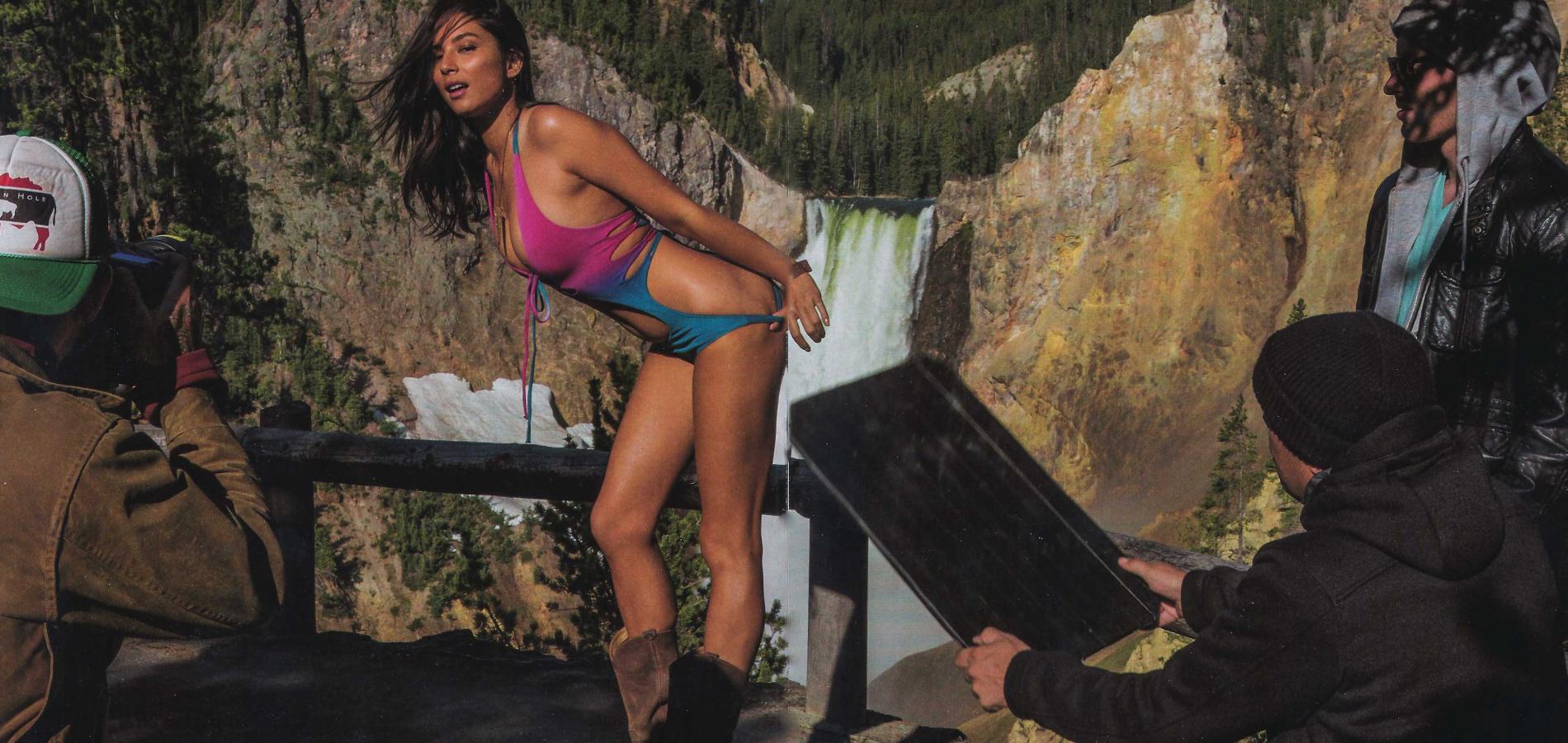
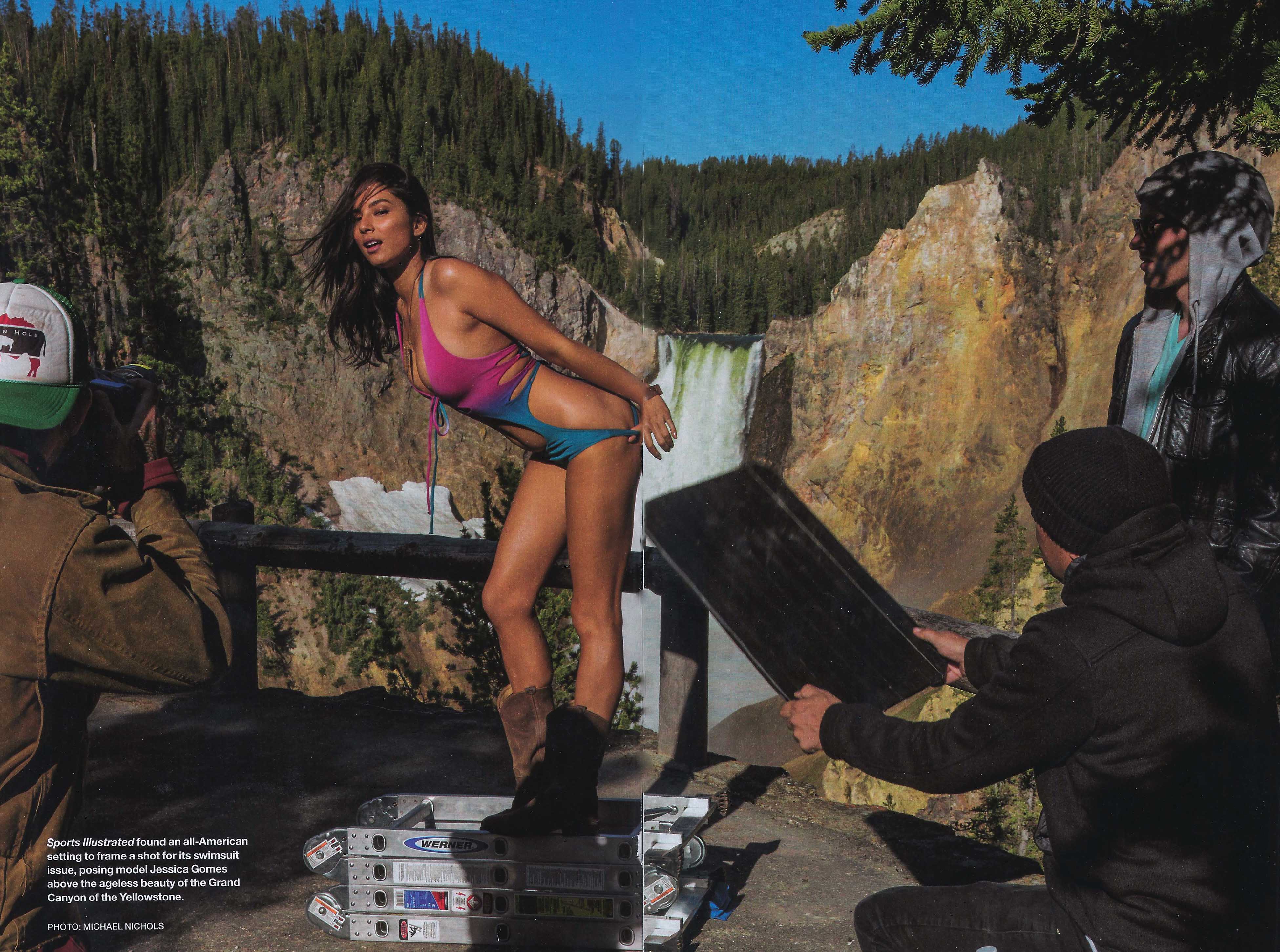
For many young adolescent boys growing up in the 1960s, the cold winds, ice, and snows of winter met a thaw in February, when a softer, not quite so lusty version of Playboy showed up in mailboxes across the country: Sports Illustrated's annual Swimsuit Issue.
With bikini-clad models such as Elle Macpherson, Christie Brinkley, Cheryl Tiegs and Rachel Hunter gracing covers and multiple-page spreads within the covers, the Swimsuit Issue quickly became a marketing success. By 2005 it was estimated that that issue alone generated $35 million in revenue for Sports Illustrated. As the years passed, the editors and art directors have gotten more and more risque, dressing their models in skimpier and skimpier swimsuits, and finally painting suits on them.
In 2002, a representative for the National Organization for Women said the issue, "promotes the harmful and dehumanizing concept that women are a product for male consumption."
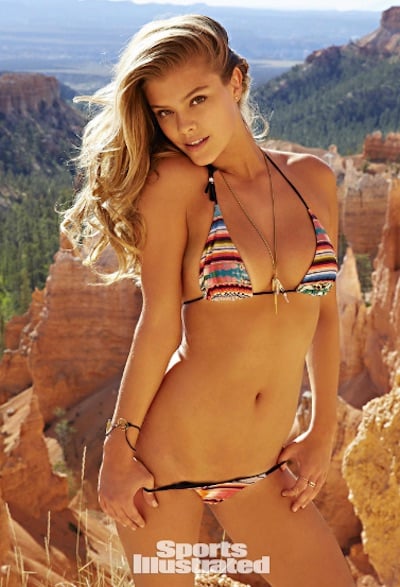
Until recently, national parks have been left out of the Swimsuit Issue, and generally have been promoted by media as wonderful family destinations. But in 2014 the sports magazine requested, and received permission, to shoot in Yellowstone, Grand Teton and Bryce Canyon national parks for its 2015 Swimsuit Issue.
An outtake from the Yellowstone shoot (above) was used by National Geographic this year in its May issue, which was dedicated to Yellowstone.
Now, as the Park Service is confronting an issue of sexual harassment and misconduct within its workforce, a watchdog group is questioning whether the agency's decision to permit the pictorials doesn't "undermine" its commitment to root out an institutional "culture of tolerance for sexual harassment." In addition, the Park Service's approval of the photo shoots illuminates the gray area in interpreting the agency's management guidelines and recalls a magazine shoot four decades ago that a former park ranger deemed "extremely offensive."
Back in August 1977 Grand Canyon National Park made a splash in Playboy in a river trip pictorial that raised more than a few eyes, as Roderick Nash noted in Wilderness and the American Mind while discussing the issue of river trip permit allocations:
The Grand Canyon allocation controversy raised the deeper question of what kind of use is most appropriate in a federal managed wilderness. One point of view regarded the large, motorized commercial trips as little more than outdoor parties. Beach volleyball and cold beer highlighted these trips. The customers neither expected nor wanted a wilderness experience. The whitewater rapids might as well have been located in an urban amusement park. The highly publicizied and much photographed river trip that Playboy staged came to represent the problem in many minds. The fact that this kind of Grand Canyon trip used part of the limited visitor quota, and in effect kept wilderness enthusiasts off the river, rubbed salt in the already tender wounds of noncommercial boaters.
Grand Canyon resurfaced early this year in another sexually charged saga; not based on titillation, but rather sexual harassment and misconduct. An Office of Inspector General report given to the National Park Service last year and released to the public in January detailed a 15-year-long chapter of sordid behavior in the park's River District. In the end, the park superintendent retired and the Park Service recommitted itself to root out sexual misconduct and harassment, promising to set up a hotline to which complaints could be voiced, anonymously if desired, and to conduct a service-wide survey to determine how prevalent the problem might be.
Last last month, Interior Secretary Sally Jewell traveled to the Grand Canyon with Park Service Director Jon Jarvis, Intermountain Region Director Sue Masica and incoming Grand Canyon Superintendent Chris Lehnertz to meet with the park's employees, hear their concerns, and discuss how the matter would be addressed.
“That’s unacceptable behavior. It is a failure of leadership. It is something that we have got to address," Secretary Jewell told a small pool of reporters gathered at Hopi Point on the South Rim after meeting with roughly 300 park employees. "I will say that this is a team of employees that wants to move on, that does not want to be defined by the actions of a few."
Objectification, Art, Or Freedom Of The Press?
Ironically, as the National Park Service tries to determine just how extensive sexual harassment and misconduct might be across its workforce of 20,000, questions about the appropriateness of Sports Illustrated's use of national parks in 2015 to show off scantily clad models have surfaced. Not only did the sports magazine stage photo shoots in Bryce Canyon, Grand Teton, and Yellowstone national parks, at least, but it also produced videos of the models and crews at work in the parks.
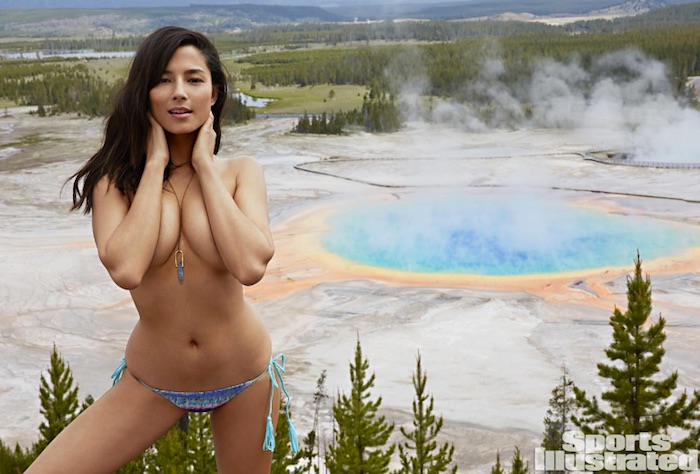
Some Park Service employees were disturbed by the Lower Falls image that appeared in National Geographic's May 2016 issue.
"Many permanent and seasonal NPS employees (male & female) object to this image, and the message communicated. It could be inferred by Dan Wenk in NPS uniform (elsewhere in the issue) as NPS endorsing or sanctioning this type of behavior," one employee told the Traveler. "At the very least, if NPS says it had no control over what Nat Geo publishes, I believe the powers that be at National Geographic AND the National Park Service would be singing a different tune if it had been Dan Wenk in his underwear instead of his carefully planned and orchestrated NPS Class A dress uniform on the preceding pages."
At National Geographic, Director of Communications Anna Kukelhaus pointed out that the swimsuit photograph was just one of 70 images of Yellowstone contained in the issue.
"As a journalistic publication, we tell multiple aspects of a story. For our Yellowstone issue, we did not want to just showcase the natural and ageless beauty of the park, but to look at how the park is used and how people interact with it," she said. "We think this image represents one of the ways the park is used. It is also important to note that any photo shoot in a national park cannot take place without park permission. Park rangers accompanied the teams to various locations throughout the park during the course of this shoot."
Concern about the propriety of the photo shoots, in light of the ongoing issue with sexual harassment and misconduct in the Park Service, led Public Employees for Environmental Responsibility to file a Freedom of Information Act request with the Park Service for:
* All permits issued by NPS to Sports Illsutrated or its employees to conduct a photo shoot or photo shoots on NPS land;
* All records indicating where each Sports Illustrated photo shoot took place, including any NPS staff briefings;
* All correspondence between NPS and Sports Illustrated or its employees regarding photo shoots and/or the publication of photos;
* All correspondence between NPS and Nat Geo or its employees regarding the publication of the Jessica Gomes photo in the magazine’s May 2016 issue.
"We are interested in the records for several reasons," PEER's legal counsel, Laura Dumais, told the Traveler. "First, Jon Jarvis and NPS leadership are currently under fire for fostering a long-term culture of tolerance for sexual harassment, where perpetrators enjoy protection while victims fear to report wrongdoing. If it is true that NPS managers found nothing inappropriate about authorizing the publication of a photo of three fully-clothed men literally in the process of objectifying a near-naked woman in front of an iconic Yellowstone waterfall, then it’s not difficult to understand why NPS has a problem."
In its FOIA request, PEER stated that, "If, in fact, NPS condoned the actions of Sports Illustrated and National Geographic in taking/publishing photos that undermine NPS’s stated commitment to ending sexual harassment in national parks, then this is very important information that the public should know about prior to the centennial celebration. Presented with such information, the public may choose not to attend such celebrations, or individuals may choose to exercise their First Amendment rights to engage in informed public discourse on the issue prior to or during the celebration."
Secretary Jewell's office did not respond to a Traveler request for comment on the appropriateness of using national parks as backdrops for the Swimsuit Issue that, after it's arrival, drew harsh criticism for its cover photo being "100 percent inappropriate" and "obscene," along with more graphic descriptions. The National Center on Sexual Exploitation was so shocked by the covergirl on the 2015 issue that the executive director sent letters to retailers asking that the magazine be removed from public display.
At the Park Service's Washington, D.C., headquarters Tom Crosson, chief of public affairs, would not comment on the appropriateness of the photo shoots or whether the agency approved of the images and videos.
"The National Park Service is obligated to protect the public’s right to free speech in national parks, as guaranteed by the First Amendment. We do not apply a 'morals test' when granting access to our parks for legal activities," he said. "When issuing permits, we do consider factors such as the potential impact to park resources and visitor use. If it is determined that a particular activity would constitute impairment to the park and its resources, or would generate unacceptable impacts as defined by NPS Management Policies, or is prohibited by law, the park would deny the request."
Does Sports Illustrated's Swimsuit Issue Uphold National Park "Values"
The management handbook for national park superintendents, the 2006 Management Policies, contains a section on "Appropriate Uses" of the parks. In that section on page 98, the narrative specifies that, "In exercising its discretionary authority, the Service will allow only uses that are (1) appropriate to the purpose for which the park was established... (emphasis added).
Under the Code of Federal Regulations that discretion was trimmed somewhat, removing the wording pertaining to the purpose for why a national park was established. It does, however, state that permits can be denied if the activity results "in unacceptable impacts or impairment to National Park Service resources or values...'" (emphasis added)
Mr. Crosson would not respond directly to whether the swimsuit photo shoots were appropriate to the purpose for which Yellowstone, Grand Teton, or Bryce Canyon were established, or whether they diminished the values of the parks.
At Yellowstone, Superintendent Wenk said his staff followed guidelines for issuing commerical photography permits when approached by Sports Illustrated.
"Because the project met the legal requirements for this type of permit, specifically that there were no resource or unacceptable impacts to visitor use, we issued the permit," he said in an email.
The guidelines set down by the Management Policies can be difficult to interpret, said Superintendent Wenk.
"We looked at this permit process objectively in 2014. Perhaps we would look at it differently today," he wrote, adding that through the years he has been told "content could not be a reason for denial of a permit as long as other conditions were met."
"The application of NPS policy that you cited can be interpreted many ways," he continued. "What purpose are you saying is not appropriate to the purpose for which the park was established? If you apply your definition, would advertisements for cars, outdoor gear, swimsuits, pain relief or insurance be appropriate? Where do you draw the line if a manufacturer wanted to advertise kayaks and the model wore a swimsuit that was as revealing as the SI model, appropriate or not?"
At the Coalition To Protect America's National Parks, some members thought the swimsuit permit request should have been denied.
"I don’t see that photos/videos of scantily-clad women in any way is consistent with park values. Moreover, I don’t see how this kind of photography or videography for commercial purposes in the public marketplace is considered freedom of the press or speech under the First Amendment," said Bill Wade, whose 30-year NPS career included the Department of the Interior Meritorious Service Award. "I’m sure the (Interior) solicitors – with much more knowledge of the legalities than I have – reviewed all this and approved it, but it seems to me to be a big stretch. One more example of how the policies and laws are gradually becoming more diluted, at the detriment of what national parks stand for."
Added Rick Smith, whose Park Service career included a stint as acting-superintendent at Yellowstone: "Park values are being degraded with this kind of activity. It reminds me of the Playboy shoot on the Colorado River through Grand Canyon, topless models and all. It was extremely offensive."
Story Categories:
A copy of National Parks Traveler's financial statements may be obtained by sending a stamped, self-addressed envelope to: National Parks Traveler, P.O. Box 980452, Park City, Utah 84098. National Parks Traveler was formed in the state of Utah for the purpose of informing and educating about national parks and protected areas.
Residents of the following states may obtain a copy of our financial and additional information as stated below:
- Florida: A COPY OF THE OFFICIAL REGISTRATION AND FINANCIAL INFORMATION FOR NATIONAL PARKS TRAVELER, (REGISTRATION NO. CH 51659), MAY BE OBTAINED FROM THE DIVISION OF CONSUMER SERVICES BY CALLING 800-435-7352 OR VISITING THEIR WEBSITE. REGISTRATION DOES NOT IMPLY ENDORSEMENT, APPROVAL, OR RECOMMENDATION BY THE STATE.
- Georgia: A full and fair description of the programs and financial statement summary of National Parks Traveler is available upon request at the office and phone number indicated above.
- Maryland: Documents and information submitted under the Maryland Solicitations Act are also available, for the cost of postage and copies, from the Secretary of State, State House, Annapolis, MD 21401 (410-974-5534).
- North Carolina: Financial information about this organization and a copy of its license are available from the State Solicitation Licensing Branch at 888-830-4989 or 919-807-2214. The license is not an endorsement by the State.
- Pennsylvania: The official registration and financial information of National Parks Traveler may be obtained from the Pennsylvania Department of State by calling 800-732-0999. Registration does not imply endorsement.
- Virginia: Financial statements are available from the Virginia Department of Agriculture and Consumer Services, 102 Governor Street, Richmond, Virginia 23219.
- Washington: National Parks Traveler is registered with Washington State’s Charities Program as required by law and additional information is available by calling 800-332-4483 or visiting www.sos.wa.gov/charities, or on file at Charities Division, Office of the Secretary of State, State of Washington, Olympia, WA 98504.


Comments
Gary - I agree with some of what you said about photographing someone in a bikini in the parks is no big deal, but I only go so far with you. You are being disingenous when you try to disregard the realities of objectivization. it is a complex and intertwined issue.
Do I like to look at pictures of pretty girls? Sure. Can focusing on pictures of pretty girls objectify them, yup. Are there complex and non black-and-white sensitivities in this, of course.
More of an issue in my mind than any body modesty or "moral" issue is the simple stupidity of showing someone in, or partially out of, a swimsuit in front of a hot springs similar to one where a person recently jumped in and died.
What I find annoying is how this is being twisted on this site, especially considering that this media outlet has a history of oversensationalizing many issues just to turn a paper. I also am losing respect for PEER as an organization, especially since I notice as time goes on, they are more apt to stirring the pot and create issue after issue to get thier name in the media instead of actually doing quality non-profit watchdog work. This is another case in point. And there have been many over the last two years.
And of course, media outlets like this one ablige to keep the sensationalization machine a turnin'. To state that the NPS is sending a message that it is promoting sexual harassment by allowing SI to have a commercial permit to photograph in National parks is a big stretch. Commercial organizations are legally able to apply for a commercial permit to photograph in National Parks, as long as they meet a handful of rules, many of which are in place to protect the integrity of National Park resources. That's it. THAT SIMPLE! The NPS is not in the business to legislate the morality of those organizations, and not a single NPS employee from my understanding was a swimsuit model. So to state that SI represents the value system and cultural workforce of the NPS is once again a stretch.
Regardless if you find women in bikini's or even men in speedos, or even a naked body as morally objectional isn't the point. Although, it is ironic that we have fallen so far down the evolutionary totem by attempting to seperate ourselves from nature, that we now look at primates that wear less clothes as "sinister beings" or "whores" or "prostitutes" or whatever the puritan folks here want to label it! This is just another form of art and no different than the old masters that painted models in front of natural settings. If you allow yourself to be bought by the objectification of the imagary than that is your choice. But to state that the NPS is forcing this imagery on the public, and promoting it as part of their "Brand" does not make any rational sense. The NPS does not use any scantily clad humans in any park materials that i've ever seen. So to state that this work is part of the NPS value system, or the NPS brand is once again, a BIG BIG stretch of the truth. These photos are strictly SI's value system, and thier work culture, and their brand. And SI is very much allowed to purchase a commercial photography permit to photograph in the National Park, and they are allowed to photograph in parks as long as they meet guidelines. It looks like all these photos were outside of designated wilderness areas, and nothing was illegal or broke park laws. In other words, it was all done by the books.
Makes about as much sense as having an orchestra in a Nat'l Park.
How about "Boatman #3" doing a photo shoot at the Grand Canyon for the "Men's" issue of SI? Or the new Yount Award winner having a cameo in the body paint section of SI shot on the beaches of CCNS ? Melania T. in lingerie promoting the values of Women's Rights NHP ? I think the Jarvis NPS is on to something here.
An NPS manager sensitive to the issues of the day would have asked this be postponed or moved elsewhere. Again, saying an NPS manager is sensitive to anything is a stretch. I like what Congressman John Duncan said in his newsletter last week about Jarvis and his mismanagement of the NPS. He cited the ever growing "maintenance backlog" ruse. He also appropriately tied it to malfeasant management and appropriately questions how it has ballooned over time. His conclusion is the same as the rest of us. How can an agency with consistently rising budgets approach the congress for more appropriations? Simple. Make more stuff up that needs fixing. What needs fixing is all management and a dust up of the moustache club. Kurt is right. This is a relevant topic.
I wonder if the person who wrote the permit knows what kind of Photo Shoot Sports Illustrated was planning. Maybe they thought it would be about fishing or something that is a sport or a athlete that is involved in a sport. Either way, I agree with Gary and EC, Unless they broke a guideline, Does not effect me. If you are worried about the gudelines, than try to change that.
This is unbelievable and in such bad taste. Stupid NPS
At least they have some clothes on. Try enjoying walking the beaches of Canaveral National Seahore and being subjected to comments and astoundingly up front and personal visuals of the fully nude visitors along with some of their sexual antics that the NPS allows. Anything for a buck I guess.
Mackie, are you referring to the short-lived 1970's TV Series "Sierra", which was largely filmed at Yosemite National Park? This production not only presented a highly inaccurate depiction of National Park Rangers, but seemed aimed at making them into cartoonish Jellystone Park characters. Future commercial filming permits need to be more discretionary, and be made to contribute something to the public's understanding of the Parks and their resources.
Ethical Retired Ranger, yes, the short lived series "Sierra". Could pontificate at length on the lessons learned, but you have to be involved in one of these efforts to understand the logistics, closures, staff and field employee time, etc. dedicated to accomplishing the project, all of which detracts from operating the park. My own view is that a series like the Ken Burns films is appropriate as it was aimed at giving the public an in depth appreciation of the historic, cultural and ecological issues facing their parks. My objection to SI is it had nothing to do with the park, except to have a scenic background for their swimsuit models. I agree with your comment Ethical, unfortunately we are moving, as Alfred Runte commented, in an opposite direction.
I was involved in monitoring a couple of location shots for the IMAX film "Grand Canyon the Hidden Secrets". While this filming did cause some disruptions in Park activities, and had its share of inaccuracies, I feel its promoters made a decent effort to promote appreciation for the Park and its resources. I consider the TV series "Sierra", on the other hand, to be a caricature.
Brickleberry has it right
"Commercial exploitation" when no resources are harmed sounds like a harsh term. Commercial exploitation is when the resources of the park are disrupted and harmed and the park is then altered. To me, commercial exploitation is mining, logging, extracting water, damming a river for energy, killing or harvesting wildlife from the park boundaries. You know, the stuff the NPS should be trying to protect against from happening in our parks.
To call a picture, which just requires some electrons being charged on a tiny light sensitive grid of pixels to create a snapshot of an extremely temporary moment even if that image contains a scantily clad lifeform posing in front of a feature that the NPS does not own as a trademark, and to label that, as a severe corruption of the NPS "Value system" is at this point becoming laughable.
A woman standing in front of a waterfall in a bikini? Please. There are much much worse things going on in an average National Park, that the NPS should focus on. Being art critics is not one of them.
The NPS also charges fees to cover administration costs to secure a permit. If you want to stop women from posing in bikinis at a national park, then you might want to make sure they all are forced to have burkas on before they enter. That way, if some tourist girl takes a duck selfie in front of old faithful and posts it on the internets, and it goes viral, she's at least wearing proper dress. Just thinking ahead here, in case a duck selfie were to upset the value system, since i'm guessing hundreds, if not thousands of those are taken every day in a park in front of famous landmarks.
Gosh, some of you are wound so tight, you may be a little too stiff. I suggest loosening up a little.
This is just shameful! Whoever allowed this should be removed from their office!
Gary, your list of "damaging" commercial intrusions is itself politically correct. You left out wind and solar farms impinging on park boundaries, viewsheds, resources, and wildlife. But I digress.
As a historian, I can tell you, in no uncertain terms, that pictures are powerful communicators. Remember that ancient proverb: "A picture is worth a thousand words." For my lectures and books, I am always searching for just the right photograph, painting, cartoon, or drawing to convey the ideals and/or foibles of American culture.
Stop and think how our culture has changed. The f-word is our favorite adjective, like, you know, Dude, what I mean. Awesome pictures! Awesome babes! Boy, would I like shagging them! You know, like, in the movie starring Mike Meyers. If Hollywood says it, it must be okay! Like, what's to get so upset about? She's just another object on a pixel, and we didn't really say the f-word.
As I listen to the Millennial generation struggle to speak and think past the third-grade level, I wonder what their struggle portends for the national parks. A cultural expression, the national parks will indeed become vulnerable to everything the culture allows or tolerates.
You allow that anything is not being debased so long as it is just a pixel. Well, your society seems to agree with you--now including two 70-year old women that I know. "Al, get over it," they say. "It's just a picture." Right. Just a picture. Nothing to worry about there!
Then what picture of our culture will we start worrying about? At what point does the culture forget entirely what it means to be a culture at all?
These are serious issues to the historian, if not those being flippant on the Internet. You would like to think you are being serious, but to be serious means to GET serious. Seriously, then, getting somewhere past the third-grade level, do you think that the national parks, let alone American culture, can survive the concept--so blatantly obvious today--that taste is nothing we need worry about, so long as we have it in our mouths?
Alfred, you continue to present yourself as out of touch with the daily reality that goes on in our National Parks. I have to admit, I find myself questioning when the last time you went off on a trail and had a real adventure in a park? It doesn't sound like you venture out very often, so I find a lot of what you say as highly aloof and out of touch with what I see on a daily basis when i'm out in the field. Unfortunately, I didn't see any supermodels, or even any women walking around in bikini's yesterday, so the immoral corruption that the "art" from SI has brought to the National Park service hasn't taken hold of our culture just yet. At least not on this day.
Regardless, as I was out in the field yesterday, I did take note of the many millenials, as well as a few boomers along a popular trail. Many seemed happy and enjoying their moment in a National park. Along the trail, there were a few bears, and sure enough there were some of those blasted young millenials stopping to photograph them. Although, I was dissapointed that the bears kept their distance, and none attempted to harass or feed on those ungrateful and unintelligent millenials, as you constantly put it.
I'm sure at least a few hundred pictures were taken in the process, and I know I added to the intrusion. It was quite similiar to experiences I had a decade ago when I walked along trails and encountered genxers, boomers, and the WW2 generation heading out to have a moment along the trail. One thing I tend to notice in National Parks is that very little changes. Sure the seasons change, but how humans interact with the parks hasn't changed much in my lifetime. What I saw yesterday, was almost the same as what I would see 10 to even 20 years ago. Maybe the styles in sunglasses and hiking boots were a touch bit different, but that was about it.
Gary, the good Dr. Runte was on a Traveler adventure back in June, when we spent four days floating the Green River through the Gates of Lodore and Lodore Canyon in Dinosaur National Monument. He was a real hit with the ladies! And last summer he floated with us for five days down the Yampa through Dinosaur. Those trips, plus his annual speaking engagements spring and fall at Zion National Park, ensure he gets into the parks.
Unfortunately, he also needs to get to the gym more often, but yes, he takes to the trails every year in Zion--and remains a hit with the ladies! (Only don't show this picture to my wife!)
Gary, I have seen enormous changes in my culture--and the parks--these past 60-odd years or so. And perhaps the biggest change I have seen is the lack of tolerance for people with "traditional" views--love of country, love of family, love of church, and yes, love of place. I will grant that in a country of 325 million people every generalization fails. But I doubt I am wrong about the coming Big Picture of a country shattered into countless tribes. Press one for the language of your choice is just the start.
The trail, as you put it, has already filtered out those who want to be there from those who don't. Thank goodness, millions still want to be there, but what of those we still need to convince? And it would seem we need to convince the majority of Americans now that the parks--like our entire infrastructure--have fallen decades in arrears.
If I thought for one moment that a beautiful woman in a bikini helped, I would say bring her on. "Now, boys, while you're off drinking and bar-hopping, don't forget your national parks!" In 1973, ARCO used such a personality (in tight shorts), telling men to go easy on the gas. "Now, boys, jackrabbit starts waste fuel. Push the pedal gently rather than floor it. Your country needs more fuel." She became part of my subsequent lectures on the energy crisis, just as, were I teaching today, I would be tempted to use the Sports Illustrated models as a cultural "expression" of the national parks.
The trouble is: I would get in trouble--BIG TROUBLE--with every feminist group now on campus. They see it: Sports Illustrated is exploiting women just to make the sale. Then are they not at the same time exploiting our national parks just to make the sale? Of course, I do object to the censorship of feminists telling me what not to teach--or how to teach. But I certainly get their point. If you turn something into an object, you get an object. If it is no longer sacred, it is just for sale.
I love to flirt. See photo above. I am not a prude. That photo is censored--and just for my wife. But I do not like to see American culture inviting any image that cheapens or demeans our sense of place.
Some months ago, a few readers objected to my fondness for railroads, pointing out that the railroads, too, were profit-motivated when it came to the national parks. That they were. But they never cheapened or demeaned the parks just to make a sale. The auto industry has--and does. The alcohol industry has--and does. I should think that any American, wishing to protect the parks, would ask every industry so inclined to think of what they're really saying.
A friend of mine, a cultural historian, insists I'm wasting my time. As Lily Tomlin says, "Things will get worse before they get worse." Those are value judgments, no doubt about it. But to express value is what a culture is. Because I value the national parks, you will forgive my outrage whenever I see less of John Muir and more of P. T. Barnum. I love the circus, baseball, football, and yes, beautiful girls posing in bikinis. I just think we should know when to say that they are distractions from the purpose of our national parks.
Sorry Alfred, but i've been in National Parks for quite a lot of my life. Now, i'm in one full time, and I don't see more PT barnum, and less John Muir. I just don't. I meet a lot of people that care about nature, and practice conservation. We all try to reminisce about a past that seemed more elegant and less confusing than it does now, however I fail to see how it was a greater time period when Yellowstone National Park would feed bears garbage for the tourists amusement, or at Yosemite when they would dump ashes off the top of Half Dome to create a sparkling fireworks display as the cinders dropped to the ground and left a giant black scar on the face of that mountain. I'm sure if PT Barnum was alive today, and spent time in the parks, he would have enjoyed those "good ol' days" and lamneted about the current culture that would never think of performing such activities today. However I don't want to come off sounding like i'm revising history, so who knows what PT Barnum would have thought since I never actually knew the guy. But, I suppose acts like that were more pure and disruptful to park resources, than a temporary click of a camera as it takes a temporary snapshot of some super model in front of Yellowstone Falls. Yes, how far the NPS has fallen from its mission of preserving and protecting the resources for future generations.
P.T. Barnum?
How about creepytings and her acrylic paintings in the parks?
Or the guys who walked along the edges of Grand Prismatic Spring in Yellowstone?
Or the dude who crashed his drone into the spring?
Or the guy who borrowed his friend's 250cc dirt bike and headed into Great Smoky Mountains National for a joy ride soon after the government shutdown and national park closure of October 2013 took effect. From that escapade --including a trail through Parsons Creek -- he wrote a story for Road & Track magazine's website, which he edits, and titled it A 250cc middle finger to the government shutdown: Civil Disobedience on Two Wheels.
Or the Texan who recently carved his initials into Roosevelt Arch at Yellowstone?
Or the idiots who vandalized Devils Hole at Death Valley National Park?
Or those who hacked down the saguaros at Saguaro National Park?
Or who vandalized the Joppa Church at Mammoth Cave National Park?
Or the guy who illegally camped out atop Half Dome, and also climbed a sequoia in Yosemite's Tuolumne Grove?
All of the above occurred within the past three years; most in the past 12 months.
Point is, no generation has a monopoly on miscreants or bad ideas, and there are plenty of examples to cherry-pick from.
At day's end, regardless the generation, there's always room to remember the special places that national parks are and treat them that way.
Unfortunately those acts of vandalism were not park approved activities. I was thinking more along the lines of activities that the NPS approved for the time period, which has led to this debate.
There's definitely no shortage of idiots, and attempting to curb idiotic behavior is always going to be a challenge for the park service. I just feel the NPS has a lot more dedicated mission today in preserving resources within a National Park, than it did in the previous eras. Heck, I see it daily where I work.
We can all argue to death the value that the mission 66 era brought to parks, as i'm sure many of us would say it had positive and negative benefits, but today the Park Service is a lot more cautious at approving structures and amentities that were common place during that period. It's rare for them to even build new roads, or even consider it.
But Gary doesn't want to remember, Kurt. He wants to be selective. And is that not the point? He wants to select for what he approves, while condemning others for what they disapprove. And to make sure we accept his values, he reminds us of what we, too, must disapprove. If you think that pretty girls are so bad, and the parks in the past so great, just look at what the firefall did--and the bear feeding shows. See? I also know how to be critical of the Park Service. You guys at The Traveler have nothing on me!
Think again, Gary. It took a century to eradicate those practices, or have you read anything but the crib notes? What new impositions on the resource might possibly originate from what you approve? More spray painting in the parks, perhaps? How do young people get those ideas if not from mimicking what they see? You tell me, all-knowing full-timer. Obviously, you have thought about this a lot.
Or not. You assume I don't get into the parks, for example, rather than bother with a lick of homework. Over the years, I've had a good many students like you, making it up as they go along. Well, this isn't Disneyland. This is the National Parks Traveler. And here we start by doing our homework.
As for history, you cannot begin to revise what you don't even know. For example, the Yosemite firefall was pushed off of Glacier Point. The summit of Half Dome is nearly 1,600 feet higher--and accessible only by cable. It's all in YOSEMITE: THE EMBATTLED WILDERNESS, should you ever care to read it. Come to think of it, it's also in NATIONAL PARKS: THE AMERICAN EXPERIENCE, along with McCauley's chicken.
The Park Service eradicated those practices because they were destructive, but how is ANY distraction not destructive? There is also a thing called "mind pollution," as Roderick Frazier Nash observes. A thought is itself a thing. "As a man thinketh, so is he," says the Bible. If we think that babes in Wonderland are a wonderful thing, is it any wonder that the next person will want his idols--even spray paint. After all, who are "we" to say no?
The proper management of our national parks is saying no to all of it, other than places to sleep and eat. If nature doesn't do it for you, please stay home. It's not a hard standard to follow--just an impossible one now that Americans want all their toys. John Muir himself got it, but that is not to say he liked it. But do read his books before you argue with him.
Allfried, is there any day where you can go by without the self-promotion and especially hawking your books on this site? The more I read you here, especially in regards to anthropogenic global warming, along with and many other topics, the more I pity any millenials that have to put up with you as a professor. It has to be hell sitting in one of your classes listenting to your constant self-righteous droning.
It's evident to me you've been stuck in academia most of your life, and you have never spent any real time slaving amongst us commoners that work in the real world trying to counter the many threats and problems National Parks face. Do you think only young people write graffitti on park walls? Also, do you think I find that activity acceptable? Do you think I approve of it, because i'm much younger than you? Do you really think that's a culturally accepted norm amongst the younger generations? You couldn't be anymore wrong, once again. And yes, my organization has come up with some potential solutions to help the park service combat grafitti. But of course, guys like you don't ever want to listen to younger people because you already know everything and always have better solutions than everyone else.
I never trust those that spend too much time dreaming up the world in academia, because most of the time when the rubber hits the road, they fail at applying real world solutions to real world problems. But then again, you haven't spent enough time working in the real world to realize this. Nor do you spend enough time getting out in the parks walking amongst the riff-raff, and the millenials, and those that try to find nature. Maybe instead of telling everyone how it is, you should take some time to maybe open your ears and listen to them. I've already heard more than my share about YOUR opinions and how it should be in YOUR world.
But that's what a lifetime achievement in academia does to one stuck in the system.. And I appologize in advance that I had to bring the butterknife but I hate having to constantly slice through the constant BS on this site.
Can't believe this thread is still going on. Must be everyone like scrolling through the story (pictures) to get to the comment section;)
One we haven't heard from is argalite - Like Rick B, rmackie, Rick S et al - all we here is crickets when asked why the climate "science" has been so wrong. We have also heard nothing but crickets from all those that predicted mass destruction from a bike ride in Zion but were faced with the reality of no negative impact.
I agree EC and for a rare moment we agree at least on one thing. Unfortunately, there's a lot of people here that don't seem to comprehend the rules, and so they float their BS, and propaganda because they disapprove of the art, and can't see beyond the photo.
Once again, i'll try this one last time.
Commercial photographers that photograph or film with models to advertise products, or filmmakers shooting for documentaries, and hollywood films have a legal right to produce their craft using the National Parks as a setting. Artists can also legally produce their works in National Parks too. Journalists like this media outlet can also legally obtain photos in parks. The landscapes of the parks are not tradmarked, and the NPS does not own it as a trademark. Their mission is simply to protect and administer the resources to keep them in tact for future generations.
There are a list of rules, and it's not standard across the board, but legally commercial organizations can produce their craft legally in National Parks.
I actually do work in the parks shooting media, and have worked with numerous media organizations, and very much understand the rules. (See Alfred, if you would stop and listen to some of us younger folks, you might learn something for a change, and fill that thick skull with some knowledge).
As I stated, there is nothing in these photos that show harm to park resources, and i've stated that legally these photos are no different than C3PO walking through the sand dunes in Death Valley, or Sylvester Stallone running through the snows in the Tetons during the filming of Rocky 4. It's still art, and the NPS is not in the business, nor have the authority to legislate the morality of the artwork. Further more, regardless if they were shot in a National Park, these images do not represent the value system of the NPS. The NPS is not producing this work, they are just allowing for a permit so that the environment can be used by the media organization. Those organizations do have a legal right to film in parks and use the environments within their media, and the National Park Service will charge a fee to oversee the shoots to make sure that no resources are jeopardized or harmed in the process. This is why you didn't see Mad Max Fury Road filmed in the National Parks of Utah, and they had to move it to Namibia since vehicles would be driving over the landscape. However if some of the shoots wanted to show Max walking under the needles of canyonlands and he was simply walking along the desert and they were using it as a background and it didn't require a lot of hefty machinary nor props, they could more than likely get away with those shoots since no harm would be done to the resources. Last year the movie, "A Walk in the Woods" was filmed along the Appalchian Trail in many spots and the NPS had to oversee the shoots..
In the end, as long as the permit states there is no harm done to the resources, and they meet some guidelines that doesn't promote illegal activity that would jeopardize park resources, they are legally allowed to use the environements for their work.
So, I don't even see this SI shoot as a grey area. This is actually a very basic and common media shoot with little complexity, and I don't even see any props, or use of them.
This is best article on NPT ever. I've read it dozens times now. I love to see how some folks are offended by this, just shows how delusional some are and thier ideology trumps rational thinking.
If no resources were harmed, I totally approve.
Gary, when you're caught with your pants down (like the young ladies in this photo shoot), admit it. Just for the record, I have not been a full-time professor since 1987, and yes, I do mention my books from time to time, since all of that time I have been self-employed. You, too, must be self-employed to spend so much time on this website. Or are you fudging on your employer's clock?
Your problem, Gary, is lack of respect. It's a generational thing, I know. The generation that raised me fought at Omaha Beach and Iwo Jima. Three of my best friends died in Vietnam. You don't respect what we are trying to say here because you don't respect American history. For your generation, the world began when you were born. For mine, it began at least in 1776, if not 1215 and Magna Carta.
Fine. Don't read Alfred Runte, but have you even read Joseph Sax? How about Michael Frome? Kurt tells me you work in Great Smoky Mountains National Park. Is there a copy of STRANGERS IN HIGH PLACES on your bookshelf?
You're right. No student got past me staying ignorant. After all, that was my job. On these pages, when you make a statement about your "knowledge" of the national parks, do expect that someone will hold you to account.
Joseph Sax, Michael Frome, Roderick Nash, Susan Schrepfer, Wallace Stegner, Edward Abbey, Terry Tempest Williams, and many others, have all sweated time and treasure to bring the nation a literature about the meaning of its national parks. Is it okay if I "hawk" them? Is it okay if they "drone on?" For starters, there is nothing new in Kurt's article about Sports Illustrated. It is only the latest example, among many written about previously, of exploiting our national parks for questionable gains. To you, the issue is closed. Of course, because you prefer listening to yourself. It's not that you're a "wage-commoner" working in the "real" world. It's rather because your generation believes in shortcuts, starting in college with Pass/Fail.
When you say that millennials love the national parks, I hope so, because they have now cost the taxpayers $125 billion (and climbing) as they default on their college loans. The National Park Service claims a $12 billion backlog. Do the math. We could pay for that at least ten times over if the millennials were paying their bills. Now that money is gone for good.
One last word about graffiti. Why should any national park need a program to "combat" it, as you say? Because yes, younger generations DO approve. It's now on the side of every railroad boxcar, bridge abuttment, and building in America that isn't protected with a razor-wire fence. At Kelso Depot two years ago, a California teacher in my presence called it "art." "I like graffiti on the trains," he said, watching one pass the depot. "I think it is so artistic." "I think it is vandalism," I replied. His reaction? Much like yours, Gary. Who was I to be so "insensitive" to young people trying to express themselves?
Who am I? That's now in every comeback, isn't it? No shortcut is complete without it. In high school, my driver-ed teacher, a Marine combat veteran of the war in the Pacific, would have put that teacher to shame. If you can't teach these kids respect for private property, you have no business being a teacher.
Sorry, Gary, but Sports Illustrated showed no respect for the public's property, whether it was "legal" or not. No harm was done? That's what everyone says when they demean an institution, rationalizing that no harm was visible to THEM. Walking the trails doesn't compensate for knowing the harm in not teaching every visitor respect. But just for the record, since personal experiences are your favorite shortcut, Kelso Depot is also part of a major national park.
I don't have respect for conmen. At least those other folks you reference spent portion of thier lives in national parks. So, please don't place yourself in the same league as people like Muir, Frome, Williams, or Cactus Ed.
Nice shortcut, Gary. Now read their books.
King Alfie, I realize, you like to come off as a smug elitist, emulating this vast superiority over others, but the reality is I have read many books from those authors. The other reality is that many of those authors have spent a lot of time in solitude within the wilderness, and I definitely speak their language. Do you? Do you know what that is like? Do you know what it's like to go out and venture off on your own into the wilderness.. With no one around, and you set off to bust your ass up some mountain, or high rocky gully and then finally reach the summit and to sit back and be overwhelmed by the moment? I know Muir has. Ed Abbey surely lived plenty of those moments. In fact, one of the books he wrote with Elliot Porters photographs interspersed between the pages is one of my favorites.
But, the more I read from you, the less I realize you have. It's easy sitting in the confines of some urban dwelling in a major city and ranting from the pulpit of a backwoods internet forum telling everyone how it should be... But, I can smell the con.
Gary, my last backpacking trip was High Divide in Olympic National Park. I did it in honor of my good friend Carsten Lien, the author of OLYMPIC BATTLEGROUND. Perhaps you read my article here in The Traveler, also the article I wrote about Michael Frome.
At this point I think I'm allowed to say it: You're beginning to sound like a jerk. As we used to say in the ranger corps at Yosemite, a jerk is still a jerk at 4,000 feet.
I don't doubt for a moment your love of wilderness, but rock scrambling is something anyone can do. You think I haven't done it just because I write books? You think I haven't been "overwhelmed" by my moments, too? I have, and that is why I don't want to see them cheapened by the likes of Sports Illustrated--or anyone else.
You're right about those authors who spent a good deal of time in wilderness, and admittedly more than I ever have--or will. But you're dead wrong if you think for a moment that their standards are invariably yours. No, they have higher standards--far higher standards, when it comes to defending the national parks. Above all, they know the meaning of VALUES, not merely of actions, and what it means to BELIEVE in values. If you believe, you don't undermine the values any more than you undermine the resource.
My good friend Michael Frome (and yes, he is my dearest friend) refers to the national parks as "popcorn playgrounds." He insists that the National Park Service has allowed the parks to deterioriate past any resemblance to the American wilderness. Oh, sure, there is plenty of wilderness in the backcountry. His point is that everything in a park should be wild.
I will be sure to tell Michael that he is "missing" something--and that Sports Illustrated has filled the void. Why, Michael, did you know that the Park Service has traded in your popcorn for soft porn? "Regreening won't be easy," Michael wrote in 1992. "The most devastating disruptions of park values, whether from within or externally, are commercial in nature." Will you next be telling Michael that Sports Illustrated believes in "regreening" the national parks?
Values speak to more than actions. They are also what people agree NOT to do. If you don't want popcorn playgrounds, you cannot be selling popcorn. Why is that so hard for the Park Service to understand?
And for you to understand? A con, you say. What an insult to everyone who has fought for and protected the national parks. If you want to be part of that, you had better start thinking of values. Meanwhile, don't give me this business about surviving in the wilderness while I live in my comfortable "urban dwelling." You must have electricity, no, or at least a wi-fi tower in the neighborhood. To be sure, the last time I visited Great Smoky Mountains National Park, it had all the comforts of home.
OK, folks, we're closing this one down. It's exceeded its "use by" date.
Pages