

A report from the National Parks Conservation Association warns of the dire fiscal fitness of the National Park Service.
In an increasingly crowded and fragmented world, national parks provide much more than a refuge from the crush. They are, in many ways, a last stand for biodiversity, an incredibly rich collection of ecological assets that contribute both value-laden natural resources and direct economic gain.
"Natural resources" not in the shape of forests to be logged, rivers to be dammed, or minerals to be mined, but rather biological connections and habitats crucial for the survival of species, sources of fresh water and, even, in the case of parks with wide expanses of forest, air filters. From that perspective, national parks have great value in today's economy.
In a new book, Capitalizing On Nature, Ecosystems as Natural Assets, Edward B. Barbier notes that, "if ecosystems and the goods and services they generate can be associated with the ecological landscape defining these systems, then we have a way of depicting these ecosystems as natural assets that is amenable to economic analysis."
"Viewing ecosystems as natural assets is also an important way of communicating to policymakers the economic importance of these valuable systems," he adds. "As they provide a flow of beneficial goods and services over time, ecosystems should be considered no different than any other form of wealth in an economy. Policymakers are then confronted with a clear choice of deciding whether or not to conserve this natural capital or to convert it to another form of wealth."
There is, of course, an economic value to the National Park System that is more tangible than streams, forests, and grizzly bears, one in the form of jobs created and dollars infused by visitors and payrolls.
And so, how Congress decides to best conserve the "natural capital" found within the National Park System -- within all 397 units -- is a question of importance not to be belittled.
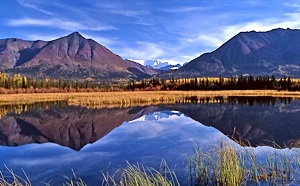
Budget cuts forced Wrangell-St. Elias National Park officials to cut their seasonal hiring positions by 24 this past summer. NPS photo of fall along the McCarthy Road in the park.
With the federal government awash in debt and the congressional "super committee" seemingly unable to compromise on a course of prudent spending, the likelihood of additional budget cuts to the National Park Service grows daily.
And additional cuts, the National Parks Conservation Association tells us today in a new report, are something the park system cannot easily shoulder.
"We are increasingly concerned that national parks are at a tipping point, and that Congress and the administration need to pay attention," Craig Obey, NPCA's senior vice president of government affairs, told reporters listening in on a conference call. "Like so many others, we're watching with concern the deliberations of the congressional super committee."
As the country struggles to regain its economic footing, the National Park Service is operating with a roughly $3.1 billion budget that is nearly $400 million less than it was a decade ago, the association explains in Made In America: Investing in National Parks for Our Heritage and Our Economy.
Whether the super committee succeeds in agreeing on how to save the country $1.5 trillion, or whether automatic cuts amounting to $1.2 trillion begin to take hold in Fiscal Year 2013, the National Park System is more than likely to be impacted to some degree. And that, NPCA says, the system cannot easily bear.
“If the super committee process fails, triggering a cut of 9 percent, the consequences will be devastating for our national parks, park visitors, and the businesses, communities, and jobs that depend on them," Mr. Obey said. "A 9 percent cut to the Park Service budget would equal approximately $231 million. The vast majority of that, about $200 million, would come from the operational fund necessary to keep the parks and the park facilities open, hire park rangers, respond to emergencies, protect our national treasures from looting and decay, hold campfire talks, and connect school groups to our national history.
“National parks already make do on a budget that’s short of the annual need by between $500 million and $600 million," he pointed out. "A 9 percent cut would quickly balloon that annual shortfall by nearly 40 percent."
Already the ramifications of inadequate funding are manifesting themselves across the system, the parks advocacy group notes.
"In FY 2011, funding for the National Park Service was reduced by nearly $140 million, including an $11.5 million reduction for operations," the NPCA report points out. "In tight budget times, it's reasonable for the National Park Service to operate frugally. But thrifty operation isn't enough to keep parks solvent: national parks today receive just 82 cents for every dollar they need to pay for the rangers who are fulfilling the experience of millions of annual visitors and protecting the parks' treasures.
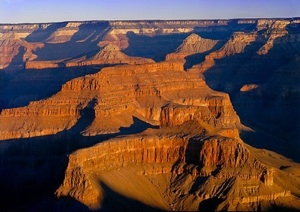
Visitors inject roughly $700 million a year into the region around Grand Canyon National park. Photo by QT Luong, www.terragalleria.com/parks.
"And threats are mounting: according to the recently-enactly Budget Control Act of 2011, if Congress is unable to agree on a level of spending and revenue that reduces the budget, programs from defense to national parks will be subject to a budgetary sequester -- which means national park budgets could be cut by as much as 9 percent."
While 9 percent might not seem like much, NPCA has provided the following glance at some of the budgetary impacts the parks already are struggling to cope with:
* The Park Service's budget for construction and routine maintenance is $325 million short of what the agency needs to provide basic maintenance for sewer and water systems, roofs, foundations, and roads.
* Grand Canyon National Park needs more than $16 million to provide visitors with safe drinking water.
* Budget cuts prompted Wrangell-St. Elias National Park and Preserve officials to reduce their seasonal employment ranks by 24 positions for the summer of 2011.
* Zion National Park can afford just one ranger to be available at night to respond to any problems in the park's campgrounds.
* Lack of funding at Acadia National Park has left 15 permanent staff positions unfilled.
* Blue Ridge Parkway's budget allows for just 170 of its 240 allocated full-time positions to be filled. Just 10 permanent interpretive rangers are on staff for the parkway's 14 visitor contact facilities.
* At Fredericksburg and Spotsylvania National Military Park, the park lacks an education specialist who could develop programs for school groups, and has unfilled positions in interpretation and maintenance.
Although national parks were set aside primarily to protect natural, cultural, and historic resources treasured by the country, the tangible economics that flow from the park system can't be ignored. For instance, the NPCA report notes that:
* Every $1 million in park construction generates 14-16 jobs. Annually, the National Park System creates 267,000 private-sector jobs, and funnels $13.2 billion into the nation's economy.
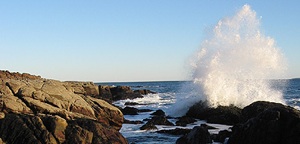
Investments in Acadia National Park handsomely reward the surrounding communities. NPS photo.
* A 2005 study pointed out that visitor spending at the Grand Canyon generated nearly $700 million annually for the region.
* Acadia produces as much as $16 in economic activity for every $1 invested in the park.
* At Big Bend National Park in Texas, visitors spent more than $15 million in the region during 2009.
* The regional economy around Shenandoah National Park received an infusion of more than $63 million in 2009, when more than 1.1 million visited the park.
Denis Galvin, a former deputy director of the Park Service, pointed to Acadia National Park in illustrating the damage a 9 percent cut could do to parks across the country. At that park, he said, hiring seasonal rangers consumes about 10 percent of the park's annual budget.
“So a 9 percent cut, if you're looking at it from the standpoint of a park superintendent, their greatest flexibility is hiring more or less seasonals. In the case of Acadia, at least, and probably in many other parks, a 9 percent cut would essentially wipe out seasonals," Mr. Galvin said. "Which means at the height of the visitor season you have nobody to staff visitor centers, give interpretive talks, provide law enforcement services, etc. It’s just very clear that anything like a 9 percent cut would be devastating to the parks and result in park closeures I think shortly after that.”
The American people, Mr. Obey offered, don't want to see such harm done to the park system.
"According to a recent polling outlined in the report, 85 percent of voters favor providing national parks with the funds they need to be fully restored and ready to serve the public for the next 100 years by 2016," he noted. "Given the federal budget situation, we don’t expect park budgets to be adequately restored in the near term. But what we are asking Washington is to please not make matters worse, either by death by 1,000 cuts for a few years, or through a near-term Draconian across-the-board cut.”
Story Categories:
A copy of National Parks Traveler's financial statements may be obtained by sending a stamped, self-addressed envelope to: National Parks Traveler, P.O. Box 980452, Park City, Utah 84098. National Parks Traveler was formed in the state of Utah for the purpose of informing and educating about national parks and protected areas.
Residents of the following states may obtain a copy of our financial and additional information as stated below:
- Florida: A COPY OF THE OFFICIAL REGISTRATION AND FINANCIAL INFORMATION FOR NATIONAL PARKS TRAVELER, (REGISTRATION NO. CH 51659), MAY BE OBTAINED FROM THE DIVISION OF CONSUMER SERVICES BY CALLING 800-435-7352 OR VISITING THEIR WEBSITE. REGISTRATION DOES NOT IMPLY ENDORSEMENT, APPROVAL, OR RECOMMENDATION BY THE STATE.
- Georgia: A full and fair description of the programs and financial statement summary of National Parks Traveler is available upon request at the office and phone number indicated above.
- Maryland: Documents and information submitted under the Maryland Solicitations Act are also available, for the cost of postage and copies, from the Secretary of State, State House, Annapolis, MD 21401 (410-974-5534).
- North Carolina: Financial information about this organization and a copy of its license are available from the State Solicitation Licensing Branch at 888-830-4989 or 919-807-2214. The license is not an endorsement by the State.
- Pennsylvania: The official registration and financial information of National Parks Traveler may be obtained from the Pennsylvania Department of State by calling 800-732-0999. Registration does not imply endorsement.
- Virginia: Financial statements are available from the Virginia Department of Agriculture and Consumer Services, 102 Governor Street, Richmond, Virginia 23219.
- Washington: National Parks Traveler is registered with Washington State’s Charities Program as required by law and additional information is available by calling 800-332-4483 or visiting www.sos.wa.gov/charities, or on file at Charities Division, Office of the Secretary of State, State of Washington, Olympia, WA 98504.


Comments
What a sad situation. The national parks depend on the taxpayer, even as more and
more money are coming from Friends groups. Also, the thousands of volunteers work
hard to fill in, where park staff is not available.
Still the primary source of funding has to be us - the taxpayer. Ultimately, we, the people, are responsible for the folks we send to Washington.
When was the last time we wrote to our legislators and said "Our national parks should be a priority"?
Danny Bernstein
www.hikertohiker.com
I totaly agree with you Danny, It is really a very poor and sad situation. I can't understand what they are doing?
Sad indeed, but is it really much different than it always has been?
National Parks have always been chronically underfunded. While the current underfunding -- and foreseeable future, too -- may be the worst in a long time, the parks have always seemed to be the poor stepchildren of the United States.
I'd love to be able to just write a letter to one of my legislators and actually get some results when I tell them parks should be a priority. But I live in Utah and my legislators hate any place that doesn't have an oil rig or mine on it --- or closely packed housing or huge mcmansions. If an acre isn't pumping dollars into the pockets of someone willing to contribute to their campaign war chests, or who will give them a lucrative lobbyist job if they're voted out of office, my legislators (in Utah they're called "loonislators") aren't going to be interested.
What we all really need to do is write to our legislators now and then follow up come election time. I'd also like to invite other concerned park lovers to consider joining us in Occupy Wall Street. If we succeed in getting the attention of people in power, national parks might benefit from spin-off results.
Wonder what the tone for priority funding for NPS was during WWII. Was everyone together in fending off the shared threats or was NPS elevated to a priority over the war machine that liberated the world. From my view the threats today are every bit as serious, more really because the culture has declined in character and more about me, me, me. Far worse now, I believe. Love the Parks but...
In WWII, the parks took their hits along with everyone else. But now, in an age of enormous corporate kick-backs and tax breaks and subsidies, the playing field is no longer level.
One day of the cost of funding the Iraq war would have paid for a few years of operating parks. So would a few months worth of corporate subsidies.
Lee I understand your frustration with our Utah legislators. Last time I wrote to one of them I recieved a scalding letter back completely bashing my beliefs. It also doesn't help that the majority of people out here hate the NPS so I'm sure the state legislators recieve many more letters against us.
Ranger Lady -- I'll have to disgree a bit with your assertion that a "majority" of people (I'm thinking you mean Utah people) hate the NPS. Based on my experience, it seems they are probably a rather small group of loud people who hate anything Federal because some of what the Feds do may interfere with some of their specialized interests.
I'll bet that even down in Wayne County, those who hate the NPS are still far short of representing 100% of your neighbors. The trouble is that too many people are apathetic or perhaps afraid of antagonizing their louder neighbors. Especially in small town Utah, it's very difficult to stand up for what one believes because there is a very real fear of being ostracized at work at church or in social circles. As a result some people tend to go underground and fail to speak out when they may wish to do so. It's really unfortunate because if they were to speak up, they might find they are not alone after all.
As for our legislators -- or loonislators, as I prefer to call them -- they are private property of those big money interests who can afford to purchase them. You can't expect them to bite the hands that feed them, can you?
So I constantly watch for opportunities to quietly educate people around me. Just a few weeks ago I was speaking with man who had a couple of left over BUSH bumper stickers on his car. When he learned that I had been a ranger in Yellowstone a thousand years ago, he began telling me of the wonderful time he and his family had up there last summer. That opened the door for me to tell him how all of us need to work together to protect our parks. I recounted some of the horror stories of the past -- of Reagan, Nixon, and Cheney/Bush. I told him of Cheney's attempt to have Paul Hoffman rewrite the NPS management guidelines and what that could have done if he'd succeeded. This gentleman was horrified to hear of it.
Yesterday we were talking again by telephone and he mentioned that he has another client who is former NPS. Then he went on to tell me that "he confirmed what you told me last month." It was pretty apparent that he'd taken my accounts with a big grain of salt. It also sounded like we won another supporter for our parks. I think we two clients managed to convert him.
So no matter how hard it may seem, or how utterly frustrating it may be, we can never give up. It's just a matter of watching for opportunities to educate and taking them. Sometimes it may actually work.
Keep smiling. And keep protecting CARE!