
It’s time for a little more TBT history, brought to you by the Traveler. This one is all about Yellowstone National Park.
Noteworthy as the world's first national park, Yellowstone's modern history extends back to the early 19th century, when mountain men John Colter and Jim Bridger found themselves in a landscape that conjured descriptions of hell and brimstone.

Lewis and Clark could have encountered the landscape we now know as Yellowstone, for they passed just to the north of it en route to the West Coast. But they were determined to reach the coast and didn't linger to explore the area.
Among the mountain men who found their way into the Yellowstone landscape were John Colter, Jim Bridger, Joe Meek, and Warren Angus Ferris, who actually was a clerk for the American Fur Co., according to Yellowstone historian Aubrey L. Haines.
John Colter passed through parts of the park in 1807-08, a trip considered the first by a white man in Yellowstone. When he told stories of gurgling hot springs, exploding gesyers and glass mountains, well, they were laughingly referred to as "tall tales" and he was thought to be crazy.
Osborne Russell was a trapper who reached the Yellowstone area in 1839, following the Snake River north out of Jackson Hole to Lewis Lake and then Shoshone Lake, where he came upon a geyser basin on the western shore. In his journal he described a small geyser called "Hour Spring" by other trappers.
...the first thing that attracts the attention is a hole about 15 inches [38 centimeters] in diameter in which the water is boiling slowly about 4 inches [10 centimeters] below the surface at length it begins to boil and bubble violently and the water commences raising and shooting upwards until the column arises to the hight of sixty feet from whence it falls to the ground in drops on a circle of about 30 feet [9 m] in diameter being perfetly cold when it strikes the ground. It continues shooting up in this manner five or six minutes and then sinks back to its former state of Slowly boiling for an hour and then shoots forth as before My Comrade Said he had watched the motions of this Spring for one whole day and part of the night the year previous and found no irregularity whatever in its movements.
As more stories drifted out of Yellowstone, the U.S. government in 1871 dispatched an official expedition into the region to investigate these tales. The expedition was led by Ferdinand Vandeveer Hayden, who, at the request of the Northern Pacific Railroad brought a young artist by the name of Thomas Moran, and William Henry Jackson, a photographer, along to document this "wonderland."
When the expedition reached Yellowstone in the summer of 1871, its members were astounded by what they saw. They watched Old Faithful belch clouds of steam and streams of hot water, clambered down to the bottom of the Grand Canyon of the Yellowstone, and sailed a boat on Yellowstone Lake. They closely examined hot springs and took samples of plants, rocks, and animals.
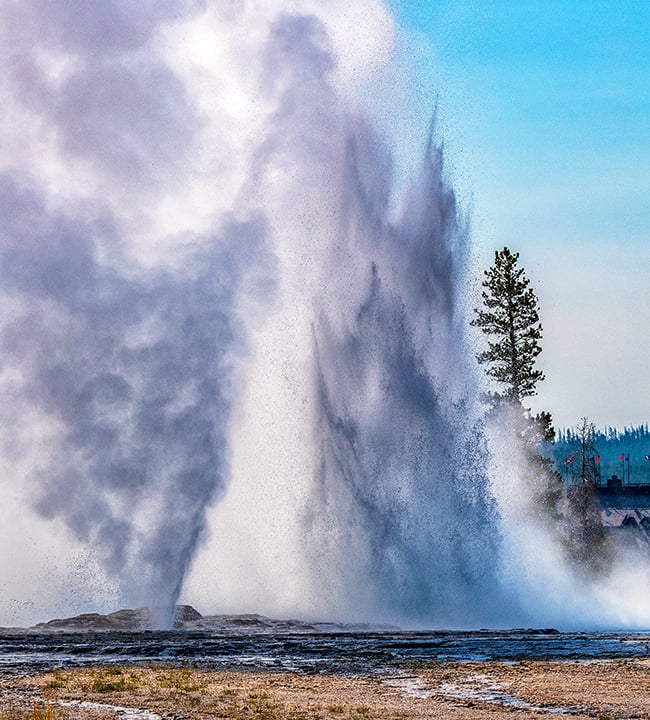
From a camp in the Upper Geyser Basin they were surprised by a geyser that erupted from a pool of water. So notable was it that the event made its way into Hayden's journal:
Soon after reaching camp a tremendous rumbling was heard, shaking the ground in every direction, and soon a column of steam burst forth from a crater near the edge of the east side of the river. Following the steam, arose, by a succession of impulses, a column of water, apparently 6 feet [1.8 m] in diameter, to a height of 200 feet [61 m], while the steam ascended a thousand feet or more. ... We called this the Grand Geyser, for its power seemed greater than any other of which we obtained any knowledge in the valley.
After a month of exploring the Yellowstone area the expedition returned to Washington with pictures, maps, sketches, and note that Hayden used to write a 500-page report. The documents helped convince Congress that the area should be protected so future generations could enjoy its wonders.
On March 1, 1872, President Ulysses S. Grant signed the legislation that made Yellowstone the first national park in the world.
If a trip to Yellowstone National Park is on your national parks bucket list (and it really should be), check out the Traveler’s Essential Park Guide for this place. The pages there should help you with your plans and preparations for a visit.

Stories about:
Story Categories:
A copy of National Parks Traveler's financial statements may be obtained by sending a stamped, self-addressed envelope to: National Parks Traveler, P.O. Box 980452, Park City, Utah 84098. National Parks Traveler was formed in the state of Utah for the purpose of informing and educating about national parks and protected areas.
Residents of the following states may obtain a copy of our financial and additional information as stated below:
- Florida: A COPY OF THE OFFICIAL REGISTRATION AND FINANCIAL INFORMATION FOR NATIONAL PARKS TRAVELER, (REGISTRATION NO. CH 51659), MAY BE OBTAINED FROM THE DIVISION OF CONSUMER SERVICES BY CALLING 800-435-7352 OR VISITING THEIR WEBSITE. REGISTRATION DOES NOT IMPLY ENDORSEMENT, APPROVAL, OR RECOMMENDATION BY THE STATE.
- Georgia: A full and fair description of the programs and financial statement summary of National Parks Traveler is available upon request at the office and phone number indicated above.
- Maryland: Documents and information submitted under the Maryland Solicitations Act are also available, for the cost of postage and copies, from the Secretary of State, State House, Annapolis, MD 21401 (410-974-5534).
- North Carolina: Financial information about this organization and a copy of its license are available from the State Solicitation Licensing Branch at 888-830-4989 or 919-807-2214. The license is not an endorsement by the State.
- Pennsylvania: The official registration and financial information of National Parks Traveler may be obtained from the Pennsylvania Department of State by calling 800-732-0999. Registration does not imply endorsement.
- Virginia: Financial statements are available from the Virginia Department of Agriculture and Consumer Services, 102 Governor Street, Richmond, Virginia 23219.
- Washington: National Parks Traveler is registered with Washington State’s Charities Program as required by law and additional information is available by calling 800-332-4483 or visiting www.sos.wa.gov/charities, or on file at Charities Division, Office of the Secretary of State, State of Washington, Olympia, WA 98504.


National parks and their natural resources belong to you. The National Parks Traveler works to ensure you know how these essential places are being cared for.
Sign Up For Our Weekly Newsletter
Unsubscribe at any time.
INN Member

The easiest way to explore RV-friendly National Park campgrounds.

Here’s the definitive guide to National Park System campgrounds where RVers can park their rigs.
Our app is packed with RVing- specific details on more than 250 campgrounds in more than 70 national parks.
You’ll also find stories about RVing in the parks, tips helpful if you’ve just recently become an RVer, and useful planning suggestions.

