
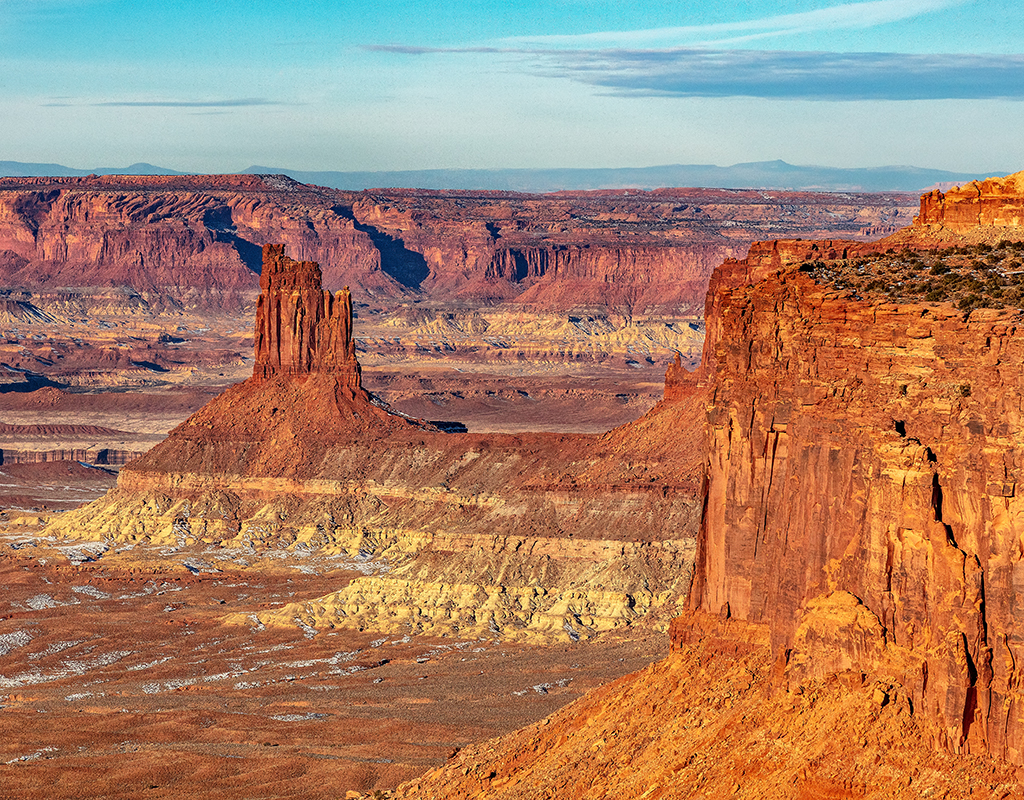
How much would you be OK with paying to visit national parks?/Canyonlands National Park vista, Rebecca Latson
How much is a national park visit worth to you? It's a question that floats to the surface from time to time when talk turns to the National Park Service's funding woes and nearly $12 billion maintenance backlog.
So, how much is too much? Instead of paying $25 or $30 per carload for a week in a park, would you be willing to pay, say, $25 or $35 per person in your car? Would you be OK with being charged a flat $100 per carload for seven days?
One-hundred-dollars per carload might seem expensive, but it also might still be a bargain, if you consider that in 1916 it cost $10 to enter Yellowstone National Park. If that $10 fee continued to rise annually with the rate of inflation, today the fee would be $244.
So, travelers, what maximum price would you place on visiting a national park? At what price point would you say, "Whoa, that's more than I can comfortably afford with my budget"?
Story Categories:
A copy of National Parks Traveler's financial statements may be obtained by sending a stamped, self-addressed envelope to: National Parks Traveler, P.O. Box 980452, Park City, Utah 84098. National Parks Traveler was formed in the state of Utah for the purpose of informing and educating about national parks and protected areas.
Residents of the following states may obtain a copy of our financial and additional information as stated below:
- Florida: A COPY OF THE OFFICIAL REGISTRATION AND FINANCIAL INFORMATION FOR NATIONAL PARKS TRAVELER, (REGISTRATION NO. CH 51659), MAY BE OBTAINED FROM THE DIVISION OF CONSUMER SERVICES BY CALLING 800-435-7352 OR VISITING THEIR WEBSITE. REGISTRATION DOES NOT IMPLY ENDORSEMENT, APPROVAL, OR RECOMMENDATION BY THE STATE.
- Georgia: A full and fair description of the programs and financial statement summary of National Parks Traveler is available upon request at the office and phone number indicated above.
- Maryland: Documents and information submitted under the Maryland Solicitations Act are also available, for the cost of postage and copies, from the Secretary of State, State House, Annapolis, MD 21401 (410-974-5534).
- North Carolina: Financial information about this organization and a copy of its license are available from the State Solicitation Licensing Branch at 888-830-4989 or 919-807-2214. The license is not an endorsement by the State.
- Pennsylvania: The official registration and financial information of National Parks Traveler may be obtained from the Pennsylvania Department of State by calling 800-732-0999. Registration does not imply endorsement.
- Virginia: Financial statements are available from the Virginia Department of Agriculture and Consumer Services, 102 Governor Street, Richmond, Virginia 23219.
- Washington: National Parks Traveler is registered with Washington State’s Charities Program as required by law and additional information is available by calling 800-332-4483 or visiting www.sos.wa.gov/charities, or on file at Charities Division, Office of the Secretary of State, State of Washington, Olympia, WA 98504.


National parks and their natural resources belong to you. The National Parks Traveler works to ensure you know how these essential places are being cared for.
Sign Up For Our Weekly Newsletter
Unsubscribe at any time.
INN Member

The easiest way to explore RV-friendly National Park campgrounds.

Here’s the definitive guide to National Park System campgrounds where RVers can park their rigs.
Our app is packed with RVing- specific details on more than 250 campgrounds in more than 70 national parks.
You’ll also find stories about RVing in the parks, tips helpful if you’ve just recently become an RVer, and useful planning suggestions.


Comments
Nothing I have a Senior pass that gets me a know any national Park for nothing
$10.00 per person with a maximum of $50.00 per vehicle. Motor homes and larger, $100.00.
I say increase the admission rates but still allow senior citizens and military receive a small discount.
I think the parks should be funded by tax dollars at an amount necessary for their protection and preservation. Anything above that that supports visitor activities should be collected at the gate or through concession fees. It would be interesting to see what that would come out to on a per person basis.
Assuming we're talking just about the big National Parks and not NRAs, NHPs etc, I'd go for $20 a person daily, $40 for a week, and an annual (one-park) pass of $100. No America the Beutiful pass, no discounts for military or seniors.
Since many national parks in locations on the East coast have no entrance fees, possibly a nominal fee at each one of these would help the funding problems which many of the large national parks have. As an example, the Smithsonian Institute museums does not charge an entrance fee. Yet as noted below the annual budget is 1.2 billion most of which is funded by federal appropriations. Have a nominal fee of $10 per person at each one of the locations such as the Smithsonian and Battle sites in the Eastern tere.
The Institution's 30 million annual visitors are admitted without charge. Its annual budget is around $1.2 billion, with two-thirds coming from annual federal appropriations. Other funding comes from the Institution's endowment, private and corporate contributions, membership dues, and earned retail, concession, and licensing revenue. Institution publications include the Smithsonian and Air and space magazines.
That's a huge assumption you're making. There certainly are countries where there's a differentiation in pricing depending on where one is from. I remember visiting China back when they still had "foreign exchange notes" that were legally the only means of exchanging foreign currency, although there was a black market for foreign currency where the rates were much better. A few times I legally got around it by buying in US dollars where the cashier just figured out what the underground exchange rate was. It's my understading that they basically never prosecuted locals for it. But visiting a park I recall the posted rates in foreign exchange currency was double that of regular money. We had some of the regular money (got it in change) and saved a bunch. Here's Komodo National Park in Indonesia, where the Indonesian citizen entrance fee is about 35 cents, while foreign visitors is about $10.50:
https://www.floreskomodoexpedition.com/komodo-national-park-entrance-fee
I certainly wouldn't want that to be the case in the United States, but there are always assorted resident/nonresident fees. We were talking about adding a fee to vehicle registration to fund California State Parks. If it passed, any state resident wouldn't need to pay a fee to get in or park. But it didn't and now residents or nonresidents pay the same fees and are eligible for the same passes. And resident status isn't dependent on citizenship.
Y_P_W - yes, countries that artificially manipulate their currencies will have non-market currency exchanges. When I went to the Soviet Union in 1971, the official conversion was 1 dollar for 1 ruble. The Russian on the street would give you 4 rubles - with the risk of both of you going to the Gulag. At the time they also had official government stores that only took foreign currency. A bottle of Vodka that cost 4 Rubles to the average Russian could be bought for 1 US dollar. Both Russia at the time- and China - are totaliarian countries. Travel today to a modernized country like England, France, Germany, Italy, Japan ...... you don't see a difference in pricing to see their sites. But I will admit, I have never been to Indonesia. Perhaps thats why.
I paid 80.00 for my annual park pass in March. This year I have been to Death Valley, Joshua Tree, Saguaro, Bryce Canyon, Zion, Great Basin, Capitol Reef, Montezuma’s Well, Montezuma’s Castle, Petrified Forrest, Grand Canyon, Walnut Canyon, Devil’s Tower, Theodore Roosevelt, Yellowstone, Grand Tetons, Glacier, Craters of the Moon and Rocky Mountain. Before my pass expires I have plans to travel to the Gateway Arch, Indiana Dunes, Cuyahoga, Shanendoah and Smokey Mountians. Most people who purchase an annual park pass do not get out to as many parks as I make it to. They buy the pass to save a little money on the big 5 in Utah or doing a batch of parks in CA. So whats the balance? If you charge people more for the pass (which I am willing to pay), You will likely sell less passes. People will make other travel arrangements and not visit as many parks. I suggest doing what Mexico does. They charge one price for citizens and another price for visitors... to me this makes perfect sense. As you can tell from above... I get around to a lot of parks, my observations are the number of foreigners visting our park are substantial. If we made the park pass for residents of the US with a valid state ID 125.00 per year and made the foreign vistitor park pass 250.00 the parks could put a big dent in the deficit. Now onto daily rates. The per vehicle charge keeps things economical for families, which is wonderful. We should keep that rate... Usually around 25 dollars per vehicle. I suggest 25 dollars per vehicle with a valid state id and 50 dollars per vehicle for visitors. As an example a family traveling from Germany with two kids and two adults would pay 12.50 per person daily rate. A family of 4 from Arizona would pay 6.25 per person. Nothing is grossly unfair about what I am proposing. It was done to me when I went to Mexico and visited Chichen Itza, Coba, Tulum, and Ek Balam even their ecological theme parks of Xcaret and Xel-ha. I did not feel it was injust. I was going to their country to see their wonders. I feel this plan could give the parks the lift they need in the budget but also keep the costs affordable for US residents and foreign visitors.
We are loving our National Parks to death. Last week I visited Rocky Mountain National Park. A park that when I was a child was peaceful and quiet. Now it’s over run with people parked on the sides of roads because someone spotted an elk laying in a meadow, even though there is no room to park, and people are walking in the road. Parking lots are filled to overflowing. People were climbing over the “Restoration in Progress-Keep Out” signs To scrabble up a hill that clearly was unstable. There’s no way the Park Service can keep up With this sort of wear and tear on our National treasures. As much as it pains me to say it, because I don’t think anyone should be denied the opportunity to see America the Beautiful, and it shouldn’t be an economic hardship to do it, I think we’re either going to have to charge $100.00 a week per car, $400.00 for an annual pass, or were going to have to start bussing people in, and supervising them and charging per person for the “tour”.
it should definitely be more than it is. I think $150-$200 per car is good.
I’d easily pay $100 per car. It’d Be the best deal in America!
you can’t put a price on how beautiful our national parks are and the amount of activities are boundless
a modest payment for a day, days or weeks at the majority of parks are priceless
Protecting these lands, ecosystems and wildlife are paramount
Buy the annual pass even if you plan to experience only one or more parks It’s a great value hands down and if you only make it to one think about the remainder as a charitable contribution
I think most people, myself included would be willing to pay more to upgrade and protect our national heritage.
POV 100. Buses 25 per person. Local annual pass per park 300 Per year.
Each year, I pay $80 for an annual national parks pass. That is a huge bargain! I would be willing to pay $400 for the same annual pass. Our national parks are one of our country’s greatest treasures. The fact that we have a $12 billion infrastructure problem is unconscionable. Theodore Roosevelt and John Muir are spinning in their graves knowing what our current administration has done to our national parks.
I wonder if maybe doing an adjustable fee based on peak times of day and/or seasons could work? Charge more at the peak times and less during slower times. There are some turnpikes that operate that way I believe.
tazz, who would be driven out of summer visits by that approach?
i would pay as much as 100$ or more, as the pleasur I get from going to these sites is much more than going to man made theme parks, which charge 100-200$ per person per day. with that money more land should be bought to espans rhese paradises.
First and foremost, all U.S. Citizens should be guarenteed one visit to every National Park Service unit at no cost or minimum. Secondly, foreign visitors should pay a premium for access and this should be regulated. (I recently visited a NP where I felt 9 of 10 people were foriegn visitors. That is overwhelming.) Thirdly, "local users" should pay significant annual fees for repeated use. Some parks are almost wholly used by locals. Fees should reflect use, just as corporate support should reflect benefits as well as impact on the U.S. environment. Finally, during the past three weeks, I visited 20 NPS units by car purchasing about $850 in gasoline. With my senior pass and other discounts my van-camping has probably averaged $25 a night so $500. I am capable of paying a similar amount for use, but again, every person should have access once without concern for fees. I must also say that having visited 259 NPS units, that the education and insight gained from our NPS units is invaluable. I do not know how to put a 'tuition' on such higher learning. Hope this makes sense. (By the way, keep the military and seniors discounts -- they earned the extra consideration.)
As others mentioned, equivalent entry fees at other theme parks approach $400.00 for a family of 4, seems like a visit to one of our major National Parks would be a bargain at $75.00 per person. The $80.00 pass I purchased for the 2018 season allowed me into southwestern destinations last year. This year we spent a week in the Smokies and the park was free. I think that those of us who use the parks should pay much more than the current rates. No less than $100.00 per vehicle, and a yearly pass should be no less than $360.00. If that seems high, then consider all the other things we value highly, and justify the cost to ourselves. The current load of visitors to the parks is not sustainable, a higher use fee will encourage fewer impromptu visits, less damage, and greater conservation for my children and their children’s visits to the Nations public resources in decades to come. Public does not equate to free, and most things which are free or low in cost are generally worth about just that.
We went to Yellowstone, Grand Teton, and Little Big Horn this summer. I would gladly pay more for entry for a season pass no problem and since we knew we were going to see all three it made sense. Plus we went in and out of Yellowstone 3 different but nto consecutive days. I like the idea of $25 -30 per head for day entry. Per car not is fair as RV can hold more people, I saw up to ten getting out of one and it many children. Those tour buses should not be allowed or pay way more. They also get easy in and out bus parking and cars wait and wait for a space and then we deal with even more crowds when they offload. I don’t mind the passenger vans for touring companies but these buses are ridiculous. There aren’t enough restrooms at trailheads because you have lines of people getting off or on a bus coming in and out. Just saying I was thankful we knew our way around the park and where to go to escape the tours. We don’t want to make it affordable for families but prices can go up for all that our National Parks give back to us in beauty and amazement.
Commercial tour vehicle have to pay a cost for their size. I'm kind of OK with it as one tour bus takes up less space on the roads and parking lots than 15 cars averaging 3 passengers each.
I take my family when I go but they would rather be somewhere else if I ask them. And you can’t compare it to Disney, it’s not an amusement park. I paid more because there’s no other choice but I been there only twice. That being said, I will pay $25 per vehicle if going alone and nothing over $50 if there’s 4 or more per vehicle. For tour buses, that’s another story, I would pay $10 per person if I’m in a bus. Tour operators can arrange that ahead of time.
i do not recommend raising fees. I feel $10-$15 per day per car is adequate. We already find the parks through our tax dollars. We can’t pick up wood from the ground to make a campfire, but itnisnok for a camp host to gather it and then sell it to us. We are over regulating and making it difficult to see and enjoy the wonders of our country. Soon the parks will only be for the animals and park officials. We won’t be able to see them for ourselves.
$25.00 per car per day is certainly reasonable. To be honest our National Parks are a bargain at just about any rate.
I would add that the $80 is not a "National Park Pass" per se. It's a federal recreation pass and includes entrance and sometimes parking at US Forest Service, Bureau of Land Management, Bureau of Reclamation, and Army Corps of Engineers fee sites. I do remember that I was planning on making a trip in December 2006 before the shift from the $50 National Parks Pass to the $80 America the Beautiful Pass. And even back then it was a $65 interagency pass or a $15 sticker to add to the National Parks Pass.
And I looked at the older Golden Age Passport that my parents each have. It strangely enough includes the Tennessee Valley Authority, which I believe operates water-based recreation around dams as well as campgrounds and day use areas.
the $25 weekly fee can go up to $40. I am ok with that. But then there should be option for a cheaper 2-day passes too for people visiting over weekend or a day.
Wsince foreign visitors do not pay federal taxes that in theory should be helping to fund the maintenance costs, they should pay a higher fee To visit the parks before increasing the fees for every American that already pays taxes.
$25.00 a day and $150.00 for a seven day pass would be fair. The parks are beautiful national treasures. They need to be staffed and maintained for future generations.
I would definitely pay more ($100) to help with getting the parks in shape. Smokey Mountains National Park charges nothing and it’s the most visited park there is. They should charge a modest fee at least. We purchased a pass last year to visit several western parks and many didn’t have anyone collecting fees or checking passes at the gates. Not enough money to pay them I suppose. Our parks are our greatest treasure and we should be willing to pay a little more to take care of them.
If the rationale for charging international visitors more is that they don't pay income taxes, then what about the 44 percent of Americans who don't pay income taxes? By your own rationale, shouldn't they also pay more? As for calls to provide low-income discounts -- how would this be handled? At the entrance gate to Yellowstone, how do you determine if someone is low income?
That's not going to change. When Tennessee ceded some of its land to the National Park Service, it was under the condition that there couldn't be an entrance fee.
A survey for 'how much would you pay to visit a national park' is interesting, and I'm ... enjoying?... reading the responses. But my comment goes to the issue of, "WHERE WOULD THOSE FEES GO?" With this current administration diverting or cutting funds from practically every agency that does something good for the American people, I have zero trust that ANY increased fees would actually get to the parks. And that is what has driven - and currently drives - the maintenance backlog in parks. I also agree with the comment about busloads of visitors in the parks, that tour buses should pay a significantly higher (or even a non-discounted per person) fee, since it DOES tax the park resources.
People have no problem paying for entrance when they see their dollars at work. For example, fee revenue in Acadia National Park helps to subsidize free bus transportation, greatly relieving the pressure on roads and parking.
Eliminating many of the special discounts would help a lot. Active duty military and their families should still be given free admission because they do not get paid much to put their lives on the line for the rest of us. At age 77 I was able in the past to buy a $10 lifetime fee. Seniors have plenty of leisure time and receive government benefits due to their age. They should pay the same fees as everyone else.
A weekly fee is better than a daily fee. Too many people come to Acadia, drive around and see the sights in one day. Parks should no longer publicize specific sights such as Thunder Hole and Cadillac Mountain in Acadia or Old Faithful in Yellowstone. Visitors should be encouraged to take a holistic view of the park and spend some time exploring.
Unlike others I think bus travel should be encouraged. Acadia charges commercial buses by the passenger. In effect, bus passengers are paying more per person than a group in a private automobile. Many who are unable to drive such as those with disabilities would not be able to visit without taking a bus tour.
hi would like to see prices for daily or weekly entrance lowered to ten to twenty dollars so you enable more young families access to all our majestic national park areas and provide experiences for them to share with each other. this is how you will save these wild lands. NOT by allowing further oil and gas exploitation.
$25 to $40 daily or $100 weekly feels reasonable. And I agree bus fees should go WAY up. Those profiting from the parks should pay. Most traveling to parks have budgeted significantly for the travel. They can budget the entry fee.
I would pay a historic related amount which should be about 10-20$ flat entry fee per vehicle
I think $50 per vehicle; $25 per person for large groups, such as buses or large vans. Also, government needs to do its part & adequately fund our National Parks.
In many other countries I have visited, non-locals pay a higher fee for museums, parks, and other government owned or run facilities. This is so common that I'm used to it, and it makes sense to me. I agree with other posters that visitors from other countries should pay more, since they aren't paying the taxes to support our national parks. If they can afford a vacation in the USA, they can afford higher NP entry fees, especially since the current fees are so low
Personally, I have a lifetime NP pass, so it's hard for me to answer what I would pay per trip!
That's actually pretty unusual for any developed country. I looked up what they do in Australia, Canada, or the UK, and entry fees to national parks don't depend on citizenship or permanent residency. The only thing I know of our federal lifetime passes is that they're supposed to be limited to US nationals and permanent residents, but all other fees are the same. I have no problem with it as it's similar across developed countries.
I‘d prefer to keep entry fees low, so that the park experience doesn’t filter out lower income individuals and families, but increase incentives, like a poster or book or special pin, to reward those able and willing to pay more. Similar to how public radio operates. Visiting our National Parks shouldn’t only be for those who can afford to pay more.
Pages