

As Vanessa McDonough scanned the ocean floor off the South Florida coast, she spotted an empty beer bottle among the fish, corals, and sponges protected by Biscayne National Park. Only the bottle wasn’t empty. Upon closer examination, a small fish had swam inside, and pebbles and shells had blocked the exit.
“The poor fish was a prisoner in this Corona bottle,” she said.
That fish was granted a reprieve, as Mrs. McDonough set it free before removing the bottle from the seabed, but other underwater organisms haven’t been so lucky.
No one knows how much debris from humans is littered about Biscayne’s marine ecosystem, so park scientists have begun a study to document and clean up trash from the ocean floor in hopes of improving the environment and gaining a better understanding of where garbage accumulates. With global warming and disease already impacting the health of the park's coral reefs, debris from humans adds another threat to this delicate ecosystem, so they’re also tracking injuries and mortalities.
“The corals are already struggling,” Mrs. McDonough, a fishery and wildlife biologist at the park since 2007, said during a phone interview. “Then you throw a 50-pound anchor at them, and it’s not a pretty picture.”
Yes, anchors. “More anchors than I can count,” she said. Plus lobster traps, fishing weights, monofilament line, bottle caps, fishing weights, and so much more.
Every year, a half-million people flock to Biscayne, many to dive or snorkel among the colorful fish and coral reefs that are unique to the area. The largest marine park in the National Park System, more than 95 percent of Biscayne is covered by water. Boating and fishing are also popular activities, and that appears to be the source of much of the marine trash, with decades of accumulation from commercial trapping and recreational fishing.
The need for the study became clear while biologists were diving late last year to track lionfish, an invasive species, along Biscayne’s eastern boundary – where the ocean floor drops from 60 to 100 feet, and where a lot of boaters and fishermen congregate.
“It became painfully obvious how much garbage is down there,” Mrs. McDonough said.
In addition, a no-fishing Marine Reserve Zone, where only snorkeling and diving would be allowed, is included in the park’s recently approved General Management Plan. From a preservation perspective, the designation would aid in recovering fisheries and improve the health of the only tropical coral reef system in the continental United States. From a recreational standpoint, snorkelers and divers could admire the wildlife without garbage marring the experience.
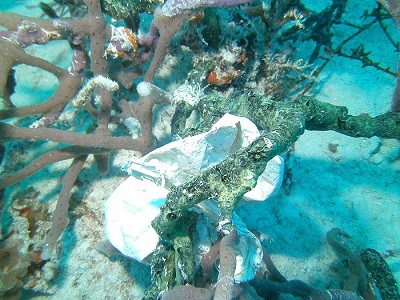
The park selected 12 sites – six within the proposed Marine Reserve Zone and six outside -- to study. Each zone is 100 meters long by 10 meters wide. Three divers split up each area, spending about an hour going back and forth over the site at least two times. They scrutinize every part of the reef, in the process documenting the debris and injuries, and then removing what they can.
“If they’ve (debris) become overgrown with stony corals, for example, we don’t want to do more harm than good by taking them out of the environment and killing the corals, so we’ll just note their location and leave them there,” Mrs. McDonough said.
Sponges can grow through abandoned trap line, so “strategic cutting” could be necessary. A bit of the line would be left in the sponge, but cutting around the edges removes, for instance, 50 feet of line on each side that would have been pulled with tidal movement.
The scientists will return to each zone every three months to understand the different types of debris, how much there is, and how much damage it’s causing.
“From that, we’ll be able to calculate accumulation rates – how quickly is garbage regenerating there – and hopefully compare if garbage is accumulating at a slower scale within the Marine Reserve Zone where people won’t be fishing,” Mrs. McDonough said.
The park has completed its first dive at just half of the sites and already has collected 306 pounds (139 kilograms) of debris.
“It’s always hard to wrap your head around that because a lot of times also we’re picking up so much monofilament, and that doesn’t have mass, so you don’t get the essence of that,” Mrs. McDonough said. “But that includes things like anchors and lobster traps that are very heavy.”
So far, 750 individual impacts on organisms have been observed, including more than 400 sponges, as well as a lot of soft corals.
“More injuries than deaths, but we are documenting mortalities as well,” she said.
This information can assist park managers in determining where and how frequently reef cleanup efforts should occur. Biscayne does not have an ongoing debris removal program. Currently, some of the money collected as fines from boaters who run aground in the park is directed to habitat restoration that’s carried out by contractors. But it’s not a substantial amount of money, so most of the seafloor hasn’t been touched.
For the new study, park staff are adjusting their schedules, and it’s “turning out to be a pretty large effort.” In order to cover two zones in one day, half of the 12 people in the resource management division are required since the same three people can’t dive both areas without concern about decompression sickness.
“We’re doing it, but it comes at a cost of other things that we’re unable to do,” Mrs. McDonough said.
Biscayne offers guidelines to visitors for preventing and picking up debris. While boating, never intentionally dispose of garbage by tossing it overboard. Instead, keep trash confined and secured to prevent it from unintentionally getting blown or otherwise dumped overboard. Trash observed in a marine environment can be removed as long as it is safe to do so. (Gloves will help protect against rusty edges, sharp points, and stinging critters that settle on the debris). Large-scale occurrences of marine debris should be reported to the park, with the precise location.
And those actions are important because, while items from all over the world are found during shoreline cleanups, most of the debris below the ocean surface is from people who are using the park, such as fishermen who toss a beer bottle overboard.
“Unfortunately,” Mrs. McDonough said, “the stuff that’s underwater is from the local users.”
Stories about:
Story Categories:
A copy of National Parks Traveler's financial statements may be obtained by sending a stamped, self-addressed envelope to: National Parks Traveler, P.O. Box 980452, Park City, Utah 84098. National Parks Traveler was formed in the state of Utah for the purpose of informing and educating about national parks and protected areas.
Residents of the following states may obtain a copy of our financial and additional information as stated below:
- Florida: A COPY OF THE OFFICIAL REGISTRATION AND FINANCIAL INFORMATION FOR NATIONAL PARKS TRAVELER, (REGISTRATION NO. CH 51659), MAY BE OBTAINED FROM THE DIVISION OF CONSUMER SERVICES BY CALLING 800-435-7352 OR VISITING THEIR WEBSITE. REGISTRATION DOES NOT IMPLY ENDORSEMENT, APPROVAL, OR RECOMMENDATION BY THE STATE.
- Georgia: A full and fair description of the programs and financial statement summary of National Parks Traveler is available upon request at the office and phone number indicated above.
- Maryland: Documents and information submitted under the Maryland Solicitations Act are also available, for the cost of postage and copies, from the Secretary of State, State House, Annapolis, MD 21401 (410-974-5534).
- North Carolina: Financial information about this organization and a copy of its license are available from the State Solicitation Licensing Branch at 888-830-4989 or 919-807-2214. The license is not an endorsement by the State.
- Pennsylvania: The official registration and financial information of National Parks Traveler may be obtained from the Pennsylvania Department of State by calling 800-732-0999. Registration does not imply endorsement.
- Virginia: Financial statements are available from the Virginia Department of Agriculture and Consumer Services, 102 Governor Street, Richmond, Virginia 23219.
- Washington: National Parks Traveler is registered with Washington State’s Charities Program as required by law and additional information is available by calling 800-332-4483 or visiting www.sos.wa.gov/charities, or on file at Charities Division, Office of the Secretary of State, State of Washington, Olympia, WA 98504.


Comments
I stopped reading when I reachd "global warming"
Good, Joe. I would not want you confused with scientifically-supported facts.
Tell us Rick, why have the predictions based on those "scientifically-supported facts" been so wrong? Maybe because they are neither scientific nor facts.
Don't get into it, Rick. He thinks he is a scientist and Neil deGrasse Tyson isn't. He's not going to change - just let his grandchildren be quietly embarrassed by cranky old grampa.
He thinks he is a scientist
Of course I have never said any such thing. More of your baseless accusations. I am familiar, however, with the scientific method which requires repeatable results. The AGW folks haven't gotten it right once much less generated repeatable results. Perhaps you can explain "why have the predictions based on those "scientifically-supported facts" been so wrong?" But probably not.
I am no cranky old grandpa, although I do qualify by age. When I was a kid, my aunt moved to Florida from Binghamton, New York. I looked Florida up in my World Book Encyclopedia and saw it had just under 3 million people (the 1950 Census). Now how many people does it have? Try 19 million (the 2010 Census). 60 years and a sixfold increase. And you wonder why Biscayne National Park has a garbage problem?
Global warming is but the tip of the iceberg. So far, the only prediction made in the 1960s that has actually come true is that people would be crawling all over this planet by now--and that the greatest problem would be in Third-World countries.
Just because we are not a Third-World country--yet--does not mean that the plastics, papers, PCBs, oils, etc., etc., etc. are not collecting in our waters, too. Here in Seattle, we like to think of ourselves as green. However, do we have any law prohibiting a car from dripping oil or antifreeze into our streets? Oh, we may have such a law, but do we enforce it? No. We simply sit back and blame global warming again. It's so much easier than cleaning up our mess, which goes straight into Puget Sound via every storm sewer, pardon me, runoff facilitator system.
For that matter, north of us, in Victoria, British Columbia, they don't even treat their municipal waste. Nothing, nadda, nix. And they worry about melting ice? The Straits of Juan de Fuca, which we share, have 70 plus orcas to protect. Fish gotta swim and birds gotta fly, but they don't last long if they try (Thank you, Mr Lehrer).
One would think, were global warming that serious, we would take care of the easy stuff first. Then why don't we, rather than stand on the beach waiting for the seas to rise? We don't because the problem got away from us in the 1960s--and that problem was population.
I don't necessarily disagree that "population" is an issue. I'm just curious what your solution to the population problem would be?
A fair question, EC, and let us keep it close to home--since home and not the world is the only thing we control.
No tax breaks for having children. Rather a tax break for NOT having them. Up to two you get to deduct. After two no deductions. We need 1.8 children for replacement, and replacement is good to do. Look at Europe falling below the replacement rate.
Then nothing that encourages other countries to transfer their population problems back to us. No jobs at home? That's a problem you will have to solve. By the way. The Philippines seems to be solving it, with more workers abroad returning home.
Tough love? You bet. But it is no longer the nineteenth century anywhere. Then the United States could absorb 30 million people and prosper--since the majority of work was unskilled labor and farming.
But, humanitarians protest, we are the consumers. The rest of the world is but a pittance of the problem. True enough, but only true to a point. Numbers matter anywhere, especially in poorer countries, and they are starting to matter here. Not everyone can become a computer whiz, and we kid ourselves by saying they can. In Seattle, even that computer whiz can barely afford a house, and suddenly has to pay 15 percent more in property taxes than last year. Seattle has a big heart, now that it is everyone else's wallet, but how long can that go on?
In short, discipline and responsility. Not your average political choice.
In general I don't think tax policy should be used with the intent to drive behavior. Further, my guess is that the drivers of excess population are probably in a tax bracket where child deductions are meaningless. More effective would be the elimination of the giveaways for having children.
I agree with your immigration stance, that certainly would help us in the US but wouldn't address the overall world problem.
The drivers of population are indeed the rich and the poor, although the poor tend to have many more children overall, since they are a far bigger proportion of the population to start with.
One thing we know. Practically everyone now alive on the planet will be dead within 70 years. If we can wisely employ birth control, the issue will take care of itself. The problem is: We haven't started yet, that is, started with the conviction that population is the problem--as we dared say in the 1960s. By the 1980s it was politically incorrect on practically every college campus in the land. In 1993, when I taught population in a summer course at the University of Montana, I was virtually shunned. The ringleader, from an extended family of 47, demanded I be removed from the course--a course on conservation biology, no less. You mean I can't talk about population? No! I find your conclusions offensive. Yup. That's "higher" education these days.
Now we have "safe zones," both mentally and physically, so we needn't offend a soul. We ask our presidential candidates to be presidential (i.e., speak in code) so no one need get upset. That is why we see stories that population is under control. A few more billion people and the population bomb will fizzle to an end.
Indeed, optimism is a wonderful thing, until someone refuses to share your optimism. Perhaps I should apply again to teach at the University of Montana, only this time fill my syllabus with trigger warnings and agree that I will not talk about anything that matters.
And how would you propose doing that? Are you proposing some kind of governmental action or do you think it can be accomplished through "education''?
BTW, I read the birthrate in the 1890s was 7+ and now we are now under 2. The rate to sustain the population is 2.1, so you may be crying Chicken Little here - at least when it comes to the US.
Yes, the birthrate in the 1890s was seven plus. The key is also the death rate. Death rates dramatically dropped after World War II, while birth rates still averaged in the high threes. Still in 1960 the prediction was that the U.S. by 2000 would have 400 million people.
It didn't "happen," but we still got 300 million--up 140 million in 40 years.
I don't propose doing anything, EC. I think the time for that is past. I am just not going to pull my hair out and scream global warming on cue. I know better what is the "cause," just as I know that no politician wants to solve it--and probably not people at large, for that matter. Those conversations always begin with "but." But I can afford it. But "we" shouldn't interfere. But Professor Runte, you make me feel bad. Can we admit that we simply disagree?
If you want to get serious about a problem, you have to see the problem, that is, admit there is a problem. That is what everyone tells me when they mention CO2. I admit it. I just want to address the problem behind it, or else addressing its byproducts won't accomplish a thing.
Vanessa and the RM Staff have their work cut out for them. Between invasive species, marine debris, and the million boat owning morons in Miami that don't know how to use a trash can or a navigational chart, the natural resources in that park are in a precarious situation. As a former BISC RM diver, I've seen it first hand and it ain't pretty.
Thanks for an on-topic comment, Max. Refreshing.
Dittos Max.
A million boat-owning morons indeed. No, it is probably just a few thousand, but again, that is all it takes. If you want to solve this problem you don't start by dissing the entire population, right? You go after the perpetrators--and again my point. No one insists we do that, since society now trains us to be tolerant and not judgmental of anyone else. So we accuse the action and not the bad actors. We call all people who like boating morons rather than give big, fat, wallet-busting tickets to the offenders, and in this case confiscate their boats. Same on the highways with DUIs. Within a day, the offender is driving again on a suspended license. Why? Because the judge didn't take his car, which he still "needs" to drive to work.
Now, that may not be a refreshing, on-comment topic, but it does happen to be why these problems persist. There is no penalty that fits the crime. There is no discipline, merely hand-wringing and finger-pointing. Another news release and still another. We need to be tolerant educators. Yes, but unfortunately it never works.
Good conversation on population etc.
I just want to say thank you to Vanessa McDonough and all the good people who work with her for choosing to go into this line of work, putting the hard work and hearts into their jobs and trying to make a difference in this world against insurmountable odds.
Just spend an hour at any south Florida boat ramp and the reason for all the stupidity will become crystal clear. LOL