
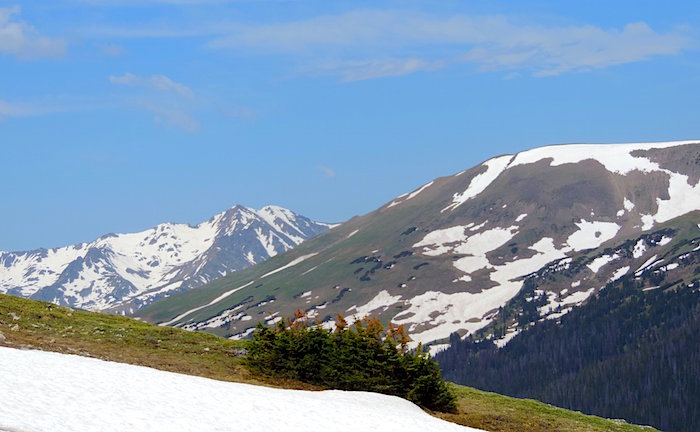
There are two essentials for the birder exploring Rocky Mountain National Park. First, make time to look for the tundra birds along the 11 miles of Trail Ridge Road above tree line. Secondly, and even more importantly, make absolutely certain at least one licensed driver in the car does NOT suffer from acrophobia.
An acute fear of heights manifests itself differently for different people. Most people have a healthy and normal appreciation for the danger of heights that might prevent them doing things like the late Dean Potter’s slackwire stunts in Yosemite. I am one of the unfortunate few who takes it to irrational extremes. If there’s a ledge with no obstruction, I can’t be closer than my own height to the edge without my knees going weak and feeling nauseated. If there are dense shrubs or a waist-high barrier, I’m fine. Driving is a similar story. If the car can’t move at least one car-width off the road without tumbling into oblivion, I’m in a literal panic.
So, I went up Trail Ridge Road with a companion whose acrophobia becomes extreme when she’s able to see the full expanse of the slope with no obstructions. Above treeline, the road has few barriers and the edge is often less than a yard past the white line. I have no problem keeping my car between the lines anywhere else, so it’s illogical to think I’d drive off the edge up there, but such are phobias.
We made it, but we didn’t enjoy the drive (I rode shotgun and offered moral support) and it made the birding less enjoyable than it could have been. I didn’t get to see two of my targets, White-tailed Ptarmigan and Brown-capped Rosy-Finch. They were there and they’ve been found there around the day I was there, but my ambition to search for them was limited.
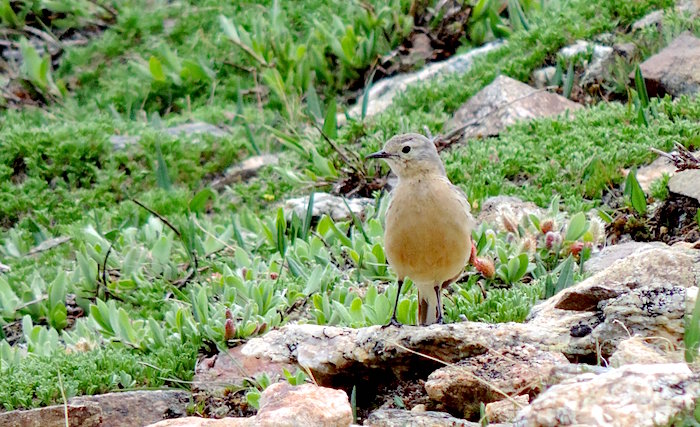
What I did find that took my mind off of falling to my death was a wonderful display of American Pipits on their breeding territory. A walk from the Alpine Visitor Center out the Pass Trail took us through the territories of at least several pairs of pipits. It was a real treat to see this unique bird in a whole new light.
The first time I saw an American Pipit, I knew without question that it was a shorebird. It was foraging shorebird-like in muddy agricultural fields during spring migration in Ohio. It was cryptically brown and had a longish, pointy bill. Obviously a shorebird. Except pipits are not shorebirds, but rather perching songbirds just like a chickadee or a crow.
Throughout most of the United States, they’re birds that will be seen only in migration, usually in habitat frequented by shorebirds. The summer finds them in arctic and alpine tundra, and it turns out the roof of the Rockies in Colorado is host to their summer displays.
It’s a good thing pipits make a good deal of noise. You’d think tundra birding would be easy, given the lack of obstructions, but you’d be wrong. The birds are cryptic and move stealthily. American Pipits make the process easier on their breeding grounds by performing loud aerial displays, chirping shrilly as they flutter up 50 feet into the air – where you can actually see them! Then they glide gracefully back to the ground. If they land in a snowfield, you can track them easily enough, but if it’s among the rocks and tortured alpine vegetation, you’ll need to not even blink or risk losing them.
I saw a couple dozen of these displays on a short walk and got to watch a pair forage not far from the trail for several minutes.
A few Common Ravens passed over, some Horned Larks frolicked around downslope from the trail, and a couple American Robins stopped by for a minute. Other than that, the only birdlife was the constant singing of White-crowned Sparrows, the background noise of the Colorado mountains.
White-tailed Ptarmigan have been spotted recently just off the trail at Medicine Bow Curve and Brown-capped Rosy-Finches were spotted a couple days after my visit at the Rock Cut. I’ll have to catch them the next time. Meanwhile, I’ll be birding back down below treeline and having fewer panic attacks.

Stories about:
Story Categories:
A copy of National Parks Traveler's financial statements may be obtained by sending a stamped, self-addressed envelope to: National Parks Traveler, P.O. Box 980452, Park City, Utah 84098. National Parks Traveler was formed in the state of Utah for the purpose of informing and educating about national parks and protected areas.
Residents of the following states may obtain a copy of our financial and additional information as stated below:
- Florida: A COPY OF THE OFFICIAL REGISTRATION AND FINANCIAL INFORMATION FOR NATIONAL PARKS TRAVELER, (REGISTRATION NO. CH 51659), MAY BE OBTAINED FROM THE DIVISION OF CONSUMER SERVICES BY CALLING 800-435-7352 OR VISITING THEIR WEBSITE. REGISTRATION DOES NOT IMPLY ENDORSEMENT, APPROVAL, OR RECOMMENDATION BY THE STATE.
- Georgia: A full and fair description of the programs and financial statement summary of National Parks Traveler is available upon request at the office and phone number indicated above.
- Maryland: Documents and information submitted under the Maryland Solicitations Act are also available, for the cost of postage and copies, from the Secretary of State, State House, Annapolis, MD 21401 (410-974-5534).
- North Carolina: Financial information about this organization and a copy of its license are available from the State Solicitation Licensing Branch at 888-830-4989 or 919-807-2214. The license is not an endorsement by the State.
- Pennsylvania: The official registration and financial information of National Parks Traveler may be obtained from the Pennsylvania Department of State by calling 800-732-0999. Registration does not imply endorsement.
- Virginia: Financial statements are available from the Virginia Department of Agriculture and Consumer Services, 102 Governor Street, Richmond, Virginia 23219.
- Washington: National Parks Traveler is registered with Washington State’s Charities Program as required by law and additional information is available by calling 800-332-4483 or visiting www.sos.wa.gov/charities, or on file at Charities Division, Office of the Secretary of State, State of Washington, Olympia, WA 98504.


National parks and their natural resources belong to you. The National Parks Traveler works to ensure you know how these essential places are being cared for.
Sign Up For Our Weekly Newsletter
Unsubscribe at any time.
INN Member

The easiest way to explore RV-friendly National Park campgrounds.

Here’s the definitive guide to National Park System campgrounds where RVers can park their rigs.
Our app is packed with RVing- specific details on more than 250 campgrounds in more than 70 national parks.
You’ll also find stories about RVing in the parks, tips helpful if you’ve just recently become an RVer, and useful planning suggestions.

