
Editor's note: The following is a rebuttal to Dr. Daniel Botkin's Oct 26 column on climate change, and his contention that global warming is not being caused by human activities. Collaborating on this response were Dr. John Lemons1, Dr. Owen Hoffman2, Lyndel Meikle3, and Ron Mackie4
Introduction
We have a lifelong dedication to national parks and are concerned about Dr. Daniel Botkin’s recent guest article in National Parks Traveler. Our combined backgrounds as scientists and as National Park Service employees leads us to question Dr. Botkin’s use of outdated information and data not accepted by an overwhelming majority of climate change scientists in his article “Climate is Changing, and Some Parks are Endangered, But Humans Aren’t the Cause.” This was his rebuttal to the report on threats to the parks by staff from the Union of Concerned Scientists. Dr. Botkin’s use of information makes it more difficult for the U.S to develop meaningful responses to human–induced global climate change, including protection of National Park Service lands. Our intended audience is people who are not experts in global climate change but who want solid, verifiable and current wisdom about its human attribution.
The sound counter–rebuttal by staff from the Union of Concerned Scientists ably addressed many of our concerns. Some concerns remain. Our concerns and the evidence we provide in rebuttal to Dr. Botkin’s article are supported by overwhelming scientific conclusions that there is a very high probability that human–induced global climate change, due primarily to fossil fuel use and secondarily to land use changes, is already happening. There are numerous reports from the world’s most authoritative scientific body on global climate change, the Intergovernmental Panel on Climate Change; reports from over 20 nations’ national academies of sciences; several reports from the U.S. National Academies of Sciences; reports from the U.S. Global Change Program; and literally many hundreds of independent scientific studies. Further, every scientific organization in the United States that deals with global climate change agrees with the scientific conclusions mentioned above.
Much of Dr. Botkin’s article focuses on a few arguments that there is no evidence of human–induced global climate change. The evidence he uses to support his views are not accepted by the overwhelming majority of global climate scientists, creating a false impression among people who are not experts in climate change that such scientists are uncertain about whether human–induced global climate change is already occurring and that it will become much more serious and irreversible unless urgent mitigation measures are adopted. A few examples of serious and for all practical purposes irreversible changes are loss of summer north pole sea ice; destabilization of the Antarctic and Greenland ice sheets; significant sea level rise; some regions becoming warmer and others cooler; increases in regional droughts and floods; shifts and losses of food producing regions; increases in various human health diseases; significant losses of biodiversity; and increases in regional wars due to conflicts over dwindling and impacted resources and whose livelihoods people depend. Recent surveys show that about 98 percent of climate scientists believe that human–induced global climate change is occurring. So, if Dr. Botkin wishes to go against the grain of the aforementioned conclusions and scientific consensus, he should present some firm evidence. And this, he failed to do.
For the most part, we limit our discussion and use of evidence to issues Dr. Botkin discusses directly; however, in some sections, including our concluding thoughts, we raise some additional issues because of their importance.
Has the Earth Been Warming?
Dr. Botkin devotes three paragraphs to the Medieval Warm Period followed by mention of the ‘Little Ice Age.’ But, he does not say why he discusses these climate events or their significance to conclusions about human–induced global climate change. Perhaps the reason he discusses these events is to demonstrate that historically there has been natural climate variability.
Scientists know very well about natural climate variability and take it into account when making conclusions about global climate change. However, Dr. Botkin does not mention that the Medieval Warm Period and the ‘Little Ice Age’ were regional to parts of Europe and other areas in northern latitudes, and largely irrelevant to the contemporary issue of human–induced global climate change. Further, Dr. Botkin mentions a single paper by Ross McKitrick, an economist, as the basis for his conclusion that there has been no warming of the earth’s atmosphere during the past few hundred years. McKitrick’s paper has gained no traction in altering the consensus of scientific conclusions about the significance of human–induced global climate change.
Consider some of the conclusions in the recent AR 5 report by the Intergovernmental Panel on Climate Change. One, that human influence on the climate system is unequivocal, and many recent observed changes are unprecedented over decades to millennia with widespread impacts on human and natural systems–the atmosphere and oceans have warmed, the amounts of snow and ice have diminished, and sea level has risen. The changes also are unprecedented with respect to both the amount of change and the rate of change. Two, each of the last three decades has been successively warmer at the earth’s surface than any decade since 1850. The period 1983–2012 was very likely the warmest 30–period of the last 800 years and likely the warmest 30–year period of the past 1400 years. Three, ocean warming dominates increases in energy stored in the climate system with subsequent changes in regions of high salinity where evaporation dominates and in regions of low salinity where precipitation dominates. Parenthetically, because of potential interest to readers of National Parks Traveler, recent estimates of global loss of biodiversity due to human–induced climate change range around 25 percent or more by 2050 -– such loss stemming from both the changes of a human–induced climate system and their rate of change.
Further, Dr. Botkin includes a graph courtesy of John Christy, a meteorologist from Alabama State. The source of the graph is The State of the Climate in 2012; the graph uses mid–troposphere temperature five-year averages. On first consideration, the graph shows that there is no correspondence between the forecasts of general circulation models used in global climate change studies and observed temperature changes since 1980. Dr. Botkin’s conclusion based on the graph is that although atmospheric temperature varies, it does so only a little if at all and, further, models are poor predictors of actual temperature changes.
Dr. Botkin ignores the main conclusion of the State of the Climate Report –- that there is a continuation of warming at the Earth’s surface, sea surface, and surface and deep ocean layers. This is the very report he uses for the data he selected in support of his own conclusions. Further, Christy uses mid–troposphere temperatures as a fundamental indicator of human–induced global climate change despite the fact that legitimacy of using mid–troposphere temperatures is thought to be small, not only by the authors of The State of the Climate in 2012 but by the Intergovernmental Panel on Climate Change and other scientific organization with a focus on the use of temperature indicators for determining human–induced global climate change.
Frequency of Severe Storms and Extremely Hot Days
Dr. Botkin’s discussion of the frequency of severe storms is problematic; for example, he asserts that a claim of the report by the Union of Concerned Scientists is that the danger of flooding simply stems from the rise of sea–level. But the Union of Concerned Scientists does not make this claim, and neither do the reports by the Intergovernmental Panel on Climate Change, or nations’ academies of sciences. As noted in the AR 5 report by the Intergovernmental Panel on Climate Change, changes in extreme weather and climate events have been observed since about 1950 and linked to human influences, including decreases in cold temperature extremes, increases in warm temperature extremes, increases in extreme high sea level, and increases in the number of heavy precipitation events in a number of regions.
Dr. Botkin presents a graph purportedly showing that the number of 95 F degree temperature readings at U.S. weather stations since 1930 shows no increase on an annual basis of days with temperatures above this level. There are two problems with his use and lack of discussion about the data. First, these data pertain to the U.S.; consequently, the data are regional and not a reliable indicator of the state of the global climate. Second, and more importantly, Dr. Botkin fails to note that in, say, a stationary climate, as the years go by there will be a statistical drop in the number of daily heat records. However, during periods of global warming, as per the conclusions of numerous scientific reports and studies we reference, the frequency of heat records has declined much less than expected in a stationary climate.
Concluding Thoughts
Dr. Botkin’s article ignores several issues relevant to global climate change and its possible effects on national parks and protected areas. We discuss these in no particular order of importance.
First, it ignores the issue of ‘finger printing,’ or data that conclusively demonstrate a human attribution to global climate change. One example is that the ratio of certain carbon isotopes in the atmosphere has been decreasing since the Industrial Revolution. The ratio of carbon–13 to carbon–12 is an example because plants preferentially take up the lighter isotope and, hence, since fossil fuels are comprised of plant matter, their burning decreases the ratio in the atmosphere and this decrease has been observed since the Industrial Revolution. Another example is that empirical evidence shows that the upper troposphere has warmed while the lower stratosphere has cooled and this evidence is entirely consistent with the theory about the observable impacts of increased heat energy from greenhouse gases being trapped in the lower levels of the Earth’s atmosphere. A final example is research that identifies how global climate change is related to the amount of carbon emissions by humans since the late 1800s.
Second, the editor of National Parks Traveler, Kurt Repanshek, makes an inadvertent but potentially confusing comment in his October 28th response to Dr. Botkin’s article, wherein Repanshek states, ‘Antarctic sea ice is at record levels.’ Although this statement is true, the more important considerations are empirical data that show instabilities and declines in the mass of ice in the Antarctic (and Greenland) ice sheets; these instabilities and mass declines prompt concerns about significant rises of sea level.
Third, one of the most disturbing things about Dr. Botkin’s article is that he denies there is even a minor probability that human–induced global climate change exists. We wish to make clear that we believe, consistent with our own work, the numerous studies we have referenced, and the very high scientific consensus we have referenced, that the probability of human–induced global climate change is very high.
But for purposes of argument and certainly germane to protected areas of the National Park Service, let us assume that there might be some chance that human–induced global climate change is occurring, but also a chance it is not. Under conditions of scientific uncertainty, the precautionary principle should be invoked. The United Nations Framework Convention on Climate Change recognizes the precautionary principle; the Convention has been ratified by over 190 nations, including the United States, and the Convention has the force of an international legal treaty.
As many readers of National Parks Traveler know, the precautionary principle states that in matters affecting environmental and human health that are serious and irreversible even if some uncertainties exist about risks or impacts, actions to mitigate them should be taken. In other words, erring in making a conclusion that there is an effect when in fact there is none is more protective than erring by making a conclusion there is no effect when in fact there is. By his denial of any chance that human–induced climate change is occurring, Dr. Botkin rules out use of the precautionary principle and therefore offers a lesser degree of protection to National Park Service lands.
Fourth, scientific conclusions are always open to debate, and independent testing is one of the hallmarks of scientific norms. But are we to believe that a single paper Dr. Botkin mentions from McKitrick, an economist, one from Christy, and Dr. Botkin’s article in National Parks Traveler overthrow the weight of evidence from the numerous scientific reports we have referenced that conclude human–induced global climate change already is here? Within the scientific community the debate about whether human–induced global climate change is occurring is outdated and akin to the question of whether the Earth is flat. Newspapers such as the New York Times have indicated publically that they will no longer publish articles concerned solely with the question: Is global climate change occurring? We are not advocating censorship, but only reiterating that the question and major thrust of Dr. Botkin’s article are outdated and have been settled within the scientific community.
Fifth, National Parks Traveler is not a scientific peer–reviewed journal and we are not advocating that it becomes one. We understand that the purpose of National Parks Traveler is to offer a platform for differing points of view. Yet, because Dr. Botkin made use of some scientific evidence and conclusions, this raises the question of whether some outside review would serve to strengthen articles that rely on empirical evidence and its interpretation.
Sixth and finally, we wish to be clear that we value Kurt’s dedication to the lands the National Park Service tries to protect. He provides a much–needed voice for the parks while not being an employee of the parks. We hope that he will continue to take into consideration the enormous effect stories in National Parks Traveler can have on the public, especially as human–induced global climate change increasingly threatens our National Park Service lands.
References
2014 National Climate Assessment, 2014, U.S. Global Change Research Program, Washington, DC (http://nca2014.globalchange.gov) Accessed 14 November 2014
Anderegg WRL, Prall JW, Harold J, Schneider SH, 2010, Expert Credibility in Climate Change, Proceedings of the National Academies of Sciences, 107: 12107–12109 (http://www.ncbi.nlm.nih.gov/pmc/articles/PMC2901439/) Accessed 15 November 2014
Burns CE, Johnston KM, Schmitz OJ, 2003, Global Climate Change and Mammalian Species Diversity in U.S. National Parks, Proceedings of the National Academy of Sciences of the United States of America, 100: 11474–11477 (http://www.pnas.org/content/100/20/11474.full) Accessed 24 November 2014
Bulletin of the American Meteorological Society, 2012, State of the Climate–2012 (http://www.ncdc.noaa.gov/bams-state-of-the-climate/2012.php) Accessed 15 November 2014
Climate Change at the National Academies, Washington DC, (http://nas-sites.org/americasclimatechoices/sample-page/panel-reports/) Accessed 14 November 2014
Convention on Biological Diversity, 2010, Global Biodiversity Outlook 3, Montreal, Canada (http://www.cbd.int/gbo3/) Accessed 26 November 2014
Goodwin P, Williams RG, Ridgwell A, 2014 Sensitivity of Climate to Cumulative Carbon Emissions Due to Compensation of Ocean Heat and Carbon Uptake, Nature Geoscience DOI: 10.1038/ngeo2304 (http://www.sciencedaily.com/releases/2014/12/141201113036.htm)
Harvard School of Public Health, 2014, Climate Change and Biodiversity Loss, in: Biodiversity and Human Health (http://www.chgeharvard.org/topic/climate-change-and-biodiversity-loss) Accessed 26 November 2014
Intergovernmental Panel on Climate Change, 2014, The Fifth Assessment Report, The World Meteorological Organization, Geneva, Switzerland (http://www.ipcc.ch/report/ar5/) Accessed 14 November 2014
Oreskes, N, 2004, Beyond the Ivory Tower: The Scientific Consensus on Climate Change, Science 306: 1686 (http://www.sciencemag.org/content/306/5702/1686.full) Accessed 15 November 2014
Shepherd A and 46 others, A Reconciled Estimate of Ice–Sheet Mass Balance 2012, 338 (6111): 1183-1189, Science (http://www.sciencemag.org/content/338/6111/1183.abstract) Accessed 15 November 2014
Skeptical Science, 2014, Is There a Scientific Consensus on Global Warming? (http://www.skepticalscience.com/global-warming-scientific-consensus-intermediate.htm) Accessed 15 November 2014
1Professor Emeritus of Biology and Environmental Science, Department of Environmental Studies, University of New England, Biddeford, ME 04005 ([email protected]); 2Dr. Owen Hoffman, President, Oak Ridge Center for Risk Analysis, Oak Ridge, TN 37830; 3Lyndel Meikle, National Park Service, Grant–Kohrs Ranch National Historic Site, Deer Lodge, MT 59722; 4Ron Mackie, Retired National Park Service Ranger. Address all correspondence to Dr. John Lemons.
Story Categories:
A copy of National Parks Traveler's financial statements may be obtained by sending a stamped, self-addressed envelope to: National Parks Traveler, P.O. Box 980452, Park City, Utah 84098. National Parks Traveler was formed in the state of Utah for the purpose of informing and educating about national parks and protected areas.
Residents of the following states may obtain a copy of our financial and additional information as stated below:
- Florida: A COPY OF THE OFFICIAL REGISTRATION AND FINANCIAL INFORMATION FOR NATIONAL PARKS TRAVELER, (REGISTRATION NO. CH 51659), MAY BE OBTAINED FROM THE DIVISION OF CONSUMER SERVICES BY CALLING 800-435-7352 OR VISITING THEIR WEBSITE. REGISTRATION DOES NOT IMPLY ENDORSEMENT, APPROVAL, OR RECOMMENDATION BY THE STATE.
- Georgia: A full and fair description of the programs and financial statement summary of National Parks Traveler is available upon request at the office and phone number indicated above.
- Maryland: Documents and information submitted under the Maryland Solicitations Act are also available, for the cost of postage and copies, from the Secretary of State, State House, Annapolis, MD 21401 (410-974-5534).
- North Carolina: Financial information about this organization and a copy of its license are available from the State Solicitation Licensing Branch at 888-830-4989 or 919-807-2214. The license is not an endorsement by the State.
- Pennsylvania: The official registration and financial information of National Parks Traveler may be obtained from the Pennsylvania Department of State by calling 800-732-0999. Registration does not imply endorsement.
- Virginia: Financial statements are available from the Virginia Department of Agriculture and Consumer Services, 102 Governor Street, Richmond, Virginia 23219.
- Washington: National Parks Traveler is registered with Washington State’s Charities Program as required by law and additional information is available by calling 800-332-4483 or visiting www.sos.wa.gov/charities, or on file at Charities Division, Office of the Secretary of State, State of Washington, Olympia, WA 98504.

Comments
Your right and the moment I heard "the science is settled", I knew this was a completely politically motivated scam. There is nothing more anti-scientific than the very idea that science is settled, static, impervious to challenge.
It's simple. There are polticians, that are mostly just marketers with great BS skills, and there are scientists that are grounded in experimentation, math, and research. The politicians turn every little thing into a political football just to stir up division to obvious challenges. This is how a majority of this country acts anymore, and it's why we are quickly becoming nothing more than a service industry for a consumer driven plantation state. To me, many of these mud wrassler's in this country are not any more different than the clergy that ostricized astromoners because they had their limited world view shook by scientific ideas during the meideval times. Yes, this country resembles a dark ages of sorts when it comes to science, and it's because of the likes of political ignoramouses that have duped other ignoramouses.
Beachdump and EC might like living in dark ages, but I do not. To undermine scientists and biologists that are working on tried and true climate science projects because they don't fit with your political brand of coke vs pepsi, really makes this subject pointless to discuss with politically driven wingnuts. Like I said, it's one thing if they were doing phenology collection experiments, and crunching climate data, but they are not. So, count me in on the crowd that find's it hard to listen to wingnuts discuss this subject, when they are not even getting their feet wet, and the only ammo they have is from some backwoods site with zero credentials and little scientific credibility. There are better ways to waste time than mud wrasslin' with them. Nothing one says will convince them, because their minds are already made up, because their brand of coke vs pepsi has already told them how to react. Science is not a battle between republican vs democrat... and should be removed from that context all together.
Gary, are these " scientists that are grounded in experimentation, math, and research" adjusting the data or not?
Isn't that how science works? One builds on the foundation of existing data and research. That's what I learned in school. That's why we EVOLVE. Nothing is 100% absolute, and that's why peer review sessions are important. You and the beachdumps of the world, don't seem to prefer peer review, but an authoratative structure where someone of a certain political stripe just shouts down the others because they act like their word is 100% absolute. How boring. I've never been a fan of the dictatorship and the associated hierarchy that comes with it.. Like I said, it's tough taking non-scientists, especially wignuts seriously when they are 100% convinced that they know more than actual scientists working in the field. I believe, the act of copying and pasting from some website, or book that agrees with thier political persuasion is simply called "plagarism", and most of those kids that practiced that method, recieved f's in school and failed out.
No its not. You don't adjust the data to fit your hypothesis. You adjust your hypothesis to fit the data.
Citing someone elses work is hardly plagarism. Manufacturing data is clearly deception.
Sorry, but copying and pasting an entire webpage into a comment to use it as your argument is not "citing". I wish Kurt would just kill those posts, because they take up half a comment thread, when all beachdump has to do is post a link.
I love how you cherry pick my comments and take it out of context. I did not say anything about changing the data. I clearly said this:
And exactly when did I do that?
No, ec, I wasn't questioning the validity of content on a site because I'd never heard of it - that's no basis for anyone to discount a website. My point was pretty clear that I can't take any information seriously from a source that is heavy on stories such as those I cited: "How Many People Will Caitlyn Jenner Kill On His New Reality Show While Driving Distractedly?" and "Have The Glasses Changed Rick Perry's Stance On Amnesty?" and "Police Remove Crazed Pantless Man From DC Metro Platform" . . . and that's only a small sample of the inane stories it covers.
Each of us has to make decisions about the caliber of information found on the internet based the site's posted content, irrespective of whether they are for or against any particular position.
In this case, I found "The Daily Caller" to be the equivalent of a supermaket tabloid. That's a big market for part of the population, but it's just not a place I'd look for serious information, which is why I'd never heard of it. Others are welcome to be impressed by that approach to "news and information" if they choose to do so.
Yes, and my decision is to evaluate the information not the source.
Question: "Gary, are these " scientists that are grounded in experimentation, math, and research" adjusting the data or not?"
Answer (from Gary) "Isn't that how science works?"
Thats not affirmation?
Ok- I'll give you another chance - Are they adjusting the data or not?
And I will ask again- when did I cut and paste an entire webpage and post it in my comment?
Man, I can tell you've never worked on anything that uses data. I have worked in IT related industries most of my career, and yes algorithms and functions can change, if they are not accurate or are shown to present errors. If variances, or even errors are discovered, then functions can be rewritten, slightly modified, and new queries that pull the data are generated. Usually functions evolve and get stronger over time. Secondly, are you talking about raw data only? Data that has been outputed through a function? What exactly are you referring to? Data is just a concept of numbers. It can mean a number of things. But, there is an attempt to bring accuracy to the data to present a solid picture. I"ve mostly only worked on databases related to financial data, web data, and 3d modeling data, but I still understand the overall concept of how data is pulled out of a database.
Regardless, thanks for helping be another glowing statistic that poor math skills and a gloated sense of egotistical superiority is about as American as apple pie..
No, i'm not going to be goaded into your political BS. I'm smarter than that. I know exactly where you are trying to head with your retorts, but you are failing miserably at it..
Okay, folks - enough of the ping pong match. Unless you have some information on the topic of the story to add to the discussion, let's move on.
We aren't talking about algorithms and functions. We are tallking about the data. If the temperature reads 76 and they record it as 78 they are "adjusting" (manipulating) the data.
Sorry Kurt, must have been writing when you posted.
Seriously, algorithms are what go into creating climate models. What those algorithms generate could be another series of data points that is used in the models. Jeez... its called a clue. Temperature is not absolute either. Go outside and hold a thermometer during an entire day, and see how often that reading changes throughout the day. Nothing is in absolute, except perhaps some lame nameless nazi that can only edit every one of my posts, but never ever provide any useful insights or comments themselves to these comment boards. That's definitely one case of an absolute in this universe.
Gary - Fyi, Kurt is away from the site for a bit this evening, and a volunteer moderator is trying to keep the discussion in bounds. As a result, yes, some comments are being edited, rather than deleting them entirely. I'd appreciate your cooperation so that won't be necessary.
http://climate.nasa.gov/news/2293/
NASA has just released its data and details about its future projections based onmultiple competing climate models. This is a major resource and treasure trove of scientific information.
Thanks Owen.
Historically the projections have been nothing but wrong and you call it a treasure trove?
Appreciate the link Owen.
Reality, there is no hiatus, temperatures are dropping and Earth is entering a cooling period.
NOAA’s latest temperature adjustments, using the identical technique on satellite data.
Here is a link to the source of beach's "data."
Yup. Looks real reliable, doesn't it?
I especially enjoyed this line from the bottom of the page: "I welcome constructive suggestions of new algorithms or datasets I could add, and in particular help from experts if I've got any of the maths badly wrong (which is quite possible)."
Yup. Really reliable. Sounds like a top notch scientific mind at work there.
Check it out for yourself. It's quite entertaining. Be sure to look at some of his graphs.
The "data" is from Remote Sensing Systems (RSS) is a world leader in processing and analyzing microwave data collected by satellite microwave sensors. Their mission is to provide research-quality geophysical data to the global scientific community. http://www.remss.com
The RSS data was graphed using woodfortrees.org, a site that hosts some C++ software tools for analysis and graphing of time series data, and an interactive graph generator where you can play with different ways of analysing data. http://www.woodfortrees.org
RSS temperature data is considered more accurate than land based data. You have to be semi intelligent to produce these graphs using the RSS data, so Lee I provided them for you.
Beach, thank you for posting the website for RSS. I did access the RSS site and did some other minor research on this company. I agree it is a reputable concern headed by Dr. James Wertz, an MIT graduate. The company is a contractor to NASA and to the Commerce department. They maybe doing much more, some of the information I found was a little out of date including a write up in the New York Times from 2003. If I read some of Dr. Wertz's conclusions correctly, he states that the troposphere has warmed considerably over the last 35 years. He further stated that climate models cannot explain this warming if human caused greenhouse gases are not included as input in the model stimulation.
Dr. Wertz went onto to say the discrepancy can include warming of the ocean, higher levels of arersols from volcanic or human activity, other factors (It gets lengthly so I stop here) ,and or a combination of all of the above. Needless to say, I am not informed enough to take an expert position, but Dr. Wertz is a reputable scientific expert in his field based on what I have found so far. His company's efforts are to add to the scientific understanding of climate change, not to refute it, in my understanding of his efforts to date.
Yep, GW ( Global Warming not George W. ) is so much more of a threat to the Parks than Iran, ISIS, China, a Nuclear Middle East, Baltimore, war on cops etc. Just another little diversion. Almost as good as the Kardashians but with a little intellectual air:). Sorry, things have gotten so much like a Rod Serling episode. Where is Kurt BTW?
Trail, it's far from a diversion. Anyone that works in the system and is out in the field all the time can see changes almost daily. If you think Arizona isn't faced with climate change factors, especially in relation to water, then you have your head buried deep in the sand. Fact is that global warming is as serious of a threat to arizona as nuclear war. It is also true the climate is always in a state of change. That's true. But, global warming is a serious threat to the human race. Ask a majority of californians what they feel the current biggest threat to them is, and many might state that the creeks, rivers, reserviors, and wells could go dry and they wont have any water. Water is a necessity of life, is it not? Or maybe it's not in the primitive brain of a neocon? If you think that what is happening in California and other areas of the country is not a factor from GW then please, let me know so I can call 911 and have an emergency crew rush to help extract your head which must be buried so deep in the sand that you obviously need to sit upright to get some blood and oxygen flowing back into your brain.
And then we wonder why Americans are becoming a society of dumbed down idiots void of math and science, and seemingly stuck on stupid. Yep, the earth is cooling. BWAHAHAHAHA.. Here's a link for you beach... I take it you were part of the study.
Semi intelligent seems to be the key word here. However, thanks for providing some entertainment.
NASA/NOAA surface temperature data is massively diverging from more accurate satellite data. I challenge any you to refute this.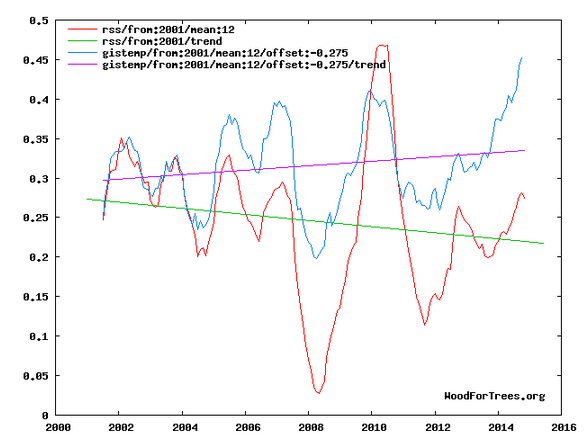 http://www.woodfortrees.org/plot/rss/from:2001/mean:12/plot/rss/from:200...
Colorful, but so were most of the light shows I saw in the 60's. Of course, I've had 47 years to sober up since then.
(Reply from volunteer moderator) Kurt has been off-line for a few days, gathering some information for future stories, and hopefully getting a little break from the relentless job of keeping this site going 24/7. I anticipate he'll be back by tomorrow.
(Post from Volunteer moderator). A reminder that the guidelines for site courtesy still apply even if Kurt is away today. Thanks.
Gary, the issues in Arizona and California are much more related to consumption than to supply.
See page two: http://www.westernresourceadvocates.org/water/WaterReportDrewBeckwith111... as an example.
Going back and exploring further in the woodfortrees website, I found that it may be possible to cherry pick almost anything you want to try to prove a preconceived agenda. But a little digging found this information. Quoting now:
WTI: The WoodForTrees Temperature Index
When playing around with temperature graphs, I always found myself having to choose which of the four global temperature sources - HADCRUT3, GISTEMP, UAH, RSS - to use. Since they all have their differences, particularly around short-term responses to extreme events like the 1998 El Nino, I thought it would be nice to have an average of all four...
Hence I've created the WoodForTrees Temperature Index (WTI). This is created from the mean of HADCRUT3VGL, GISTEMP, RSS and UAH, offset by their baseline differences. It covers only the time period where all four series are valid, so begins in 1979 and will only contain the latest month's values when all four sources are in. It is updated from the master sources at 3am GMT/BST each night.
It certainly appears that the trend of World temperatures is UP and not heading down. Before anyone can comment on this kind of data, we must understand it. And I admit that it is difficult to understand without some serious effort. Have some people simply picked graphs that appeared to agree with their belief without fully understanding what the graphs actually portray?
While I have a hard time trusting much out of the NOAA these days, I do agree with their common sense analysis of the normal cyclical drought in California.
http://www.usatoday.com/story/weather/2014/12/08/california-drought-caus...
Two sources cited above say water woes in the west are due to a combination of inadequate supply due and increased demand.
"It's important to note that California's drought, while extreme, is not an uncommon occurrence for the state . . .multiyear droughts appear regularly in the state's climate record, and it's a safe bet that a similar event will happen again . . ."
" ...there is not enough water in the Colorado River to meet the Basin’s current water demands. . ." and "...municipal and industrial demand (for water in the Colorado River basin) increased by nearly 60 percent from 1971 to 1999."
People can wrangle all they want about climate change and whether or not it's "man-caused," but those who live in the west need to face the fact that "human activity" is a major factor in the current water problems: demand for water exceeds supply in sections of the country that are arid in the best of times.
Recent floods in previously drought-parched Texas show that dramatic localized changes in weather (vs. climate) patterns can occur pretty quickly. The question is whether that will happen in California in time to avoid major economic disruptions, and parks like Lake Mead are already feeling the pinch.
Interesting post Jim, unfortunately, there is enough evidence to support both positions, the debate over human activity contributing to climate change and the periodic droughts common to the southwestern United States including California. Issues of water and growth go back to John Wesley Powell. As Alfred Runte points out, population pressure is a key factor. Here in the Central San Joaquin Valley, there is an ag town, Mendota California, billed the melon capitol of the world. When you enter the town, there is a stake measuring ground subsidence. The stake is 30 feet higher than the current ground level. That is the consequences of overdrafting the aquifer.
Agreed - we need to spend our efforts on addressing the consequences and quit spending time and money on trying to prevent something (climate change) we have little if any control over.
I choose to use RSS temperature data, that is widely accepted as being the most accurate, and graphed it to show there has been a temperature decline for well over a decade. This fact was also acknowledged by the IPCC, also known as the global warming hiatus.
NASA has known for 25 years that satellite data is more accurate than surface data, but it gives the wrong political answer so they continue to ignore it. Why would the US space agency trust satellites?
Oh, so a 25 year old article from an Australian newspaper proves that there is no global warming.
Right.
Be careful. Don't fall out of that cherry tree.
Lee, you have a reading comprehension problem. I did not say that, just showing that NASA used to claim that RSS (satellite temperature sensor data) is a more accurate way to measure global temperatures. But now that it doesn't align with the political agenda, they ignore it.
I am a skeptic of climate change/global warming and have YET to be convinced that it's true or just normal climate variations. I believe we need to protect the environment and especially the environment in our cherished parks.
Ron -
I agree about evidence to support both sides. I think that there is a lot of semantic dancing in the shadows between the differences of "caused by" versus "contributed to". Posturing ensues.
It would take an absolute blinders-on partisan to argue that either climate is not changing, or that man has not contributed to global climate change. The rest of the noise is arguing to what degree, and whether or not man alone has caused the changes.
Thanks Rick, I must admit being a bit skeptical about all the information flow on these issues is not entirely bad. I do however have enormous respect for those that work in the field and have the expertise to comment. There are questions, but taking a position of completely denying the research by the scientific community to date is not a good approach. " I am not a scientist" talking point is unacceptable. I am not a doctor either, but I have found it is a good idea to listen to what they have to say to you.
http://www.bloomberg.com/graphics/2015-whats-warming-the-world/
An interesting graphical comparion of various factors that might affect global warming
Owen, that graphic is terrific! Thanks for finding it.
Lee or Owen,
Perhaps you can explain how they isolated the influence of the axis, solar or volcanoes every year since 1880? (Hint - they made the numbers up)
In the 1990 IPCC report, the Medieval Warm Period was much warmer than the late 20th century.
https://stevengoddard.files.wordpress.com/2013/11/fartemperature.jpg
But the truth doesn't fit tye political agenda...
Thanks, Owen. Facts never convince the deniers, sadly.
Pages