
Editor's note: The following is a rebuttal to Dr. Daniel Botkin's Oct 26 column on climate change, and his contention that global warming is not being caused by human activities. Collaborating on this response were Dr. John Lemons1, Dr. Owen Hoffman2, Lyndel Meikle3, and Ron Mackie4
Introduction
We have a lifelong dedication to national parks and are concerned about Dr. Daniel Botkin’s recent guest article in National Parks Traveler. Our combined backgrounds as scientists and as National Park Service employees leads us to question Dr. Botkin’s use of outdated information and data not accepted by an overwhelming majority of climate change scientists in his article “Climate is Changing, and Some Parks are Endangered, But Humans Aren’t the Cause.” This was his rebuttal to the report on threats to the parks by staff from the Union of Concerned Scientists. Dr. Botkin’s use of information makes it more difficult for the U.S to develop meaningful responses to human–induced global climate change, including protection of National Park Service lands. Our intended audience is people who are not experts in global climate change but who want solid, verifiable and current wisdom about its human attribution.
The sound counter–rebuttal by staff from the Union of Concerned Scientists ably addressed many of our concerns. Some concerns remain. Our concerns and the evidence we provide in rebuttal to Dr. Botkin’s article are supported by overwhelming scientific conclusions that there is a very high probability that human–induced global climate change, due primarily to fossil fuel use and secondarily to land use changes, is already happening. There are numerous reports from the world’s most authoritative scientific body on global climate change, the Intergovernmental Panel on Climate Change; reports from over 20 nations’ national academies of sciences; several reports from the U.S. National Academies of Sciences; reports from the U.S. Global Change Program; and literally many hundreds of independent scientific studies. Further, every scientific organization in the United States that deals with global climate change agrees with the scientific conclusions mentioned above.
Much of Dr. Botkin’s article focuses on a few arguments that there is no evidence of human–induced global climate change. The evidence he uses to support his views are not accepted by the overwhelming majority of global climate scientists, creating a false impression among people who are not experts in climate change that such scientists are uncertain about whether human–induced global climate change is already occurring and that it will become much more serious and irreversible unless urgent mitigation measures are adopted. A few examples of serious and for all practical purposes irreversible changes are loss of summer north pole sea ice; destabilization of the Antarctic and Greenland ice sheets; significant sea level rise; some regions becoming warmer and others cooler; increases in regional droughts and floods; shifts and losses of food producing regions; increases in various human health diseases; significant losses of biodiversity; and increases in regional wars due to conflicts over dwindling and impacted resources and whose livelihoods people depend. Recent surveys show that about 98 percent of climate scientists believe that human–induced global climate change is occurring. So, if Dr. Botkin wishes to go against the grain of the aforementioned conclusions and scientific consensus, he should present some firm evidence. And this, he failed to do.
For the most part, we limit our discussion and use of evidence to issues Dr. Botkin discusses directly; however, in some sections, including our concluding thoughts, we raise some additional issues because of their importance.
Has the Earth Been Warming?
Dr. Botkin devotes three paragraphs to the Medieval Warm Period followed by mention of the ‘Little Ice Age.’ But, he does not say why he discusses these climate events or their significance to conclusions about human–induced global climate change. Perhaps the reason he discusses these events is to demonstrate that historically there has been natural climate variability.
Scientists know very well about natural climate variability and take it into account when making conclusions about global climate change. However, Dr. Botkin does not mention that the Medieval Warm Period and the ‘Little Ice Age’ were regional to parts of Europe and other areas in northern latitudes, and largely irrelevant to the contemporary issue of human–induced global climate change. Further, Dr. Botkin mentions a single paper by Ross McKitrick, an economist, as the basis for his conclusion that there has been no warming of the earth’s atmosphere during the past few hundred years. McKitrick’s paper has gained no traction in altering the consensus of scientific conclusions about the significance of human–induced global climate change.
Consider some of the conclusions in the recent AR 5 report by the Intergovernmental Panel on Climate Change. One, that human influence on the climate system is unequivocal, and many recent observed changes are unprecedented over decades to millennia with widespread impacts on human and natural systems–the atmosphere and oceans have warmed, the amounts of snow and ice have diminished, and sea level has risen. The changes also are unprecedented with respect to both the amount of change and the rate of change. Two, each of the last three decades has been successively warmer at the earth’s surface than any decade since 1850. The period 1983–2012 was very likely the warmest 30–period of the last 800 years and likely the warmest 30–year period of the past 1400 years. Three, ocean warming dominates increases in energy stored in the climate system with subsequent changes in regions of high salinity where evaporation dominates and in regions of low salinity where precipitation dominates. Parenthetically, because of potential interest to readers of National Parks Traveler, recent estimates of global loss of biodiversity due to human–induced climate change range around 25 percent or more by 2050 -– such loss stemming from both the changes of a human–induced climate system and their rate of change.
Further, Dr. Botkin includes a graph courtesy of John Christy, a meteorologist from Alabama State. The source of the graph is The State of the Climate in 2012; the graph uses mid–troposphere temperature five-year averages. On first consideration, the graph shows that there is no correspondence between the forecasts of general circulation models used in global climate change studies and observed temperature changes since 1980. Dr. Botkin’s conclusion based on the graph is that although atmospheric temperature varies, it does so only a little if at all and, further, models are poor predictors of actual temperature changes.
Dr. Botkin ignores the main conclusion of the State of the Climate Report –- that there is a continuation of warming at the Earth’s surface, sea surface, and surface and deep ocean layers. This is the very report he uses for the data he selected in support of his own conclusions. Further, Christy uses mid–troposphere temperatures as a fundamental indicator of human–induced global climate change despite the fact that legitimacy of using mid–troposphere temperatures is thought to be small, not only by the authors of The State of the Climate in 2012 but by the Intergovernmental Panel on Climate Change and other scientific organization with a focus on the use of temperature indicators for determining human–induced global climate change.
Frequency of Severe Storms and Extremely Hot Days
Dr. Botkin’s discussion of the frequency of severe storms is problematic; for example, he asserts that a claim of the report by the Union of Concerned Scientists is that the danger of flooding simply stems from the rise of sea–level. But the Union of Concerned Scientists does not make this claim, and neither do the reports by the Intergovernmental Panel on Climate Change, or nations’ academies of sciences. As noted in the AR 5 report by the Intergovernmental Panel on Climate Change, changes in extreme weather and climate events have been observed since about 1950 and linked to human influences, including decreases in cold temperature extremes, increases in warm temperature extremes, increases in extreme high sea level, and increases in the number of heavy precipitation events in a number of regions.
Dr. Botkin presents a graph purportedly showing that the number of 95 F degree temperature readings at U.S. weather stations since 1930 shows no increase on an annual basis of days with temperatures above this level. There are two problems with his use and lack of discussion about the data. First, these data pertain to the U.S.; consequently, the data are regional and not a reliable indicator of the state of the global climate. Second, and more importantly, Dr. Botkin fails to note that in, say, a stationary climate, as the years go by there will be a statistical drop in the number of daily heat records. However, during periods of global warming, as per the conclusions of numerous scientific reports and studies we reference, the frequency of heat records has declined much less than expected in a stationary climate.
Concluding Thoughts
Dr. Botkin’s article ignores several issues relevant to global climate change and its possible effects on national parks and protected areas. We discuss these in no particular order of importance.
First, it ignores the issue of ‘finger printing,’ or data that conclusively demonstrate a human attribution to global climate change. One example is that the ratio of certain carbon isotopes in the atmosphere has been decreasing since the Industrial Revolution. The ratio of carbon–13 to carbon–12 is an example because plants preferentially take up the lighter isotope and, hence, since fossil fuels are comprised of plant matter, their burning decreases the ratio in the atmosphere and this decrease has been observed since the Industrial Revolution. Another example is that empirical evidence shows that the upper troposphere has warmed while the lower stratosphere has cooled and this evidence is entirely consistent with the theory about the observable impacts of increased heat energy from greenhouse gases being trapped in the lower levels of the Earth’s atmosphere. A final example is research that identifies how global climate change is related to the amount of carbon emissions by humans since the late 1800s.
Second, the editor of National Parks Traveler, Kurt Repanshek, makes an inadvertent but potentially confusing comment in his October 28th response to Dr. Botkin’s article, wherein Repanshek states, ‘Antarctic sea ice is at record levels.’ Although this statement is true, the more important considerations are empirical data that show instabilities and declines in the mass of ice in the Antarctic (and Greenland) ice sheets; these instabilities and mass declines prompt concerns about significant rises of sea level.
Third, one of the most disturbing things about Dr. Botkin’s article is that he denies there is even a minor probability that human–induced global climate change exists. We wish to make clear that we believe, consistent with our own work, the numerous studies we have referenced, and the very high scientific consensus we have referenced, that the probability of human–induced global climate change is very high.
But for purposes of argument and certainly germane to protected areas of the National Park Service, let us assume that there might be some chance that human–induced global climate change is occurring, but also a chance it is not. Under conditions of scientific uncertainty, the precautionary principle should be invoked. The United Nations Framework Convention on Climate Change recognizes the precautionary principle; the Convention has been ratified by over 190 nations, including the United States, and the Convention has the force of an international legal treaty.
As many readers of National Parks Traveler know, the precautionary principle states that in matters affecting environmental and human health that are serious and irreversible even if some uncertainties exist about risks or impacts, actions to mitigate them should be taken. In other words, erring in making a conclusion that there is an effect when in fact there is none is more protective than erring by making a conclusion there is no effect when in fact there is. By his denial of any chance that human–induced climate change is occurring, Dr. Botkin rules out use of the precautionary principle and therefore offers a lesser degree of protection to National Park Service lands.
Fourth, scientific conclusions are always open to debate, and independent testing is one of the hallmarks of scientific norms. But are we to believe that a single paper Dr. Botkin mentions from McKitrick, an economist, one from Christy, and Dr. Botkin’s article in National Parks Traveler overthrow the weight of evidence from the numerous scientific reports we have referenced that conclude human–induced global climate change already is here? Within the scientific community the debate about whether human–induced global climate change is occurring is outdated and akin to the question of whether the Earth is flat. Newspapers such as the New York Times have indicated publically that they will no longer publish articles concerned solely with the question: Is global climate change occurring? We are not advocating censorship, but only reiterating that the question and major thrust of Dr. Botkin’s article are outdated and have been settled within the scientific community.
Fifth, National Parks Traveler is not a scientific peer–reviewed journal and we are not advocating that it becomes one. We understand that the purpose of National Parks Traveler is to offer a platform for differing points of view. Yet, because Dr. Botkin made use of some scientific evidence and conclusions, this raises the question of whether some outside review would serve to strengthen articles that rely on empirical evidence and its interpretation.
Sixth and finally, we wish to be clear that we value Kurt’s dedication to the lands the National Park Service tries to protect. He provides a much–needed voice for the parks while not being an employee of the parks. We hope that he will continue to take into consideration the enormous effect stories in National Parks Traveler can have on the public, especially as human–induced global climate change increasingly threatens our National Park Service lands.
References
2014 National Climate Assessment, 2014, U.S. Global Change Research Program, Washington, DC (http://nca2014.globalchange.gov) Accessed 14 November 2014
Anderegg WRL, Prall JW, Harold J, Schneider SH, 2010, Expert Credibility in Climate Change, Proceedings of the National Academies of Sciences, 107: 12107–12109 (http://www.ncbi.nlm.nih.gov/pmc/articles/PMC2901439/) Accessed 15 November 2014
Burns CE, Johnston KM, Schmitz OJ, 2003, Global Climate Change and Mammalian Species Diversity in U.S. National Parks, Proceedings of the National Academy of Sciences of the United States of America, 100: 11474–11477 (http://www.pnas.org/content/100/20/11474.full) Accessed 24 November 2014
Bulletin of the American Meteorological Society, 2012, State of the Climate–2012 (http://www.ncdc.noaa.gov/bams-state-of-the-climate/2012.php) Accessed 15 November 2014
Climate Change at the National Academies, Washington DC, (http://nas-sites.org/americasclimatechoices/sample-page/panel-reports/) Accessed 14 November 2014
Convention on Biological Diversity, 2010, Global Biodiversity Outlook 3, Montreal, Canada (http://www.cbd.int/gbo3/) Accessed 26 November 2014
Goodwin P, Williams RG, Ridgwell A, 2014 Sensitivity of Climate to Cumulative Carbon Emissions Due to Compensation of Ocean Heat and Carbon Uptake, Nature Geoscience DOI: 10.1038/ngeo2304 (http://www.sciencedaily.com/releases/2014/12/141201113036.htm)
Harvard School of Public Health, 2014, Climate Change and Biodiversity Loss, in: Biodiversity and Human Health (http://www.chgeharvard.org/topic/climate-change-and-biodiversity-loss) Accessed 26 November 2014
Intergovernmental Panel on Climate Change, 2014, The Fifth Assessment Report, The World Meteorological Organization, Geneva, Switzerland (http://www.ipcc.ch/report/ar5/) Accessed 14 November 2014
Oreskes, N, 2004, Beyond the Ivory Tower: The Scientific Consensus on Climate Change, Science 306: 1686 (http://www.sciencemag.org/content/306/5702/1686.full) Accessed 15 November 2014
Shepherd A and 46 others, A Reconciled Estimate of Ice–Sheet Mass Balance 2012, 338 (6111): 1183-1189, Science (http://www.sciencemag.org/content/338/6111/1183.abstract) Accessed 15 November 2014
Skeptical Science, 2014, Is There a Scientific Consensus on Global Warming? (http://www.skepticalscience.com/global-warming-scientific-consensus-intermediate.htm) Accessed 15 November 2014
1Professor Emeritus of Biology and Environmental Science, Department of Environmental Studies, University of New England, Biddeford, ME 04005 ([email protected]); 2Dr. Owen Hoffman, President, Oak Ridge Center for Risk Analysis, Oak Ridge, TN 37830; 3Lyndel Meikle, National Park Service, Grant–Kohrs Ranch National Historic Site, Deer Lodge, MT 59722; 4Ron Mackie, Retired National Park Service Ranger. Address all correspondence to Dr. John Lemons.
Story Categories:
A copy of National Parks Traveler's financial statements may be obtained by sending a stamped, self-addressed envelope to: National Parks Traveler, P.O. Box 980452, Park City, Utah 84098. National Parks Traveler was formed in the state of Utah for the purpose of informing and educating about national parks and protected areas.
Residents of the following states may obtain a copy of our financial and additional information as stated below:
- Florida: A COPY OF THE OFFICIAL REGISTRATION AND FINANCIAL INFORMATION FOR NATIONAL PARKS TRAVELER, (REGISTRATION NO. CH 51659), MAY BE OBTAINED FROM THE DIVISION OF CONSUMER SERVICES BY CALLING 800-435-7352 OR VISITING THEIR WEBSITE. REGISTRATION DOES NOT IMPLY ENDORSEMENT, APPROVAL, OR RECOMMENDATION BY THE STATE.
- Georgia: A full and fair description of the programs and financial statement summary of National Parks Traveler is available upon request at the office and phone number indicated above.
- Maryland: Documents and information submitted under the Maryland Solicitations Act are also available, for the cost of postage and copies, from the Secretary of State, State House, Annapolis, MD 21401 (410-974-5534).
- North Carolina: Financial information about this organization and a copy of its license are available from the State Solicitation Licensing Branch at 888-830-4989 or 919-807-2214. The license is not an endorsement by the State.
- Pennsylvania: The official registration and financial information of National Parks Traveler may be obtained from the Pennsylvania Department of State by calling 800-732-0999. Registration does not imply endorsement.
- Virginia: Financial statements are available from the Virginia Department of Agriculture and Consumer Services, 102 Governor Street, Richmond, Virginia 23219.
- Washington: National Parks Traveler is registered with Washington State’s Charities Program as required by law and additional information is available by calling 800-332-4483 or visiting www.sos.wa.gov/charities, or on file at Charities Division, Office of the Secretary of State, State of Washington, Olympia, WA 98504.

Comments
An excellent article. Thanks to all of you.
And is the Doctor Owen Hoffman the same Owen Hoffman who worked with me in Yosemite in the last century?
I have read all of Dan Botkin’s books, so I believe I know what he is saying. And he is not in the least saying what he is accused of saying here.
What he is saying is that change is permanent. Get used to it, folks. The earth will change. Human caused, sunspot caused, tilt in the earth’s axis caused—God caused. The earth is going to warm, and cool, and warm and cool again. We just won’t be here to see how it all comes out, because our bodies are changing, too. Next up for most of us, and eventually all of us—death.
Now you know how to read Dan Botkin. There is no such thing as a “balance of nature.” There is only perpetual change. Is he wrong? I sit on the very spot inhabited by ice sheets ten thousand years ago. What melted them? Global warming. And thank God, because I hate ice. There would not be a Seattle had not the forces of CHANGE melted the ice and freed the land.
That is how to read Dan Botkin. He “admits” to global warming. He just wants scientists to think for once about what they can and cannot do.
Wring your hands. Beat your chests. Call all of it irreversible. It is not irreversible. At some point in the future, all if it will change again. And change and change and change.
Is change human caused? Of course it is. But humans are part of the planet—part of the natural order of perpetual change. You don’t like the change? Tell people to stop having babies. And if you can’t force them to stop, you have change again. And change and change and change.
Bottom line: What are you going to do about it—you in the 98 percent? You agree and have peer-reviewed your agreement. That’s the wonderful thing about peer-review. You get to throw everyone else off the bus.
The trouble with Dr. Botkin is that he knows how to hang on—how to make people think. Believe me, we have had our own knockdowns over wind and solar power. I hate wind power and he does not. He rather has a whole book about what the human race can do to SOLVE global warming by eliminating fossil fuels.
Have any of the 98 percent read it? I doubt it. Because that book, like any Botkin book, comes with the humility to know what scientists cannot do. We can tinker and undoubtedly improve some things, but the earth will forever be out of our notion of balance, for after all, it is the earth.
Thank you, Dr. Runte. I just checked and found that my local library has Dr. Botkin's book Forces of Change. I'll read it as soon as I can.
Very good, Lee. Dan's classic work is THE MOON IN THE NAUTILUS SHELL: DISCORDANT HARMONIES RECONSIDERED, which is a second, wholly revised edtion of DISCORDANT HARMONIES: A NEW ECOLOGY FOR THE TWENTY-FIRST CENTURY. For that volume, Dan was awarded a full-year fellowship at the Woodrow Wilson International Center for Scholars in Washington, D.C., where we were colleagues, I on the staff and he a fellow. That was in 1978-79, after which he became chair of Environmental Studies and Professor of Biology at UC Santa Barbara, where we first met.
If anything, Dan has been consistent. He believes that scientists promise far too much when they talk about a "balance of nature." No one can promise any outcome when it comes to planet earth. Scientists rather need to study the dynamics of change and work within those parameters. From Thoreau and Lewis and Clark to renewable energy, Dan's books are all about understanding change.
On that score, his book about "solutions"--insofar as they are possible--is POWERING THE FUTURE: A SCIENTIST'S GUIDE TO ENERGY INDEPENDENCE. Here you will find exactly what the alleged 98 percent of scientists claim they want--solutions to global warming--wind, solar, tides, and the eventual discontinuance of fossil fuels. Dan just will not say that change is human-caused alone, i.e., that we are somehow "responsible" for whatever change occurs just because it in fact occurred, and as much to the point, that simply by reverting to another behavior any change can be "reversed."
The original environmental movement had that humility. I see none of that humility now. Just as likely, if someone pitched damming the Grand Canyon as a "solution" to global warming, those 98 percent of scientists would go along.
My thanks to the authors for their hard work.
Hi Lee Dalton, yes you and I worked together in Yosemite in 1969 and perhaps early 1970. I never did obtain that elusive NPS permanent position, so I went on and got a Ph. D. instead. However, I really enjoyed my work Yosemite as a park ranger-naturalist, and it was a pleasure this time to collaborate with my former Yosemite colleagues, Dr. John Lemons, Lyndel Meikle, and Ron Mackie, some 43 years later, to produce this special article for NPT. Dr. Alfred Runte is also a Yosemite NPS alumnus, but I believe he worked in the park some years, if not a decade or so, after the rest of us had left (except for Ron Mackie of course).
Well, Owen, congratulations on that PhD. We've exchanged some communications, but I wasn't aware of that. You and Ron are two of several folks I remember from Yosemite for whom I've always had very high regard.
Keep smiling and have a wonderful Christmas!
Hi Owen, Yes, I was on the seasonal staff in Valley District from 1980 through 1983. A very memorable time indeed. When the concessionaire asked that I be--how should I put it?--"retrained," I began my research on YOSEMITE: THE EMBATTLED WILDERNESS. I am slowly revising it now. Little has changed, and then again everything has changed, led by academic attacks on wilderness. It just wasn't like that in the 1980s when the history of the achievement seemed secure.
Meanwhile, all of us who were privileged to be a part of those "days" have much to be thankful for. To be sure, this debate reminds me of what Environmental Studies used to be like, again, when our best idea needed no apologies. At least on that point we all still agree.
Its pretty evident that a warming climate is vastly affecting the central valley of California. It's not a stretch that 20 years from now people will be saying "remember when the Central Valley was one of the most productive food production regions in the country". The way it's going, it will be a desert. They are depleting the ground water at a rate that is unsustainable, and southern California's population is not sustianable, and will collapse under a long term drought. I wouldn't doubt we see a mass migration out of LA in the coming decades. People cheer 3 inches of rain and think the problem is solved, but that's not nearly going to recover the demands placed on the water resources. This problem just doesn't stop and end in California. Same thing has been happening in most of the interior west, in Texas, and many other areas of this country.
And I don't take this site that seriously. It's just mere entertainment. The battles of the free Earth are not going to be won in the discussion forums of NPT. It seems this site is a battle between a lot of people that don't like the NPS because they were once slighted by an action around their "local park", and a lot of retired personnel that once worked in the system decades ago. I can't speak for everyone, but i've already long forgotten about the original article and whatever ECbucks stance was.
Gary, the really frightening thing about it all is that water woes are not unique to California. Here in Utah, water is vastly overexpended. Las Vegas is still trying to pirate ground water from Snake Valley to slake its ever growing thirst and waste. But as long as most Americans are still able to have water coming out of their faucets when they want it, nothing will change.
When the water no longer flows, it will be much too late.
Ohh those days are coming closer and closer, Lee. I saw it in the Wood River Valley of Idaho when I lived there. People just sucked up ground water like it was unlimited and dosed it on kentucky blue grass which was not even close to being native to the great basin desert. Just last year, people's wells started going dry from the "unlimited abundance" that they thought they had under them. And that is in "underpopulated" part of the lower 48 that has suffered through a 5 year drought cycle that has not been very pretty. It's not going to be fun during the next few decades watching the desert regions implode (the new rust belt), while a good portion of the US population sits next to depleting water sources. In my opinion, it's already not very pretty. The money people are going to save on "cheap gas" because of the fracking wars will instead be spent on increasing food prices due to the drought having its way on vast regions of this country. And as they deplete the Ogallala aquifer to fuel the breadbasket, it's only going to hit a tipping point. Fortunately, urban gardens and farming in old industrial warehouses is becoming a booming cottage industry in places like Japan and old industrial rust belt areas, so not all is lost. And maybe some will realize that water is more precious than oil. Eventually, more will figure that out when their faucets do go dry.
I think that human activity (data tampering) at GISS/NOAA/CRU is responsible for most of the reported warming over the past century. This should be the focus of CSU, if they were not just bunch policitcal hack activisits. The CSU is hardly credible and anyone with a credit card can join these fear mongering alarmist charlatans.
Kenji the dog joins UCS
Here are some real science facts:
* Artic sea extent is at a 10 year high.
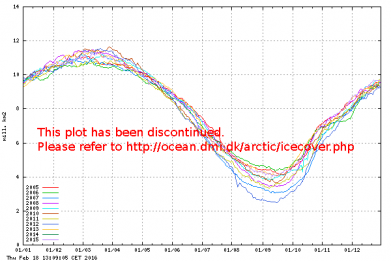 http://ocean.dmi.dk/arctic/old_icecover.uk.php
* Greenland ice sheet has gained a record amount of ice this Autumn.

Greenland Ice Sheet Surface Mass Budget: DMI
* Satellite temperatures are far more accurate than surface temperatures, and they show that temperatures are not warming, and are nowhere near a record.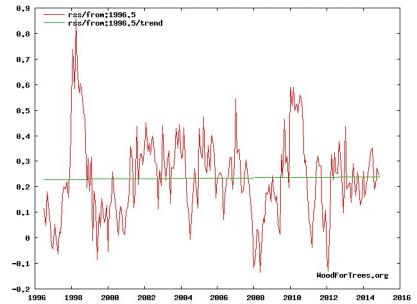
Wood for Trees: Interactive Graphs
* The surface temperature record which the claims are based on has huge geographical gaps of no data, shown in gray. They have an error of at least half a degree, yet make claims of record heat at 0.01 degrees.
Junk science and fraud at its absolute worst.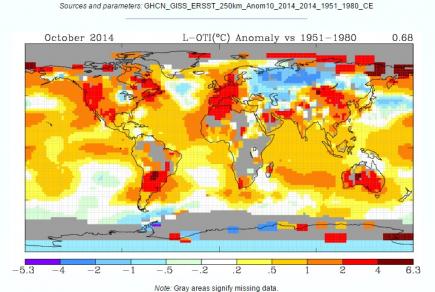
* And even with all their endless data tampering, GISS is still below zero emissions scenario C.
These claims of record heat by NASA and NCDC are not even remotely credible. They are in defiance of all corroborating science, and are complete utter nonsense.
The NPS should not persue any policies or regulations regarding climate change fraud.
Beachdumb:
Please note the following concerning the graphs and comments you submitted in response to our article:
1. The first graph you showed from the Danmarks Meteorologiske Institut Centre for Ocean and Ice (Denmark) (http://ocean.dmi.dk/english/index.php) shows total Arctic sea ice extent for 2005–2014. As we mentioned in our article, sea ice extent is an indicator used in making forecasts and conclusions about the state of the Arctic; however, sea ice mass and volume often are more useful indicators. Further, had you read the text accompanying the graph you should have noted that based on satellite measurements the sea ice extent today is significantly smaller than 30 years ago and that in particular during the past 10 years the melting of sea ice has accelerated.
2. The second and third graphs you show also are from data collected by the Danmarks Meteorologiske Institut Centre for Ocean and Ice. The second graph simply shows, for Greenland, this season’s daily contribution to the surface mass balance in Gts (blue line) compared to mean curves from historical model runs. The third graph shows the accumulated surface mass balance from September 1st to now (blue line) compared to a couple of other years. The grey area shows the high and low mean accumulated surface values for 1990–2011. If you had read the very same report that you took the graphs from, you would have read that based on satellite observations over the past ten years or so that Greenland is losing about 200 Gts of surface mass ice per year.
3. The fourth graph you showed is without much scientific merit. This graph has appeared on numerous climate change denialists’ websites. Why is it irrelevant? Because as we explained in our article sound science concerning temperature data typically covers longer time periods with the inclusion of running means. The data presented in this graph also begin, basically, with 1998–one of the warmest years of the recent past and therefore using it to draw an inference that there is a downward temperature slope, say, to 2014 is misleading. Choose another starting year and you get a different graph. For example, if one plots global mean temperatures and uses confidence intervals, one finds that from 1999–2010 there has been an increasing trend of 0.175 C per decade. One also finds that 2010 was the warmest year of the recent past, followed by 2005; forecasts are that 2014 will be the warmest year on record, or at least a close runner–up.
As we also stated in our article, many recent observed changes are unprecedented over decades to millennia with widespread impacts on human and natural systems–the atmosphere and oceans have warmed, the amounts of snow and ice have diminished, and sea level has risen. The changes also are unprecedented with respect to both the amount of change and the rate of change. Each of the last three decades has been successively warmer at the earth’s surface than any decade since 1850. The period 1983–2012 was very likely the warmest 30–period of the last 800 years and likely the warmest 30–year period of the past 1400 years.
4. In presenting your fifth graph, you neglect to state that all general circulation models, of which there are about 14 or so in common uses, contain different gaps in coverage. Scientists know the gaps, but take them into account when studying the utility of the models or when making projections based on various scenarios.
5. Finally, your sixth and last graph is irrelevant. It appears to be an old graph of one of Dr. Hansen’s three scenarios that he used when alerting the world to global climate change in 1988. This graph, which you present, is not used in making assessments of on–going global climate change or future projections.
Dr. John Lemons
Dr. Owen Hoffman
Of course it isn't because it proved the past predictions horribly wrong.
I though you were an expert in math. If so you are well aware that in proper trend analysis the start year has no more influence than the finish year, or any othe year for that matter. 1999-2010 may indeed show a rising trend. Its a different period. For the last 18 years, the trend has been flat despite steady increases in CO2 emmissions. That's not what the AWG models predicted. The AWG models have been horribly wrong.
(carried over where I posted on wrong thread)
I'm so sorry John, let me correct myself. Your "scenario projections" have been horribly wrong. Its tough keeping up with this Orwellian double speak. Oh, and the "predictions" have been horribly wrong as well.
Do you mean like California?
http://www.usatoday.com/story/weather/2014/12/08/california-drought-caus...
Just another example of the alarmist citing natural fluctuations as "evidence" of AGW.
<<LIMA, Peru (AP) — With temperature data showing 2014 currently tied for the hottest year on record, the U.N. weather agency on Wednesday rejected claims that global warming has paused.
The World Meteorological Organization said the global average temperature in January-October was 0.57 Celsius (1.03 Fahrenheit) above average, the same as in record hot year 2010.
The ocean temperature set a new record in the nine-month period, while land temperatures were the fourth or fifth highest since record-keeping began in the 19th century, the WMO said in a report released at U.N. climate talks in Lima and at its headquarters in Geneva.
"The provisional information for 2014 means that 14 of the 15 warmest years on record have all occurred in the 21st century," WMO Secretary-General Michel Jarraud said in a statement. "There is no standstill in global warming."
Climate skeptics point to a perceived hiatus in the temperature rise since 1998, an exceptionally hot year, to support their claims that man-made warming is not a big problem. Most climate scientists reject that idea. Michael Oppenheimer of Princeton University said the long-term warming trend is combined with natural variations that tend to be cyclical, with a period of lower-than-average warming followed by a period of rapid warming.>>
Owen. If 2000 was the highest temperature ever and the 13 of the next 14 years were the same temperature then, 14 of the last 15 years would be the hottest on record. Yet, the trend would be flat for those 15 years - despite a steady increase in co2. The predictions have been horribly wrong.
2010 was the warmest year on record. Globally, the ten hottest years in record have all been since 1998 with 2005 and 2010 being hotter than 1998.
Looked at another way, in the 20th Century there was only one year in the top ten. In the 21st Century, there have been nine years in the top ten. With only one more month to go, 2014 may be the hottest year on record.
the climate is warming - there is no fact you can point to that denies that. You can argue that CO2 is not the cause.
Yes, the climate has warmed, no one here is denying that. But it has not warmed in the last 18 years. CO2 on the other hand has continued to increase which disproves the direct link between CO2 and warming. That was the point of the original piece on this subject. The climate changes. Rather than waste time trying to blame man and take expensive steps to alter that change, we should be preparing for its potential consequences.
I still think it was a very poor editorial choice for NPT to give a forum to climate science denialists and give the false impression that there's pervasive uncertainty about this issue. This fiasco was a disservice to your readers.
Current global climate models accurately reflect long-term trends in observational data of climate change when natural and anthropogenic carbon dioxide are included. When anthropogenic green house gas emissions are not included, an increasing trend in global warming is not evident.
For further reading, see: http://www.skepticalscience.com/climate-models-intermediate.htm
Baloney. Please provide examples of models that ten years ago accurately forecast the recent 18 year lull in rising temperatures.
Yes, rdm24, let's "hide the decline". Why are you so afraid of an open discussion of the issue? Not so confident in what you want to believe?
From http://www.skepticalscience.com/climate-models-intermediate.htm:
<<Even if we focus exclusively on global surface temperatures, Cowtan & Way (2013) shows that when we account for temperatures across the entire globe (including the Arctic, which is the part of the planet warming fastest), the global surface warming trend for 1997–2012 is approximatley 0.11 to 0.12°C per decade.>>
Owen,
You said that sea ice extent is significantly smaller than 30 years ago. But history tells us it was like that 60 years ago.
http://trove.nla.gov.au/
The sea ice extents are larger and ice is getting thicker. NSIDC just said this was just another extremely ordinary year for sea ice.
http://nsidc.org/arcticseaicenews/2014/12/extremely-ordinary/
History says 75 years ago Greenland's ice was catastrophically loosing just as many Gts. Ever wonder why they called it Greenland?
http://trove.nla.gov.au
How can it be irrelevant? It just copies of all the major climate data (NASA, Hadcrut, UHI, and others) from satellite systems, surface records, and allows you to plot using the data. Might to be too complicated for you guys. There is actually much more accurate satellite data (RSS TLT) that shows 2014 as being quite an ordinary year. In fact also shows the continuing 18 year cooling trend.
I have seen the considerations and projections based on made up data, the only way to claim 2014 is the hottest year ever.
(edit) this satellite image black is no data, the fill is "made up" data
I think an organization with a name like yours would actually be concerned about what is being "modeled". The models and projections have been wrong and very wrong.
The trend that not a single AGW model predicted (sceneriod) 20 years ago.
From http://nsidc.org/arcticseaicenews/2014/12/extremely-ordinary/.
The NSIDC conclusion about an "ordinary" increase in ice in November 2014 is with respect to the increase in Arctic ice compared with ice cover during the previous months in 2014. However, comparing Arctic sea ice in November of 2014 with past Novembers from the satellite record, NSIDC has this to say:
<<Arctic sea ice extent for November was the 9th lowest in the satellite record. Through 2014, the linear rate of decline for November extent over the satellite record is 4.7% per decade.>>
Which would be totally consistent with a flattening trend in temperatures but inconsistent with a claim that CO2 causes global warming.
Give it up, already EC. If people actually cared about your constant harping on this subject, you'd have at least a few people chime in saying you are right. Stick to real estate, which doesn't take any scientific knowledge. This site was a lot more readable a few weeks ago when you weren't on here hijacking every thread 24/7. And I take it, since you were in Hawaii, you didn't stop by Mauna Loa to tell all the scientists that their efforts are meaningless and wrong, according to YOU!
Testing current climate models against existing instrumental records indicates that increases in CO2 is the primary cause for global warming. Climate models are unable to reproduce observed long-term averaged trends in global temperature rise, unless human-caused increases in CO2 are added into the models. No other factors can account for this long-term upward trend in temperature increase.
Global climate models also replicate other climate outcomes, subsequently confirmed by observation, including greater warming in the Arctic and over land, greater warming at night, and stratospheric cooling. http://www.skepticalscience.com/climate-models-intermediate.htm.
We wrote our rebuttal article “Global Climate Change and National Parks: Another Response” in reply to Dr. Daniel Botkin’s article because we believed he had used scant and highly questionable information in making his conclusion that a significant amount of global climate change is not attributed to humans and, in so doing, could influence others’ thinking in a way that might have adverse impacts in national parks and protected areas by, for example, sowing doubts in the minds of non–climate change scientists.
When thinking about whether to write our reply, all of the coauthors were concerned that a lot of Dr. Botkin’s article merely focused on the question about the human attribution of global climate change. We debated the wisdom of writing a reply because it might seem to give legitimacy to a question that has been settled for some time within the scientific community. That is, as we pointed out the question of human attribution to global climate change is settled by about 98 percent of published global climate change scientists.
Despite our initial misgivings about writing a rebuttal article, we decided doing so was warranted because of the prominence of Dr. Botkin’s article as a feature in National Parks Traveler.
However, in reviewing the information and interpretations used by ‘Ecbuck and Beachdumb’ and various replies to them we do believe that there is little to be gained by continuing to respond to their incessant use of dubious scientific information and erroneous conclusions. Again, the reason is because constant replies to such information and interpretations lead to possible confusion within non–experts about global climate change and about whether there is significant disagreement among such scientists when, in fact, there is none.
Given our views, we tend to agree with the comments submitted by ‘rdm24’ and Gary Wilson. Put differently, there are a lot of questions about science and policy that is ripe for research and discussion, but the fundamental question of human attribution to global climate change is not one of them.
John Lemons
Owen Hoffman
Lyndel Meikle
Ron Mackie
In other words, we can't defend our position anymore so we are taking our ball and going home.
I'd like to thank the authors of the article for their patience.
When it is time to move on, your job well done, there will always be that guy living in his own world who will try to tear you down. Walk on by.
Beachdumb and EC
I just don't get why you think all these people are so stupid or devious to try to warn others of this giant pot hole (global warming) looming down the road. Wouldn't you guys at least slow down instead of telling everyone else no problem, full steam ahead and these guys and their friends (the greater majority of the scientific community) are just blowing smoke up everyones behind.
If you think the earth can take this same kind of abuse for another 100 years you are living in fantasy land.
Thanks to John Lemons, Owen Hoffman, Lyndel Meikle and Ron Mackie for stating their case.
This isn't a game, EC. There is no ball, and there is nothing to be won. If it was a game, you'd be sitting at the bottom of the standings, with a good chance of drafting second after Beach.
You are right Gary - its not a game. Pursuing the path of your AGW fantasy will have meaningful negative impacts on us Americans and be devastating to the third world.
Stop feeding trolls and they just might go away.
The IGNORE button really does make life a lot more peaceful on here and allows one to enjoy some very pertinent posts.
Agreed on the IGNORE button. Spread the word.
To National Parks Traveler
11 Dec 2014
Re: Recent Prof. Dan Botkin piece on “Global Warming” & National Parks, the UCS rebuttal and the NPT staff submitted rebuttal.
I am retired from two former careers: I served as a Captain in the US Navy, during which I had command of Naval Reserve Intelligence Units, in the New York area. Concurrently I worked as a Certified Management Consultant [CMC] for over 30 years. I have had a deep interest in the global warming controversy and I have followed the opposing arguments for years as the stridency has increased.
I have great regard for our National Parks and I am one of those lay people referred to in the second rebuttal of December 4th as the intended audience. The writers say they want to serve “people who are not experts in global climate change but who want solid, verifiable and current wisdom…”
I’ll begin with an observation about the UCS rebuttal and those few virtues they say they wish to uphold. In my opinion, their rebuttal to Dr. Botkin falls short of delivering those virtues: solid, verifiable, current wisdom. Best example, one that Botkin points out: None of the models so widely touted as the foundation for global warming forecasts have been validated by solid standards for computer modeling. Plus, the emerging empirical data are simply not tracking to corroborate claims about human caused warming.
It seems to me Prof. Botkin presented clear, concise, and persuasive information. in making the case challenging claims that anthropogenic global warming [AGW] is the prime mover in what are called disastrous rates of warming. The Prof. could not go on at great length in this forum. Yet he is taken to task for providing thin support, among other criticisms. As I understand his reasoning in the NPT article and in his other books I have read, he acknowledges some human factor in warming causation, but disagrees with assertions about it being the dominant cause.
Why is it so out of the question for the UCS and so many of like mind to give any credence to numerous serious recent studies showing that many disaster claims are ill-founded on many basic assertions? Prof. Botkin points out some of these in the UCS article: 1. Supposed Human Caused Rising Sea Levels as human caused. 2. The Frequency of Major Storms. 3. The Severity of Recent Storms. 4. Frequency of Extremely Hot Days. 5. Frequency of Wild Fires? These are so often cited as increasingly severe disasters of human causation. Botkin makes the case that these claims are not well supported and that public policy should not be driven by them while possibly solvable environmental issues go unaddressed.
Why should we accept condescending claims from a wide circle of zealous believers who assail us with such pronouncements as: “The science is settled”; “97% of world scientists support these assertions”; The discredited “Balance of Nature” theory; and that all claims to the contrary must be vigorously rejected? These claims of consensus and worldwide agreement have been exposed as invalid, and antithetical to the rigors of proper scientific method. None of this consensus business can be respected as science. It should be seen as politics wrapped in pseudo science.
I agree with Prof. Botkin in his sensible exhortation that we reject name calling and vitriol that deflect attention from practical efforts at solutions in the way that Olmstead did at Boston’s Back Bay Fens Park. This should be our model for present day policy.
Let’s face it folks, there has been far too much cant and even clear evidence of fraud in these matters by entities in England, the US and elsewhere. The examples are so well known they need no further recitation here. We need to admire authoritative voices of reason and defend them from irresponsible rejection and charges of heresy. There are increasing numbers of voices of reason speaking out. I think Professor Dan Botkin comes across as one to listen to.
In closing I must declare that this attempt at scholarly rebuttal does not burnish the UCS reputation. There is too much evidence here indicating they favor only the AGW point of view and refuse to fairly acknowledge any challenging findings. This does not enhance the dialogue.
I do applaud the National Parks Traveler for making all this material available on the web on a topic that deserves widespread serious attention.
Kenneth L.Purdy, Captain, USNR, Ret, CMC
Ken - it's damn nice of you to say such nice things about Botkin, an old high school classmate and friend of yours, just like it was nice of him to acknowledge your help in editing his book right there along with his wife and all of his other colleagues. ["Moon in Nautilus Shell", pg ix]
I mean, as far as listing all your admittedly nice career credentials, you might as well mention your bias as well.
Not much of that going on here for the most part (getting past the bias). Guess we need a bomb to land amongst us to get in the problem solving mode (not being bias:).
I've been around bombs. Never really cared much for bomb jokes.
Once again, Rick, lacking the skills to address the points made, attacks the author.
Quietest 3 years for twisters on record
http://www.usatoday.com/story/weather/2014/12/13/tornado-drought/2024006... exact opposite of the AGW predictions. The AGW models have been horribly wrong.
An excellent summary about the evidence and causes of global climate change can be obtained online as a pdf issued by the US National Academy of Sciences and The Royal Society of the United Kingdom. I consider these organizations to be highly credible sources of scientific information.
Climate Change Evidence & Causes
http://dels.nas.edu/resources/static-assets/exec-office-other/climate-change-full.pdf
The document explains that there are well-understood physical mechanisms by which changes in the amounts of greenhouse gases cause climate changes. It discusses the evidence that the concentrations of these gases in the atmosphere have increased and are still increasing rapidly, that climate change is occurring, and that most of the recent change is almost certainly due to emissions of greenhouse gases caused by human activities. Here are two brief excerpts addressing issues that have been raised repeatedly on this and other discussion threads by adament climate change deniers:
Does the rate of warming vary from one decade to another? Yes. The observed warming rate has varied from year to year, decade to decade, and place to place, as is expected from our understanding of the climate system. These shorter term variations are mostly due to natural causes, and do not contradict our fundamental understanding that the long-term warming trend is primarily due to human-induced changes in the atmospheric levels of CO2 and other greenhouse gases.
Does the recent slowdown of warming mean that climate change is no longer happening? No. Since the very warm year 1998 that followed the strong 1997-98 El Niño, the increase in average surface temperature has slowed relative to the previous decadeof rapid temperature increases. Despite the slower rate of warming the 2000s were warmer than the 1990s. A short-term slowdown in the warming of Earth’s surface does not invalidate our understanding of long-term changes in global temperature arisingfrom human-induced changes in greenhouse gases.
Much more pertinent information is contained in the main report. I highly recommend it for further reading. http://dels.nas.edu/resources/static-assets/exec-office-other/climate-change-full.pdf
It doesn't invalidate his "understanding" it does invalidate his claim. Claim, global warming is caused by increasing CO2. Fact, CO2 increases dramatically over nearly two decades and temperatures remain flat. Rational conclusion? CO2 does not cause global warming. The models have been horribly wrong. To say it doesn't matter doesn't make it so.
Owen, am I correct in thinking that at lease some of the denial spouted by deniers is due to slower warmnig of the atmosphere while oceans are continuing to become warmer and warmer? Our oceans are heat sinks that will at some point become the tipping mechanism.
Correct?
Yeah, for a hundred years co2 warms the air and then all of a sudden it decides to warm the oceans instead. Did any of the AGW models predict that? Of course not. The models have been horribly wrong.
Lee, you are correct. Much more information about this can be obtained from the joint NAS/RS report, which has been authored by a collective team of climate scientists and peer reviewed. I find that "global climate change deniers" are actively engaged in a political campaign repeating the same pseudo facts over and over again in online media. I have a very high regard for the following report. It's worth your time to look through.
http://dels.nas.edu/resources/static-assets/exec-office-other/climate-ch...
Pages