
Editor's note: The climate is changing, but is it humankind's fault? Daniel B. Botkin, professor Emeritus in the Department of Ecology, Evolution, and Marine Biology at University of California Santa Barbara, doesn't believe so. In the following column, he dissects the conclusions reached by the Union of Concerned Scientists in its report, National Landmarks at Risk, How Rising Seas, Floods, and Wildfires Are Threatening the United States' Most Cherished Historic Sites.
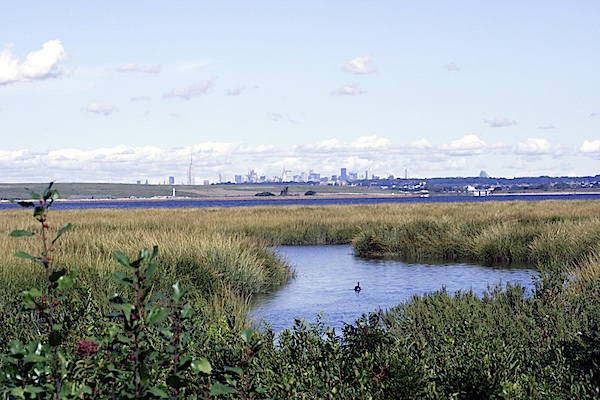
Jamaica Bay National Wildlife Refuge. The only wildlife refuge in the National Park System lies within New York City, and is not on the Union of Concerned Scientists List. The refuge is the largest bird migration stop in the Northeast, and serves as a buffer protecting urban development from major storms. Its well-developed paths among birds and flowering plants and along inland wetlands and waterways are available by public transportation to the 8.6 million residents of New York City. (Photo by the author)
For those of us who love our national parks and are confronted daily with media, politicians, and pundits warning us of a coming global-warming disaster, it's only natural to ask what that warming will mean for our national parks. This is exactly what the well-known Union of Concerned Scientists discuss in their recent report, National Landmarks at Risk: How Rising Seas, Floods, and Wildfires Are Threatening the United States' Most Cherished Historic Sites.
I've done research since 1968 on the possibility of human-caused global warming and its possible ecological effects, and have published widely on this topic, discussing possible effects on biodiversity and on specific endangered species as well as on forests, cities, and historical evidence of Arctic sea ice change. I've also been involved in the development of some aspects of some climate models, and having developed a computer model of forests that is one of the principal methods used to forecast global warming effects on vegetation, I sought out the UCS report with great interest.
The approach the Union has taken is to have the report written by four staff members: Debra Holtz, a journalist; Kate Cell, a fund-raiser for the organization; Adam Markham, with a B.S. in zoology, who was the founder of Clean Air-Cool Planet, a nonprofit organization 'to promote innovative community-based solutions to climate change in the Northeast'; and Brenda Ekwurzel, the Union's Senior Climate Scientist. She is the only author with research experience on the subject, has a Ph.D. in isotope geochemistry from the Department of Earth Sciences at Columbia University's Lamont-Doherty Earth Observatory and has been on the faculty of the University of Arizona Department of Hydrology and Water Resources.
These four authors took the standard reports from such organizations as the United National Intergovernmental Panel on Climate Change, treating them as accurate and true, and then discussed the implications for 16 American historic sites. As shown in the accompanying table, they write that 11 of the sites are threatened by rising sea levels and their consequences (coastal erosion and flooding); two by inland flooding; two by wildfires; and one by 'extreme heat and drought' (table 1).
The report opens with a bold assertion: 'Many of the United States' iconic landmarks and heritage sites are at risk as never before. Sea level rise, coastal erosion, increased flooding, heavy rains, and more frequent large wildfires are damaging archaeological resources, historic buildings, and cultural landscapes across the nation.' The report later goes on to add, 'All of the case studies in this report draw on observations of impacts that are either consistent with, or attributable to, human-induced climate change based on multiple lines of scientific evidence.' To which the authors add, 'This report sounds a wake-up call: as the impacts of climate change continue, we must protect these sites and reduce the risks."
The point of the report, its opening theme and its major conclusion, is that these historic places are in trouble and it's our fault, we have been the bad guys interfering with nature and therefore damaging places we value. This is consistent with the IPCC 2014 report and the 2014 White House Climate Change Assessment, for both of which I acted as an expert reviewer and testified before the House and Senate about.
TABLE 1. HISTORIC SITES AND CLAIMED THREATS TO THEM
Threatened by Sea Level Rise and Accompanying Flooding
- Boston's Faneuil Hall and surroundings
- Statue of Liberty and Ellis Island
- Harriet Tubman National Monument Monument
- Historic Jamestown, VA
- NASA's coastal facilities
- Annapolis, MD
- Fort Monroe National Monument
- Cape Hatteras Lighthouse
- Bering Land Bridge National Monument & Shishmaref; Cape Krusenstern National Monument, including Kivalina Native Villages and Ancestral Lands
- Pu'uhonua O Honaunau & Kaloko-Honokhau National Historical Parks
- Prehistoric Florida shell structures
Threatened by Future Floods
- Charleston, SC; Historic St. Augustine, Fl and Castillo De San Marcos
Threatened by Wildfires (and perhaps also flooding)
- Mesa Verde National Park and Bandelier National Monument & Santa Clara Pueblo
- Groveland, CA and other California Gold Rush era towns
Threatened by Extreme Heat and Drought
- Cesar Chavez National Monument, California
Back Bay Fens Park and Jamaica Bay National Wildlife Refuge
Reading the dire forecasts of the UCS report, I thought immediately about two seaside places familiar to me: Back Bay Fens Park in Boston and Jamaica Bay National Wildlife Refuge in New York City. Back Bay Fens park was designed by Frederick Law Olmsted, the famous landscape architect known especially for designing New York City's Central Park. Back Bay was a problem because it was a landfill on Boston's shore that flooded frequently, which caused various problems.
To understand what Olmsted did in designing Back Bay, one has to step back and consider Boston's original site, which had certain advantages for a major city: a narrow peninsula with several hills that could be easily defended, a good harbor, and a good water supply. But as the city grew, demand increased for more land for buildings, a larger area for docking ships, and a better water supply. The need to control ocean floods and to dispose of solid and liquid wastes grew as well. Much of the original tidal flats area, which had been too wet to build on and too shallow to navigate, had been converted, before Olmsted got involved, to flat land --- hills cut away and the marshes filled with their soil. The filling of Back Bay began in 1858 and continued for decades.
Olmsted's solution to the flooding and sewage pollution was a water-control project he called the "fens." His goal was to "abate existing nuisances" by keeping sewage out of the streams and ponds and building artificial banks for the streams to prevent flooding'and to do this in a natural-looking way. His solution included creating artificial watercourses by digging shallow depressions in the tidal flats, following meandering patterns like natural streams; setting aside other artificial depressions as holding ponds for tidal flooding; restoring a natural salt marsh planted with vegetation tolerant of brackish water; and planting the entire area to serve as a recreational park when not in flood. He put a tidal gate on the Charles River'Boston's major river'and had two major streams diverted directly through culverts into the Charles so that they flooded the fens only during flood periods. He reconstructed the Muddy River primarily to create new, accessible landscape.
Professor Botkin's two most recent books are The Moon in the Nautilus Shell and Powering the Future: A Scientist's Guide To Energy Independence.
The result of Olmsted's vision was that control of water became an aesthetic addition to the city. The blending of several goals made the development of the fens a landmark in city planning. Although to the casual stroller it appears to be simply a park for recreation, the area serves an important environmental function in flood and sewage control. Confronted with the combined problems of ocean surges and flooding from river runoff inland, Olmsted did not waste his time complaining about whether or not people have caused the problem. He just set out and solved it.
Jamaica Bay National Wildlife Refuge, although not directly planned to solve flooding problems, does so in much the same way that the Boston Back Bay Fens does. The Refuge has become one of my favorite places in New York City. It is the largest migratory bird sanctuary in the northeastern United States. It is the only wildlife sanctuary that is part of the National Park System, and it lies within the city of New York, in view of the Empire State Building, as my accompanying photograph shows. New York City residents wanting contact with nature can get there by public transportation.
The Refuge faces the Atlantic Ocean and New York's outer harbor and includes inlets and wetlands directly connected to the Sound. The refuge was damaged during tropical storm Sandy, but it served the same multiple functions that Back Bay does in Boston ' it acted as a buffer between that major ocean storm and city structures inland.
As I read the UCS report, Back Bay Fens and Jamaica Bay Refuge were in mind as what to do about coastal flooding along cities. Then I went to the scientific evidence that should be forming the basis for the UCS report, and which I will turn to now.
The Scientific Evidence
What is the evidence that sea level is rising, that wildfires, drought, and episodes of very high temperatures are increasing, and what is the evidence that such changes are our fault? Let's take them one by one.
As is well-known, we are blamed for causing a global warming mainly because our burning of fossil fuels is increasing the carbon dioxide (CO2) concentration in the atmosphere. Since this is a greenhouse gas, we must be warming the climate.
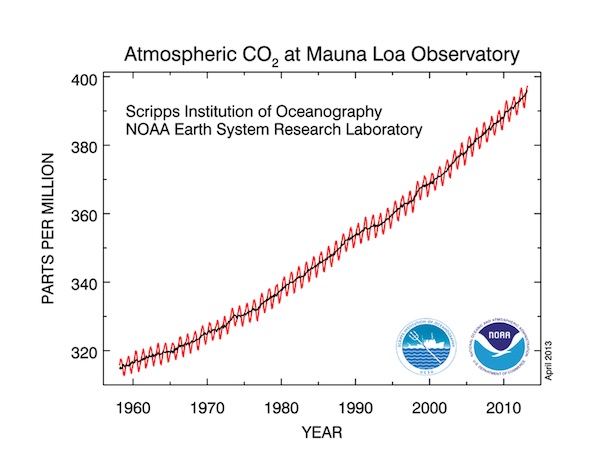
Yes, carbon dioxide, the greenhouse gas that gets so much attention, has increased greatly and rapidly, from 280 parts per million to 400, and as this graph shows, it is continuing that rapid rise.
Has Earth been warming?
Climate has always changed and is always changing. The last Ice Age, which covered places like what is now New York City with ice two miles deep, ended between 17,000 and 12,500 years ago, with overall but highly variable warming since then. Among the variations during the last thousand or so years, there was a warming period lasting approximately 300 years, from A.D. 950 to 1250, known as the Medieval Warm Period (warming compared to what climatologists today call 'normal,' taken in general by today's climatologists to mean the average surface temperature during the past century between 1960-1980 or between 1960'1990). This is the time when Vikings settled Greenland and reached North America, and when in the southern Pacific the Polynesians did a lot of their expansion among far-flung Pacific islands.
The Medieval Warming was followed by the 'Little Ice Age,' which lasted from approximately mid-1400 to 1700 A.D and somewhat later. Crop failures occurred in western Europe, and some mountain glaciers in the Swiss Alps advanced to the extent that they filled valleys and destroyed villages. Areas to the north that had enjoyed abundant crop production were under ice. This was the time when the human population was devastated by the Black Plague, whose effects may have been exacerbated by poor nutrition as a result of crop failures, and by the damp and cold that reached out across Europe and even to Iceland by about 1400. It was also the time of the early European settlement of the United States. As I have written elsewhere, when the Pilgrims said it was a cold winter, it was a very cold winter.
A warming trend started in the mid-nineteenth century. This was interrupted from about 1940 to 1960 by a cooling, and then the temperature rose until about 20 years ago. An important scientific paper published September 1 this year states that Earth's surface temperature has not changed for the past 19 years, and 16-26 years for the lower atmosphere. That's the conclusion of University of Guelph statistician and Professor of Economics Ross R. McKitrick, who used a novel kind of statistical analysis. He points out that this lack of warming is of "particular note because climate models project continuing warming over the period. Since 1990, atmospheric carbon dioxide levels rose from 354 ppm to just under 400 ppm, a 13% increase."
Carbon dioxide is definitely continuing to increase in the atmosphere, but Earth's surface and atmospheric temperatures aren't tracking it. Even though our activities are adding carbon dioxide rapidly to the atmosphere, it seems to be having no effect right now on Earth's average surface and lower atmosphere temperature.
However, the UCS report blithely comments, 'Climate models show that if our emissions of carbon dioxide and other heat-trapping gases remain high, Bakersfield could have almost 50 days of extreme heat, with temperatures reaching 104°F or more, by 2050'up from four days a year on average between 1961 and 1990.'
But if the temperature has not changed in 19 to 26 years, then how much credence can we give to this assertion? We must ask whether the climate models have been accurate predictors of recent climate change.
John Christy, the climatologist who is said to be the primary person responsible for the development of satellites that measure Earth's temperature, compared the combined forecasts of major global climate models with observed temperature change since 1980. As you can see in his graph, there is no correspondence. The climate models do not even come close to forecasting actual temperature change; they forecast a huge, steady increase. In contrast, as you can see in the graph, the temperature has varied a little, as it always does, but as the new paper that I mentioned earlier asserts, it has not changed.
John Christy's Comparison of Global Warming Model Forecasts
Actual Temperature Change since 1980 (Courtesy of John Christy, Alabama State Climatologist)

Thus the climate models cannot be considered reliable bases for forecasting the future. Indeed, other experts on model validation say that the climate models have never been sufficiently validated in any other ways as well, and therefore are not an accurate representation of the real world we live in. Conclusion: our addition of carbon dioxide to the atmosphere does not appear to be increasing Earth's temperature.
Whatever is happening to Earth's climate does not seem to be our fault.
Sea Level Rise
What about the claim that sea level rise is another factor 'damaging archaeological resources, historic buildings, and cultural landscapes across the nation? Well, the sea level has been rising since the end of the last Ice Age, starting about 14,000 years ago as the continental and mountain glaciers have melted and sea water has expanded with the overall warming. The average rate has been about a foot or two a century (about 23-46 cm per century). Data suggest that the rate was much greater until about 8,000 years ago.
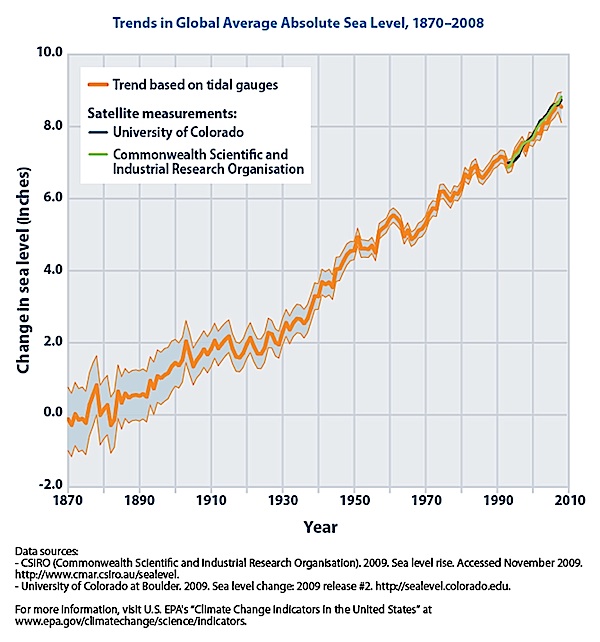
Yes, sea-level rise is definitely a problem, but it is not a problem simply because it is our fault. It is a problem that we just haven't bothered to face up to in any serious way until the global warming issue captured our attention. Whether or not we are adding to the rate of sea level rise, this is causing problems and will continue to cause problems. It would be a mistake to focus on it only if we were convinced it was our fault. For many years past, we should have been planning for sea level rise, and we need to make this an important environmental priority.
Frequency of Severe Storms
The main concern often expressed about sea levels is that severe ocean storms do greater damage than indicated by the simple rise in the water level. Therefore, it is necessary for us to look at how the frequency of severe storms has changed over time. Underlying the claim by the UCS report that 12 of the 16 sites are in danger of flooding is the assumption that the frequency of severe storms has increased, as have their landfalls. But the graphs below of severe storm frequency, show variation over time but no overall increase. Therefore, during the recent past the claim by the UCS report is contradicted. And since the climate models don't even come close to forecasting temperature change, we cannot trust them to forecast changes in storm frequency.
Number of Severe Storms affecting the United States since 1970
(Courtesy of Roger Pielke Jr., Professor in the Environmental Studies Program, University of Colorado, from his House of Representatives Testimony 11 December 2013)

Frequency of Extremely Hot Days
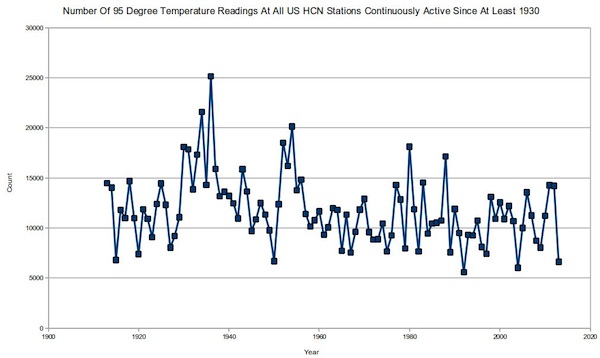
This is controversial, because it is difficult to get information that summarizes these trends for the entire United States, and there are a variety of opinions and discussions about these data, so I put this into the article with some caution to the reader. But several graphs indicate that there has not been an increase in the average number of very hot days. For example, this graph shows days with temperatures above 95° F. This graph is based on the summary from all United States Historical Climatology Network weather stations that have been in operation since 1930.
Wildfire Frequency in the U.S. Has Not Increased
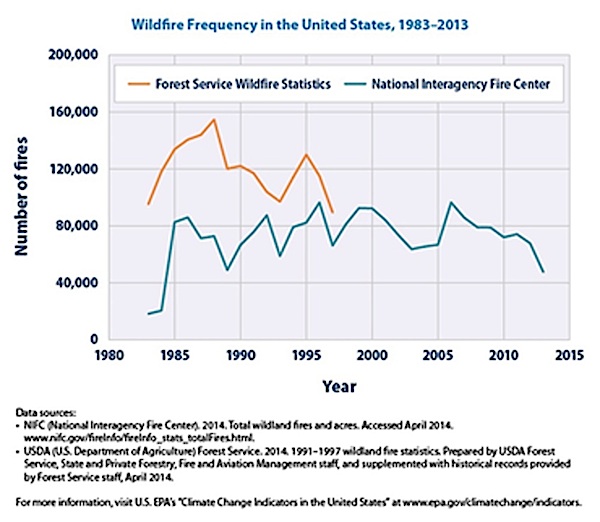
The UCS report claims that two historic sites within the National Park System are being, and will be, damaged by increases in wildfire frequency. But once again, a graph from the U.S. government agencies involved, of number of wildfires, shows no increase.
Furthermore, it is well-established that most major wildfires that occur these days are from the failure to allow much more frequent, and therefore light fires, to burn. The 20th century policy dominated by Smokey Bear ' 'only you can prevent forest fires' ' and the belief, ill-founded, that all forest and grassland fires are bad and must be prevented ' have had a damaging effect.
Wildfire Frequency
(Source EPA http://www.epa.gov/climatechange/)
As I wrote in my latest book, The Moon in the Nautilus Shell, this Smokey Bear policy also caused the near-extinction of Kirtland's warbler, which nests in young jack pine, a tree species that regenerates only after fire. It was only when ornithologists realized the population had dropped in half in a decade and that fire suppression was the cause that the Audubon Society, the U. S. Fish and Wildlife Service, and the state of Michigan began prescribed burning programs.
As I also discuss in that book, excellent work by Professor Wallace Covington of Northern Arizona University, involving careful historical analysis of the pre-European ponderosa pine forests of that state, followed by careful removal of excess fuel and trees, followed by prescribed burns every 3 to 5 years, as was the natural rate---restored some of these forests to their beautiful and natural condition: large pines widely spaced with grasses filling the land between. In contrast, next door to his experimental forests is one of The Nature Conservancy ponderosa pine protected, no-touch areas, which does not resemble the pre-European ponderosa pine forests at all, but instead forms a very dense stand of young, small trees and a lot of fuel on the ground, just waiting for a wildfire.
Carefully managed Ponderosa Pine Forest, with excess fuel built up over more than a century removed and light fires every 3 to 5 years (Photo by the author)

Next to the strongly managed forest is a Nature Conservancy no-touch Ponderosa Pine Preserve. (Photo by the author)

What Should be Done About Sea Level Rise and Wildfires and Our National Parks?
As I have shown, observations do not support the claim that our activities are currently warming the globe. Does this mean that we should stop worrying about climate change? Of course not. Because sea level has been rising for thousands of years, the encroachment of ocean waters and damage from ocean storms have been problems for coastal structures, which we have just ignored. We have to face up to these. But arguing about whether this is our fault or not is beside the point and detracts us away from doing anything useful, as we focus instead of what can best be called a fairy-tale debate. The same must be said about wildfires. For decades, experts on wildfires have been calling for improved management of America's forests, and the need remains important. We must remember Frederick Law Olmsted's approach to designing the Back Bay Fens--- solve the problem, do not waste your time arguing if we are to blame.
However, global warming has become the sole focus of so much environmental discussion that it risks eclipsing much more pressing and demonstrable environmental problems. The major damage that we as a species are doing here and now to the environment is not getting the attention it deserves.
We need to keep in mind the reality of Nature, which I have portrayed in a replacement for Smokey Bear: Morph the Moose (Copyright and trademarked by the author).

Story Categories:
A copy of National Parks Traveler's financial statements may be obtained by sending a stamped, self-addressed envelope to: National Parks Traveler, P.O. Box 980452, Park City, Utah 84098. National Parks Traveler was formed in the state of Utah for the purpose of informing and educating about national parks and protected areas.
Residents of the following states may obtain a copy of our financial and additional information as stated below:
- Florida: A COPY OF THE OFFICIAL REGISTRATION AND FINANCIAL INFORMATION FOR NATIONAL PARKS TRAVELER, (REGISTRATION NO. CH 51659), MAY BE OBTAINED FROM THE DIVISION OF CONSUMER SERVICES BY CALLING 800-435-7352 OR VISITING THEIR WEBSITE. REGISTRATION DOES NOT IMPLY ENDORSEMENT, APPROVAL, OR RECOMMENDATION BY THE STATE.
- Georgia: A full and fair description of the programs and financial statement summary of National Parks Traveler is available upon request at the office and phone number indicated above.
- Maryland: Documents and information submitted under the Maryland Solicitations Act are also available, for the cost of postage and copies, from the Secretary of State, State House, Annapolis, MD 21401 (410-974-5534).
- North Carolina: Financial information about this organization and a copy of its license are available from the State Solicitation Licensing Branch at 888-830-4989 or 919-807-2214. The license is not an endorsement by the State.
- Pennsylvania: The official registration and financial information of National Parks Traveler may be obtained from the Pennsylvania Department of State by calling 800-732-0999. Registration does not imply endorsement.
- Virginia: Financial statements are available from the Virginia Department of Agriculture and Consumer Services, 102 Governor Street, Richmond, Virginia 23219.
- Washington: National Parks Traveler is registered with Washington State’s Charities Program as required by law and additional information is available by calling 800-332-4483 or visiting www.sos.wa.gov/charities, or on file at Charities Division, Office of the Secretary of State, State of Washington, Olympia, WA 98504.


Comments
Interesting article. These points caught my eye:
On topics such as climate change and sea level rise, he notes, "....arguing about whether this is our fault or not is beside the point and detracts us away from doing anything useful."
"...global warming has become the sole focus of so much environmental discussion that it risks eclipsing much more pressing and demonstrable environmental problems. The major damage that we as a species are doing here and now to the environment is not getting the attention it deserves."
He makes some valid comments about wildfire policy, but his summary of recent wildfire statistics needs a little closer look. While he notes that "Wildfire Frequency in the U.S. Has Not Increased" since 1980, statistics from the National Interagency Fire Center (NIFC) offers some other key data.
For example, the number of acres burned has been considerably larger since the year 2000. Between 1969 through 2013 (23 years) a total of 6 million acres or more were burned in only 3 years; between 2000 and 2013, that threshold was reached 8 times.
Federal costs for wildfire suppression? Prior to 2000, that total never reached $1 billion; since 2000, those costs have exceeded $1 billion for 12 of the 14 years.
NIFC has compiled a table summarizing Historically Significant Wildland Fires (between 1803 and Aug 2013). That table lists 78 wildfires over a 210 year span; 25 of those listed (nearly 1/3 have occurred since the year 2000).
Whether or not wildfire policy or climate change are the cause, the fact is we've had a significant increase in the impacts of wildfires, based on several measures, in the past decade or so.
We have to factor in the spread of non - indigenous species as a cause of increase of fires as well as devastation to , birds, animals, plants in the US, This seems to be overlooked.
http://www.news.cornell.edu/stories/1999/01/environmental-and-economic-c...
http://anrcatalog.ucdavis.edu/pdf/8397.pdf
The exact point I have been making and Gary et al have no explaination.
This article has many logical errors, but I refuse to get into an all day debate about it. I could spend all day lamenting about population growth, the amount of wildfire conflagration events that have occurred in the northwest over the last few years, tornadoes slamming into mountainous terrain - all events that I have witnessed first hand... but I'd waste my time. I truly am done with this website. It's a rather pointless endeveur to butt heads with a realtor from colorado, and a bunch of loudmouth anonymous fundies from the south. There is no point in it.. so Eric... you WIN the internet..
And yet the NPS is formulating all kinds policies and regulations on these flawed models. I think the Climate Change agenda is dangerous and irresponsible. There is so much overwhelming evidence to the contrary, I can't understand why any intelligent person would not consider the opposing positions side. Gary and others just want to believe and that's all that matters... Pretty sad.
And beach, finally, if the OB washes away into the ocean it would really free up the insanity that you lay on this website, since you would have nothing more to talk about. Maybe I shouldn't care..
Gary, remember the IGNORE button. Let's try to return this site to it's former thoughtful commentary. Trolls dry up if no one stokes their egos by trying to respond to them.
I would hope that other experts engaged professionally in climate change research might comment on this article. It seems strange to me that such an evidence-based article should be introduced here, without some level of peer review. It also seems strange to me to conclude that since climate change models are uncertain, that they are not useful for forecasting climate change.
The scientific state of the art in the use of computer models for forecasting environmental effects involve the use of multiple competing models, calibration against actual data, and the use of quantitative uncertainty/sensitivity analysis to place credibiity intervals around forecasts to communicate the uncertainty in the model predictions, rather than present results as a point estimate (single value). I am reluctant to discard the important conclusions of the IPCC simply because it is well known that environmental computer models are inherently uncertain.
Uncertain? They have missed consistently by a wide mark. The fact that anyone would put any credence into and base decisions upon these models is mind bogling. The only plausable explaination is that the models support some other end goal.
This is really disappointing. Next you'll show us an article proving that the Grand Canyon is 4000 years old. If you want to focus on scientific debate, do so. But anthropogenic climate change is not really under debate amont climate scientists, and it's a disservice for you to give us the impression that it is. Being open-minded doesn't mean giving voice to fringe opinions.
I am starting to get the impression that National Parks Traveller is no longer a good source of news about the National Parks.
We all need to remember that this is the opinion of one man. Good question, has this been peer-reviewed?
In any science there will be dissenting opinions. That's actually good. It's a vital part of the scientific process as long as those participating are actually serious scientists and not commenters off the streets whose knowledge of the the subject -- whatever it is -- comes only from digesting predigested propaganda of any kind.
Good science depends upon rigorous examination and discussion with all evidence carefully considered.
Lee, this is the opinion of more than one man. As we discover more data tampering and manipulation, more people will question the validity of the Climate Change agenda which is a good thing.
I think posting this op-ed, in my opinion, restores some credibility to NPT.
We can debate whether or not this report is good science, but by doing so we'll miss a key point of this story: a number of parks are facing threats due to climate change and sea level rise, and whether or not it's human caused isn't the most important question. I'll repeat here two quotes:
"....arguing about whether this is our fault or not is beside the point and detracts us away from doing anything useful."
"...global warming has become the sole focus of so much environmental discussion that it risks eclipsing much more pressing and demonstrable environmental problems. The major damage that we as a species are doing here and now to the environment is not getting the attention it deserves."
Most of the comments above confirm the concerns raised by the report. We need to stop wasting time arguing about whether climate change is human caused, and get busy dealing with the threats to our "most treasured historic sites" mentioned in the report.
If climate change is accelerated by human influences, we should be able to do something about it. The IPCC gives a 90% probability that climate change is being accelerated by human activity and the production of greenhouse gases. However, if climate change is only due to random natural forces, and if human activities have virtually no consequences (the IPCC gives a 10% probabilty that this is the case), there's virtually nothing to be done, other than documenting the change, lamenting the disappearance of glaciers and the loss of key species and the evolution of entire ecosystems, and moving to higher ground.
I personally believe that exponential growth of human population and the increasing demand this population growth has on natural resources, is an even larger issue than climate change. But, I believe that accelerated climate change is inherently linked to global population growth.
In terms of immediate impacts on parks, what might happen when US corporate and public institutions adopt a more liberal vacation policy for their employees that rivals that of most of Europe? What will happen when park visitation doesn't just increase by 10% or 20%. What happens when it triples? What will happen when Baby Boomers retire and begin to migrate closer to the parks?
Off topic: I was recently in Badlands National Park. It was mid Sept. The visitor center was packed with grey haired retirees on vacation, yet the NPS was understaffed because mid Sept. was deemed to be "post season."
rdm24,
Only those that build houses out of straw and sticks are afraid of the Big Bad Wolf. No the scientific debate isn't over but there isn't any wonder why you wish it were.
EC ... Kurt pushes these articles to keep people like you fed, which is sad. Whatever credibility this site wants to have is lost. At least thats how I look at it. I notice this way too much here, and it seems to get worse.... This article was meant for you. Enjoy it! It was served to spark up debate and get people like you a chance to think you are right. I could waste my time debating this 24/7, but I won't. This is one of the most poorly written click-bait articles yet.
This comment was edited to remove gratuitous attacks.--Ed.
This article reminds me of so much web click-bait out there for online diet/skincare/pharmaceutical hucksters...
"Read this one report which shows how all the experts are wrong!!!"
One graph? Really?
On another note, because one has x likelihood of being punched in the nose in one's lifetime doesn't diminish the criminal responsibility of the person who eventually delivers the blow. That the climate is cyclic is perhaps the most earth shattering "no duh!" moment in this opinion piece. So what, I ask?
Gary - I'd once again suggest you're missing the point. Note the title of the report; "National Landmarks at Risk, How Rising Seas, Floods, and Wildfires Are Threatening the United States’ Most Cherished Historic Sites.
The report states, "Many of the United States’ iconic landmarks and heritage sites are at risk as never before. Sea level rise, coastal erosion, increased flooding, heavy rains, and more frequent large wildfires are damaging archaeological resources, historic buildings, and cultural landscapes across the nation.”
This report is a call to action to address serious threats to some NPS areas; we should not allow ourselves to be distracted by the side issue, which is whether or not these threats are human-caused. No matter what the underlying cause, the results must be addressed.
Agreed
I like NPT because of the various views but the responses today and this article have been very disappointing. Nice History lesson if only he had put as much effort into the scientific explanations for the various climate events as he did telling us about them and their dates and social history. We all know the earth's climate changes but a 5th grader and google could find the necessary papers on why items like the Little Ice Age have no relevance to the discussion on current climate change. Wouldn't it be nice if those who think its not human caused (including our favorite troll) could show a study and model that actually survived peer review that shows the current climate issues are caused by activity other than man-made. The author of this article sure didn't. The current climate studies are far from perfect but if they are even remotely correct the cost of attempting to make such large scale adjustments will be much more expensive to start 25 years from now than it would be to do something now. Its as simple as Inertia.
What current climate issues? The undisputed data shows no global warming for over 18 years, less Hurricanes, and Artic ice coverage is higher than over 40 years ago.
Once again the prove a negative tact. Your side claims man is causing it and you have models based on that conclusion. Your models haven't been imperfect, they and their predictions have been horribly wrong. They fail miserably on their own merits. We don't have to come up with an alternative model to understand your models don't work.
If you don't feed trolls, they might go somewhere else. The IGNORE button works.
Hey beach, where the hell did you get your data that arCtic sea ice is higher than over 40 years ago? I doubt you have any insight. Regardless, you are wrong.
Interestingly, Antarctic sea ice is at record levels.
http://nsidc.org/arcticseaicenews/
And if you follow the next link, you'll see how scientists explain that seeming contradiction between the shrinking Arctic sea ice extent and the growing Antarctic sea ice extent.
http://nsidc.org/icelights/2014/01/31/why-is-there-so-much-antarctic-sea...
I believe this guy's science about as much as I believe the NPS data on anything or Gary's constant assertions that he is leaving this site.
However, in publishing this nonsense, Kurt is showing a true "fair and balanced" approach to journalism absent in most all media these days.
This comment was edited to remove gratuitous language. Please, let's refrain from personal attacks and stick with substances. -- Ed.
Hmmm, the Ostrich Syndrome in effect for some. Also, lots and lots of money being made off of the man made warming logo. Yep, might investigate the corruption involved in this movement, seriously! Get it right, please.
Gary, I was incorrect on Arctic sea ice. The estimated thickness now is the same level it was in 1940. The Arctic sea ice extent has grown 64% over the past two years. Based on these facts, the Arctic sea ice seems to be fluctuating in thickness and extent size normally. No evidence of any alarming changes.
http://www.therightplanet.com/2014/08/steven-goddard-arctic-sea-ice-cove...
Just for the record, Dan Botkin has more scientific credentials than anyone could shake a stick at. And is that not the point? Doing science is far different from arguing about it. Dr. Botkin has done science all his life. Most of the rest of us are just tossing out opinions, nor does it matter which side we’re on.
As responsible citizens we should be open-minded, but no, that is not what the media teaches these days—or higher education. It is all about guilt, guilt, guilt. Who is guilty of slavery? Who is guilty of poverty? And now: Who is guilty of warming the earth?
Again, for the record, Dan Botkin agrees about the need to replace fossil fuels. But that is based on science and not on guilt. I have read his book on renewable energy. It is another masterpiece committed to solving the problem rather than passing out guilt, guilt, guilt. No wonder the press ignores it. No, I don’t agree with all of its conclusions, but the science behind those conclusions is eminently sound.
This is to explain the source of so much anger here—and downright anti-intellectualism just to make a point. We get angry when we are made to think. Take that business about the 97 percent of scientists who believe in global warming. Well, what other choice do they have? As Dr. Botkin has carefully explained, global warming is an observable, scientific fact. What the press keeps leaving out is the timeframe, a mere 10,000 years. Dr. Botkin dares complete the thought. Just because we think global warming has gone on far too long, how are we to stop it? No one has been able to suspend the earth at the point he wanted—or thought he wanted—and no one ever will.
Say we could reverse global warming. Then what? What if somehow we reversed it much too far? A scientist allows for that possibility—all possibilities. The point about dispensing guilt is to gain an advantage based on assertions that no one dare dispute.
We are barely allowed to call it political correctness. Fake courses in African-American Studies? Did the University of North Carolina really do that? You bet it did, and you bet “scientists” are doing it, too, for that is exactly how political correctness works.
We prefer our thinking “light.” Lite beer, lite thoughts, lite research—go to commercial. I can just imagine Barbara Walters in 10,000 B.C. reporting on the disappearance of the Bering Land Bridge. “My God, how did the Mastodon Party ever allow global warming to happen? There goes the only bridge we had!”
Well, we seem to have invented more bridges. Which remains the scientific point. Human beings have needed to adjust for three million years. When the Bering Land Bridge finally disappeared, somehow Asia and Europe learned how to sail. And yes, if the Bering Land Bridge had been a national park, it would have been wiped out in the rising seas. No national park is “guaranteed” to us. Even Yellowstone cannot assure us with absolute certainty that one day soon it won’t blow its top.
If you want to blame someone, blame the creative forces that made the system, over which we have absolutely no control. Yes, Al Gore will assert we do—and has a prize to prove it—but every graveyard in this country says something else.
How ironic we no longer ask the question why we would ever want a colder planet. Our ancestors most certainly ran from that. Just as many now hope to run from Africa and escape the Ebola scourge. I would welcome them were it not an infectious disease, but again, who dares say how infectious? Why interrupt a wonderful story of humans doing good? Why? Because it was disease, not global warming, that depopulated the world in 1347, and in 1918 contributed far more deaths on the planet than even World War I.
Come on, Mr. Gore. You have time to write another book. Or do you? Sorry for the inconvenience, as you say, but Ebola kills you in a week. And with a mortality rate of 70 percent, I would say that is a bit worse than global warming.
Refreshing post, Mr. Runte.
Well said Alfred.
Very good post Alfred.
Nice news source beach. I think i'll take NASA's data, and their sophisticated instruments over some teabaggin' right wing propaganda toolbox website. But I realize that's data from brainy "scary government" scientists, and can't be trusted by politically motivated right wing nutjobs.
http://climate.nasa.gov/news/986/
Once again, beach, I realize you're not sophisticated enough to tell the difference, but science goes beyond the left vs right paradigm. Keep promoting your extreme right wing mantra though. I'm sure there maybe one or two people on here that take you seriously. These blogs tend to fuel the ingornant to outshout everyone else. In a real academic setting most of you would be sent to the corner, but here, you're given a loudspeaker.
These blogs tend to fuel the ingornant to outshout everyone else.
I have hard time trusting NASA at this point, since it has been revealed they are fabricating data.
Once again, having edited this comment to remove a gratuitious attack, we will ask folks not to verbally attack others with demeaning language. Last warning.--Ed.
Mr. Botkin's reputation as a climate scientist seems to be overstated. I could only find 5 articules with him as a co-author, with the topic of "climate" when searching abstracts at Web Of Science (14 articles by him as a co-author altogether). This is not the track record of someone who's been working for many productive years in the field of climatology.
I like Kurt's idea of a limit of three comments on each subject. It does not discriminate based on ideology or position on issues. Something must be done before frequent commentators destroy the website. Incidentally my wife and I just finished a 6,700 mile road trip visiting relatives in the west and several federal sites. It really made us appreciate what the federal agencies are doing to serve the public and manage resources.
I don't understand the logic of wanting to restrict discussion. If someone doesn't want to read the comments, don't read the comments. Why restrict someone else's ability to discuss? Not to mention it wouldn't be a good business decision. Less discussion will mean less clicks.
Once again, having edited this comment to remove a gratuitious attack, we will ask folks not to verbally attack others with demeaning language. Last warning.--Ed
So, it's okay for someone to attack me, I get it now.
The shift was noticeable to me when Nasa's priorities were changed to Muslim Outreach. Trusting any information coming out in today's environment has it's pitfalls. Trust is going out the window.
Again, just for the record, Dr. Botkin is past chair of the Environmental Studies Program at the University of California, Santa Barbara, and professor emeritus of biology. And lest anyone think that UC Santa Barbara is a "teabaggin', right-wing school," it is one of the most liberal universities in the country, and gladly hired Dr. Botkin in 1978 from among a field of 100 applicants, as did the Woodrow Wilson International Center for Scholars, also in 1978, choose Dr. Botkin from among an even bigger field of applicants to represent the environmental sciences in Washington, D.C. How do I know? Because I was on the staff at both insitutions and, at UC Santa Barbara, voted to hire Dr. Botkin myself.
So, the next time anyone threatens to send Dr. Botkin to the "academic corner," just remember this. He has paid his dues--every one of them. He has nothing left to prove. Some of you people, on the other hand, have everything to prove, led by your ability to conduct debate. Debate is forever formal and forever welcoming of new ideas, however upsetting to one's core values they may be. At least, that is what a university education used to teach. Obviously, some of you were cutting class. Too bad, because you missed the best part of your educations--the opportunity to meet people who shake you to your very foundations, and forever change your lives.
It's closed folks.