
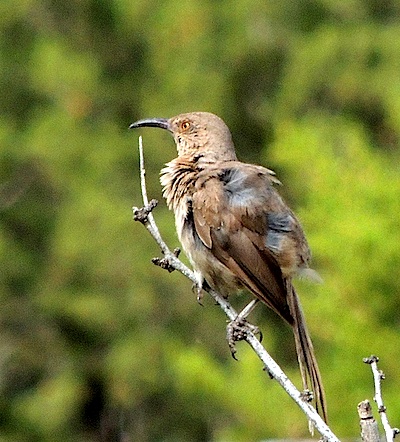
You can find the Curve-billed Thrasher at Saguaro National Park...if you know what you're looking at. Kirby Adams photo.
One of the complaints about birding in summer in many parts of the country is the plethora of leaves hiding the birds. Just when you think you’re about to get a good look, the sparrow dives into a bush or behind a leafy branch, never to be seen again.
I figured that meant desert birding would be easy. Cacti don’t have leaves.
Almost nothing in the desert does. Piece of cake, right?
Yup, birding in the desert is a piece of cake just like a prickly pear is a cuddly snuggle-pillow. It is simply amazing how many hiding places there are in a cholla. In fact, one of the highlights of my recent birding adventure in Saguaro National Park was discovering an entire family of Curve-billed Thrashers in a small cholla tangle.
We’d heard the sound of fledgling birds begging, eventually catching the adult returning with food. Only then, at very close range, did we discover at least three birds within the branches of the cactus waiting for a meal.
Birds do an exemplary job of hiding in the desert. Most desert organisms take a decidedly more in-your-face approach to life. This is partly because nearly everything in the desert is venomous, poisonous, lethally sharp, or all of the above. Birds, however, are one of the most benign creatures in the whole angry ecosystem. Thus, they stay hidden.
Dawn is the time to bird in the Saguaro forests. Everyone wants to sing at first light, and this is the one time of day they may show themselves off.
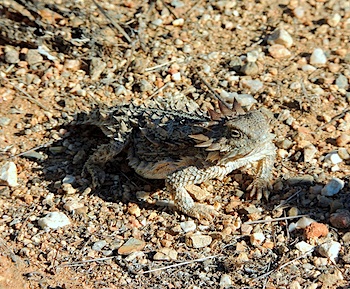
When birding at Saguaro National Park, you have to watch your step, or risk stepping on a Regal Horned Lizard. Kirby Adams photo.
Cactus Wrens love to sing from the very tip of the tallest cacti. Cactus Wrens are built like wrens, but with the size of a thrush or a thrasher. Their morning song isn’t very melodic, being more akin to the sound of a decrepit motorcycle trying to turn over. You don’t have to be beautiful in the desert, just effective.
House Finches are singing and readily visible everywhere. Gila Woodpeckers are likewise not very shy about their whereabouts in the early morning. The Gilas are among the most important animals in the Saguaro forest, being the excavators of a majority of the cavities found in the giant cacti. Those cavities are then used by a host of other birds like Lucy’s Warbler, Purple Martins, various owls, and even the American Kestrel. The list of species reliant on woodpecker cavities reads like a who’s-who of desert birds.
The Purple Martins are particularly entertaining. Where I come from, martins live in martin houses, the multi-unit birdhouses seen commonly in parks and urban areas. The reestablishment of Purple Martins in the east is so tied to those houses, I had trouble getting my head around the sight of swarms of martins coming in and out of holes in gigantic cacti in the middle of the desert.
We began our tour of the East (Rincon Mountain) Unit of Saguaro as close to dawn as possible. The drive opens at 7 a.m., and the ranger at the booth sent us in at 6:55 a.m. Still, it wasn’t long before most of the singing had stopped and bird activity slowed down to a trickle. It was 80 degrees at sunrise and would be close to 100 by noon. In heat like that, birds don’t expend much energy, but that doesn’t mean you can’t find them.
Unfortunately, it does mean that you have to expend some energy in the desert heat. Parking the car and going for a walk turned out to be the most productive way to bird after 8 o’clock in the morning. Until that time, we’d been stopping at pull-outs and birding from that spot.
Once on foot in the desert, you realize there’s more life around than you thought. I noticed at one point that I was standing on or near an anthill. I wasn’t the only one. Not three feet away from my feet was a perfectly camouflaged Regal Horned Lizard, hanging out and picking off every tenth ant in line as they marched past.
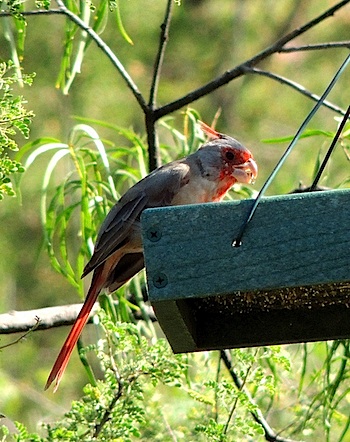
A cardinal, or a pyrrhuloxia? Kirby Adams photo.
I could have watched that all day, but a chipping sound in a palo verde tree nearby distracted me. It sounded like the Northern Cardinal we all know so well, but I had a feeling this was different.
Northern Cardinals can be found in the desert, but this bird was the “desert cardinal’, the Pyrrhuloxia. This is one of those birds that looks ridiculous in a field guide, and then you see it person and realize it actually does look that odd. A friend of mine says “pyrrhuloxia” is Greek for “a cardinal stole my red feathers and punched me in the beak.”
That’s precisely how’d I’d describe the bird, although I think the Greek roots actually mean “red” and “oblique.”
As the heat of the day continued to build, only a few birds were willing to show themselves. The house finches still gathered here and there. A Greater Roadrunner sauntered past, mouth agape, not looking like it had any intention of running on any roads today.
At one point we heard the morning wailing of two or three coyotes not too far away. That, along with the roadrunner and the cacti, made me feel like I should expect to see a package from the Acme Dynamite Company lying around somewhere.
The most iconic of desert birds doesn’t seem to mind the heat much. The Gambel’s Quail keep singing out their “Chi-ca-go!” song and scuttling around through cactus fields even as the sun begins to bake everything in sight. With its stout, wobbly shape and black upright tassel, the Gambel’s Quail looks cartoonish to start with, but one of them went above and beyond to provide some much-needed comic relief just when the heat was about to make the birding more miserable than fun.
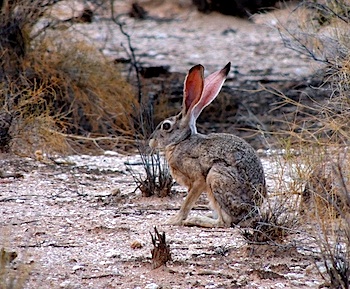
Jackrabbits claim a part of Saguaro's landscape. Kirby Adams photo.
I had approached a patch of prickly pear at the base of two huge saguaro, having seen a quail retreat to the shade there. I didn’t want to flush the poor thing, but apparently I got a bit too close, because he erupted out the back side of the prickly pears in a bulldog run, head forward, feet pumping furiously.
I had also inadvertently flushed a large Antelope Jackrabbit from the opposite side of the cactus thicket who was now bolting into the clearing on a perfect collision course with the quail. I’m not sure what capacity for fear quail have, but I swear that bird saw his life flash before his eyes. At the last second, he slammed on the brakes, lowered his head, and skidded to a halt. The jackrabbit didn’t slow at all, but executed a brilliant swerving maneuver by pushing to the right and high into air with one of its massive hind legs.
A very literal cloud of dust appeared, and when it cleared the rabbit was gone and the quail was casually walking away as if nothing had happened. Maybe I was in a cartoon world after all. It was over 100 degrees by that point, so I just held up a sign that said “That’s all, folks!” and went back to the car.
Story Categories:
A copy of National Parks Traveler's financial statements may be obtained by sending a stamped, self-addressed envelope to: National Parks Traveler, P.O. Box 980452, Park City, Utah 84098. National Parks Traveler was formed in the state of Utah for the purpose of informing and educating about national parks and protected areas.
Residents of the following states may obtain a copy of our financial and additional information as stated below:
- Florida: A COPY OF THE OFFICIAL REGISTRATION AND FINANCIAL INFORMATION FOR NATIONAL PARKS TRAVELER, (REGISTRATION NO. CH 51659), MAY BE OBTAINED FROM THE DIVISION OF CONSUMER SERVICES BY CALLING 800-435-7352 OR VISITING THEIR WEBSITE. REGISTRATION DOES NOT IMPLY ENDORSEMENT, APPROVAL, OR RECOMMENDATION BY THE STATE.
- Georgia: A full and fair description of the programs and financial statement summary of National Parks Traveler is available upon request at the office and phone number indicated above.
- Maryland: Documents and information submitted under the Maryland Solicitations Act are also available, for the cost of postage and copies, from the Secretary of State, State House, Annapolis, MD 21401 (410-974-5534).
- North Carolina: Financial information about this organization and a copy of its license are available from the State Solicitation Licensing Branch at 888-830-4989 or 919-807-2214. The license is not an endorsement by the State.
- Pennsylvania: The official registration and financial information of National Parks Traveler may be obtained from the Pennsylvania Department of State by calling 800-732-0999. Registration does not imply endorsement.
- Virginia: Financial statements are available from the Virginia Department of Agriculture and Consumer Services, 102 Governor Street, Richmond, Virginia 23219.
- Washington: National Parks Traveler is registered with Washington State’s Charities Program as required by law and additional information is available by calling 800-332-4483 or visiting www.sos.wa.gov/charities, or on file at Charities Division, Office of the Secretary of State, State of Washington, Olympia, WA 98504.


National parks and their natural resources belong to you. The National Parks Traveler works to ensure you know how these essential places are being cared for.
Sign Up For Our Weekly Newsletter
Unsubscribe at any time.
INN Member

The easiest way to explore RV-friendly National Park campgrounds.

Here’s the definitive guide to National Park System campgrounds where RVers can park their rigs.
Our app is packed with RVing- specific details on more than 250 campgrounds in more than 70 national parks.
You’ll also find stories about RVing in the parks, tips helpful if you’ve just recently become an RVer, and useful planning suggestions.


Comments
Thanks for another great piece, Kirby - and for the reminder that the desert isn't devoid of interesting wildlife...even on a hot summer day.