
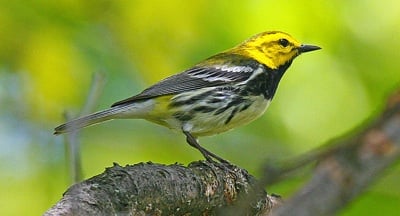
Black-throated green warblers are drawn to Fundy National Park in Canada by Old Man's Beard, a lichen similar in appearance to Spanish moss. Photo by John Harrison via Wikipedia.
Birds don’t seem to recognize political borders.
Some might call that uncivilized, but I find it endearing that a migrating bird doesn’t know – or care – if it’s about to land in Utah, Ohio, Mexico, or Canada. As long as the habitat is suitable and the time is right, the bird will land, and hopefully be spotted by an observant birder.
With that in mind, this year we’re going to explore, in this column, some national parks beyond the confines of the United States’ borders. Our first journey will head slightly north and mostly east from Acadia National Park, the easternmost park of the United States. This will take us to some of the gems of Parks Canada, the agency tasked with the administration and protection of Canada’s national parks, national historic sites, and National Marine Conservation Areas. Some of the continent’s finest birding is waiting for us in the Atlantic provinces of New Brunswick, Nova Scotia, and Newfoundland and Labrador.
Our journey begins with a five-hour drive east-northeast from Acadia. There, right along the Atlantic migration flyway is New Brunswick’s Fundy National Park. The park takes its name from the Bay of Fundy, famous for some of the highest tides in the world. But Fundy National Park is about much more than just the bay, though the daily tides certainly influence much of the ecology of the region, even far inland.
The forests of Fundy are unique along the Atlantic coast, being more akin to the temperate rainforests of the Pacific Northwest than anything else in the east. In summer months, the cold waters of the bay surging in and out with the tides lead to frequent heavy fog. Water drips from the trees, even on sunny summer mornings.
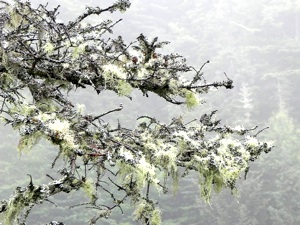
Usnea, also known as Old Man's Beard, is great for nests and fungal infections. Kirby Adams photo.
Thanks to this moisture, the forest is a lush mixture of conifers, deciduous trees, beds of moss and ferns, and epiphytic lichens. Here is a spot to watch and wait for warblers.
You may recall our celebration of Pictured Rocks National Lakeshore winning the US warbler competition with 23 nesting species. Fundy National Parks bests that number with 26 warblers. Settle down in a grove of spruce and watch the Black-throated Green Warblers tugging at the Usnea lichens that goes by the more charming common name of Old Man’s Beard.
The warblers incorporate the tough lichens into their nests, so the activity around well-adorned spruce boughs in June can be intense. The forest can be so thick with birds scouting out mates and spots to nest, an old man with a beard may just become a nesting site himself! Usnea has been used medicinally by humans as an antibiotic and anti-fungal remedy for centuries. I often wonder if the birds benefit likewise from constantly gnawing on the stuff. It seems like a wonderful convenience to have the walls of your home constructed of palatable, nutritious, and therapeutic lichens.
Along with the warblers, many birds known as common winter residents in the United States can be found nesting for the summer in Fundy. Dark-eyed Juncos, both Red and White-winged Crossbills, and Pine Siskins may be “snowbirds” to most of us, but they’re the boys (and girls) of summer in much of Canada.
Just a bit further inland from the coastal fog forests are extensive bogs, excellent for boreal species. Boreal Chickadees and Spruce Grouse might reward the patient searcher in these highlands, not to mention the occasional moose.
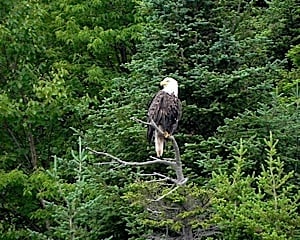
Kayaking in Fundy National Park allows you to get closeups of birds, including bald eagles. Photo by Kirby Adams.
While all of that makes for wonderful birding, it’s frankly not a whole lot different than the experience one might get in Michigan’s Upper Peninsula or Northern Minnesota.
Where Fundy National Park truly distinguishes itself is, of course, on the Bay of Fundy with its famous (or infamous, if you aren’t paying attention) tides. In some areas along the shoreline, the tide can rise or fall by as much as 30 feet every six hours. At that rate, the water is rising at about an inch per minute when the tide is coming in. I speak from experience that when scanning for seabirds from a rock on the beach at low tide, being distracted with the view through your binoculars for ten or fifteen minutes can result in a knee-deep slog back to dry land across what had been a beach moments before.
Presuming you keep tidal safety in mind, the view from the beaches is spectacular. Rafts of Common Eiders, a true saltwater duck, are common just offshore. I even managed to have some eiders float past me on the Point Wolfe River, several hundred yards from the ocean, as the tide rolled out. Of course, just a couple hours earlier, this part of the river had been essentially a bay with the gravel bar I was perched upon fifteen feet under water. That doesn’t happen in Michigan!
Gulls and terns are plentiful, as would be expected. And during spring and fall migration, the mudflats exposed at low tides are a favorite of travelling shorebirds like sandpipers and plovers.
For an intimate look at some of the seabirds and denizens of the coast, a kayak trip is just what the birding doctor ordered. The good folks at Fresh Air Adventure in Alma, New Brunswick offer guided sea kayak trips along the park’s shoreline. This is the best way to spot some of the off-shore rookeries of cormorants and gulls, as well as Bald Eagles and Peregrine Falcons perched on trees above sea caves.
Our kayak guide discussed the burgeoning population of both the eagles and falcons, citing the banning of DDT and a similar story to that of the raptors in the United States. Peregrine Falcons had been extirpated from the Fundy area when the park was christened in 1948, but have since been reintroduced and are flourishing.
We were joined on our kayak trip by a couple from France, who, although they understood English fairly well, were thrilled that the guide repeated most of our discussion en Francais.
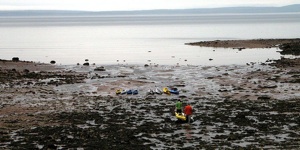
Launching kayaks in the Bay of Fundy. Kirby Adams photo.
That doesn’t happen in Michigan either!
Fundy National Park is a birding destination well worth a crossing of the border. And should you forget where you wake up at dawn in your tent or cabin, you need only listen to the numerous White-throated Sparrows that begin their songs before even the first hint of light.
As any seasoned birder will tell you, their song is “Oh, sweet Canada, Canada, Canada!”
Story Categories:
A copy of National Parks Traveler's financial statements may be obtained by sending a stamped, self-addressed envelope to: National Parks Traveler, P.O. Box 980452, Park City, Utah 84098. National Parks Traveler was formed in the state of Utah for the purpose of informing and educating about national parks and protected areas.
Residents of the following states may obtain a copy of our financial and additional information as stated below:
- Florida: A COPY OF THE OFFICIAL REGISTRATION AND FINANCIAL INFORMATION FOR NATIONAL PARKS TRAVELER, (REGISTRATION NO. CH 51659), MAY BE OBTAINED FROM THE DIVISION OF CONSUMER SERVICES BY CALLING 800-435-7352 OR VISITING THEIR WEBSITE. REGISTRATION DOES NOT IMPLY ENDORSEMENT, APPROVAL, OR RECOMMENDATION BY THE STATE.
- Georgia: A full and fair description of the programs and financial statement summary of National Parks Traveler is available upon request at the office and phone number indicated above.
- Maryland: Documents and information submitted under the Maryland Solicitations Act are also available, for the cost of postage and copies, from the Secretary of State, State House, Annapolis, MD 21401 (410-974-5534).
- North Carolina: Financial information about this organization and a copy of its license are available from the State Solicitation Licensing Branch at 888-830-4989 or 919-807-2214. The license is not an endorsement by the State.
- Pennsylvania: The official registration and financial information of National Parks Traveler may be obtained from the Pennsylvania Department of State by calling 800-732-0999. Registration does not imply endorsement.
- Virginia: Financial statements are available from the Virginia Department of Agriculture and Consumer Services, 102 Governor Street, Richmond, Virginia 23219.
- Washington: National Parks Traveler is registered with Washington State’s Charities Program as required by law and additional information is available by calling 800-332-4483 or visiting www.sos.wa.gov/charities, or on file at Charities Division, Office of the Secretary of State, State of Washington, Olympia, WA 98504.


National parks and their natural resources belong to you. The National Parks Traveler works to ensure you know how these essential places are being cared for.
Sign Up For Our Weekly Newsletter
Unsubscribe at any time.
INN Member

The easiest way to explore RV-friendly National Park campgrounds.

Here’s the definitive guide to National Park System campgrounds where RVers can park their rigs.
Our app is packed with RVing- specific details on more than 250 campgrounds in more than 70 national parks.
You’ll also find stories about RVing in the parks, tips helpful if you’ve just recently become an RVer, and useful planning suggestions.


Comments
Fantastic article on a beautiful park. I may be a bit biased however...(I work for Parks Canada). Fundy National Park is actively involved in Christmas Bird Counts and other provincial/national birding surveys. The return of the Peregrine Falcon is a fantastic FundyNP success story. Such a majestic bird.
Perhaps you should make a birding trip here in Winter?...brrrr. We have some nice heated Yurts though!
Thanks, Bronwyn. I very badly want to get to Fundy, and Newfoundland as well, in the winter. Those yurts do look appealing!
Not to take anything away from the U.S. NPS, but I've been singularly impressed by every member of the Parks Canada team I've run into.
Thank-you for the reply Kirby. I will pass on your compliment to the Team. It is always great to hear some good feedback. I'm serious about the winter trip - I saw a flock of Boreal Chickadees, maybe 20, during this year's Christmas Bird Count. It was great.
Kirby-- can you shed any more light on how the Old mans beard is used as a medicinal. As a physician I've never heard of its use in that manner?? Seems very interesting.
Hi Dick,
You mean you aren't prescibing lichens? :-)
Keeping in mind I'm far from a homeopathic medicine expert, I'll tell you what I know. The active "ingredient" of interest in Usnea is Usnic Acid. I think most peer-reviewed research concerns its ability to inhibit oxidative phosphorylation in gram positive bacteria. (Although the chemistry escapes me at the moment, I think Usnic Acid is believed to protect the lichens from oxidation in the same manner as enzymes like superoxide dismutase, but I may just be making things up now...how this would be related, if at all, to inhibition of oxidative phosphorylation, I have no clue).
I have a friend who has eaten Usnea directly, but he usually prepares it by steeping it in alcohol. I could probably track down some sources from him, as he and sister are herbalists but with a strong scientific bent. I've heard about supposed immune-boosting and anti-viral properties as well, but I think as an antibiotic for gram+ is where the real support for its use lies.
Outside of the realm of easily supportable efficacy, the Chinese have used it for cancer, Native Americans for wound dressing, etc.
Hope that sheds a little light on it.
Great article! I know the focus of this website is on American parks, but since both Canada and Mexico share in our common North American landscapes and ecosystems, it is nice to give parks in those countries some exposure as well.
Wow, thank you. As someone who grew up in Saint John (about 2 hours drive west of Fundy National Park) who spent many summers at his aunt and uncles farm near the park, it's wonderful to hear one of our southern neighbours show appreciation for this gem. Now, planning for my retirement , I am reviving my wildlife and scenic photography business and Fundy Park is a regular destination, as well as Kouchibuguac Park, north of Moncton, on the warm (in summer) Northumberlad Strait, where you can see tern nesting colonies from up close, by canoe or kayak, and Piping Plovers nest on the 25 kilometers 15 miles ) of offshore dunes. Thanks.