
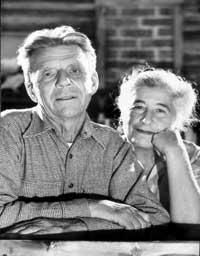
Mardy and Olaus Murie. Murie Center photo.
They are Jackson Hole’s first family of environmental protection, this valley’s version of Aldo Leopold, John Muir, Henry David Thoreau, Margory Stoneman Douglas, and St. Francis rolled into one clan.
Newcomers soon discover the progeny of the Muries, both the amazing children and grandchildren connected to them directly by bloodline and the eminently larger number of ideological descendants.
You find them fanned out across every category of business enterprise, scattered to every state, and certainly flowing through the mission statements of hundreds of local grassroots conservation organizations.
It’s an extraordinary feat thinking about the legion of individuals who acknowledge how the work of Olaus, Mardy and Adolph Murie, and Louise Murie MacLeod, impacted their lives, and affected the way they orient themselves toward the natural world.
A modicum of evidence can be found flipping through the latest Murie Center newsletter. If you have not yet seen a copy, I suggest you get one by calling the Murie Center at 307-739-2246.
Steve Duerr, the center’s executive director, and his staff have assembled a sweet, diverse lineup of stories that demonstrates how the Murie values continue to trickle down.
You’ll read about their impact on Pete Simpson and his brother, former U.S. senator Al Simpson, who actually lived for a year during the 1940s at the site of the Murie Center in Grand Teton National Park, now a National Historic Landmark.
You’ll learn how Olaus’ gentle interaction with a local ranch kid, John Turner, helped encourage Mr. Turner to leave his mark on conservation nationally as director of the U.S. Fish and Wildlife Service. And you’ll find a joyous picture of remarkable ladies carrying on the inspiration of Mrs. Murie under the umbrella of “Mardy’s Women.”
For Olaus, Mardy, Adolph and Louise, it was never about pretending to be big shots. They achieved their status by standing behind their convictions and suffering for them, grinding out a steadfast argument for the value of environmental protection when it was most unpopular. Their richness wasn’t measured in dollars but in satisfaction gleaned for their conscience by engaging the good fight and standing for something nonmaterial.
That’s why Mr. Duerr and his impressive predecessor at the Murie Center, Brooke Williams, believe so ardently in the “je ne sais quoi” concept that Olaus Murie coined about Jackson Hole, referring to its “spirit of place.”
Interestingly, Olaus made the observation in 1943, during arguably one of conservation’s darkest hours in Jackson Hole, when townsfolk in this community engaged in bitter name-calling. They accused the Muries and their circle of friends of being extremists, socialists, communists, and insisting their beliefs would destroy the valley.
Time vindicated conservation here, but it’s important to never forget the level of mean-spiritedness that erupted. It’s important to remember that history circles back upon itself.
As certain characters in the West persist in slinging the same baseless charges about modern conservationists, it’s important to ask: What’s really behind the posturing?
The Murie Center and its Jackson Hole cousin, Teton Science Schools, are anchors for an ethic that humans attain when they open themselves to a real relationship with nature. It’s why part-time valley residents like Wyomingite Rob Wallace, a senior international executive developing alternative energy for General Electric and who was touched by Mardy Murie’s spirit as a young man, keep coming “home” to Jackson Hole.
This year marks the 50th anniversary of the Arctic National Wildlife Refuge in Alaska, a place that was considered sacred to Olaus and Mardy Murie. Again, and perhaps more than ever, the refuge provides a mirror for each of us to reflect on values.
Don’t say that conservationists aren’t patriotic. Both Olaus and Adolph served their country by working for government agencies on behalf of citizens. Lest we forget, Mardy and Olaus’ son, Martin, a fine writer and now retired college professor, was a member of the legendary 10th Mountain Division—the same Army unit in which the late David Brower and other prominent conservationists served. You can read Martin's excellent essays and get links to his books by going to the Canyon Country Zephyr.
Aldo Leopold had Sand County as his muse, Margory Stoneman Douglas the Everglades, Muir the Sierra-Nevada, and Thoreau the North Woods of Maine, and for St. Francis, divinity dwelled in the countryside of Perugia.
The Muries’ vision of Valhalla was the Tetons. From the stoop of the Murie Center, you can see it.
Story Categories:
A copy of National Parks Traveler's financial statements may be obtained by sending a stamped, self-addressed envelope to: National Parks Traveler, P.O. Box 980452, Park City, Utah 84098. National Parks Traveler was formed in the state of Utah for the purpose of informing and educating about national parks and protected areas.
Residents of the following states may obtain a copy of our financial and additional information as stated below:
- Florida: A COPY OF THE OFFICIAL REGISTRATION AND FINANCIAL INFORMATION FOR NATIONAL PARKS TRAVELER, (REGISTRATION NO. CH 51659), MAY BE OBTAINED FROM THE DIVISION OF CONSUMER SERVICES BY CALLING 800-435-7352 OR VISITING THEIR WEBSITE. REGISTRATION DOES NOT IMPLY ENDORSEMENT, APPROVAL, OR RECOMMENDATION BY THE STATE.
- Georgia: A full and fair description of the programs and financial statement summary of National Parks Traveler is available upon request at the office and phone number indicated above.
- Maryland: Documents and information submitted under the Maryland Solicitations Act are also available, for the cost of postage and copies, from the Secretary of State, State House, Annapolis, MD 21401 (410-974-5534).
- North Carolina: Financial information about this organization and a copy of its license are available from the State Solicitation Licensing Branch at 888-830-4989 or 919-807-2214. The license is not an endorsement by the State.
- Pennsylvania: The official registration and financial information of National Parks Traveler may be obtained from the Pennsylvania Department of State by calling 800-732-0999. Registration does not imply endorsement.
- Virginia: Financial statements are available from the Virginia Department of Agriculture and Consumer Services, 102 Governor Street, Richmond, Virginia 23219.
- Washington: National Parks Traveler is registered with Washington State’s Charities Program as required by law and additional information is available by calling 800-332-4483 or visiting www.sos.wa.gov/charities, or on file at Charities Division, Office of the Secretary of State, State of Washington, Olympia, WA 98504.


National parks and their natural resources belong to you. The National Parks Traveler works to ensure you know how these essential places are being cared for.
Sign Up For Our Weekly Newsletter
Unsubscribe at any time.
INN Member

The easiest way to explore RV-friendly National Park campgrounds.

Here’s the definitive guide to National Park System campgrounds where RVers can park their rigs.
Our app is packed with RVing- specific details on more than 250 campgrounds in more than 70 national parks.
You’ll also find stories about RVing in the parks, tips helpful if you’ve just recently become an RVer, and useful planning suggestions.


Comments
One of my favorite books is "Two In The Far North". I loved Mardy's adventuresome, pioneer spirit!
Connie
Once upon a long, long time ago while I was a first-year seasonal naturalist in Yellowstone, John Good (I think it was) arranged for some of us to meet and talk for a while with Mardy Murie. What an experience! I think I had expected to meet someone with the ego and forcefulness of the other big shots I'd met in my early years, but what we met was a wonderful woman so quiet and humble that she reminded us all of our grandmothers. She had even baked cookies for us and served it up with big glasses of milk.
I met Olaus and Mardy just a couple of years before he died. Their inspiration was a source of strength 20 years later when I worked in the Bureau of Land Management wilderness program.
Adolph Murie (1899–1974)
Episode(s): [color=#0000ff]6[/color]
After visiting Mount McKinley National Park in Alaska as a 22-year-old college student, Adolph Murie was inspired to pursue his doctoral degree in biology. He became an important voice in preserving wild nature in national parks. He conducted a number of wildlife studies for the Park Service in a range of parks, the most significant being his landmark observations of wolves in their natural habitat at Mount McKinley. His conclusions that wolves were not a scourge on the landscape – and his call for wolves to be protected, not exterminated – made him unpopular, even within the Park Service itself. But he persevered, and eventually many of his proposals were adopted.
In the 1950s and 1960s, Murie objected to plans for building a paved highway into the heart of Mount McKinley National Park, and for a hotel and gas station near Wonder Lake. He won a partial victory when the Park Service ended the paving after the first 13 miles and abandoned the plans for the hotel and other construction.
Murie's half-brother Olaus, also a biologist, was an important figure in American conservation, serving as a director of the Wilderness Society and playing an instrumental role in the creation of the Arctic National Wildlife Refuge and the passage of the Wilderness Act. Olaus' wife, Mardy, was his full partner in the conservation efforts and carried on after his death. She played a key role in the fight for creation of the Alaska parks in the late 1970s and was eventually awarded a Presidential Medal of Freedom by President Bill Clinton.
The Murie Center in [color=#0000ff]Grand Teton National Park[/color], created from a ranch given to the park by the families of the Murie brothers, continues their conservation work. On August 16, 2004, the Murie Science and Learning Center in [color=#0000ff]Denali National Park[/color] was officially opened and dedicated to Adolph Murie, in honor of his work to enlarge and protect national parks and their wildlife populations.
Does anyone have any historical insight as to why the GRTE Superintendent asked
The Murie Center staff to leave in 2007 ? We are curious what skullduggery
may have been occurring for this "revolting development" to occur ?
http://www.jhnewsandguide.com/news/top_stories/murie-center-gets-boot/article_3c893e39-c5af-5afd-8d4c-a738b4c3f86b.html
and
http://www.jhnewsandguide.com/news/top_stories/executive-director-at-mur...