
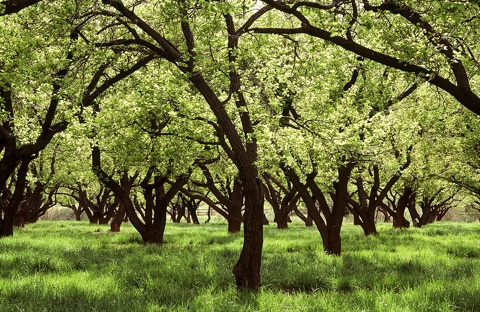
The orchards at Fruita in Capitol Reef National Park are yours for the pickin'. NPS photo.
Fall is one of the most gorgeous seasons in the National Park System. Trees are changing colors, the air is cooler and carrying scents of autumn, animals are on the move, and if you visit Capitol Reef National Park you'll find the peaches and apples are ripe for harvest!
The orchards not far from the park's visitor center date to old Fruita, a community settled by Mormons in the church's effort to populate southern Utah. These trees are among the most obvious remnants of the pioneer community, which was settled in 1880. Usually no more than 10 families lived in Fruita at any one time, and the last resident moved away in 1969. Early settlers planted the orchards to ensure subsistence; come harvest time they would head to surrounding communities to sell apples, peaches, various nuts, cherries, pears and apricots.
According to Red Rock Eden, Story of Fruita by George E. Davidson, those early pioneers weren't too far removed from Johnny Appleseed:
Pioneers planted varieties of apples that have almost disappeared or are completely gone from today's Fruita apple orchards -- applies like the Jonathan, Rome Beauty, Ben Davis, Red Astrachan, Twenty-ounce Pippin and Yellow Transparent. Other fruits of those early orchards are still popular: Morpark apricot, Elberta peach, Bartlett pear, Fellenburg plum and that great favorite of the Mormon pioneers, the Potawatomi plum. (Nels) Johnson also planted nut trees -- English walnut, black walnut, and almond. Within a decade, grape arbors were everywhere and later became the basis of a thriving -- but illegal -- local industry.
According to the folks at Capitol Reef, today the orchards are preserved and protected as a Rural Historic Landscape. The orchards hold approximately 2,700 trees and are composed of cherry, apricot, peach, pear, and apple, as well as, a few plum, mulberry, almond, and walnut trees.
Now, unfortunately we've already passed the harvest seasons for cherries (mid-June to early July), apricots (late June through mid-July), and are on the tail-end of the peach and pear harvest. However, apples should be ripe through mid-October. Best of all, these fruits are yours for the taking (for a modest fee).
You are welcome to stroll in any unlocked orchard and you may consume as much ripe fruit as you want while in the orchards. Fruit may not be picked in quantity until the designated harvest begins. Orchards that are open for picking are signed as such. A fee is charged for all fruit picked and removed from the orchards. Signs listing fruit prices, scales, plastic bags, and a self-pay station are located near the entrance of open orchards. Please select only ripe fruit and leave the rest to ripen for other visitors.
For probably more information than you'd like to know about the Fruita orchards, see the attached document that details the various types of fruits and nuts grown there.
Elsewhere in the National Park System, you're allowed to pick up to one bushel of apples per person per day in the historic orchards found in Shenandoah National Park.

Story Categories:
A copy of National Parks Traveler's financial statements may be obtained by sending a stamped, self-addressed envelope to: National Parks Traveler, P.O. Box 980452, Park City, Utah 84098. National Parks Traveler was formed in the state of Utah for the purpose of informing and educating about national parks and protected areas.
Residents of the following states may obtain a copy of our financial and additional information as stated below:
- Florida: A COPY OF THE OFFICIAL REGISTRATION AND FINANCIAL INFORMATION FOR NATIONAL PARKS TRAVELER, (REGISTRATION NO. CH 51659), MAY BE OBTAINED FROM THE DIVISION OF CONSUMER SERVICES BY CALLING 800-435-7352 OR VISITING THEIR WEBSITE. REGISTRATION DOES NOT IMPLY ENDORSEMENT, APPROVAL, OR RECOMMENDATION BY THE STATE.
- Georgia: A full and fair description of the programs and financial statement summary of National Parks Traveler is available upon request at the office and phone number indicated above.
- Maryland: Documents and information submitted under the Maryland Solicitations Act are also available, for the cost of postage and copies, from the Secretary of State, State House, Annapolis, MD 21401 (410-974-5534).
- North Carolina: Financial information about this organization and a copy of its license are available from the State Solicitation Licensing Branch at 888-830-4989 or 919-807-2214. The license is not an endorsement by the State.
- Pennsylvania: The official registration and financial information of National Parks Traveler may be obtained from the Pennsylvania Department of State by calling 800-732-0999. Registration does not imply endorsement.
- Virginia: Financial statements are available from the Virginia Department of Agriculture and Consumer Services, 102 Governor Street, Richmond, Virginia 23219.
- Washington: National Parks Traveler is registered with Washington State’s Charities Program as required by law and additional information is available by calling 800-332-4483 or visiting www.sos.wa.gov/charities, or on file at Charities Division, Office of the Secretary of State, State of Washington, Olympia, WA 98504.


National parks and their natural resources belong to you. The National Parks Traveler works to ensure you know how these essential places are being cared for.
Sign Up For Our Weekly Newsletter
Unsubscribe at any time.
INN Member

The easiest way to explore RV-friendly National Park campgrounds.

Here’s the definitive guide to National Park System campgrounds where RVers can park their rigs.
Our app is packed with RVing- specific details on more than 250 campgrounds in more than 70 national parks.
You’ll also find stories about RVing in the parks, tips helpful if you’ve just recently become an RVer, and useful planning suggestions.


Comments
When my wife and I were traveling during October, 2007, from Arches NP to Bryce Canyon NP, we spent some time driving through Capital Reef NP and visiting Fruita. This park is really one of the hidden gems of the park service. The rock formations are astounding and the orchards are beautiful; and there are a lot of them. There are around 2,600 trees altogether comprising an amazing number of varieties of fruits and nuts. The park is located on Utah 24, which together with Utah 12, makes one of the most scenic drives in the US. So you get a lot of bang out of your touring buck.
One of the little-known pleasures of the national parks is that you sometimes find a good fruit tree way off by itself where there was once a farm. I remember one small tree on a remote trail in Shenandoah that bore a few tasty apples. I forgot where it was and never found it again, but I've remembered that tree and that apple for 40 years.
Great story. I thank you, Kurt. You run a great site and have exponentially increased my awareness and knowledge of our incredible Park System in just a few months. This has become one of my favorite sites, and I just wish there were more articles every day! Haha. Not that I expect it, as I'm sure you put all your time into this as it is. But keep up the good work; it's appreciated!
Now for my tough question, perhaps. It could also easily be a dumb one. Or perhaps an impossible one! Anyway, the third to last word in that initial quote mystifies me. Any idea as to why such an orchard would be illegal at this time? I can't imagine there were laws about fruit trees in 1880..perhaps I am missing something simple. But I have read the excerpt a few times here, and don't see a glaring answer. Do you know? Or anyone?
Marshall, thanks for your kind words. We do the best we can. As for number of articles, believe it or not with the great help of Bob Janiskee and Jim Burnett through the end of August we've posted more articles than in all of 2008!
As to your question, it's really not too tough if you remember in which state Capitol Reef is located -- Utah, where the Latter-Day Saints frown on alcohol consumption -- and when you reread that sentence and focus on "grape arbors," which, of course, you need to produce wine.
I well remember camping at Capitol Reef in our motor home probably 25 years ago. We were hiking in the rocks above Fruita and wondering what the wonderful fragrance was which was wafting up on the breezes. When we came down, we realized it was the smell of the ripening apples. I always hoped to return in the Spring and see if the blossoms were as fragrant. We did return, but again in the Fall.