
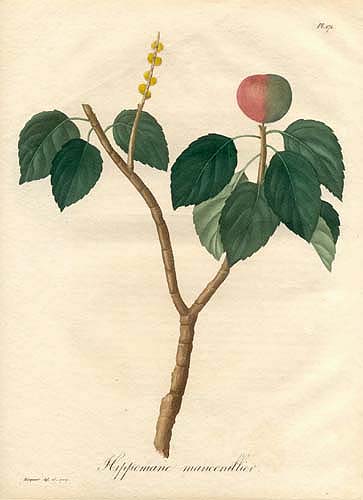
"Phytographie Medicale" painting by Joseph Roques, published in Paris in 1821. Wikimedia photo.
According to historical accounts, when Christopher Columbus’ men visited the Virgin Islands in 1493, one of the novel things they encountered near the beach was a tree that appeared to offer possibilities as a food source. The sweet-smelling fruit, which resembles small apples or crab apples, seemed very appealing, so some of the newbies tried it. They shouldn’t have.
This is the most poisonous tree found in America and one of the most dangerous in the entire world. Its bark, sap, leaves, and fruit contain a veritable witche's brew of toxins.
Though juicy and reportedly quite tasty when ripe, the fruit of this tree is loaded with physostigminet. And believe me, that’s something you do not want to ingest carelessly. Eat just a little bit of the fruit – as many careless tourists have -- and the resulting pain and swelling of your mouth and throat will give you a new and vital entry for your “don’t do it again” list. Eat a good bit of it, and you’re going to suffer about the same fate as someone exposed to nerve gas. The oral swelling and excruciating pain, esophageal ulcerations, edema, and cervical lymphadenopathy will make it hard to breathe, almost impossible to swallow, and very difficult to talk.
This tree can, and has, killed people.
This good-looking and fairly large tree, which tops out at about 40 feet, exudes a milky white latex sap that contains tigliane phorbol esters. Contact with the bark or leaves is very irritating to human skin and can result in severe dermatitis with blistering, swelling, and inflammation.
Long ago, Indians tied people to this tree to torture them, sometimes used its leaves to poison water sources, and (as the mortally wounded Spanish explorer Ponce de León discovered in 1521) they also poisoned arrows with the sap.
You can’t safely touch the bark or stand beneath this tree when moisture is dripping from its branches and leaves. You can’t safely inhale its vapors for prolonged periods in still air. When the wood is on fire, you’d be ill-advised to breathe the smoke, and you certainly don’t want to get the smoke or sap in your eyes (which can cause acute keratoconjunctivitis and other ocular injuries, normally only temporary).
In the Virgin Islands, this tropical evergreen tree is found at Salt River Bay National Historical Park and Ecological Preserve, Virgin Islands National Park, and Buck Island Reef National Monument.
Although this tree is fairly widely distributed along sandy beaches and waterways in the Bahamas, the Caribbean, Central America, and (northern) South America, its mainland U.S. distribution is confined to Florida. Fortunately, it is not common there. In fact, in Everglades National Park, Big Cypress National Preserve, Biscayne National Park, and elsewhere in Florida, this tree is scarce enough to be a state-listed endangered species.
Do you know the name of the tree that the Spanish dubbed manzanilla de la muerte, or "little apple of death"?
Answer: The mystery plant is the manchineel tree (Hippomane mancinella), a flowering plant in the spurge family that is colloquially known as the beach apple or death apple.
Postscript: Recommended treatment for skin contact is to cleanse with soap and water to remove the plant latex and dose with antihistamines to minimize immune response and reduce edema. Sickness from ingestion is often a medical emergency calling for professional treatment.
Traveler Trivia, no extra charge: The Salt River Bay National Historical Park and Ecological Preserve at Christiansted, Virgin Islands (St. Croix Island) is the only site where members of Christopher Columbus’ expedition set foot on what is now U.S. territory.
A copy of National Parks Traveler's financial statements may be obtained by sending a stamped, self-addressed envelope to: National Parks Traveler, P.O. Box 980452, Park City, Utah 84098. National Parks Traveler was formed in the state of Utah for the purpose of informing and educating about national parks and protected areas.
Residents of the following states may obtain a copy of our financial and additional information as stated below:
- Florida: A COPY OF THE OFFICIAL REGISTRATION AND FINANCIAL INFORMATION FOR NATIONAL PARKS TRAVELER, (REGISTRATION NO. CH 51659), MAY BE OBTAINED FROM THE DIVISION OF CONSUMER SERVICES BY CALLING 800-435-7352 OR VISITING THEIR WEBSITE. REGISTRATION DOES NOT IMPLY ENDORSEMENT, APPROVAL, OR RECOMMENDATION BY THE STATE.
- Georgia: A full and fair description of the programs and financial statement summary of National Parks Traveler is available upon request at the office and phone number indicated above.
- Maryland: Documents and information submitted under the Maryland Solicitations Act are also available, for the cost of postage and copies, from the Secretary of State, State House, Annapolis, MD 21401 (410-974-5534).
- North Carolina: Financial information about this organization and a copy of its license are available from the State Solicitation Licensing Branch at 888-830-4989 or 919-807-2214. The license is not an endorsement by the State.
- Pennsylvania: The official registration and financial information of National Parks Traveler may be obtained from the Pennsylvania Department of State by calling 800-732-0999. Registration does not imply endorsement.
- Virginia: Financial statements are available from the Virginia Department of Agriculture and Consumer Services, 102 Governor Street, Richmond, Virginia 23219.
- Washington: National Parks Traveler is registered with Washington State’s Charities Program as required by law and additional information is available by calling 800-332-4483 or visiting www.sos.wa.gov/charities, or on file at Charities Division, Office of the Secretary of State, State of Washington, Olympia, WA 98504.


National parks and their natural resources belong to you. The National Parks Traveler works to ensure you know how these essential places are being cared for.
Sign Up For Our Weekly Newsletter
Unsubscribe at any time.
INN Member

The easiest way to explore RV-friendly National Park campgrounds.

Here’s the definitive guide to National Park System campgrounds where RVers can park their rigs.
Our app is packed with RVing- specific details on more than 250 campgrounds in more than 70 national parks.
You’ll also find stories about RVing in the parks, tips helpful if you’ve just recently become an RVer, and useful planning suggestions.


Comments
Great article! Some fascinating information that was new to me.
Bob--
Speaking of Columbus' visit to the so-called "new world", it is a thrill to stand in what is believed to be Columbus' first house in the Americas in Parque Histórico La Isabela in the Dominican Republic. The park is managed by the Secretariat of the Environment and Natural Resources. All that is left is the outline of where archeologists believe the house stood and when I was there 4 or 5 years ago, part of the outlined foundation had collapsed into the sea. Nonetheless, it is an important historic site.
Rick Smith
I am 53...and it amazes me to see an artical about a tree that is this bad. I lived in Florida for many years as a child...never heard of this tree. I have always concidered myself "in-the-know" about rare tid-bits like this. Great artical! maybe this will be a question in a trivia game...lol.. But, ya know....it seems that when the Lord made such bad things...there was always a good part about them...perhaps one day...some scientist will find a cure for some ailement with the sap, fruit, or another part of this tree. One never knows. Be Well All, and God Bless!
Rick, I've wanted to visit Parque Histórico La Isabela ever since I first heard of it many years ago. But it's so inconvenient to get to that park (even after you've managed to get to the Dominican Republic) it's unlikely I'll ever visit. Maybe in my next lifetime.
Chef Bill, I sure hope you've never whipped up a dessert with manchineel fruit as a mystery ingredient! On a more serious note, the special chemical properties of the manchineel tree have been and continue to be of great scientific interest. Perhaps other Traveler readers can comment on the useful properties of mancinellin, hippomanins, sapogenin, 12-deoxy-5-hydroxyphorbol-6gamma, 7alpha-oxide, phloracetophenone-2, 4-dimethylether, etc.
I second the comment from the gentleman that said that he had never heard of this tree before. I just got back from a trip to the US Virgin Islands (St. John) and the only thing that alerted me that such a thing existed was a sign in front of a grove of these trees. The sign mentioned that they are poisonous and that even touching them is a bad thing.
Now, I am thinking that this sort of information should be general knowledge and be expressed to a person that is visiting this area. You know how kids are......a cute little "apple-like" thing on the beach would be very high on the list of things that some young knucklehead would put in their mouth. It would be very sad if a youngster was injured (or worse) by merely touching this tree or nibbling on the fruit.
Now, in their defense, they DID put up the sign that discussed the particular nastiness of the tree, so I guess that I was warned. But, something that could randomly kill you is something that I would expect to be warned about.
Give credit where it's due, Anon. A sign stating that trees in that grove are poisonous and shouldn't even be touched is a pretty stern warning. I think I do see your point, though. More people should be aware of this hazard (and warn their children) so we don't have to just rely on signage.
it tasted like pineapple/apple/cherry. then came the intense burning all the way down my throat. Thank god i didnt actually ingest it but insted nibble a piece, and promptly spit it out thanks to common sense.I am a manchineel/manzanilla de la muerte (as it is known in Nicaragua) survivor!
We just snorkeled Leinster Bay (in St. John) today. (We usually are very curious and read all signs - we never saw a warning sign - anywhere - about this death apple tree.) Sure enough, my 'knucklehead' boyfriend ate just two small bites of the fruit, and I politely declined. I won't eat anything I'm not sure about... but he thought it smelled so good, it must be safe. Within minutes, he began feeling a burning in his throat. As soon as we made it to the villa, he began a series of bathroom trips for diarrhea! We were checking the web to see if he's dying when we saw this blog. I packed essential first aid meds, so he's had Tums, Benadryl, and Immodium. It's been almost three hours and he's still talking - a lot - so I guess he hasn't lost his ability to breathe ;-) Wish us luck... sure hope we don't have to make a trip to the nearest medical center, wherever that is on this remote side of the island (Haulover Bay - east end). I agree that warnings should be posted everywhere, as well as verbally relayed to visitors upon arrival. This is our second trip here (last year and this year), and the second time we snorkeled Leinster. Never saw the warning sign - I wonder if it's still there!
We were recently on a beach in Mexico and my grand-daughter and I filled her sand bucket up with these cute round balls. I hadn't heard of this tree and there were no warnings posted. She delightfully carried them back to our vacation home and played with them by the pool. Fortunately, the housekeeper saw her and ran over to tell us they were Muy Malo! So glad she did. We immediately threw them away and were relieved we didn't have any reaction.
Just returned from USVI (St. John). No indication that this tree even existed until returning how to find an itchy, aggressively red rash covering my entire latimus muscle area. Went on multiple hikes through the national park and easily could have touched or leaned against said tree. Wish someone with the National Park servies would have said something! Crazy that the worlds most dangerous tree can reside in such plain sight in such a popular tourist/vacation destination.