
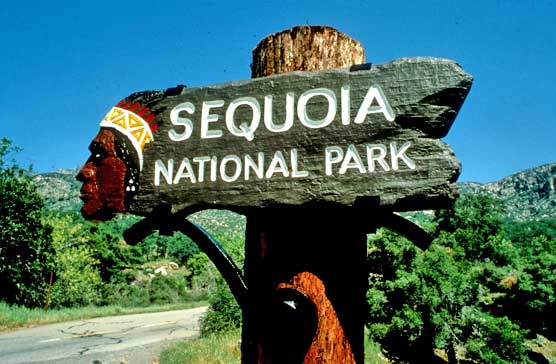
It was during the days of the Civilian Conservation Corps more than 70 years ago that this entrance sign to Sequoia National Park was crafted and posted along Highway 198. NPS photo.
Editor's note: William Tweed, who ended his National Park Service career as the chief of interpretation and cultural resources for Sequoia and Kings Canyon national parks and now writes on parks and nature from his Sierra Nevada home, was spurred by President Obama's inauguration to reflect on another president's efforts to right the country's economic promise.
The events of this past week and the advent of a new government cannot help but take our minds back to other times in our history, particularly to 1933. It was in that winter, another troubled time in our national history, that Franklin Roosevelt assumed the presidency. As it does now, the United States in 1933 faced severe and unresolved economic problems. In response, the Roosevelt administration initiated a bold and controversial program of national work. Now, some 76 years later, it is worth looking backward to see what endures of that investment here in Tulare County.
I write this column from the perspective of being a longtime national park ranger. In that work, most of which occurred in the national parks of Central California, I was surrounded every day by the 1930s products of Franklin Roosevelt's New Deal programs.
For more than a decade, for example, I worked in and around the national park campground at Lodgepole, still a popular summer destination for locals seeking a cool campsite in the heat of summer. In the vicinity of Lodgepole, the New Deal's works could not be missed. To this day, the campground's basic layout, its roads and bridges, its water and sewer systems, its comfort stations, even its amphitheater date from the 1930s.
Starting in the campground, the trail to Tokopah Falls reflected New Deal investment, as did the Generals Highway leading north to Grant Grove, a route opened to the public in 1935. Other local improvements included much of the Giant Forest trail system, the Pear lake Ski Hut, and the road, trail and electrical system at Crystal Cave. In other areas of the park, the story was much the same. Throughout the park, the New Deal built public-use facilities, support infrastructure such as ranger housing and maintenance facilities, and utility infrastructure
In succeeding decades all of these improvements have seen periodic maintenance work, but the New Deal roots of what we all use even today in the parks cannot be denied. More investment went into our national parks in a few years during the 1930s than during all the surrounding decades put together. All this work not only produced facilities of enduring value but also employed hundreds at a time of national economic distress. Now we face a similar time of national crisis and a similar moment of national opportunity. What better investment can we make as a people than insuring that our public lands receive the care they need and that facilities be available in our parks to sustain public enjoyment?
In coming weeks we will hear much debate about how much we should invest in our national future and where we should spend it. As that conversation progresses, I hope many will remember the enduring legacy of the investment made by our grandparent's generation in our public lands and how that investment still produces important benefits today.
William Tweed is a writer and historian who lives in the southern Sierra Nevada. He is working on a book about California's national parks and wilderness areas in the 21st century.
Story Categories:
A copy of National Parks Traveler's financial statements may be obtained by sending a stamped, self-addressed envelope to: National Parks Traveler, P.O. Box 980452, Park City, Utah 84098. National Parks Traveler was formed in the state of Utah for the purpose of informing and educating about national parks and protected areas.
Residents of the following states may obtain a copy of our financial and additional information as stated below:
- Florida: A COPY OF THE OFFICIAL REGISTRATION AND FINANCIAL INFORMATION FOR NATIONAL PARKS TRAVELER, (REGISTRATION NO. CH 51659), MAY BE OBTAINED FROM THE DIVISION OF CONSUMER SERVICES BY CALLING 800-435-7352 OR VISITING THEIR WEBSITE. REGISTRATION DOES NOT IMPLY ENDORSEMENT, APPROVAL, OR RECOMMENDATION BY THE STATE.
- Georgia: A full and fair description of the programs and financial statement summary of National Parks Traveler is available upon request at the office and phone number indicated above.
- Maryland: Documents and information submitted under the Maryland Solicitations Act are also available, for the cost of postage and copies, from the Secretary of State, State House, Annapolis, MD 21401 (410-974-5534).
- North Carolina: Financial information about this organization and a copy of its license are available from the State Solicitation Licensing Branch at 888-830-4989 or 919-807-2214. The license is not an endorsement by the State.
- Pennsylvania: The official registration and financial information of National Parks Traveler may be obtained from the Pennsylvania Department of State by calling 800-732-0999. Registration does not imply endorsement.
- Virginia: Financial statements are available from the Virginia Department of Agriculture and Consumer Services, 102 Governor Street, Richmond, Virginia 23219.
- Washington: National Parks Traveler is registered with Washington State’s Charities Program as required by law and additional information is available by calling 800-332-4483 or visiting www.sos.wa.gov/charities, or on file at Charities Division, Office of the Secretary of State, State of Washington, Olympia, WA 98504.


National parks and their natural resources belong to you. The National Parks Traveler works to ensure you know how these essential places are being cared for.
Sign Up For Our Weekly Newsletter
Unsubscribe at any time.
INN Member

The easiest way to explore RV-friendly National Park campgrounds.

Here’s the definitive guide to National Park System campgrounds where RVers can park their rigs.
Our app is packed with RVing- specific details on more than 250 campgrounds in more than 70 national parks.
You’ll also find stories about RVing in the parks, tips helpful if you’ve just recently become an RVer, and useful planning suggestions.


Comments
William Tweed has provided us with a fond reminder of the monumental role FDR's New Deal played in the development of the NPS. I'll be looking forward to reading his new book.
Four out of the five parks I worked during my field career in the east were developed and restored by the Civilian Conservation Corps. In those four parks, the scope of work was huge, even by today's standards, and I doubt that it would have occurred in more prosperous times. Obviously, I'd like to see the current maintenance backlog eliminated and the NPS mission sustained by providing an unparalleled experience for visitors. Unfortunately for the NPS, the science of economics has made some serious progress in the last 60 years. What many economists are telling us is that any stimulus must enter the banking and credit economy NOW, not 2010, not 2011 or later through infrastructure development. In other words, a recovery cannot wait for NEPA, NHPA, ESA and other legal requirements or the years necessary to provide the A&E drawings nor through government-sponsored programs.
On the other hand, the Obama administration may choose the FDR approach supplemented by a multi-billion dollar wealth transfer in the spirit of his campaign statement to "spread the wealth" across the nation. If this is the case, the NPS may eliminate some of that backlog, but the economic recovery will be weak and come at a very slow pace. We must remember that history tell us the Great Depression ended, not by the multitude of New Deal programs, but by the coming of the rapid industrial build-up in preparation for World War II. It's a scenario I'd rather not see repeated.
My point is that, at this time, we should not place too much confidence in a stimulus package to benefit the NPS. The Service is simply not positioned to have much influence on the economy in the short term, and that may become very apparent as the current stimulus package gets careful review. We should hope that the Obama administration and Congress make the right choices to build an economic recovery in which we can restore and enjoy the parks. Either way though, I think Frank C reminds us of the bottom line: our children and grandchildren will be paying for this American bankruptcy with hyper-inflated dollars to China and India for many, many years.
For further reading, check out Guy Sorman's article, "Economics Does Not Lie," in the Summer 2008 issue of City Journal. Also, Amity Shlaes's 2008 book, The Forgotten Man: A New History of the Great Depression, offers some interesting perspectives on that time, given our new understanding and appreciation of that dry science called economics.