
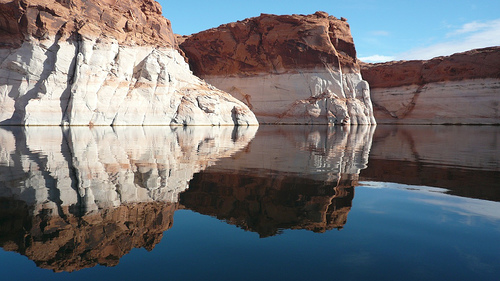
At Glen Canyon National Recreation Area, years of drought, possibly an indicator of climate change, have revealed Lake Powell's bathtub walls. Spring runoff, however, could soon make those bathtub walls vanish. Photo by Marco Ammannati via flickr.
Climate change is taking it on the chin in the Rockies this winter. So much snow has fallen in the Intermountain West that when it melts it's expected to raise the level of Lake Powell by some 50 feet, to the highest point it's been since 2002. As a result, if you haven't already explored the previously submerged back canyons of Glen Canyon National Recreation Area, your time is running out.
According to the U.S. Bureau of Reclamation, snowpack in the Upper Colorado River Basin is currently at 124 percent of average. As this snow melts, it will flow into the Colorado River and eventually into Lake Powell. What's interesting about this forecast is that NRA officials are not lamenting the soon-to-be-submerged landscape, but rather saying how the higher reservoir level will benefit boaters.
“With the runoff anticipated into Lake Powell this spring, it’s going to be a great summer at Glen Canyon National Recreation Area. We are expecting a busy season with the likely opening of the Castle Rock Cut,” said Superintendent Stan Austin.
The spring runoff is expected to reopen the Castle Rock Cut early this June. The Castle Rock Cut is a popular route on Lake Powell that allows boaters to conveniently travel between the Wahweap Marina and other destinations uplake. Traveling through the Castle Rock Cut saves about 12-miles to popular areas such as Rainbow Bridge, Padre Bay, and Warm Creek Bay. Due to long-term drought conditions, however, the Castle Rock Cut has not been usable since 2003.
With the promising spring runoff forecast, the National Park Service will not need to proceed with plans to deepen the Castle Rock Cut this spring. The Bureau of Reclamation’s projections for Lake Powell indicate that the Castle Rock Cut is expected to remain passable for boats into 2010. This will also save Glen Canyon NRA $1.5 million, which can be directed toward other park needs.
“Lake Powell should quickly start rising in April and May and it will be nearly impossible for us to deepen the cut this spring,” said Superintendent Austin.
The Park Service released an environmental assessment for public review in February 2008 that examined deepening the Castle Rock Cut so it would be passable for boats at lower water levels. The environmental assessment process will continue, even though the Castle Rock Cut will likely become passable to boats this summer.
Currently, public comments are being reviewed and analyzed. A formal decision about whether to proceed with the deepening project is expected to be made later this year, and the Cut could be deepened in the future if lake levels drop again.
Story Categories:
A copy of National Parks Traveler's financial statements may be obtained by sending a stamped, self-addressed envelope to: National Parks Traveler, P.O. Box 980452, Park City, Utah 84098. National Parks Traveler was formed in the state of Utah for the purpose of informing and educating about national parks and protected areas.
Residents of the following states may obtain a copy of our financial and additional information as stated below:
- Florida: A COPY OF THE OFFICIAL REGISTRATION AND FINANCIAL INFORMATION FOR NATIONAL PARKS TRAVELER, (REGISTRATION NO. CH 51659), MAY BE OBTAINED FROM THE DIVISION OF CONSUMER SERVICES BY CALLING 800-435-7352 OR VISITING THEIR WEBSITE. REGISTRATION DOES NOT IMPLY ENDORSEMENT, APPROVAL, OR RECOMMENDATION BY THE STATE.
- Georgia: A full and fair description of the programs and financial statement summary of National Parks Traveler is available upon request at the office and phone number indicated above.
- Maryland: Documents and information submitted under the Maryland Solicitations Act are also available, for the cost of postage and copies, from the Secretary of State, State House, Annapolis, MD 21401 (410-974-5534).
- North Carolina: Financial information about this organization and a copy of its license are available from the State Solicitation Licensing Branch at 888-830-4989 or 919-807-2214. The license is not an endorsement by the State.
- Pennsylvania: The official registration and financial information of National Parks Traveler may be obtained from the Pennsylvania Department of State by calling 800-732-0999. Registration does not imply endorsement.
- Virginia: Financial statements are available from the Virginia Department of Agriculture and Consumer Services, 102 Governor Street, Richmond, Virginia 23219.
- Washington: National Parks Traveler is registered with Washington State’s Charities Program as required by law and additional information is available by calling 800-332-4483 or visiting www.sos.wa.gov/charities, or on file at Charities Division, Office of the Secretary of State, State of Washington, Olympia, WA 98504.
INN Member

The easiest way to explore RV-friendly National Park campgrounds.

Here’s the definitive guide to National Park System campgrounds where RVers can park their rigs.
Our app is packed with RVing- specific details on more than 250 campgrounds in more than 70 national parks.
You’ll also find stories about RVing in the parks, tips helpful if you’ve just recently become an RVer, and useful planning suggestions.


Comments
Unbelievable! We are now lamenting the natural flow of snow-pack to river, & the attitude that we need to intervene in natural processes to make it 'easier' for visitors. This makes me gag. No wonder we are losing our place on Earth with species extinctions, habitat loss & environmental disasters: we refuse to allow Nature to take its course, & instead insist on manipulating all for human convenience ... terrific. I am a disabled person who is tired of having the Earth sabotaged for my theoretical benefit. What benefits me is to allow more unguided existence. Surely we humans have more than demonstrated our inability to 'govern' the Earth!
So you're happier with the theoretical benefit not losing our place on Earth with species extinctions, habitat loss & environmental disasters. If you lived in the southwest, you would have been out of water for the last few years had it not been for Lake Powell. I think we should do all we can to make it easier for humans.
What gags me are hypocrites that cry about touching the environment for any reason. Do they use roads to go places? Do they live in a home with running water and electricity? Do they use refrigerators or washing machines? If the answer is yes to any of these questions, you better start changing you own life before imposing your views on everyone else.
Deepening of the cut will reduce fuel usage and pollution in the lake, yet, won’t harm the landscape or native habitat that currently exist. The cut was done once before, the new cut will only deepen the original cut.
"...possibly an indicator of climate change." Ya think? When it rains, that is climate change. When it doesn't rain, that is climate change, too. Is this some kind of sleeper signal to the alien tinfoil hat crowd? Seems too inane on the surface.
Climate change is incredibly complicated. In fact, atmospheric scientists have pretty much quit saying that climate change is “more complicated than we know” and are now admitting that it is “more complicated than we will EVER know.” Are the fluctuating water levels of Lake Powell and some other western impoundments "indicators” of long-term changes in the regional or global climate? Kurt doesn’t know for sure, and I don’t know for sure, and you don’t know either. What we do know is that everything is connected to everything else, and nothing happens without a cause. Maybe someday scientists will be able to put the various facts together and understand what has caused these changes in precipitation and snowpack in the Rockies. Meanwhile, I see no reason why we shouldn’t speculate that these weather and runoff anomalies COULD be signals of long-term shifts in regional patterns of temperature and precipitation. In fact, the stewards of our western land, water, and wildlife resources have a solemn obligation to take that possibility into account in their management plans.
First we blame the lack of precip to climate change, then we blame too much on climate change. I am about to throw up. And using a single data point (one season's snow fall) to either prove or disprove any theory is scientifically bankrupt.
Let the science drive the conclusions!
Last year I was through the Lake Powell area (I go there every year) and was stunned how low the water level had gotten. It is somewhat good news that the water level is returning to normal.
"The science" has already spoken. Now it's up to the media, the politicians and of course the public to understand the interdependencies: Global warming means more energy in the climate system (as heat is energy, any rising of the medium temperature puts more energy in the system). More energy in a system dos not necessarily mean that all temperatures will rise. Only the average will, but some of the additional energy will show in more extremes (as that is another aspect or more energy in a system).
So expect more precipitation in shorter times, meaning flash floods. And more droughts. Both are aspects of more energy in the climate system.
What a bunch of baloney! Science has not spoken! There is not a scientific consensus on "Global Warming." Many legitimate scientists disagree with the idea that Global Warming is caused by man or that Global Warming is even occurring. So what happens if we have this same kind of winter for about 3 years in a row? Will the alarmists start shouting that man is causing a new ice age? To save face their mantra will change and become "Global Climate change." What a bunch of bunk! Man has no idea what is going on or how to control it. One volcano has the capacity to spew more material into the air than most people can imagine.
Nicely said Mr. Anonymous. I'm not convinced that there is a "climate crisis". I also doubt that there is very little, probably nothing, that we could do about it anyway. Here's an interesting piece you might enjoy reading:
http://johnrlott.blogspot.com/2008/04/are-we-heading-towards-ice-age.html
The "sky is falling" amateur climatologists love to point out the increase in man-made carbon dioxide emissions due to the automobile and the mechanisms related to the Industrial Revolution. All well and good. But as Bob pointed out above, our Mother Earth and her environment is a slightly more complicated issue than we would care to imagine. And basing the doomsday forecast on 135 years worth of meteorological data is akin to standing on the South Rim of the Grand Canyon, peering in for a few minutes and believing you've "seen" all that comprises the Abyss. Funny how it goes that until recently our planet had the ability, much as does our human physiology, to effect repairs and maintain the status quo in spite of us. Unfortunately, we have begun to cut away at the very foundations of planetary climate maintenance and garbage control. The amount of carbon dioxide emissions is not the issue, per se, unless you couple that along with what we have done to reduce the effectiveness of Earth's ability to "recycle" those gases but our new-found love for slash and burn agricultural techniques. By reducing the rainforests at a greater rate than ever, and not having time to replenish those mature stands of trees that were once able to shoulder the increased burden of burning off the vegatation requried to maintain the delicate balance in nature, you in effect over-burden that remaining plant life, some of it lethally, and thereby the snowball races down the hill. You can take whatever steps you like to "green" yourself, but the real issue qutie literally is the lack of green that we have let proliferate on our planet.
Unfortunately and most conveniently, Big Al doesn't mention much about that, since it involves upsetting the "developing" world.
The cut is for recreational boaters and the abiity to save time and more importantly, FUEL. I have read the comments from the various posters talking about climate change and can only smile and wonder to what extent everyone who posts about it really knows. Lake Powell was created for 2 purposes: 1) Provide back up water holding capacity for Lake Mead and 2) Provide employment and recreational oppurtunites to south central Utah and northern Arizona. Boaters spend loads more money then do hikers and backpackers, so unfortunately Lake Powell will rise and fall depending on the CO Basin snowpack or untill Lake Mead is low enought that it becomes the priority for refilling. Projections for Lake Mead this summer are that it will drop between 6 -19 feet more. Lake Powell was built before EIS's (Environmental Impact Study) were required for such projects and will continue to try and fulfill its primary purpose. What many don't realize is that Lake Powell is filling up, not with water, but with CO River sediment. This is going to happen regardless what happens with the SW and the amount of CO River runoff. The more snow, the more runoff, the more sediment, the faster it fills and the less it will hold. Less runoff only means it will take longer to fill with sediment.
As Lake Powell fills with sediment the dredging and trenching will need to be increased to keep Lake Powell as a viable reservoir for the CO River drainage system--but at what cost? How many millions of dollars will it take to keep the reservoir usable?
Climate change is happening regardless of who or what is causing it, it is happening. The mean ambient tempature for the world is rising and as the ice shelf's melt at the poles the proscess picks up speed. This has happened before according to the scientists who have been studying this issue. The difference is this time it will have far reaching effects on People and where the majority of the world population lives. Personally, I don't believe we can stop it or change the current course, maybe slow it down, but we have neither the will nor the money to stop it. Tokyo, LA, NYC, and the rest of the large cities that have develped along coasts are not underwater or are being theatened YET. New Orleans was underwater 2 years ago and we see the amount of $ill the Government is willing to deal with that mess. Add LA, NYC, Miami, SF, Seattle, SD, Houston, Boston, Baltimore, Washington DC, Coast of NJ, and numerous other high density areas and at some point there will be a huge mess to deal with--but till then lets leave will enough alone. Or as we have seen in New Orleans, people will just have to move. This will of course will be an economic Boom! More construction, new roads, new schools, Energy efficient buildings, new jobs, and all the wonderfully good things that go with mass relocation of families and business. For the life of me I can not think of any negatives.
Remember to plan ahead, after all it was not raining when Noah built the ark!