
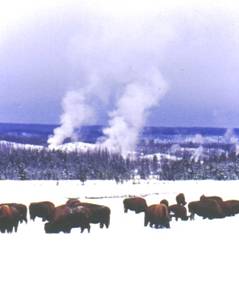
A GAO report says state and federal agencies are far behind in their efforts to come up with a solution to the possibility of Yellowstone National Park bison spreading a deadly disease to livestock. Kurt Repanshek photo.
The other shoe has dropped in the Government Accountability Office's investigation into the management plan for Yellowstone National Park bison. In a biting report the GAO says the plan has been a failure on numerous fronts and the involved agencies need to come up with a better solution.
It was back in 2000 that the state of Montana, the National Park Service, the U.S. Forest Service, and the U.S. Agriculture Department's Animal and Plant Health Inspection Service agreed to an Interagency Bison Management Plan. The goal was to come up with a way to prevent Yellowstone bison from spreading brucellosis, a disease that can cause livestock to abort their fetuses, to cattle beyond the park's borders. (There has, however, been no documented case of such a transmission, although there have been suspected transmissions from elk to livestock.)
But according to the GAO, not only are the agencies -- which have spent a combined $16 million on their work in this arena -- far behind the schedule they adopted eight years ago, but they have been, in a word, dysfunctional.
...the agencies have not adequately implemented adaptive management, in that they (1) have not established critical linkages among clearly defined objections (which are absent from the plan), information about the impacts of their management actions obtained through systematic monitoring, and decisions regarding adjustments they make to the plan and their management actions; (2) have continued to act more as individual entities, rather than as a cohesive interagency group; and (3) have not adequately communicated with or involved key stakeholders, such as conservation groups, livestock industry groups, and private landowners. Consequently, their decision-making more often resembles trial and error than adaptive management and also lacks accountability and transparency.
It was a year ago that GAO issued some preliminary findings from its investigation, telling a congressional subcommittee that the agencies were at least four years behind the schedule they established in the Interagency Bison Management Plan.
"A key condition for the partner agencies to progress further under the plan requires that cattle no longer graze in the winter on certain private lands north of Yellowstone National Park and west of the Yellowstone River to minimize the risk of brucellosis transmission from bison to cattle; the agencies anticipated meeting this condition by the winter of 2002/2003," Robin Nazzaro, who heads the GAO's Natural Resources and Environment branch, wrote in her report to the House Subcommittee on National Parks, Forests and Public Lands.
In her final report, which was released late Wednesday by U.S. Reps. Nick Rahall, D-WV, and Maurice Hinchey, D-NY, Ms. Nazzaro says little has changed.
"Each of the plan's three successive steps for managing bison is intended to incrementally increase tolerance of bison roaming outside the park," she noted. "As of late 2007, however, the agencies remained in step one because they have yet to meet two important conditions for moving to step two -- first, that no cattle graze on a ranch (the Royal Teton Ranch) north of the park, and second, that a safe and effective remote brucellosis vaccine-delivery system be available for bison."
Indeed, if you look at just the number of bison killed this winter in the name of brucellosis containment it would appear as if there has been no tolerance of bison roaming beyond Yellowstone's borders. The report is released in the midst of the highest level of annual slaughter since the 19th century - 1,167 bison have been sent to slaughter to date.
Not surprisingly, the GAO report was applauded by advocacy groups who have been urging the agencies find a solution to the bison-livestock controversy.
"After eight years of stalemate, NPCA is pleased that the GAO report focuses on the critical need for agency accountability and better solutions for bison," said Timothy Stevens, Yellowstone program manager for the National Parks Conservation Association. "The management agencies should recognize new research and on-the-ground changes and adapt the plan so that it works for both bison and the livestock industry. Simply put, the current bison management isn't working and must be fixed."
At the Greater Yellowstone Coalition, which in 2006 proposed its own solution to the problem, parks program director Amy McNamara said, "Opportunities exist right now to provide additional habitat and tolerance for Yellowstone bison. A critical step to address the lack of progress in the plan is a finalized and funded agreement with the Royal Teton Ranch. Agencies must step up to the plate and provide the resources necessary to complete this agreement."
Now, the GAO report does note that the Park Service intends to "release its evaluation of remote delivery methods for use within the park for public comment in summer 2008." Additionally, it notes that the agencies "have implemented management actions to keep bison separate from cattle in space and time; conducted some scientific research on brucellosis; verified the safety of a brucellosis vaccine in bison, and vaccinated a limited number of bison calves and yearlings on a limited basis; and taken steps to ensure the vaccination of all cattle within certain areas close to the park's northern and western boundaries."
And yet, the GAO questions whether accomplishing all the goals in the Interagency Bison Management Plan will resolve the annual controversy over Yellowstone's bison.
Even if the agencies improve their management and fully implement the current plan through step three, we believe the controversies will continue, in part because critical underlying differences among agency mandates, management philosophies, and political interests have not been resolved," the GAO says. "In addition, the plan lacks clearly defined, measurable objectives to guide the agencies bison management actions, and the agencies are not adequately applying an adaptive management approach in implementing the plan.
Moreover, the agencies’ implementation of the plan has remained fragmented, because no single entity is accountable for coordinating and steering the management, research, and resolution of these bison-related issues. In addition, the agencies’ management lacks the accountability and transparency expected by the public and Congress. Meanwhile, the federal government continues to spend millions of dollars on uncoordinated management and research efforts, with no means to ensure that these efforts are focused on a common outcome that could help resolve the controversies.
Because the plan is not a brucellosis eradication plan, concerns about brucellosis transmission will still require the agencies to actively manage bison moving from the park into Montana, even if they fully implement all steps of the plan. Given these realities, improvements in the partner agencies’ implementation of the plan, including more systematic application of an adaptive management approach, could contribute greatly to helping address the larger brucellosis issue in the Greater Yellowstone Area. Multiple recent suspected transmissions of brucellosis from elk to cattle in the area have highlighted the importance of addressing this disease in its broader wildlife and ecological context, and doing so could have significant implications for the future management of Yellowstone bison.
Earlier this year conservation groups urged Montana's congressional delegation to work harder on resolving this issue.
Story Categories:
A copy of National Parks Traveler's financial statements may be obtained by sending a stamped, self-addressed envelope to: National Parks Traveler, P.O. Box 980452, Park City, Utah 84098. National Parks Traveler was formed in the state of Utah for the purpose of informing and educating about national parks and protected areas.
Residents of the following states may obtain a copy of our financial and additional information as stated below:
- Florida: A COPY OF THE OFFICIAL REGISTRATION AND FINANCIAL INFORMATION FOR NATIONAL PARKS TRAVELER, (REGISTRATION NO. CH 51659), MAY BE OBTAINED FROM THE DIVISION OF CONSUMER SERVICES BY CALLING 800-435-7352 OR VISITING THEIR WEBSITE. REGISTRATION DOES NOT IMPLY ENDORSEMENT, APPROVAL, OR RECOMMENDATION BY THE STATE.
- Georgia: A full and fair description of the programs and financial statement summary of National Parks Traveler is available upon request at the office and phone number indicated above.
- Maryland: Documents and information submitted under the Maryland Solicitations Act are also available, for the cost of postage and copies, from the Secretary of State, State House, Annapolis, MD 21401 (410-974-5534).
- North Carolina: Financial information about this organization and a copy of its license are available from the State Solicitation Licensing Branch at 888-830-4989 or 919-807-2214. The license is not an endorsement by the State.
- Pennsylvania: The official registration and financial information of National Parks Traveler may be obtained from the Pennsylvania Department of State by calling 800-732-0999. Registration does not imply endorsement.
- Virginia: Financial statements are available from the Virginia Department of Agriculture and Consumer Services, 102 Governor Street, Richmond, Virginia 23219.
- Washington: National Parks Traveler is registered with Washington State’s Charities Program as required by law and additional information is available by calling 800-332-4483 or visiting www.sos.wa.gov/charities, or on file at Charities Division, Office of the Secretary of State, State of Washington, Olympia, WA 98504.


National parks and their natural resources belong to you. The National Parks Traveler works to ensure you know how these essential places are being cared for.
Sign Up For Our Weekly Newsletter
Unsubscribe at any time.
INN Member

The easiest way to explore RV-friendly National Park campgrounds.

Here’s the definitive guide to National Park System campgrounds where RVers can park their rigs.
Our app is packed with RVing- specific details on more than 250 campgrounds in more than 70 national parks.
You’ll also find stories about RVing in the parks, tips helpful if you’ve just recently become an RVer, and useful planning suggestions.


Comments
The Park Service has continued to slaughter bison; the totals are by far the highest ever. A lot more are being held in the Stephens Creek. Montana hasn't really amped up its slaughter yet. By the math I've done, another 500 or more buffalo have died from the winter. This is not just any other year; this is the worst year ever. What's been different this year is that the Park Service has done most of the killing.
There were two women with Buffalo Field Campaign arrested for chaining themselves to the visitor center at Mammoth Hot Springs last week. The same night, our new group in Bozeman hosted Mike Mease of Buffalo Field Campaign for an educational event; there was a lot of talk there about how easy some of the solutions would be to implement. BFC, in contrast to the Greater Yellowstone Coalition, opposes further money going to buy out the Royal Teton Ranch; it really is a kind of extortion. While I personally think this is an ideological struggle that should play itself out, others have made convincing arguments that there are natural geographic boundaries to bison expansion, that it wouldn't be hard to vaccinate cows, that the rest could be handled by fencing. Mease points out that in the Tetons where bison graze on the same land as cattle - where the cattle have been vaccinated (not the bison) - that there's never been any brucellosis transmission. On the west side, advocates there in the audience pointed out that there really aren't that many ranches in the Madison Valley. In a private conversation, Mease told me the Paradise Valley would be much more difficult, but it still would be nothing that fenches and vaccination couldn't deal with. A lot of landowners actually want bison on their land, but right now they aren't allowed to do this. That's a big story in the Madison Valley.
And, yet, when it comes down to it, this is not at all about brucellosis; this is about turf wars and control of land, and value judgments about the proper use of land. The GAO report in some ways helps to identify that.
It's the dumbest thing and most maddening thing here, though. You don't have to be a radical like me to see that none of this has to be. And, yet, there is not a partisan or a political solution to this (though some in our audience were urging legislative lobbying in Helena as the best strategy here).
Jim Macdonald
The Magic of Yellowstone
Yellowstone Newspaper
Jim's Eclectic World
We know where the bison go when they leave the park boundaries, this isn't a mystery. It would have been better to use that 16 million to buy up land on their usual path to protect the bison! 16 million would have made a nice start in purchasing more land for the park, at least. For those of us in D.C. however, we just roll our eyes at the mess the government created... Anytime we see one of these 'interagency management plans' it means nothing will be accomplished for an enormous price tag of money and time. The path the governmental 'interagency' was going to flounder on was as predictable as the path the bison take.
Marylander, making the park larger would likely never fly in these here parts--the guvmint is already an unwelcomed intruder. Parks are more restrictive than other public lands (no huntin' or trappin' or rippin' it up on ATVs & snowmobiles in national parks).
But check out this page http://www.buffalofieldcampaign.org/maps/yellowstonemaps.html scroll down to Greater Yellowstone Ecosystem and National Forests (it's a small map, couldn't locate a better one without spending more time) and you'll see that the park is already surrounded by public lands. Granted, there are private parcels and the towns of Gardiner and West Yellowstone in there, too, but had the park's boundaries been drawn to acknowledge seasonal migrations corridors and such, I guess we wouldn't be having this discussion now.
You're right-on about the interagency boondoggle, although from their perspective, it's working quite nicely, thank you. They get to "manage" and slaughter the wildlife they see as problematic (competition), and they are awash in taxpayer money for doing it.
The public land is there. The state of Montana simply needs to designate it as bison habitat, the Forest Svc. needs to retire a few grazing permits, and let 'em roam. At this stage in the game, Montana doesn't even consider wild bison to be wildlife!