
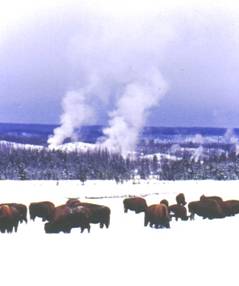
Congressional help is being sought to halt the killing of Yellowstone National Park bison. Kurt Repanshek photo.
As the killing of Yellowstone National Park bison continues, a coalition of groups is looking for congressional support to fund a solution.
Earlier this month the National Parks Conservation Association, Greater Yellowstone Coalition, Montana Wildlife Federation, and the National Wildlife Federation wrote Montana's congressional delegation with a request that they get actively involved in the bison matter.
Already more than 1,040 park bison have been killed because they tried to head out of the park to lower wintering grounds. Another 160 are waiting to be shipped to slaughter. Why? Out of concern that they might harbor brucellosis, a disease that can cause livestock to abort their fetuses.
Today the groups called on Montana's congressional delegation -- Senators Max Baucus and Jon Tester and Representative Dennis Rehberg -- to seek federal funding that might allow some bison to migrate safely onto adjacent lands outside Yellowstone. Additionally, they want the delegation to look into why a "locally negotiated and federally and publicly supported agreement to remove cattle during the winter from the Royal Teton Ranch, owned and managed by the Church Universal and Triumphant, adjacent to Yellowstone has apparently stalled."
That agreement was intended to allow bison to migrate through the Royal Teton Ranch and onto an additional 7,500 acres of winter habitat on public lands.
"Unfortunately, while federal agencies, specifically APHIS, have so far refused to commit resources towards completing the RTR agreement, the hazing, capture, and slaughter of bison has reached record levels this year," said Tim Stevens, Yellowstone Field Office Program Manager for the NPCA. "Several organizations have already expressed a willingness to raise private financial support for this agreement, but the federal government must do its part by providing critical funding and completing the deal."
The National Park Service, the Animal and Plant Health Inspection Service (APHIS), the U.S. Forest Service, and the Montana Departments of Livestock and Fish, Wildlife and Parks signed the Interagency Bison Management Plan (IBMP) in 2000 to "maintain a wild, free-ranging population of bison and address the risk of brucellosis transmission to protect the economic interest and viability of the livestock industry in the state of Montana." The grazing retirement of the Royal Teton Ranch is part of this plan.
"Nearly eight years after the implementation of the management plan, bison remain largely restricted to within the boundaries of Yellowstone due to the failure of federal agencies to move beyond step one of the plan, which was supposed to happen by 2002," said Amy McNamara, national parks program director for the Greater Yellowstone Coalition. "We are asking that Congress request the federal agencies to step up and help implement the RTR agreement by allocating the appropriate funding in the next appropriations cycle."
"This agreement moves us closer to managing bison just like other wildlife species and follows the letter of the law, however it alone is not the sole solution to managing bison outside of Yellowstone," said Craig Sharpe, executive director of Montana Wildlife Federation. "Without a commitment of funds by the federal government, the RTR agreement will not go through and the bison management plan will remain stuck on step one."
"This opportunity to resolve a significant part of the bison controversy could be lost if federal agencies fail to act," said Hank Fischer, special projects coordinator for the National Wildlife Federation. "After long and difficult negotiations with the Church Universal and Triumphant, an agreement has finally been reached to remove the livestock and create the bison corridor, and it would be tragic if the agreement is not acted on."

Story Categories:
A copy of National Parks Traveler's financial statements may be obtained by sending a stamped, self-addressed envelope to: National Parks Traveler, P.O. Box 980452, Park City, Utah 84098. National Parks Traveler was formed in the state of Utah for the purpose of informing and educating about national parks and protected areas.
Residents of the following states may obtain a copy of our financial and additional information as stated below:
- Florida: A COPY OF THE OFFICIAL REGISTRATION AND FINANCIAL INFORMATION FOR NATIONAL PARKS TRAVELER, (REGISTRATION NO. CH 51659), MAY BE OBTAINED FROM THE DIVISION OF CONSUMER SERVICES BY CALLING 800-435-7352 OR VISITING THEIR WEBSITE. REGISTRATION DOES NOT IMPLY ENDORSEMENT, APPROVAL, OR RECOMMENDATION BY THE STATE.
- Georgia: A full and fair description of the programs and financial statement summary of National Parks Traveler is available upon request at the office and phone number indicated above.
- Maryland: Documents and information submitted under the Maryland Solicitations Act are also available, for the cost of postage and copies, from the Secretary of State, State House, Annapolis, MD 21401 (410-974-5534).
- North Carolina: Financial information about this organization and a copy of its license are available from the State Solicitation Licensing Branch at 888-830-4989 or 919-807-2214. The license is not an endorsement by the State.
- Pennsylvania: The official registration and financial information of National Parks Traveler may be obtained from the Pennsylvania Department of State by calling 800-732-0999. Registration does not imply endorsement.
- Virginia: Financial statements are available from the Virginia Department of Agriculture and Consumer Services, 102 Governor Street, Richmond, Virginia 23219.
- Washington: National Parks Traveler is registered with Washington State’s Charities Program as required by law and additional information is available by calling 800-332-4483 or visiting www.sos.wa.gov/charities, or on file at Charities Division, Office of the Secretary of State, State of Washington, Olympia, WA 98504.


National parks and their natural resources belong to you. The National Parks Traveler works to ensure you know how these essential places are being cared for.
Sign Up For Our Weekly Newsletter
Unsubscribe at any time.
INN Member

The easiest way to explore RV-friendly National Park campgrounds.

Here’s the definitive guide to National Park System campgrounds where RVers can park their rigs.
Our app is packed with RVing- specific details on more than 250 campgrounds in more than 70 national parks.
You’ll also find stories about RVing in the parks, tips helpful if you’ve just recently become an RVer, and useful planning suggestions.


Comments
I have been following this tragic story/scene. Why is it that the federal government (which as I recall is created "by the people, for the people"), is not playing an active role to stop this senseless slaughter?
And my biggest question is: who and what is the Church Universal and Triumphant? And who are the leaders of said church?
There's a lengthy article on this group in wikipedia. See http://en.wikipedia.org/wiki/Church_Universal_and_Triumphant.
I remember when I was working in Yellowstone in the 1990s that co-workers were convinced that this would be the next Waco, but people often say a lot of ignorant things about people they don't understand - whether the group is worthwhile or not. In any event, they own a lot of land on the northern boundary of the park.
We'll be talking a lot more about the bison issue here in Bozeman on Wednesday, March 26, at 7 PM, in a film and talk featuring Mike Mease. It's on the MSU campus in Linfield Hall, Room 125. We're using this film (which documents some of the recent years in the bison struggle - hope to have some new footage as well) as a means for local organizing here in Bozeman on this and other local issues related to environmental, economic, and social justice.
By the way, I took a journey into Yellowstone this weekend. Besides getting some fantastic photos, I saw a number of bison in the park but mostly small groups of males. Every other trip this winter I saw larger herds of females with young. Not seeing any is not a sign of reduced numbers, but now that almost 1 in every 4 bison in Yellowstone is now dead, it would be shocking if there were not consequences.
For more on the educational film and organizing event, please visit bozemanactivist.wordpress.com
Jim Macdonald
The Magic of Yellowstone
Yellowstone Newspaper
Jim's Eclectic World
Church Universal and Triumphant
oops, redundant post...
Hi,
Has anyone tested the Bison for this disease? or is this a case of "I suspect you have the plague and therefore without testing (to be sure) I will slaughter you all"? In order for the bison to have this disease a blood test would be required to confirm and there would be a great nubmer of spontaneous abortions of calves to indicate that they might have this disease. In additon, there are antibiotics that can be given. Bison have also been used in a vaccine study.
Per wikipedia:(more information on this disease)
http://en.wikipedia.org/wiki/Brucellosis
Per the Centers for Disease and Control and Prevention:
"How is brucellosis diagnosed?
Brucellosis is diagnosed in a laboratory by finding Brucella organisms in samples of blood or bone marrow. Also, blood tests can be done to detect antibodies against the bacteria. If this method is used, two blood samples should be collected 2 weeks apart. "
Let us all pray that these wonderful animals are allowed to be free and roam as they did in the past.
kat...the federal government is not playing an active role to stop the slaughter because the federal government is COMMITTING the slaughter...along with Montana. The management of YNP bison falls to the US Forest Svc., the Nat'l Park Svc., USDA/APHIS (all federal), Montana Fish, Wildlife & Parks, and Montana Dept. of Livestock. They are all partners in this crime against American wildlife.
nlitenall, yes, bison are frequently tested. Brucellosis doesn't have the same abortive effect on them, however. Blood testing detects exposure, not active infection, and males can be exposed yet they don't transmit the disease. This doesn't prevent their slaughter, however. And keep in mind that bison to cattle transmission has never happened in the wild--never. But make no mistake, the blood-lust that's occurring now has nothing to do with whether or not an individual bison has brucellosis, and up to this point, no testing has been utilized. It is a culling of the herd to appease the powerful, greedy, and corrupt Montana livestock industry. The onus should be placed squarely on livestock producers to vaccinate their cattle...wild bison should remain wild. I agree with you heartily--may they roam free on our public land.
To add to Pronghorn's point, actually the feds are only right now (press release released yesterday) starting to test before they slaughter - a very flawed test at that, which leads to flawed management decisions (for instance, males cannot transmit the disease, no thought is given to herd integrity, treating animals as mere individuals). Montana on the west side of the park will continue to slaughter without testing and will do so presumably until at least 1,700 bison are killed this winter (if the slaughter gets that high). The NPS will continue to slaughter bison testing positive for mere exposure to brucellosis. The young will be sent to a quarantine facility just up the road outside the park - where they will have none of the familial herd structure, then they will be given away like dysfunctional youth (there's an interesting essay by Bob Jackson floating around in the blogosphere on that sort of thing - links to all these things are in my newspaper).
Elk in the meantime continue to spread the disease of brucellosis on occasion but there's no capture and slaughter program for elk. And, there shouldn't be.
And, the cows in Montana are really stuck; trapped between the industry that has forever abused it and the bison and other wildlife who just need more space.
Jim Macdonald
The Magic of Yellowstone
Yellowstone Newspaper
Jim's Eclectic World