
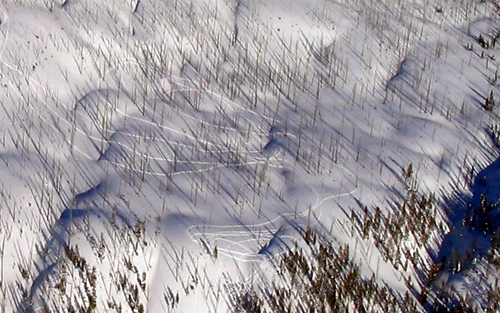
Tracks in the snow show where snowmobilers illegally entered Yellowstone National Park south of the West Entrance. Bob Peterson photo.
There's a section of Yellowstone National Park not too far south of the park's West Entrance where access is tricky no matter what the season. But in winter, when the snow is deep, rogue snowmobilers find their way into the park to play.
The picture accompanying this post was taken February 21, 2008, by Bob Peterson, who spent 34 years with the National Park Service, including stints as chief ranger at Zion National Park and Everglades National Park. Earlier this month it and several others were forwarded by Mr. Peterson to Yellowstone Superintendent Suzanne Lewis with hopes she somehow might be able to expend more resources to halt these incursions.
"Hopefully these will be helpful in your efforts to protect and manage park resources. Clearly, a portion of the public needs to receive a strong message from park management that disregard for regulations designed to protect the park, including snowmobile use off of designated routes, will not be tolerated," Mr. Peterson said in a letter to Superintendent Lewis.
"The park’s boundary south of the West Entrance is certainly difficult to manage under winter conditions that provide optimum opportunity for snowmobile trespass from the adjacent national forest. These national forest lands of course, share a common boundary with Yellowstone and are used intensively for winter recreation by snowmobiles," he added. "With disturbing regularity this activity crosses into the park. Undoubtedly, there is a prevalent attitude held by some snowmobilers that violation of park regulations is acceptable behavior, and that the risk of apprehension at times may be minimal."
Why the big deal over a few snowmobilers? In large part it's the principle of their flaunting the law and invading a national park. And part of it is due to the fact that rangers dispatched to chase them have better things to do.
"When a pattern of disregard for the rules that protect our first national park sets in, it threatens to devalue Yellowstone and set a dangerous precedent by allowing erosion of the high standards of resource protection that Americans have demonstrated time and again that they want upheld throughout the National Park System," says Bill Wade, who chairs the executive council of the Coalition of National Park Service Retirees.
Beyond the principle, it can be dangerous for rangers to head out to the boundary region to chase snowmobilers. "Often, logs and stumps are just beneath the surface and the light is flat, making it difficult to see these dangers. It's a recipe for accidents," says the coalition. "NPS has to send two rangers on these patrols in case anyone becomes lost or injured or breaks down. The patrols take a full-day and require two high-performance, high-cost, snowmobiles -- the same two-stroke machines typically used by trespassers. The expense to taxpayers to purchase and maintain these machines stemmed almost exclusively from illegal snowmobile incursions."
Beyond those hazards, Yellowstone rangers are busy on a daily basis on the west side of the park, where they have to enforce speed limits along U.S. 191, respond to accidents, and investigate poaching.
Not to be overlooked is the damage to resources caused by these snowmobilers.
"The western portions of the park where snowmobile trespass has been chronic do not have a dense wildlife presence in winter because of deep snow," says the coalition. "However, this region of the park does include sensitive spots, including geothermal areas where vegetation continues to grow in winter because of heating. Sometimes these areas are used by animals struggling to survive Yellowstone's harsh winter conditions. Snowmobile trespass into these areas poses an additional burden. NPS has also documented and provided as evidence in court that snowmobilers trespassing into Yellowstone run over tops of trees and break them off."
What's the solution? According to the coalition, stiffer penalties -- possibly as stiff as seizing the sleds of those who invade the park illegally.
At Yellowstone, spokesman Al Nash says officials are aware of the snowmobile trespass.
“I know that our rangers do look into and deal with some incursions into the park on snowmobile. I don’t know how widespread it is. I do know it occurs,” says Ranger Nash. "There aren’t a lot of locations where that type of access would be very easy. But I know that we do have some instances. My understanding is it is primarily focused on the area surrounding West Yellowstone. But I don’t know what extent.
"I know we do boundary patrols on snowmobile where it’s feasible. So we are out there patrolling. But again, with the amount of area that we have for boundary, it’s certainly possible for somebody, if they’re determined, to get into the park unnoticed.”
Story Categories:
A copy of National Parks Traveler's financial statements may be obtained by sending a stamped, self-addressed envelope to: National Parks Traveler, P.O. Box 980452, Park City, Utah 84098. National Parks Traveler was formed in the state of Utah for the purpose of informing and educating about national parks and protected areas.
Residents of the following states may obtain a copy of our financial and additional information as stated below:
- Florida: A COPY OF THE OFFICIAL REGISTRATION AND FINANCIAL INFORMATION FOR NATIONAL PARKS TRAVELER, (REGISTRATION NO. CH 51659), MAY BE OBTAINED FROM THE DIVISION OF CONSUMER SERVICES BY CALLING 800-435-7352 OR VISITING THEIR WEBSITE. REGISTRATION DOES NOT IMPLY ENDORSEMENT, APPROVAL, OR RECOMMENDATION BY THE STATE.
- Georgia: A full and fair description of the programs and financial statement summary of National Parks Traveler is available upon request at the office and phone number indicated above.
- Maryland: Documents and information submitted under the Maryland Solicitations Act are also available, for the cost of postage and copies, from the Secretary of State, State House, Annapolis, MD 21401 (410-974-5534).
- North Carolina: Financial information about this organization and a copy of its license are available from the State Solicitation Licensing Branch at 888-830-4989 or 919-807-2214. The license is not an endorsement by the State.
- Pennsylvania: The official registration and financial information of National Parks Traveler may be obtained from the Pennsylvania Department of State by calling 800-732-0999. Registration does not imply endorsement.
- Virginia: Financial statements are available from the Virginia Department of Agriculture and Consumer Services, 102 Governor Street, Richmond, Virginia 23219.
- Washington: National Parks Traveler is registered with Washington State’s Charities Program as required by law and additional information is available by calling 800-332-4483 or visiting www.sos.wa.gov/charities, or on file at Charities Division, Office of the Secretary of State, State of Washington, Olympia, WA 98504.


National parks and their natural resources belong to you. The National Parks Traveler works to ensure you know how these essential places are being cared for.
Sign Up For Our Weekly Newsletter
Unsubscribe at any time.
INN Member

The easiest way to explore RV-friendly National Park campgrounds.

Here’s the definitive guide to National Park System campgrounds where RVers can park their rigs.
Our app is packed with RVing- specific details on more than 250 campgrounds in more than 70 national parks.
You’ll also find stories about RVing in the parks, tips helpful if you’ve just recently become an RVer, and useful planning suggestions.


Comments
Hopefully someone can come up with a solution for this problem. As for US 191 patrol, it seems to me that a public road, not necessarily a Park road, should be patrolled by local law enforcement folk instead of Rangers. We need our dwindling numbers of Rangers to protect the wildlife and the Park visitors, not be traffic cops.
So to summarize, no one (including the animals) uses this part of the park during the winter and you think there should be more enforcement. Perhaps just charging the snowmobilers what it costs to come out there and rescue them would be a reasonable solution. Why do you care so much about what someone else enjoys doing? The snow melts and there is a hardly a trace of the snowmobilers left there anyway. I agree they should not break the law, but in your articles you make it sound like they should not be allowed to enjoy their sport anywhere and are a nuisance to you. People enjoy different things and enjoy the outdoors differently than you. Besides, people do not normally hike there in the winter anyway. Leaving our human footprint is inevitable, so why don't you enjoy what you do and they will enjoy what they do. Those who break laws should be fined when they are caught and the rest of us can all go about enjoying the earth in our own unique ways. My point is, why is what you enjoy superior/more important than what they enjoy or do you have more right to say your wants are more important than what they want or enjoy? What gives you the right to say they should not be able to enjoy their sport? What makes your beliefs about nature and the environment more important or righteous than someone else's? I like to enjoy these parks in the summertime as well, but I am not about to tell someone else that the way they enjoy their freetime isn't a valid way to enjoy it. Nascar annoys me to no end, but I am not petitioning to have it banned and I don't dislike it because I believe it is beneath me which seems to be the tone you display in your articles. I understand you may not respond on your forum (as it is your forum) but I thought it might be good food for thought for you.
Feel better?
I've addressed this quite a few times over the years, but let me try to lay it out for you again.
There are more than 450 million acres of public lands overseen by the Forest Service and BLM, and most of that is open to multiple use, ie. mountain biking, snowmobiling, hiking, Jet skiing, etc.
There is just about 84 million acres of national park acreage, and some of that already is open to gas-oriented recreation. There is no need to open all of it.
The Park Service has a decidedly different mission than the Forest Service and BLM; it's focused more on conservation of the resources, while the other two agencies are focused on multiple use of the resources on their landscapes. In a nutshell, there already exist more than enough opportunities for snowmobiling without a need to break the law.
To say that snowmobilers should not illegally roam into Yellowstone is not telling them they can't enjoy their sport. As the above figures clearly indicate, there is plenty of space for them to get their kicks without breaking the law and illegally entering the park. Heck, they could legally enter the park if they wanted to observe the rules. That said, for most snowmobilers who head to West Yellowstone, a trip into the park is merely a side trip to their forays into the national forests surrounding the park.
Mentioning your dislike of NASCAR isn't even germane to this matter, as there's nothing illegal about racing in circles on a track.
As for whether snowmobiling is beneath me, I've ridden sleds before and think they're great tools for negotiating deep snow where necessary. I don't own one, but I certainly don't wish them wiped from the landscape. I just happen to believe that the land-management agencies have different roles and the general public should respect them.
You are right-on "Righteous?"...too many envirowhacko bureaucrats, with the help of junk science has infiltrated our land-use agencies. It's not about protecting wildlife to them...it's about keeping "evil HUMANS" out...as if we are not part of the ecosystem.
The angrier people get over restrictions to OUR parks that WE pay taxes for, the greater chance that these parks will eventually be developed as population pressures increase and land becomes more and more valuable, especially to find new domestic sources of fossil fuels to wean us from foreign oil.
If ya can't enjoy these wildlands within good reason without nutzo environazi quasi-religious zeal that excludes us terrible humans then why have it? People ARE starting to ask that question. Stay tuned.
No one is acting like with nutzo, environazi, quais-religious zeal. Indeed, we are *trying* to have intelligent discourse about the issue at hand, and us liberal crazies have so far refrained from name-calling (sad I can't say the same about others...)
As Kurt says, there are more than 450 million acres of Forest Service/BLM land, and most of which is open to snowmobiling and whatnot. We only have 84 million acres of protected parkland. Who is trying to control what here? Is 84% of public lands not enough for motorized recreation? Are we not entitled to have someplace, somewhere, that is closed to motorized recreation?
Could it be that the majority of public lands in America are already open to multi-use and/or motorized recreation? Yep. So please, stop complaining about having no place to ride a snowmobile, ATV, etc. You have about 84% of federal land in America - isn't that enough?
Snowbird06
Gary, the problem with you is your probably one those guy's who are hell bent in having his own way, even if it means breaking the law to satisfy your own personal agenda for outdoor fun and activity. Your language follows the same selfish platform as the "Wise Use" folks: suck it for all it's worth and condemn those that wish for a safe and sound environment that's well managed for all of us to enjoy. I've seen over years reckless fools that need a sever mental attitude adjustment, for their so-called "outa-my-way" I'll behavior ("It's my park and I'm going to do what I damn right please!"). Also, I've seen name calling hot heads like you, wind up in jail for being a threat to yourself and to the public safety of others. Cool down or you might wind up in jail someday. Laws and regulations are written to protect the environment and to enhance the public safety...not to curtail you spirit and energy to enjoy the great outdoors. Enjoy with safety!