
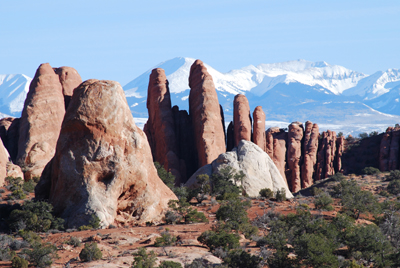
Trying to explain the wonders of Arches National Park to someone not familiar with the Southwest can be a challenge. Kurt Repanshek photo.
How would you describe Arches National Park to someone who had never been to the Southwest? You could try to explain the landscape by comparing it to the old Flintstones cartoons, but what if they weren't familiar with the Flintstones? Do you think they'd believe you if you said Arches was a cathedral of rocks, where gravity doesn't always work, where the sunsets stain the cliffs?
“From (writers) Edward Abbey to Terry Tempest Williams, there’re all kinds of people who talk about red-rock country,” Paul Henderson, the operations chief for the National Park Service’s Southeastern Utah Group that includes Arches, Canyonlands, Natural Bridges National Monument and Hovenweep National Monument told me when I asked him to explain the lure of southeastern Utah. “Nowhere else will you see the assemblage of geology that we’ve got here. We’ve got all of it – mesas, buttes, needles, goblins, natural bridges – and it happens to be a really cool palette of colors.”
Arches National Park was under construction for millions of years. In fact, it still isn't finished, as erosional forces continue to sculpt and chip away at the landscape. Over the millennia erosion has created more than 2,000 arches in the park, ranging from small, three-foot spans to Landscape Arch, which measures 306 feet from base to base.
How did all this come to be? Here's how the Park Service explains the geologic forces at work:
Arches National Park lies atop an underground salt bed called the “Paradox Formation” which is responsible for the arches, spires, balanced rocks, fins and eroded monoliths common throughout the park. Thousands of feet thick in places, the Paradox Formation was deposited over 300 million years ago when seas flowed into the region and eventually evaporated. Over millions of years, the salt bed was covered with the residue of floods and winds as the oceans returned and evaporated again and again. Much of this debris was cemented into rock. At one time this overlying layer of rock may have been more than a mile thick.
Salt under pressure is unstable, and the salt bed below Arches began to flow under the weight of the overlying sandstones. This movement caused the surface rock to buckle and shift, thrusting some sections upward into domes, dropping others into surrounding cavities, and causing vertical cracks which would later contribute to the development of arches.
As the subsurface movement of salt shaped the surface, erosion stripped away the younger rock layers. Water seeped into cracks and joints, washing away loose debris and eroding the "cement" that held the sandstone together, leaving a series of free-standing fins. During colder periods, ice formed, its expansion putting pressure on the rock, breaking off bits and pieces, and sometimes creating openings. Many damaged fins collapsed. Others, with the right degree of hardness and balance, have survived as the world famous formations of Arches National Park.
We're just the latest batch of humans to be amazed by Arches. Human history in the park goes back at least 10,000 years, to when hunter-gatherers came to today's Courthouse Wash to find rocks and stones suitable for working into tools and weapons. More recently, in the late 1800s, Civil War veteran John Wesley Wolfe settled in today's park along Salt Wash near the trailhead to Delicate Arch. His weathered cabin still stands there, albeit it a little worse for the wear.
Things didn't really start happening for Arches as a national icon until the 1920s, when Alexander Ringhoffer, a prospector, wrote the Rio Grande Western Railroad in 1923 in an effort to publicize the area and gain support for creating a national park.
Ringhoffer led railroad executives interested in attracting more rail passengers into the formations; they were impressed, and the campaign began. The government sent research teams to investigate and gather evidence. On April 12, 1929 President Herbert Hoover signed the legislation creating Arches National Monument, to protect the arches, spires, balanced rocks, and other sandstone formations. On November 12, 1971 congress changed the status of Arches to a National Park, recognizing over 10,000 years of cultural history that flourished in this now famous landscape of sandstone arches and canyons.
And, of course, the late Edward Abbey got his taste of Park Service life as a seasonal ranger at Arches in the 1950s. During that stint, Abbey discovered the soul of the red-rock landscape and proceeded to warn of its downfall if development wasn't halted and more land wasn't preserved unscathed.
Many visitors to Arches National Park take the park on the fly, driving past Courthouse Wash, stopping briefly to snap a shot of Balanced Rock, and then proceeding to the Windows Section, Delicate Arch, and Landscape Arch. And then they're gone, which is a shame, because Arches is a park that, though only protects about 73,000 acres, is an intricate place that takes time and patience to start to understand.
You need to hike beyond Landscape Arch, past Navajo Arch and Wall Arch all the way to Double O and the Dark Angel, and then take the primitive trail back. Walk along the backs of fins, search for potholes, explore the sandy washes. Delicate Arch should be experienced only by hiking to its location, not by opting for the viewpoint reached by autos. Klondike Bluffs might look distant on the map, but it's worth the trek. And it would be a shame not to explore the Fiery Furnace.
There's only one designated campground in Arches, and that's found next to the Devil's Garden Trailhead. There are only 52 sites available, so if you're planning to show up any time between March 1st and Halloween you might want to reserve ahead via the national reservation system. Bring your own wood for a campfire. While there are flush toilets, there are no showers and no RV hookups. The cost of a night here is $15, but the star shows are, as they say, priceless.
Backpacking is allowed within Arches, but water is pretty scarce, so that might limit your wandering. Check with the folks at the Visitor Center for a permit and suggestions on where to head to.
For now, it costs $10 to gain entry to Arches for a seven-day period, if you're driving. If you're walking or riding a bike, the fee is $5.
For more insight to Arches and the Moab area, be sure to read The Essential Arches.
Story Categories:
A copy of National Parks Traveler's financial statements may be obtained by sending a stamped, self-addressed envelope to: National Parks Traveler, P.O. Box 980452, Park City, Utah 84098. National Parks Traveler was formed in the state of Utah for the purpose of informing and educating about national parks and protected areas.
Residents of the following states may obtain a copy of our financial and additional information as stated below:
- Florida: A COPY OF THE OFFICIAL REGISTRATION AND FINANCIAL INFORMATION FOR NATIONAL PARKS TRAVELER, (REGISTRATION NO. CH 51659), MAY BE OBTAINED FROM THE DIVISION OF CONSUMER SERVICES BY CALLING 800-435-7352 OR VISITING THEIR WEBSITE. REGISTRATION DOES NOT IMPLY ENDORSEMENT, APPROVAL, OR RECOMMENDATION BY THE STATE.
- Georgia: A full and fair description of the programs and financial statement summary of National Parks Traveler is available upon request at the office and phone number indicated above.
- Maryland: Documents and information submitted under the Maryland Solicitations Act are also available, for the cost of postage and copies, from the Secretary of State, State House, Annapolis, MD 21401 (410-974-5534).
- North Carolina: Financial information about this organization and a copy of its license are available from the State Solicitation Licensing Branch at 888-830-4989 or 919-807-2214. The license is not an endorsement by the State.
- Pennsylvania: The official registration and financial information of National Parks Traveler may be obtained from the Pennsylvania Department of State by calling 800-732-0999. Registration does not imply endorsement.
- Virginia: Financial statements are available from the Virginia Department of Agriculture and Consumer Services, 102 Governor Street, Richmond, Virginia 23219.
- Washington: National Parks Traveler is registered with Washington State’s Charities Program as required by law and additional information is available by calling 800-332-4483 or visiting www.sos.wa.gov/charities, or on file at Charities Division, Office of the Secretary of State, State of Washington, Olympia, WA 98504.


National parks and their natural resources belong to you. The National Parks Traveler works to ensure you know how these essential places are being cared for.
Sign Up For Our Weekly Newsletter
Unsubscribe at any time.
INN Member

The easiest way to explore RV-friendly National Park campgrounds.

Here’s the definitive guide to National Park System campgrounds where RVers can park their rigs.
Our app is packed with RVing- specific details on more than 250 campgrounds in more than 70 national parks.
You’ll also find stories about RVing in the parks, tips helpful if you’ve just recently become an RVer, and useful planning suggestions.


Comments
One should mention another highlight of Arches NP. Do the ranger let walk into the Fiery Furnace section. It is kind of a nursery for arches, here you can see them in the making. There is at least one tour every day and if you are hooked, you can return to the area on your own - but need a backcounty permit for that.
And maybe the biggest highlights of all at Arches......the crowds are miniscule and there's not a difficult hike in the entire park. Although somewhat off the beaten path, it's a fantastic place for families, even those who have younger kids not quite yet into the whole hiking experience. To them, it's like a BIG sandbox, and there isn't much soil damage you can do on slickrock, which is also easier for the youngsters to traverse. If they're looking for Pizza the Hut or McArches for dinner, you're have an inconveniet ride to Moab, but it could be worse.
I really didn't know Arches National Park teems with so many arches - 2000. That's prodigious!
We were driving through Colorado, took 128 out of 50 and there, few miles down the Colorado river was Arches National Park. Frankly, If we didn't have a mobile internet and google with open panoramino we would have passed but checking the images it was a must see. It took us about another 10-15min from the entrance to reach the parking area, our car overheated the during the steep curly road, but then the arches revealed, it was amazing. It is a must see place, be sure to put it on your adventure map!
The National Park Service reversed and scrambled the names of things on the maps when they made Arches a NP instead of leaving it a Monument. The biggest oops was the reversed the names on Delicate Arch and Landscape Arch. Landscape Arch (now known as Delicate Arch) was also known as The School Marm's Britches. One look at the view and you know it is Landscape Arch. Panoramas abound. Delicate Arch (now known as Landscape Arch) has no panoramic view from any angle, except from on top of it -- which is not allowed -- and it is exquisitely fragile and long. One might say "delicate".
Just guess which roadside protuberance was Brigham Young's Organ.
There were lots of fun names for formations that dated back to the early 1900's.
We just returned from Arches National Park. As I stood taking pictures at the lower viewing point of what is currently "Delicate Arch", two couples were there. One couple seemed to be showing the other around the area and the man told that story ... that the names were reversed. Made a lot of sense to me. But he said between tour guides and park rangers, there are people on both sides of this question. But it seems pretty plain to me. Ironic that "Delicate Arch" - the iconic symbol of Arches National Park - probably has a name not intended for it!
Not quite true anon at 3:07 - Arches became a national park in 1971 by an Act of Congress (the National Park Service did not change the monument into a park) and Delicate Arch had been Delicate Arch for decades before that.
Now there may be some truth to a mixup way back when between the names for Landscape Arch and Delicate Arch - but it most certainly didn't occur in 1971. Far too many of us have lived in Moab long enough (well before 1971) to know that.
The story I heard was that the mixup occurred when Congress first asked that the land be scouted and a report be sent back so that would have probably been before the turn of the century around the time of UT statehood.