
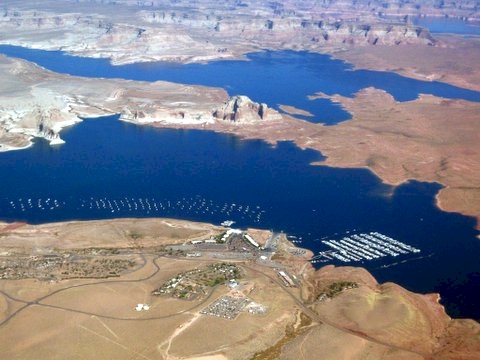
Dropping levels of Lake Powell are making it harder to get to and from Wahweap Marina. Friends of Lake Powell Photo.
Climate change, both short term or in the long run, can exact changes on the landscape. Native wildlife can vanish, non-native species can arrive, things we have come to know over a lifetime of visits can be transformed, if not made to disappear altogether.
How we react to these changes can have significant impacts, as well as be telling as to our overall stewardship of the land.
At Glen Canyon National Recreation Area the ongoing drought has revealed fascinating canyon-country landscapes that long have been inundated by Lake Powell. Cathedral in the Desert, said to be one of Edward Abbey's favorite haunts, has reappeared, drawing Abbeyites and the curious.
While there have been long-running efforts to drain the lake entirely, they have been staved off and today Lake Powell is one of the Southwest's premier boating areas. But in recent years the regional drought has lowered Lake Powell. While that has opened up some fascinating canyon landscapes that had been under water, the drought also has created some logistical problems for boaters.
For years, you see, boaters have used the so-called "Castle Rock Cut" to shorten a 12-mile trip when heading to and from the Wahweap Marina to such areas as Rainbow Bridge, Padre Bay, and Warm Creek Bay. However, that shortcut is only possible when Lake Powell is at an elevation of 3,620 feet; currently the lake is right around 3,600 feet. Boaters have not been able to use the cut since the 2003 season, and in recent years they've been asking the Park Service to deepen the cut.
So how can this problem be solved? Well, NRA officials are thinking of digging the cut even deeper than it is, a solution last resorted to in 1992 when it was deepened by about 8 feet. Before that, the cut was dug deeper back in the 1970s. The current proposal -- which doesn't yet have a price tag attached -- is to dig another 15 feet deeper along a half-mile-long section of the cut. This slice also would be about 80 feet wide.
But perhaps a more important question that should be considered is, "Should the cut be deepened?" Is this how we should respond to climate change, or long-term drought, by just digging a little deeper? Have we become so omnipotent in our environmental stewardship that we haven't been confronted by a problem we couldn't engineer a solution to?
For now, the Park Service is getting ready to prepare an environmental assessment that will analyze the potential impacts of digging the cut deeper on the area’s natural and cultural resources and the quality of visitors’ experience.
To help the agency prepare that EA, the public is being invited to submit suggestions on how the situation with the Castle Rock Cut can best be addressed and what issues and alternatives the EA should consider. You can forward your thoughts to the Park Service online at this site or by mailing them at Castle Rock Cut EA, Glen Canyon National Recreation Area, P.O. Box 1507, Page, AZ, 86040.
Scoping comments must be received by December 4. Once the draft EA is prepared later this winter there will be another public comment period.
Story Categories:
A copy of National Parks Traveler's financial statements may be obtained by sending a stamped, self-addressed envelope to: National Parks Traveler, P.O. Box 980452, Park City, Utah 84098. National Parks Traveler was formed in the state of Utah for the purpose of informing and educating about national parks and protected areas.
Residents of the following states may obtain a copy of our financial and additional information as stated below:
- Florida: A COPY OF THE OFFICIAL REGISTRATION AND FINANCIAL INFORMATION FOR NATIONAL PARKS TRAVELER, (REGISTRATION NO. CH 51659), MAY BE OBTAINED FROM THE DIVISION OF CONSUMER SERVICES BY CALLING 800-435-7352 OR VISITING THEIR WEBSITE. REGISTRATION DOES NOT IMPLY ENDORSEMENT, APPROVAL, OR RECOMMENDATION BY THE STATE.
- Georgia: A full and fair description of the programs and financial statement summary of National Parks Traveler is available upon request at the office and phone number indicated above.
- Maryland: Documents and information submitted under the Maryland Solicitations Act are also available, for the cost of postage and copies, from the Secretary of State, State House, Annapolis, MD 21401 (410-974-5534).
- North Carolina: Financial information about this organization and a copy of its license are available from the State Solicitation Licensing Branch at 888-830-4989 or 919-807-2214. The license is not an endorsement by the State.
- Pennsylvania: The official registration and financial information of National Parks Traveler may be obtained from the Pennsylvania Department of State by calling 800-732-0999. Registration does not imply endorsement.
- Virginia: Financial statements are available from the Virginia Department of Agriculture and Consumer Services, 102 Governor Street, Richmond, Virginia 23219.
- Washington: National Parks Traveler is registered with Washington State’s Charities Program as required by law and additional information is available by calling 800-332-4483 or visiting www.sos.wa.gov/charities, or on file at Charities Division, Office of the Secretary of State, State of Washington, Olympia, WA 98504.


National parks and their natural resources belong to you. The National Parks Traveler works to ensure you know how these essential places are being cared for.
Sign Up For Our Weekly Newsletter
Unsubscribe at any time.
INN Member

The easiest way to explore RV-friendly National Park campgrounds.

Here’s the definitive guide to National Park System campgrounds where RVers can park their rigs.
Our app is packed with RVing- specific details on more than 250 campgrounds in more than 70 national parks.
You’ll also find stories about RVing in the parks, tips helpful if you’ve just recently become an RVer, and useful planning suggestions.


Comments
There are arguments on both sides of this fence...but one thing cannot be ignored by either side. The proposed Castle Rock Cut would SAVE LIVES!! That is one point that cannot be argued or ignored in all of this. Lives are lost each year by boaters having to navigate the "Narrows" at Lake Powell. Opening the cut would alleviate this problem. Not to mention enhancing the efforts of rescue operations at the lake. You cannot put a pricetag on human life.
Beamis,
Good points all. Frankly, I think the region with its fantastic canyon country and ancient history would better qualify as an NPS unit if the lake didn't exist. I wonder if the NPS could swap Glen Canyon NRA for the BLM's Grand Staircase-Escalante National Monument, which really should be an NPS unit.
Wouldn't that be true for all National Recreation Areas? Are they really fit to be units of the National Park Service? shouldn't they be swapped with the BLM against their National Monuments?
Not to mention how the presence of that much water in the middle of the desert has drastically changed the ecosystem. I agree this shouldn't be the Park Service's problem. Reservoir management and sport hunting management should be the responsibility of some organization other than NPS.
The NPS "preservation slant" is only how some interpret the Organic Act. I could argue that the NPS should have a "provide for the enjoyment slant."
In fact, I can't find the word preservation in the Organic Act. Though I do find words such as "conserve" and "promote the use of."
Devil's advocacy aside, the NPS seems to have much more urgent problems than to spend precious funds "planning to plan" in order to open a channel up to boaters.
I say, parks are for enjoyment not preservation. I say, conservation is exactly the right word. I say, "wilderness" is wilderness; a park should be just that "a park." I say, science and research are also institutions which have a history of being "antiquated, fundamentally flawed, and needs constant revision."
I say, we can define "unimpaired" until the glaciers return but it still won't resolve these issues.
I say, providing for human enjoyment is a profound and beautiful mandate. And if protecting the environment also provides for human enjoyment, it is even the more sublime.
Below I've reposted my earlier comments on this Organic Act matter.
"Frank and I have disagreed on this before.
But I still insist that the Organic Act has not failed. Yes, it is a paradox to conserve, promote the use of, and provide enjoyment for while leaving unimpaired. Yes, in order to fulfill such a mandate requires leaders possessing intellect, insight, and courage that the current NPS may not have or nuture. Yes, the NPS fails in small and not so small ways every day. But, all in all, the NPS has suceeded in its mandate by keeping the parks unimpaired enough to continue to provide for the enjoyment of billions of people over the last 150+ years. I don't buy into this doom and gloom scenario.
The Organic Act is not "antiquated, fundamentally flawed, and needs extensive revision" any more than the Constitution of the United States is "antiquated, fundamentally flawed, and needs extensive revision."
Hell, if anything's antiquated, it's evoking Edward Abbey. "
science and research are also institutions which have a history of being "antiquated, fundamentally flawed, and needs constant revision
Are you just attempting to throw off my blood sugar Haunted Hiker?
I'll agree with your final premise, that science, ALL diciplines of the sciences, are subject to a constant state of revision. That's what good science is, hypothesis continually being subjected to experimental review, and modifications to current "conventional wisdom" mind-sets due to evidence collected by good design, execution and analysis. Science is subject to an ongoing, evolving process, and is the sum of knowledge gained through the course of mankind's thinking abount, reacting to, and exploring his environment. Due to the data collected by a series of good scientific practices, we now know that a) the world isn't really flat after all, b) the Earth really isn't the center of the known universe, c) you can't kill microorganisms by freezing them, at any temperature, for any length of time, d) life doesn't "spontaneously generate", e) certain chemical reactions give off heat which can be harnessed for multiple purposes, while others require an influx of energy to initiate an reaction, f) the controlled splitting of an atom releases copious amounts of raw energy, ......you get the point I'm sure. But the claim that these institutions have a history of being antiquated and fundamentally flawed, well, you've got the burden of proof on your side if you intend to make those accusations stick. Antiquated indeed.......absolutely NOTHING in our lifetimes has advanced faster than the quality of our lives derived directly from the knowledge brought forth by the sciences except our ignorance of the environment and our general arrogance as a species. Common, everyday mundane items such as microwaves, freezers, radio, CD/DVD's, analog and digital recording devices, computers, automobiles, healthier crops and a wider variety of them, synthetic clothing materials, plastic, rubber, steel, glass, procelain, air conditioning, jet and space travel, the advances to mankind's life directly accountable to the various sciences is almost endless. Not that all of these advances qualify as good......plastics are a blight on the environment, but without them, the cost of protecting and transporting goods would literally skyrocket. Microwaves are a truly useless innovation, originally intended solely as a method by which to rapidly increase the rate of motion in water molecules. Synthetic fibers are tear and wear resistant, color fast, but highly flammable and not really cost effective, but it saves the environment from the stresses of producing cotton. Automobiles? Don't even go there. Aviation brought the world closer together, so now we can fight about trivial things at incredible rates. But to write off the sciences as ANTIQUATED is absurd.
Moving some dirt and rocks around the bottom of the lake is not such a big deal. Doing so will save it's total cost probably in the first year. When the drought ends, (which it can in a single year), it's all covered with water anyway. Safety is also a major concern and such is a major concern for the NRA managers, the NPS. Dredging this small cut will wave lives, property, trauma, lawsuits and peoples investments in THEIR chosen method of recreating.
As to the issues about NP's vs. NRA's and their joint management by the NPS. Well quite frankly a National Recreation Area is NOT a National Park! They should have very different management goals and the personel staffed at Rec areas should have a different mindset than what the NPS system provides. I think the Dept of Interior should create another division specifically aimed at managing rec areas and staffed with like minded people as well. They are different and require a different point of view in their management. (Yeah I said that twice)!
For you science and history lovers, May I recommend reading "Forbidden History" by J. Douglas Kenyon.
I agree with RRR's comments concerning safety, and economics ( saving money, time, and lives). There are more people using Lake Powell, on a yearly basis than all the wilderness areas of the whole west combined! I wish they would build more dam's up and down the Colorado River, not only for the recreational value, but for power generation that is clean and renewable. It would allow the dismantling of many filthy coal fired generating plants. As for the humpback chub, I say let them go the way of the carrier pigeon, and doddo bird. None of us will miss them.
Whoa there Lone Hiker, I sure didn't mean to send you into Diabetic Ketoacidosis! But I sure love to get a man's blood boiling.
Read carefully, I said science has a "history" of being "flawed." My point being that it doesn't provide all the answers and many of its conclusions become obsolete. I would never write off science, but I wouldn't but all my eggs in its basket either.
Besides, weren't you the one who brought up the very lovely point that art and aesthetics can play a role in planning that, at times, can rival the practicality of scientific facts?
I have doubts that science is capable a defining "unimpaired" because there really is no such thing. It's a human idea more than it is a quantifiable goal.
Sorry Frank, I love you too. But even if Edward Abbey's ideas aren't antiquated, quoting him to make a point about preserving the environment is.
Kurt, an interview with the management at Chickasaw would be a good perspective to have here regarding the Rec Area vs. Park Service issue, and whether these areas really belong under NPS. They seem to have perennial problems with rowdiness, litter, boozefests, weapons, and the like, and I'd wager that it's a common thread among other Nat'l Rec Areas too.
Science, history or RA management alternative issues may make for interesting conversation but dance around the issue of shoving accumulated silt out of a previously excavated channel. Which is all we are really talking about here. There are no sandstone cliffs involved. Only a salt cedar infested silt flat. Take another look at the photo at the page-head. And when one considers that this clean-out operation has already been performed in the past and the resulting channel has been historically flooded more often than not, it is truly amazing that the time and money expenditure for an EA is even required. As for the pros and cons of the proposal, the benefits are obvious to anyone familiar with the lower end of Lake Powell. If all other advantages are set aside, the annual savings in fuel consumed and exhaust gasses released by diesel powered tour boats and freight carrying commercial craft, gasoline powered NPS vessels, and recreational boaters, with up lake trips totalling numbers in the millions each year, should provide reason enough for supporting the proposal. To oppose the work would suggest the support of some alternative agenda beyond the facts on the ground.
Hey HH-
Glad I could be of service. But let's say it was more of a heavy simmer than a rolling boil. I'll try harder next time.
Many scientific conclusions, as well as the ever popular public opinions, are apt to be drawn from flawed information. That's why, as mentioned by your's truly in post after post, I'm a BIG proponent of "good science", which lends itself to a far lesser degree of misinterpretation of data than do bad data and general opinion, but still ain't perfect by any means. Science is not now, nor ever was a source of perfection, in no small part due to the fact that we're constantly dealing with a state of flux in our knowledge base. As techniques and tools develop to assist in collection of additional volumes and more accurate evidence, hypothesis have to be amended, and that is a good thing. It goes a long way towards lending "street cred" to our field, showing our ability and willingness to admit errors were made that were based on previous sampling, but that these previous conclusions were the best we could do at the time, based on the evidence that was available at the time. Now, as access to better methodology evolves, we readily (and sheepishly) admit our past ineptitude, and take a stand behind the new, cleaner, more substantial body of evidence. That new stance will remain, until the next generation of technology and enlightenment bring us to the next intellectual level and we are able to scale the next mountain. All science is capable of is the best it can do at any given time with what it has to work with, just like every other facet of our society. I don't think that makes us evil-doers, or the products of a "flawed" system. If we are to be labeled as such, then every other aspect of our character is likely equivilently flawed as well. I seem to recall a story about a certain group of people about 2000 years ago, who killed someone in a rather barbaric manner, and almost immediately upon achieving their goal, some say, realized their mistake, and all anyone could say was "oops". In the current scientific climate we try and limit the "oops" factor to the best of our ability, but there are still folks out there who have a notion that publicity is more desireable than accuracy, and run off at the mouth long before enough evidence is gathered to render a competent verdict.
I'm not one to utilize a sole source of information to formulate my stance on any issue either. Science is nothing other than one arrow in the quiver. Limited scope produces limited and fundamentally skewed results. I'm in the discovery business, and we can't afford the "blinders on" view of the world.
By the by, I don't think it was I who endeavored to resolve the term "unimpaired" for you. I can list the "official" Funk & Wagnalls for you, and I have my own addendum to their terminology based on the focal point of the discussion, but I'm fairly sure I'm innocent of all charges on that topic. But you're right, even our path to the stars isn't unimpaired, what with all those little nuisances orbiting the globe these days. In a purist sense, they qualify as "annoyances" since you'd have to schedule departure so as to avoid them, so your point is well taken.
Next time I promise to really make your day and allow myself to achieve full-blown case of "The Bends"!!
Haunted Hiker said: Devil's advocacy aside, the NPS seems to have much more urgent problems than to spend precious funds "planning to plan" in order to open a channel up to boaters."
As long as the process dictates that the NPS perform an EA to undertake what is specifically removing a couple of feet of silt and rock from the now dry lake floor, then so be it. The Castle Rock Cut widening project is a win for the environment (less gas and carbon generated by boaters) and safety (shaves at least an hour off first responder times). The NPS process has been perverted by environmentalist to slow down (aka preserve) the status quo at NRAs. In the case of Lake Powell, the Castle Rock Cut issue gives them hope that if the drainers stop this project, they can eventually get the Glen Canyon Dam removed. Pipe dream of the Abbey followers for a long time. It is time they get a clue, boaters have rights to the NRA they recreate in and we are going to make sure our requirements for safe/quick passage are recognized by the NPS in what should be a trivial administrative process to get the CRC open to boaters at 3600’
I fail to see why anyone would be against this project. It's a win for "Environmentalists" in fuel savings and reduction of exhaust emissions. It's a win for boaters and fishermen. It's a win for the NPS and the over all safety of those using the area in greatly improved response time to emergency and potentially life-threatening situations. What's not to like?
All we're really talking about here is the removal of some silt accumulation from a channel that has been deepened twice in the last 30 years. No virgin sandstone deposits are being threatened and there is no impact on either the paleontology, geology, or historical sites of the GCNRA. I say, "Git 'ur done!"
The only reason I can think of why anybody would oppose deepening the "CRC", is someone who has never been to Lake Powell. Someone who has never traveled up-lake through the "Maytag Straits" on a busy day in the summer. Someone who has never been hurt or injured (or heard stories about the same) up-lake and waiting that extra emergency response time for medical assistance.
The "CRC" has no cultural or historical significance. It has been deepened twice previously. When (or if) this prolonged drought ends, it will not be seen again. There will be no visible "scar" on the landscape.
The subject of Glen Canyon and Lake Powell is one that draws a very emotional response from a variety of people. If Glen Canyon was exposed all the way to the level of the Colorado River, I would love it. Now that Lake Powell has been filled, I love it far more. Those who would battle to drain Lake Powell simply do not understand that a huge part of the canyon is now available to thousands of people who would otherwise have no access to this national treasure.
Before Lake Powell, one had to be physically fit and probably reasonably young to brave the desert heat and sheer sandstone cliffs in order to see much of the canyon on foot. Now, with at least 3/4 of Glen Canyon still above water, it is all easily available to anyone, regardless of physical condition, age or even serious handicaps, all from the comfort of a boat. That to me makes Lake Powell an asset well worth supporting and even improving. I agree with the poster above who stated: "The only reason I can think of why anybody would oppose deepening the "CRC", is someone who has never been to Lake Powell."
Well said RainyRoads. I agree with you 100%. I am wheel chair bound. Because I can access Lake Powell by boat, I have seen wonders I would have never seen. I even got to see Rainbow Bridge once, when the Lake was Full. I have seen Dino tracks, petrified wood on the shore line from my boat. These things I cherish and am glad to be alive to enjoy them. The Park Service has done a wonderful job to make this park accessible to all. I have a few friends that hike the Lake and show me pictures of the things beyond the shore lines I have enjoyed seeing very much. It was not for Lake Powell I would have not known these friends who have helped me to enjoy the park even more.
But to make your point, Lake Powell part of the park is very small compared to the places people can go that is untouched. Many people use a boat to start there journey to get to these places.
So if digging out the cut makes this park more accessible and safe for ALL, I am ALL FOR IT.
Beamis:
Your second Tilden quote and accompanying commentary have me eager to post Simple Proposal #8...
An insidious transformation has occurred in the NPS. Many of its employees are now obsessed with shaping the worldview of park visitors.
Innocently enough, this started with trying to make visitors better "park stewards." You know, don't throw trash, don't pick wildflowers, don't feed the chipmunks. Fair enough.
But over time, the goals have morphed. Nowadays rangers are often expected to turn park visitors into "global stewards"...obedient soldiers who will march back home to fight the war against environmental destruction. I can see it now...Ethyl & Bill Dokes, retired grocery store checkers from Rapid City, roaring home in their RV while torching every billboard they see along the way.
Don't get me wrong. I'm very much against environmental destruction. I oppose population growth. I donate generously to private, non-profit organizations which acquire and preserve land. I also donate to organizations which fight for legitimate environmental causes. And, like verbose Freeman, I choose quality over material superfluity. Oh...did I mention that I oppose population growth?
But when I write my annual check to the federal government, I want my money spent on providing something in return. Regarding national parks, I want my money spent on maintaining trails, protecting wildlife from poachers, and replacing faded signs. I want my money spent on rangers who can tell me about their park...why it was established, how its ecosystems function, and what cultural treasures it holds. I'm also grateful to being informed about legitimate threats to the parks.
But I'm not happy when the government and its employees cross the line into trying to "shape people's hearts and minds" in a global sense. That role should be left to private interests, who receive their money through voluntary donations.
As I recall, shaping hearts and minds was a primary goal for the Iraqi people pre-invasion.
Simple Proposal #8: Think not what your taxpayer can do for you; Think what you can do for your taxpayer.
Frank:
I'm new to this site. I discovered it just a few days ago. I did not understand it to be a political forum however. Do you have a position on the proposed Castle Rock Cut at Lake Powell, or do you have some other drum to beat?
Pete K.
Hotwheels,
Well said. I forgot to mention that point, boating at Lake Powell opens up GCNRA in so many ways. The bottom line is that getting the CRC open to navigation (assuming that Mother Nature will not cooperate next year) does greatly enhance the Lake Powell experience.
Frank,
I'm sorry but our Government does not work that way. We are all in this together, our system of taxation does not allow individuals to "opt" out of funding for things they don't like. We have a representative system, we have delegated that power collectively to our Congressional representatives. It is up to them to provide for the stewardship of the park system and provide the funding to support our troops in the field until victory is achieved in the War on Terror.
ALL,
Playing Devil's Advocate, although I do support opening up the CRC, I can think of a good reason why some people who boat on Lake Powell would be opposed to this project. I assume the GCNRA budget is constant and any funds allocated to deepen the CRC will mean that some park projects will not be completed or commenced. Therefore, uplakers (boaters out of Bullfrog, Halls Crossing or Hite) may get short changed and some of their pet projects will be put on hold for lack of funding. Since I assume this will be a zero sum game and the NPS won't throw additional dollars into GCNRA to execute the CRC project. I do feel uncomfortable with this situation and it is a shame. However, since close to two-thirds of the GCNRA visitors enter from down-lake, I guess that is the way the cookie crumbles. Sorry folks.
Castle Rock Cut in 2008!
-rich
San Diego, CA
http://groups.yahoo.com/group/LakePowellFishCampBoat/
Frank,
In all fairness to the writer, the word "War," as used above and in the expression, "War on terror," is a metaphor similar to "War on Drugs," War on drunk driving," etc. As such, it is commonly used to describe struggles against many things not requiring congressional approval. It was used extensively in the 50's through the 80's by both parties in the "War on Communism" and the ever-popular "Cold war."
As for the Income Tax, the U.S. government has been collecting income taxes since 1862 when Congress enacted the nation's first income tax law to support the Civil War.
http://www.infoplease.com/ipa/A0005921.html
The Constitution does indeed give the right to tax income and has done so since the 16th Amendment of 1913:
Amendment 16 - Status of Income Tax Clarified. Ratified 2/3/1913
"The Congress shall have power to lay and collect taxes on incomes, from whatever source derived, without apportionment among the several States, and without regard to any census or enumeration."
But regardless of any of that, What are your feelings about the NPS plan to deepen a small shortcut between Wahweap Bay and the rest of Lake Powell? That is the topic, I believe.
"Just to be clear" what Beamis says is not really true. A number of people (Most notably a Mr. Bill Benson) have challenged the validity of the process that took place adding the 16th Amendment to the Constitution. It was however ratified by Congress and as such it remains "The law of the land" until such time as it is removed via the normal legal process. That has not happened and simply because someone or some partisan group says it isn't legal and binding, that doesn't make it true. Definitely NOT so "Pure and simple," rather more like an "Opinion."
Now...can we get back to the topic at hand? That would be the deepening of the Castle Rock Cut on Lake Powell. While some may find discussions on Constitutional law interesting, there are many places on the web to conduct them. This, IMO would not necessarily be one of them. Just my opinion and, being a newbie, I don't want to upset anyone, but I am a frequent user of the Glen Canyon Recreational Area and Lake Powell, so the stated topic is important to me. Thanks!
O.K., I'm getting sucked onto a tangent of which I really have little interest, but I would appreciate a simple clarification from Beamis who says,
'The fact that the U.S. government is run by thieving thugs who subvert the Constitution on a regular basis is not news."
That's some statement, Sir/Ma'am, especially when you call it a "Fact." If I follow your logic (?), it appears you are saying that every congress and administration this country has had, at least since 1913, has been corrupt. That would have to be the case according to your POV, since the 16th Amendment became law in that year (Illegally, according to you). If this is indeed the way you think, I would suggest to you that you have a very unfortunate view of the greatest country the world has ever known. Again, just my opinion and I'm new around here.
Frank,
Abortion is not in the constitution but it is a political, judicial and medical reality across the land. I am pro-choice BTW, just using this issue as an example of the error in your logic of a literal read of the U.S. Constitution.
Beamis,
Even if there is some legal or constitutional procedural ambiguity about the constitutional reality regarding income taxes, doesn't make it any less real. Every pay day a host of governmental entities take their share of my income.
All,
Now back on the topic at hand, the latest buzz is that GCNRA will use funds set aside for park upkeep and maintenance, and the CRC project in my opinion falls under this category. Like I've said before, its a win-win proposal for all parties. Everyone should be writing to the NPS during the public input and urging the NPS to save money by waiving this whole absurd EA process.. Let the bull dozers roll!
Castle Rock Cut in 2008!
-rich
San Diego, CA
http://groups.yahoo.com/group/LakePowellFishCampBoat/
Just a slight clarification; The Glen Canyon National Recreation Area is NOT a "Park." It is a "Recreation area," and as such it is run under a very different set of rules. Some will disagree with those rules and others will call for a change to the status of "Park." The most extreme will even lobby for complete restoration to its pre-dam state, but for now, it remains a "Recreation area" and as such it is administered for the recreation and enjoyment of the general public, not according to a biased agenda of a small minority.
We're sorry to interrupt this debate for the following news update:
"Wars" on ideologies are never won.
And are ALWAYS lost. And there never was, or is now, just cause to spend billions of US taxpayer dollars, that could and SHOULD be spent improving our domestic issues, of which there are many, on a "war" that has and had no real point since it's inception. The REAL "war on terror" should have been fought in the mountains of the Pakistan / Afghan region, against an alleged "identified" threat, not in the deserts of Iraq against an idiot and his regime who were then and even lesser now a threat against this country and it's citizens. End that pointless conflict, and you can have all the monies you desire for improving the convenience of a few boaters in Lake Powell. Maybe mandatory boating safety classes and enforcement of boating regulations, along with making consumption of alcohol on US waterways illegal, would be a better usage of everyone's time and funding than additional digging, if the area is as hazardous as many posters have claimed.
The independent voice of political conscience reason is dead in this country. REVIVE IT NOW!
Now, back to the previously scheduled programming.........
Reality check:
Those "Few" boaters to which Lone Hiker makes mention actually number in the neighborhood of about 2 million per year. Also, the funding for this project is scheduled to come from a fund collected "Off the top" from Aramark Corp. and represent a percentage of the concessionaire's profits derived from private business activities on and around the lake. In essence, those who use the lake are those who will be paying for the project. What's wrong with that? They have nothing whatsoever to do with Iraq, Afganistan, or any other conflict around the world and would not be increased in the slightest if any of those conflicts were to end tomorrow.
Let's keep it real, folks.
For clarification purposes, the studies I've surveyed make mention of 2 million boaters as an annual visitation estimate and does not directly correlate to 2 million vessels traversing the waterway. This I understand with all clarity. But in the "real world" of business, of which I possess extensive experience, any corporation doing business in more than one location bases their fees for products, services, etc. on the sum cost of doing business. The entity in question must account for the sum overhead package, no matter what nature they be, in the base prices that are charged to the consumer. As you all should be aware, the Aramark Corporation is a national service company. For you to believe for one instance that their entire customer base will not feel the sting for this project is simply not realistic. All costs of doing business will be passed throughout the operating network, whether it is an increase in employee health care rates, pay raises, transportation related fees (e.g. fuel rate increases, maintenance costs, building of distribution centers, tax rates on properties), increases costs of raw materials, handling and processing, or the above mentioned "slush fund" designed to benefit a SMALL portion of their service base.
Speaking of keeping it real........
LH:
I'm not able to follow this. NPS will pay for the project. Not Aramark. True, NPS will utilize revenue generated by concession operations to pay for it. So Aramark funds it indirectly. But since the NPS skim off the top of Aramark's operation is the same whether the cut goes forward or not, how does it affect Aramark's bottom line? The "SUM" cost of their overhead package remains X whether NPS spends the money on other infrastructure maintenance, repair or upgrade, or, whether or not they spend it on the Castle Rock project, right?
Pete K.
Geez, if what you say is true, you'd sure think that a country as great as ours would have had at least one single Congress in those 97 some years decent enough to abolish that illegal 16th Amendment, now wouldn't you?
Tax revenues generated by this Act of Congress are to the Washington bureaucrats what nicotine is to many people.....a craving, an addiction to which they simply aren't willing or able to remove themselves from, no matter what the cost. Once the government began spending this revenue source prior to it actually being in the treasury, we were all done for. Now they simply can't and won't stop, short of a taxpayer revolt. Which isn't really a bad idea. They can't throw us all in jail, and since they don't have the stones to deport illegals, I feel safe as a citizen of this "great nation" in taking a stance against these types of injustices. As citizens, that's our responsibility, our duty. Or, you can choose to be a lamb heading to slaughter. The choice is all OURS.
Most of what the government does to us is on the shady side of unconstitutional, but this discussion is about the CRC. As the GCNRA is a national RECREATION area rather than a national park, recreation is the issue here. The cut has been lowered several times over the years. There are no artifacts that would be involved here. No time and waste of taxpayer dollars for an EA is needed. The safety of the people that pay to use this RECREATION area should be paramount. The savings in fuel, reduction of pollution, and time saved in responding to emergencies uplake demands that CRC must be open at the lowest levels of the lake.
This will be my last comment on the subject, as IMO it's miles off-topic and the topic in question is of far more interest to me. I will however make this final comment.
While Lone Hiker does indeed offer a few interesting ideas, he/she is dead wrong in making this comment:
"For you to believe for one instance that their entire customer base will not feel the sting for this project is simply not realistic."
The money has already been collected! It's part of the requirement for being awarded the concession to do exclusive business in the GCNRA, not an additional cost of doing business to be passed on to their (Aramark) customers in the form of higher prices, lower wages, reduced level of service, or anything else. The funds have already been collected and are discretionary, to be used by the NPS for any project benefiting those who use the GCNRA. That would be mostly boaters and fishermen like me!
Trying to keep it real. Enough said, at least by me.
Yes Pete, that is correct. The "SUM" cost of their (Aramark's) overhead package remains the same, so not only Aramark, but even those who actually USE Lake Powell, will be the one's indirectly paying for the project.
As has already been said, "What's not to like?" Even Libertarians should approve of this one!
As I have witnessed over the years on other forums and blogs, whenever a posting goes contrary to the beliefs of folks over at www.wayneswords.com they head over, join the offending forum / blog and post their values, beliefs etc..
I am not saying this is a bad thing, just that it makes interesting reading on their own bulletin board which one can find at:
National Parks Traveler on the Castle Rock Cut *LINK*
or
LPYC soliciting lowering CRC comments to NPS *LINK*, which states, "I just received a mass e-mail from Lake Powell Yacht Club soliciting our comments to the NPS comment site below. I added my 2.5 cents there already."
or
Fresh comments on the NP Traveler site are up., which states, "Forest and Mondofish, among others, have been heard from. Might not hurt for a few more to pile on and smother the green-goofay-eggheads with ,,,,,, OOPS! Sorry. That's hardly PC of me. Pete K."
Whether or not funding has been allocated is a non-factor. In order for those funds to have been cyphoned "Off the Top" the have to have been appropriated from some revenue source. If the local fees in the Lake Powell area have remained the same, it is a fact of business that they have been increased elsewhere along the Aramark corporate umbrella. There is absolutely no such thing as a free lunch.
Faith in this manner of corporate pledge is indicative of the effect that marketing and corporate propaganda can have on consumers uneduated in the methods of doing business. I know from personal experience. Our holding company practiced the EXACT same techniques, quite effectively I add with tail between legs. But it works. And those who we were able to manage to control via this shell game were exactly the types of clientele that every American company relies upon.......gullible to a fault, loyal as the day is long. The American Sucker.
Lone Hiker,
There is no siphoning. It's a set percentage of revenue the consessionaire agrees to pay for the right to do business in the NRA. The NPS strictly regulates the fees they may charge for ANY goods or services provided with-in the NRA boundaries. I do agree that Aramark may charge more at other venues. That's probably why a beer costs a minimum $5 at any of the myriad ball parks or concert halls they manage. I believe the whole point of this discussion was monies being diverted from the NPS budget. It is absolutely not.
I've owned a business before. I've worked for Aramark and the NPS. I find you comments about "gullible to a fault" and "the American sucker" highly offensive.
Ted
Lone Hiker must have never been to Lake Powell, or at least not since the CRC became unusable. The hazards in "Maytag Straits" cannot be resolved with more laws. The problem is that it is a narrow channel with sheer rock walls along both sides that do not absorb wakes, but reflect them full strength back into the channel. Couple that with the hundreds of boats that use that channel and the result is like boating in a huge washing machine. The Aramark tour boats leave rollers that are sometimes over 8 feet from crest to trough. Despite his claim of a "few boaters, we counted over 200 oncoming boats in the 12 miles on a weekday in May. Lone Hiker needs to rent a "Blue top", and try it on July 4th weekend. I think that will make a convert of him/her.
Sounds like there are to many boats.
Again, my apologies for posting Simple Proposals that seem to be out of context (but maybe they really aren't?):
Nowadays NPS staff are charged with constantly writing plans and reports. Years ago we had to write plans and reports, but the number and complexity of these tasks seems to have mushroomed over past decades. Some staff seem to be doing nothing but writing plans and reports.
Certain folks are so busy writing plans and reports (along with attending meetings, implementing initiatives, and reacting to other bureaucratic processes and procedures), that time doesn't allow for anyone to actually read the countless plans and reports that are produced. These documents typically sit on shelves, gathering dust and slowly yellowing with age. But, unlike aging works of art, these black holes of information don't gain value over time.
Try a little test. Next time you're at a meeting, ask if anyone has recently read a plan or report which might serve as a guideline relevant to the discussion. I've been making a habit of this recently. It's amazing how many people who are eager to write plans and reports never refer to them later!
Yes, I know. Some will argue that these documents are essential, since they help highers-up to formulate budgets. But why do these processes seem to grow more time consuming, but less valuable, with each passing decade? Fifty years ago Chiefs of Interpretation, for example, actually had time to write reports on the wildlife they were personally observing in their parks. So...how did THEY get any money?
Whatever you do, don't waste valuable time and tax dollars on plans and reports. Give them the minimal attention they command, and move on to those things that directly connect caring visitors to our fantastic national parks.
Simple Proposal #13: Plan for fewer reports...and Report on fewer plans
A quick tutorial in the art of Creative Financing and the World of Contact Bidding:
With the NPS being the "limiting factor" in the final pricing structure of goods and services being charged within their jurisdiction, and vendor wishing to operate and represent the NPS is obligated to ensure their stockholders that acceptance of new contracts, whether for the NPS, school lunch programs, stadium concessions, airport concessions, etc. will enhance the overall bottom-line, not in any way, shape or form detract from existing profit strutures. While on some few operations, business is accepted (always short-term) at minimal profiteering or even under drastic circumstances, at a marginal loss, those contracts have a direct effect on the pricing charged to the consumer throughout the remainer of the corporate business units. That is why you might see a Target store, for instance, erected and operated in one location with a perpetually "empty" parking lot, designed to service a relatively remote local community, and retain the ability to keep their doors open, versus another Target store some miles distant with check out lines constantly 10 people deep. The "failing" store is supported by the corporate entity for whatever time they are willing to operate that location at an overall loss, as its sales and store profits cannot, on it's own merit, justify keeping the doors open for that "remote" community.
In the case of Aramark, many of you who are posting arguements against my knowledge of business practices and negotiations have all already lent enough evidence to my hypothesis.
For the corporation to successfully win a contract bid process, they must account for ALL the elements that will be under that all-encompassing umbrella entitiled "overhead". For a company (i.e. the contractee) to allow for a percentage of gross or net revenue to be allocated to the contractor, and NOT have a fail-safe built into the corporate cost of business leads to fiscal hemorrhaging and insolvency in the short-term, many times prior to the fulfillment of the contract period. For these reasons, smaller corporations, who do not possess the abilty to "hide", or pass along these costs further down the corporate stream, cannot effectively compete in these bidding wars and are more often than not eliminated from consideration. That again is why the names of these operators changes little as contracts expire and are rebid and renewed.
For a sports analogy, consider how many teams can effectively bid for a commodity such as A-Rod. Of the whole of the available options, the sum total of professional baseball franshises, how many are actually viable candidates to complete the bidding process considering the overall expenditure? MLB supports teams in Kansas City, Pittsburgh, Milwaukee, Minnesota, and others through financial stipends resulting from contractual agreements with television and other sponsors. Without the "corporate" powers who can sustain themselves like the Dodgers, Cubs, Yankees, Mets, Braves, and Red Sox, do you really believe the Royals or Pirates would exist? The picture is the same with Aramark. Only by raising profits in other corporate entities can an contractual agreement such as the one at GCNP be allowed to perpetuate. Have baseball ticket prices remained the same since the inception of the $15-20MM dollar player? Neither have concession prices remained intact during these times, and those rates are not "locked in" by the owners, but the base costs are indeed a direct reflection of the food service suppliers and unit operators who support their corporate bottom-line and enable their infrastructure to survive and expand based partially on their contributions to the profit structure.
It was not I who stated that funding was to be collected "off the top" from the corporation. Nor was it I who made mention of how the NPS was to utilize the appropriated funds. Nor does it ultimately matter how or when the monies were collected and what their final disposition might be. those bits of information, factual or otherwise you can credit to RainyRoad. Incorrrectly stated by same is this ridiculous notion that only Lake Powell users are subjected to the "tax" from which the funds were to be drawn. It comes from the corporate entity and ALL Aramark customers across the corporation, from a pack of gum at the airport to a pack of peanuts at a ball game, and from the cost of milk at school lunches to watercraft rentals at the Lake.
I proposed no additional laws regarding operations, just enforcement of existing common-sense vehicular operating techniques. Or maybe inadvertently I did suggest "new" laws regarding alcohol consumption, but they are not new where I reside. Due to the many annual collisions, damage, personal injuries and deaths on our local waterways, we already have said laws on our books, as would and civilized locale, in order to properly deal with criminal vehicular activity.
And you're absolutely correct, I'm not stupid enough to join the masses on the lake during the holiday periods. Lake Powell is over-crowded, just as is Lake Mead, many major inland riverways, the California coast, the Florida Keys, the costal Gulf of Mexico, the Bays of Maryland and Virginia, and the Intercoastal Waterway of the Carolinas during prime season. Renting a "blue top" and converting me? Not a chance. That's akin to suggesting that I'd approve of having my local fuel costs adjusted to allocate funding for a road project in Juneau. Ain't gonna happen. If it's as dangerous as many claim, and I'm not insinuating that it isn't, and they insist on "riding the washtub" even in spite of these treacherous conditions, what does infer about judgement?
A few facts for the uninformed. There are too many boats in that stretch, but until CRC is open, it is the only way to access the rest of the 100+ mile long main channel or the 2000 miles of shoreline. How many of you realize that at full pool, the shoreline of Lake Powell is longer than the entire west coast of the US, from Mexico to Canada. When CRC is open, there is only a short wakeless zone through the cut. Then boats start to disperse into the side canyons. If you look at the photo at the top of this, the cut is through the flat area just to the right of the rock tower in the center of the photo.