
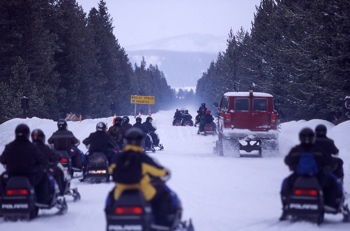
Snowmobiles & exhaust at West entrance in the winter on Presidents Day weekend. NPS photo, Jim Peaco, March 2000.
Yellowstone National Park planners seem to have shunted aside science, the public, even their own management guidelines, in their desire to see more snowmobiles in the park by backing a final Environmental Impact Statement on snowmobile use that favors more of the machines in the park than have been in use in recent years.
Yet to be seen is whether the Interior Department under Secretary Dirk Kempthorne or the Park Service under Director Mary Bomar, who have said science will guide management decisions across the national park system, will override that decision.
"When there is a conflict between conserving resources unimpaired for future generations and the use of those resources, conservation will be predominant," Secretary Kempthorne said in June of 2006.
Just last year, when Mr. Kempthorne replaced Gail Norton as Secretary of the Interior, and Ms. Bomar replaced Fran Mainella as Director of the National Park Service, there was hope that old problems would be solved with new leadership. On the top of that heap of old problems is the snowmobile debate in Yellowstone.
Yellowstone officials today released their final EIS for winter use in Yellowstone and Grand Teton. That hefty, costly document contains a preferred alternative that would allow up to 540 snowmobiles and 83 snow coaches, all relying on commercial guides, in Yellowstone per day. The park is touting this as a reduction in the number of snowmobiles from the previously-allowed 720 per day. But, what seems like a small victory for the environment is far from it.
Over the last four years 250-300 snowmobiles entered the park per day. During that span of time scientific research conducted in the park documented in detail that increasing the number of snowmobiles above 250 per day would add significantly to noise and air pollution problems that already exceed park thresholds and would carry addition impacts on the park's wildlife.
Plus, according to a U.S. Environmental Protection Agency analysis of the research, allowing more than 250 snowmobiles per day into Yellowstone could compromise human health. Here's what the EPA told Yellowstone planners this past June: "Today, vehicle numbers are reduced by two-thirds compared to historic use, resulting in improved air quality and soundscapes as well as reduced wildlife disturbance."
Beyond the scientific data, which provide enough ammunition for park officials to ban recreational snowmobiling in Yellowstone, there's been huge public backlash against snowmobiles in the park.
Seven of the eight surviving former directors of the NPS wrote to Secretary Kempthorne in March, 2007, saying that allowing snowmobile use to increase from significantly reduced levels "would radically contravene both the spirit and letter of the 2006 Management Policies" and "would undercut the park's resurgent natural conditions."
The park's decision also once again ignores the vast number of people who took the time to comment on the draft plan. Seventy-three percent of those commenting on the two parks' proposed winter-use plan favored ending snowmobile use in Yellowstone. Ninety-four percent agreed that snowmobiling damages the natural soundscape of the park.
At the Coalition of National Park Service Retirees, Bill Wade calls the EIS an attempt to "mislead" the American public.
"The National Park Service is proposing a daily limit of 540 snowmobiles, which is down from the temporary cap of 720 snowmobiles per day. But with this proposal, the agency would allow a significant increase in the number of snowmobiles beyond the daily average that was actually present in Yellowstone during the past four winters—between 250 and 290 snowmobiles," says Wade, chair of the group's executive council.
"Monitoring has shown that noise from this actual level of snowmobile use since 2003 is already exceeding Yellowstone’s thresholds. If the number of snowmobiles is allowed to increase from 250 snowmobiles per day to as many as 540 per day, National Park Service scientists have determined that snowmobile noise will grow significantly worse, unhealthy air pollution that has been markedly reduced with fewer snowmobiles could increase, and wildlife will be disturbed more frequently by machines," he adds.
If a few dozen letters from businesses in gateway towns surrounding Yosemite National Park can convince Ms. Bomar not to increase entrance fees to that park, shouldn't sound science and comments from tens, if not hundreds, of thousands of Americans from across the country convince her to prohibit recreational snowmobiling in Yellowstone? If not, should we assume politics are guiding the Park Service in Yellowstone?
Yellowstone's own scientists have recommended that the park should cap snowmobile use to the numbers that have cruised park roads during the last four years or, better yet, reduce the number further to avoid or minimize disturbance of the park's wildlife. The further use of snowmobiles also threatens the 2006 Management Policy directive that the NPS should "seek to perpetuate the best possible air quality in parks."
Of course, those scientists have admitted that politics often trump science.
So, when you have science and public opinion in the same camp, is it terribly hard to agree that the park's suggested 540-snowmobile-limit feels out of touch with Secretary Kempthorne's promise of conservation first?
"Why would they pick a number that is higher than they are already having a problem with?" wonders Rick Smith, a member of the Coalition of National Park Service Retirees. "It just seems hard to understand."
Moving forward, the superintendents of Yellowstone (Suzanne Lewis) and Grand Teton (Mary Scott Gibson) will analyze the final EIS and make a recommendation on the future of winter use in the two parks to the Park Service's regional director in Denver. The regional director will then make his decision, which is expected to be announced in early to mid-November.
Regardless of that decision, it's already been decided that for the upcoming winter as many as 720 snowmobiles will be allowed in Yellowstone on a daily basis.
With Mr. Kempthorne and Ms. Bomar in place, and other key personnel either retired or shuffled away, there had been hope that science and conservation would this time prevail. Many had seen this as an opportunity for the Mary Bomar-led NPS to get it right.
While Mr. Kempthorne has recused himself from this matter, as he was Idaho's governor before becoming Interior secretary, Ms. Bomar can could step in and overturn Yellowstone's desired direction before it is implemented. Whether she will remains to be seen. If she doesn't, don't be surprised if this thorny issue heads back to the federal courts.
Story Categories:
A copy of National Parks Traveler's financial statements may be obtained by sending a stamped, self-addressed envelope to: National Parks Traveler, P.O. Box 980452, Park City, Utah 84098. National Parks Traveler was formed in the state of Utah for the purpose of informing and educating about national parks and protected areas.
Residents of the following states may obtain a copy of our financial and additional information as stated below:
- Florida: A COPY OF THE OFFICIAL REGISTRATION AND FINANCIAL INFORMATION FOR NATIONAL PARKS TRAVELER, (REGISTRATION NO. CH 51659), MAY BE OBTAINED FROM THE DIVISION OF CONSUMER SERVICES BY CALLING 800-435-7352 OR VISITING THEIR WEBSITE. REGISTRATION DOES NOT IMPLY ENDORSEMENT, APPROVAL, OR RECOMMENDATION BY THE STATE.
- Georgia: A full and fair description of the programs and financial statement summary of National Parks Traveler is available upon request at the office and phone number indicated above.
- Maryland: Documents and information submitted under the Maryland Solicitations Act are also available, for the cost of postage and copies, from the Secretary of State, State House, Annapolis, MD 21401 (410-974-5534).
- North Carolina: Financial information about this organization and a copy of its license are available from the State Solicitation Licensing Branch at 888-830-4989 or 919-807-2214. The license is not an endorsement by the State.
- Pennsylvania: The official registration and financial information of National Parks Traveler may be obtained from the Pennsylvania Department of State by calling 800-732-0999. Registration does not imply endorsement.
- Virginia: Financial statements are available from the Virginia Department of Agriculture and Consumer Services, 102 Governor Street, Richmond, Virginia 23219.
- Washington: National Parks Traveler is registered with Washington State’s Charities Program as required by law and additional information is available by calling 800-332-4483 or visiting www.sos.wa.gov/charities, or on file at Charities Division, Office of the Secretary of State, State of Washington, Olympia, WA 98504.
INN Member

The easiest way to explore RV-friendly National Park campgrounds.

Here’s the definitive guide to National Park System campgrounds where RVers can park their rigs.
Our app is packed with RVing- specific details on more than 250 campgrounds in more than 70 national parks.
You’ll also find stories about RVing in the parks, tips helpful if you’ve just recently become an RVer, and useful planning suggestions.


Comments
I've never had the pleasure of visiting Yellowstone or Grand Teton in winter, so I can't comment on the noise and pollution brought about by snowmobiles in the park. Few people (relatively) visit those parks in winter. But there is a vehicular noise problem in the national parks in summer that disrupts the peace and quiet of many, many visitors, myself included, that seems never to have been addressed.
I'm talking about motorcycles. They like to ride in packs of four or five cycles together, gunning their engines over the Tuolumne Road in Yosemite past the meadows and lakes, drowning out the wind in the trees or quiet conversations. They are much louder than passenger vehicles. They roar through Yellowstone and Grand Teton in summer.
Why is this permitted? And at reduced entrance fees? If the NPS is serious about combating noise pollution in the parks, there must be some standard based on decibels that applies to all noise makers. I don't understand why the noise from snowmobiles prompts headlines and environmental impact assessments and the noise from motorcycles is overlooked.
I googled a bit and found that motorcycle noise is an issue along the Blue Ridge Parkway per a recent article in the Asheville Citizen-Times.
Really, this seems like a much larger issue as far as noise pollution in the parks. Why not more attention to it? There are more motorcycles making noise than snowmobiles. There are more places that motorcycles can go and cause noise pollution. There are more people being annoyed by motorcycles than snowmobiles. Yet the snowmobile issue in one park goes all the way to the top of the NPS and there isn't even any discussion on the noise pollution caused by motorcycles.
I know this is off-topic for this article. But an article on the noise pollution in the parks caused by motorcycles would be appreciated. Ask your contact in the NPS why they don't do anything.
Kath, you are so right. I was just on the parkway this week(June 25, 2009) and the motorcycles out number the cars. That could be because the bikes are running everyone else out. Anyway, my wife and I like to go on the parkway about mid-June every year to see the flowering bushes(azalea, rhododendrum). We like to rent a convertible and ride the parkway-one of the most beautiful places on earth. BUT, the motorcycles are out of control thundering through the hills and in your ears. It crazy. Isn't the parkway suppose to be a place to get away from it all? Guess not and the NPS seems to be doing nothing about. The Goldwings and BMW's are fine, but the Harleys are the problem. What can we do??????????
Kath, you raise a good point. I can't give you a complete answer, but I do know that those who want to see a snowmobile ban focus on the complete pollution package -- noise, air, water, etc., as well as wildlife disturbances.
I know a while back we ran a story about noise pollution studies in the parks, but belief it was more generic. We'll add this question to the list of issues we need to address.
I hate to throw this into the mix without double checking first, but I *think* one big difference between the motorcycle noise and snowmobile noise, is that snowmobile noise is unregulated. Motorcycles have to meet federal standards for highway travel, whereas snowmobiles are an off-road vehicle not confined to the same regulations. I know that modern snowmobiles are a lot less noisy than older models, but I don't think that is because of a federal mandate.
Someone, please feel free to clarify, or shoot me down if I'm wrong!
By the way, a year ago, I wrote about my own perceived sense of overly loud motorcycle noise, associated with Sturgis Ralley, in Devils Tower National Monument. You can read those articles here:
Boom City
Boom City: Follow-Up
I have had the privilege of visiting Yellowstone on snowmobile twice. I love this trip. There are no crowds, it's like having a private pass to the park. I have to admit, before I went on the trip, I was ambivalent. I'm a conservationist at heart, so I was leaning toward the snowmobile ban. Now, I have to say that I support the limited use. Our guides were very conscientious, and shared a very environmentalist perspective. The guides keep their groups on the same main roads that the regular season traffic travels. The machines are the most clean running that are available. I have to wonder why they are not restricting the number of cars/camper/motorcycles to 540 during the regular season? Also, I wonder if anyone has a statistic for how many snowmobiles actually enter the park each day vs. the number permitted to.
I have done some research on the subject of motorcycle noise, I live close to the entrance of the GW Parkway which is a national park area starting at the Mt. Vernon Estate. Loud motorcycles often turn this area into what sounds like a racetrack.
It turns out that there are indeed hard to find federal regulations that are designed to regulate motorcycles and motorcycle exhaust systems. Many state and local laws that contain language pertaining to mufflers for street legal vehicles which is meant to reference the federal regulations. For example, a reference to "standard factory equipment, or comparable to that designed for use upon the particular vehicle as standard factory equipment" when referencing exhaust systems (muffler) will allow an officer to simply visually inspect a motorcycle muffler for the required EPA label which will be present if the muffler meets those conditions (stock or designed as stock replacement for street legal muffler).
These federal regulations are EPA Title 40, Part 205, Subpart D (motorcycles) and Subpart E (motorcycle exhaust systems).
Subpart D—Motorcycles
http://ecfr.gpoaccess.gov/cgi/t/text/text-idx?c=ecfr&sid=9d2dcc1c4ab65a2...
Subpart E—Motorcycle Exhaust Systems
http://ecfr.gpoaccess.gov/cgi/t/text/text-idx?c=ecfr;sid=9d2dcc1c4ab65a2...
Motorcycles evidently cannot be [legally] manufactured to be loud. Owners replace the factory exhaust which must meet the federal regulations with an aftermarket exhaust system designed to make at least 2 to 4 times as much noise as a street legal muffler.
How could park police enforce these laws, is it possible?
Another issue with the park service and loud motorcycles is that the park police use them. A park police motorcycle officer roared by my house one sunday at 8 am while escorting some VIPs to the Mt. Vernon Estate. I drove over and asked him about his motorcycle. He agreed that it was much louder than it came from the factory, that it had aftermarket mufflers which were much louder. He had no idea that it might actually be illegal. He was a super nice guy and professional and it is not his responsibility to decide what mufflers are used on motorcycles (that is what I told him).
There is actually a section in Section D of the federal regulations which states that federally procured motorcycles cannot exceed a decibel limit of 71, which is much lower than the decibel limit of 80 for street legal motorcycles manufactured after 1983.
Anyway, this might be a barrier in getting park police to enforce loud motorcycles? What bothers me the most is that the practice by the park service police of using these mufflers sets a terrible example for the general public. There were people lined up to talk to the officer about his motorcycle, it is like a constant advertisement that loud motorcycles are perfectly ok.
Plus, it seems to run counter to two National Park Service management policies that stress the importance of mitigating noise.
4.9 Soundscape Management: The National Park Service will preserve, to the greatest extent possible, the natural soundscapes of parks.
8.2 Visitor Use: For the purpose of these policies, unacceptable impacts are impacts that, individually or cumulatively, would unreasonably interfere with the atmosphere of peace and tranquility, or the natural soundscape maintained in wilderness and natural, historic, or commemorative locations within the park.
(c) Low noise emission product standard. For the purpose of Low-Noise-Emission Product certification pursuant to 40 CFR part 203, motorcycles procured by the Federal government after the following dates must not produce noise emissions in excess of the noise levels indicated:
(1) For street motorcycles with engine displacement greater than 170 cc:
Date A-weighted noise level (dB)
(i) January 1, 1982 73
(ii) January 1, 1989 71
There is a big difference between a vehicle that is being ridden or driven thoughtfully & considerately in the course of transporting oneself and achieving access, and a vehicle that is being used as a source of entertainment, in & of itself.
In the case of Yellowstone snowmobile tours, each accompanied by a formal guide and restricted to set routes, the usual excesses of riding snowmobiles for amusement are curtailed and the participants' behavior can be expected to remain moderate. They are using the machine to access snowy country, and do not have a license to tear up the landscape at will (a popular activity of choice on snowmobiles).
Highway motorcycles - which figure prominently in these comments - are nowadays sold as "crotch rockets": they are consumer entertainment products, by definition. The basic intent is to enable one to 'act up', and if there is a shocked & dismayed audience - all the better!
Congress has in recent years systematically pressed to provide improved markets & venues for recreational vehicles in the context of all public lands, Parks included. Partly this is an economic stimulus idea, and it may also be partly to encourage those inclined toward conservative and consumer lifestyles in contexts which are sometimes dominated by liberal-environmentalist perspectives.
Some will object aesthetically to the presence of snowmobiles in National Parks, at any level or style of usage. Some are simply offended by the machine, and prefer it not be allowed at all.
Personally, I find the crasser forms of consumerism somewhat bovine, but I like that hard-working citizens pour unconscionable amounts of money into the corporate development of astonishingly excellent machinery. It is then up to each of us to decide how we personally use the equipment.
All loud motorcycles are using illegal mufflers designed to make 10 to 100 times more noise than street legal mufflers. National Parks are federal entities, and each park can enact and enforce its own set of laws. Therefor each park should require that all motorcycles accessing a national park must use EPA labeled mufflers per federal regulations. Each one of these illegally modified motorcycles also pollute more than 30 normal automobiles. Yet in most places the majority of motorcycles (excluding BMW owners) are illegally modified to produce noise.