
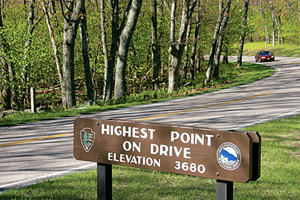
 Two weeks ago, on Earth Day, I had the opportunity to visit Shenandoah National Park. The drive along Skyline Drive was astoundingly beautiful. Long-distance views were possible given outstanding weather – dry, clear, and cloudless -- and the fact that spring leaf-out was delayed due to late-spring storms and the freezing weather of a few weeks earlier.
Looking out to the northwest, I gazed deep into the Shenandoah Valley, able to see beyond the long, dark ridge of Massanutten Mountain to the rumpled Shenandoah and Allegheny mountains beyond. To the southeast, I could view far into the Piedmont plains of the Chesapeake Bay watershed.
Along Skyline Drive itself, there was virtually no traffic; only a few cars seen mostly at pullouts and at the parking area at Big Meadows. In many places the leafless, deciduous forest alongside the road was in shambles.
There was dead and downed wood from recent storms, and upper parts of the canopy branches showed signs of fresh damage from heavy ice and high-speed wind sheer. But the road was totally clear of debris and the drive wonderfully pleasant.
A large part of my joy along Skyline Drive was the outstanding scenery. Another part was the relative absence of traffic. I found myself wondering why there weren’t more cars along this fine stretch of scenic roadway on a brilliant Sunday afternoon, given the fact that Shenandoah is just 75 miles from the heavily populated region surrounding Washington, D.C., and its beltway.
Could it be related to Shenandoah’s $15 entrance fee?
My thoughts soon focused on the issue of entrance fees in the national parks and the concern expressed by many, including myself, of a continual and sometimes not-so-gradual attempt to increase entrance fees in parks throughout the country, one park at a time, to the extent that fees have become a deterrent for some groups of Americans to visit the parks. Some of us have referred to this phenomenon as “fee creep.”
So, while slowly taking in the sights along the Skyline Drive, I asked myself, “Do park fees affect park visitation?”
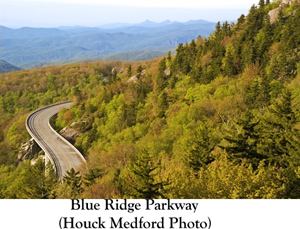
The Skyline Drive in Shenandoah is a natural extension of the Blue Ridge Parkway, which does not charge an entrance fee. Both roads ride along the Blue Ridge, which forms the southeastern boarder of the Appalachian Mountain chain.
Being a scientist by training and profession, I wondered how the park’s visitation statistics would compare. Of course, the Blue Ridge Parkway, at 469 miles, is much longer than Shenandoah’s 105-mile-long Skyline Drive.The Blue Ridge Parkway also is more distant from major population centers.
I also wondered how Shenandoah visitation compared with that of the Great Smoky Mountains National Park, which by legislative mandate does not charge a fee for park entrance. Living as I do in east Tennessee, growing traffic in the Great Smoky is a major reason why I seldom visit, even though I live but 90 minutes away from that park’s boundary.
To examine the extent to which differences in traffic and park visitation might be due to the presence versus the absence of park entrance fees, I decided to use my computer and Google the visitation statistics for each park.
 Here’s what I found for 2006 park visitation at the National Park Service's web site.
Shenandoah National Park: 80,032 (April 2006); 1,076,150 (2006 Total)
Blue Ridge Parkway: 1,394,730 (April 2006); 18,953,478 (2006 Total)
Great Smoky Mountains National Park: 1,716,614 (April 2006); 9,289,215 (2006 Total)
I was astounded at these results. To be honest, I distrust the huge numbers reported for the Blue Ridge Parkway. Those numbers violate my sense of face validity. I have never visited the Blue Ridge and experienced anything that I would call “traffic.”
The frequency of encountering other cars along the Blue Ridge has never been anything close to the weekend congestion that I have experienced within and near the Great Smoky Mountains National Park. On the other hand, I have never visited the Blue Ridge during the peak season of fall colors.
Certainly, the NPS visitation stats for each park might reflect different estimation methods and procedures. There might be many reasons why comparison of the reported number of visits per park per month and per year might not be totally accurate or proper. But, the reported data indicate nearly a factor of 15 to 20 lower visitation for Shenandoah than for either of the other two related NPS areas, and Shenandoah is a “national park,” not a “parkway,” and it is located much closer to major population centers.
Now, the only major difference between these three closely related parks is that Shenandoah charges an entrance fee and the Blue Ridge and the Smokies do not.Certainly, I thought, entrance fees will impact the frequency of park visits by local residents. But for those traveling to Shenandoah from the Washington, DC area, would a $15 entrance fee be a deterrent for a potential park visit? Or, could there be other socio-economic factors involved that I am not aware of when evaluating this comparison of NPS visitation statistics?
My visit to Shenandoah was delightful. If the $15 entrance fee was solely responsible for the premium conditions along Skyline Drive, then I must admit I’m all for having the fee. But I’m not one of those deterred by a charge at the gate. In fact, I probably could have gotten into the park for much less, but I forgot about the fee discounts available to those over 62 years of age and the fact that my wife had already purchased an annual park pass while we were in the Four Corners area last September.
But despite the fact that we had Skyline Drive essentially for ourselves on this fine day, without much oncoming traffic or cars backed up behind us, I am still disturbed by the fact that park fees might function as a de facto deterrent for other others. Those who aren’t affected by the fee enjoy the park. Those who find that paying a fee causes difficulties don’t visit.
Another question that came to mind is whether park fees affect the diversity of park visitation? The Washington, D.C., area is ethnically diverse. However, I didn’t see much evidence of diversity in either park visitation or among park employees at Shenandoah. Most visitors I saw were white and what I would classify as upper middle-class, albeit somewhat more stressed-out looking than I’m used to seeing among groups of visitors to a national park.
Ethnic diversity among concessionaire employees at the Big Meadow coffee shop was notably absent. I presume that concessionaire hiring at Shenandoah is mostly from local mountain/valley communities and that housing and wage opportunities are perhaps unattractive to those from more distant, diverse urban and suburban locations, like Washington, D.C., and its beltway.
Before closing, I should mention that, in stark contrast to the scenery along Skyline Drive, the food service at the Big Meadows Coffee Shop was charitably substandard. Food service there seemed to be in somewhat of disarray. We experienced a very long (more than ½ hour) wait at our table. Some other customers were overheard saying that they were waiting more than one hour for service. I wonder if any other readers have had a similar (or different) experience at this location.
We finally gave up on food service and left the coffee shop without having eaten, opting instead to purchase packaged snacks from the counter of the curio shop and proceed to wander out into Big Meadow where we enjoyed an impromptu lunch on an old log, under a comfortably warm sun.
Owen Hoffman, Ph.D., is president and director
of the Center for Risk Analysis
SENES Oak Ridge, Inc., in Oak Ridge, Tennessee, a director of the
Crater Lake Institute, and a member of the Coalition of National Park
Service Retirees.
Story Categories:
A copy of National Parks Traveler's financial statements may be obtained by sending a stamped, self-addressed envelope to: National Parks Traveler, P.O. Box 980452, Park City, Utah 84098. National Parks Traveler was formed in the state of Utah for the purpose of informing and educating about national parks and protected areas.
Residents of the following states may obtain a copy of our financial and additional information as stated below:
- Florida: A COPY OF THE OFFICIAL REGISTRATION AND FINANCIAL INFORMATION FOR NATIONAL PARKS TRAVELER, (REGISTRATION NO. CH 51659), MAY BE OBTAINED FROM THE DIVISION OF CONSUMER SERVICES BY CALLING 800-435-7352 OR VISITING THEIR WEBSITE. REGISTRATION DOES NOT IMPLY ENDORSEMENT, APPROVAL, OR RECOMMENDATION BY THE STATE.
- Georgia: A full and fair description of the programs and financial statement summary of National Parks Traveler is available upon request at the office and phone number indicated above.
- Maryland: Documents and information submitted under the Maryland Solicitations Act are also available, for the cost of postage and copies, from the Secretary of State, State House, Annapolis, MD 21401 (410-974-5534).
- North Carolina: Financial information about this organization and a copy of its license are available from the State Solicitation Licensing Branch at 888-830-4989 or 919-807-2214. The license is not an endorsement by the State.
- Pennsylvania: The official registration and financial information of National Parks Traveler may be obtained from the Pennsylvania Department of State by calling 800-732-0999. Registration does not imply endorsement.
- Virginia: Financial statements are available from the Virginia Department of Agriculture and Consumer Services, 102 Governor Street, Richmond, Virginia 23219.
- Washington: National Parks Traveler is registered with Washington State’s Charities Program as required by law and additional information is available by calling 800-332-4483 or visiting www.sos.wa.gov/charities, or on file at Charities Division, Office of the Secretary of State, State of Washington, Olympia, WA 98504.


National parks and their natural resources belong to you. The National Parks Traveler works to ensure you know how these essential places are being cared for.
Sign Up For Our Weekly Newsletter
Unsubscribe at any time.
INN Member

The easiest way to explore RV-friendly National Park campgrounds.

Here’s the definitive guide to National Park System campgrounds where RVers can park their rigs.
Our app is packed with RVing- specific details on more than 250 campgrounds in more than 70 national parks.
You’ll also find stories about RVing in the parks, tips helpful if you’ve just recently become an RVer, and useful planning suggestions.


Comments
I have never been to the Great Smoky Mountains but I suspect that they get alot of their visitation from citizens of states that have no mountains.When you think about it, there are many states within close proximity of the Smokies who have to travel to either GA, NC or TN if they want a mountain vacation.Virginia, however is surrounded by other states that already have mountains of their own.As beautiful as Shenandoah is,why would someone from WV or PA come to Virginia and see mountains when they have them in their own backyard? Most of the visitors to Shenandoah I suspect are from Virginia and DC alone could make up the difference between annual visitation differences between the two parks.Cities further away like Baltimore or Philadelphia already have mountains that are much closer so I doubt citizens of these two cities would make many treks down to Virginia. As far as fees go, it's probably more of an issue for people who actually live in and around Shenandoah than it is for DC residents.People who live in NW Virginia are not as affluent on the whole as those in DC and after all why pay to go through SNP when you can see it from your front porch.The DC jet set crowd's idea of a nice getaway is something other than the mountains most of the time.They think "water" and not "mountains" excpet in ski season and then they fly to the west coast for that.I have seen pictures of the Smokies and they are beautiful but I can't think of any place more beautiful than Shenandoah.It is truly God's country.