
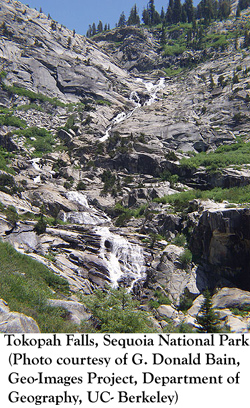
 In Sequoia National Park there's a short hike from the Lodgepole Campground that leads not quite two miles along the boulder-crowded Marble Fork of the Kaweah River to a tumbling stream of water known as Tokopah Falls. It's a pretty easy hike along the river's edge, fairly level, perfect for young kids exploring nature.
Now, most times when you think of a waterfall you conjure a vision of a free-falling stream of water. But that's not Tokopah Falls. No, while the water pitches and leaps out of the Sierra, plummeting 1,200 feet, it does so mostly by slipping, sliding, and plunging down the face of a granite cliff. Still, it's a wondrous destination.
I found myself at the base of the falls in the summer of 2000 while researching a national parks guidebook. It was a gorgeous summer day, with few clouds in the blue sky. It wasn't too hot, and the mist from the falls was cooling. The only sound was from the plunging water the filled the Marble Fork.
Though I was less than two miles from the campground with its picnicking families and bounding, laughing children, lying there on a flat-topped boulder near the base of the falls I might have been deep in the backcountry.
It's a scene that national park visitors repeat time after time after time year-in and year-out. It's one that comes with countless backdrops. You might find yourself across from Cathedral Peak in Yosemite National Park, or at any one of the numerous waterfalls that tumble off the wooded-flanks of the Appalachian Mountains in Shenandoah National Park, or strolling the cobble-covered beaches of Olympic National Park.
And the beauty of these outings....is the intrinsic beauty of nature.
Spotting birds, marveling at the scenery, watching wildlife. True, some hikes require more effort and more time than others, but that's part of the lure of the national parks. You can push yourself as little or as much as you want.
You can relax with a picnic beside a backcountry lake or spend weeks hiking the John Muir Trail. And you don't give a thought to whether the Park Service's prime mandate is protecting these landscapes, or allowing folks to enjoy them. Because at the moment, that's not what's relevant. It's the setting and how you've inserted yourself into it that's relevant.
The other day I broached the question of whether we were losing sight of the relevancy of the national park system. It was a post that generated some discussion on this site, and much more on a private listserve. On this site, two comments stood out, for their very divergent viewpoints.
Random Walker talked of her nephews and niece and their love of the out-of-doors, enjoying, as Aldo Leopold once said, "...adventure, without regard to prudence, profit, self – improvement, learning or any other serious thing.”
Conversely, Sally ridiculed "unbathed hippies/leftists" and 'treehuggers." She evidently finds her glory not in a backcountry campfire beneath a starry canopy but rather in a "big gas-guzzling SUV."
In my original post, I worried that we as a society are losing our
collective mindset of the significance and vision of the national parks
movement, that we're confusing the purpose of the national parks.
A companion question that went unasked is why have we come to this crossroads, how did we get here? Why do some seem to believe that parks can only be enjoyed with motorized accessories, be they snowmobiles, personal watercraft, ATVs, or other off-road vehicles, that interpretation should be multi-media and downloadable onto your iPod or cell phone?
I'm pretty sure national parks were never intended to be theme parks, places where you "pay to play," where you look for instant gratification, whether it be found in the thrills of a roller-coaster or a ride that mimics a white-water raft trip.
As he neared his retirement from the National Park Service, where he last worked as chief naturalist for Sequoia and Kings Canyon, Bill Tweed pondered the differences between theme parks and national parks and, in my opinion, succeeded in explaining why today's theme parks are more popular than national parks.
I've reprinted what he's said before, but believe his words are so valuable in this discussion of relevancy that they deserve another shot. Here are a few of them:
Story Categories:
A copy of National Parks Traveler's financial statements may be obtained by sending a stamped, self-addressed envelope to: National Parks Traveler, P.O. Box 980452, Park City, Utah 84098. National Parks Traveler was formed in the state of Utah for the purpose of informing and educating about national parks and protected areas.
Residents of the following states may obtain a copy of our financial and additional information as stated below:
- Florida: A COPY OF THE OFFICIAL REGISTRATION AND FINANCIAL INFORMATION FOR NATIONAL PARKS TRAVELER, (REGISTRATION NO. CH 51659), MAY BE OBTAINED FROM THE DIVISION OF CONSUMER SERVICES BY CALLING 800-435-7352 OR VISITING THEIR WEBSITE. REGISTRATION DOES NOT IMPLY ENDORSEMENT, APPROVAL, OR RECOMMENDATION BY THE STATE.
- Georgia: A full and fair description of the programs and financial statement summary of National Parks Traveler is available upon request at the office and phone number indicated above.
- Maryland: Documents and information submitted under the Maryland Solicitations Act are also available, for the cost of postage and copies, from the Secretary of State, State House, Annapolis, MD 21401 (410-974-5534).
- North Carolina: Financial information about this organization and a copy of its license are available from the State Solicitation Licensing Branch at 888-830-4989 or 919-807-2214. The license is not an endorsement by the State.
- Pennsylvania: The official registration and financial information of National Parks Traveler may be obtained from the Pennsylvania Department of State by calling 800-732-0999. Registration does not imply endorsement.
- Virginia: Financial statements are available from the Virginia Department of Agriculture and Consumer Services, 102 Governor Street, Richmond, Virginia 23219.
- Washington: National Parks Traveler is registered with Washington State’s Charities Program as required by law and additional information is available by calling 800-332-4483 or visiting www.sos.wa.gov/charities, or on file at Charities Division, Office of the Secretary of State, State of Washington, Olympia, WA 98504.
INN Member

The easiest way to explore RV-friendly National Park campgrounds.

Here’s the definitive guide to National Park System campgrounds where RVers can park their rigs.
Our app is packed with RVing- specific details on more than 250 campgrounds in more than 70 national parks.
You’ll also find stories about RVing in the parks, tips helpful if you’ve just recently become an RVer, and useful planning suggestions.


Comments