
 What a week. Economic impacts and impacting economics.
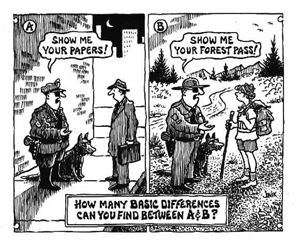
If you've spent any time surfing the 'net, you've seen I'm not the only one talking about the National Parks Conservation Association's latest study on how much economic good the national parks generate or the soon-to-debut $80 America the Beautiful pass.
Over at Wild Wilderness and Get Outdoors bloggers are wondering why we need to attach economic impact figures to the parks. At the New West site, Bill Schneider fears the constant increase in fees to visit our public lands will only continue to escalate and that the ATB pass has been ill-conceived. At Park Remark, the reaction to the pass is that it will make public lands access more restrictive. Washington-based Jim MacDonald has waxed philosophical in his comments to my posts about the NPCA report and vented about the same on his own site.
So what are we to make of all this?
I suppose the short answer is that there's great concern for our public lands, the national parks specifically.
But that concern is, as the saying goes, a mile wide and a foot deep.
Why? I suppose it's because we are barraged today with an amazing, constantly changing, kaleidoscope of issues. There are family concerns, relationships to grapple with, personal economics, health care, retirement, wars, and on and on and on.
Is it any surprise that advocacy groups such as the NPCA hope to kindle attention by pointing out the economic benefits of national parks? How much attention would the group garner by trotting out beautiful photos of Yosemite Falls or Clingmans Dome or Mount Rainier and say Congress needs to fully fund these places? They'd be beautiful shots, for sure, but what would the reaction be? What response would they get if they focused on the intrinsic values of the park system, the beautiful landscapes, the waterfalls, the wildlife, the cultural and history?
People can relate to economics, particularly those folks who rely on national parks for their livelihoods. At the same time, many who love national parks are disconcerted when those places are boiled down to dollars and cents.
As for the ATB pass, my guess is that the furor will subside and the agencies will move forward with their chosen path, just as Yellowstone officials seem blindly determined to allow snowmobiles into the park even though science suggests that would be an unwise decision.
I guess what's disturbing about both of these developments (the economic impact study and the ATB pass, not the snowmobile dispute, which is a whole 'nother matter) is that they'd be unnecessary if the millions of national park visitors across the country took a stand on how the park system is being managed and funded.
(Tens of thousands have taken a stand against snowmobiles in Yellowstone, but to no avail. Perhaps that's why there's apathy out there.)
Folks, if you don't show up, you don't get a say when it comes time to make decisions. Sit quietly on the sidelines and you have nothing to complain about if you don't like that decision.
Those millions of park visitors could accomplish a whole lot of good for the national parks if they would voice their concerns over park funding and entrance pass fees to their elected representatives. Without that pressure, Congress isn't likely to respond.
And it can't be just a little pressure. It's got to be a lot, and it's got to be persistent.
Truth be known, Congress itself, even those members on the National Parks Caucus, a
group that counts fewer than 40 members, is lukewarm about national
park issues.
Earlier this year Congressman Raul Grijalva of Arizona circulated among his colleagues a letter he just sent to the secretaries of
Interior and Agriculture urging that energy corridors being proposed across the country avoid national parks and other sensitive lands. He wound up with
19 total signatures. Nineteen. Not even the entire National Parks Caucus would
sign on.
Nearly two years ago Congressmen Mark Souder of Indiana and Brian Baird
of Washington introduced the National Park Centennial Act, a piece of
legislation they thought could help the Park Service dig out of its
fiscal black hole by the agency's centennial in 2016. It's gone
absolutely nowhere.
Congressman Souder also has spent a good deal of time crisscrossing the country the past year or so collecting testimony on how underfunded the park system is. Yet we have yet to hear the details of his fact-finding.
If we truly love and appreciate the national parks, if we want these magical places to last for future generations, we need to make some noise. For if we, the taxpayers who own and support the parks, don't get more concerned about how our public
lands are managed, I fear things will only get uglier on the landscape.
Story Categories:
A copy of National Parks Traveler's financial statements may be obtained by sending a stamped, self-addressed envelope to: National Parks Traveler, P.O. Box 980452, Park City, Utah 84098. National Parks Traveler was formed in the state of Utah for the purpose of informing and educating about national parks and protected areas.
Residents of the following states may obtain a copy of our financial and additional information as stated below:
- Florida: A COPY OF THE OFFICIAL REGISTRATION AND FINANCIAL INFORMATION FOR NATIONAL PARKS TRAVELER, (REGISTRATION NO. CH 51659), MAY BE OBTAINED FROM THE DIVISION OF CONSUMER SERVICES BY CALLING 800-435-7352 OR VISITING THEIR WEBSITE. REGISTRATION DOES NOT IMPLY ENDORSEMENT, APPROVAL, OR RECOMMENDATION BY THE STATE.
- Georgia: A full and fair description of the programs and financial statement summary of National Parks Traveler is available upon request at the office and phone number indicated above.
- Maryland: Documents and information submitted under the Maryland Solicitations Act are also available, for the cost of postage and copies, from the Secretary of State, State House, Annapolis, MD 21401 (410-974-5534).
- North Carolina: Financial information about this organization and a copy of its license are available from the State Solicitation Licensing Branch at 888-830-4989 or 919-807-2214. The license is not an endorsement by the State.
- Pennsylvania: The official registration and financial information of National Parks Traveler may be obtained from the Pennsylvania Department of State by calling 800-732-0999. Registration does not imply endorsement.
- Virginia: Financial statements are available from the Virginia Department of Agriculture and Consumer Services, 102 Governor Street, Richmond, Virginia 23219.
- Washington: National Parks Traveler is registered with Washington State’s Charities Program as required by law and additional information is available by calling 800-332-4483 or visiting www.sos.wa.gov/charities, or on file at Charities Division, Office of the Secretary of State, State of Washington, Olympia, WA 98504.
INN Member

The easiest way to explore RV-friendly National Park campgrounds.

Here’s the definitive guide to National Park System campgrounds where RVers can park their rigs.
Our app is packed with RVing- specific details on more than 250 campgrounds in more than 70 national parks.
You’ll also find stories about RVing in the parks, tips helpful if you’ve just recently become an RVer, and useful planning suggestions.


Comments