
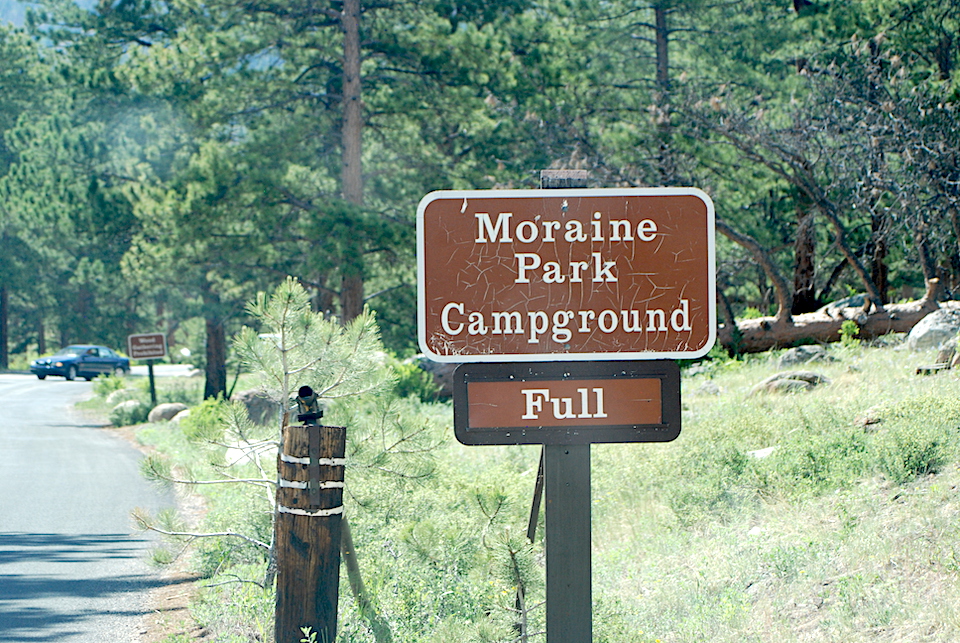
Are there enough campgrounds in the National Park System?/Kurt Repanshek file
How many front-country campgrounds are in the National Park System? How many are needed? If you've struggled with making a campsite reservation on recreation.gov, these questions might have come to mind. Here are some answers.
According to the National Park Service, at the end of Fiscal 2018, there were 1,421 campgrounds in the park system, with 27,513 campsites. Filter that done a bit more, and there are 502 front-country campgrounds with 16,648 sites (another 494 campgrounds don't have front- or backcountry designations), according to the Park Service.
That 16,648 number might explain why it is such a struggle to reserve a campsite. After all, Yellowstone National Park has more than 2,000 front-country campsites alone, Yosemite National Park has nearly 1,500, Glacier National Park has more than 1,000, Grand Teton National Park has more than 1,100, and Sequoia and Kings Canyon combined have just a bit more than 1,200 sites. Do the math and you'll see that those six parks alone hold 40 percent of those 16,648 campsites.
Many other parks that are highly desireable with campers, meanwhile, have considerably fewer sites. Canyonlands National Park has fewer than 40, Arches National Park has 50, Rocky Mountain National Park has around 571, Acadia National Park has a few more than 600, and Shenandoah National Park has 472.
Of course, if you're looking for RV campsites, they are even more scarce.
And some parks don't have any front-country campsites: Saguaro, Petrified Forest, Carlsbad Caverns, and Cuyahoga Valley national parks all fall in that category.
According to the Park Service, "the variety of available NPS campground facilities and amenities is extremely broad, from primitive, unstaffed backcountry campsites to campgrounds that provide hot showers or can accommodate 25’ recreational vehicles. Campgrounds are also managed through multiple models; some campgrounds are operated by the NPS, some by concessioners, and a few by other partners. The range and complexity of these models and amenities, in conjunction with limited financial resources, presents unique management challenges."
Amenities at campgrounds in the National Park System include:
- 1,015 comfort stations at 346 campgrounds
- 12,730 tent pads at 485 campgrounds
- 8,585 RV pads
- 426 campgrounds with water stations
- 130 campgrounds with year-round hot showers
- 1,889 campsites at 36 campgrounds with electrical hook ups
- 130 campgrounds with dumping stations
- 33 campgrounds with Wi-Fi
- 60 amphitheaters at 55 campgrounds
- 3,534 fire rings at 556 campgrounds
- 14 camp stores at 11 parks
Of the 1,421 campgrounds in the park system, as of Fiscal 2018 1,340 were managed by Park Service and 81 were managed through concessions contracts.
According to the Park Service, during Fiscal 2018 these were the top 10 campgrounds in terms of occupancy;
1. Mather Campground, Grand Cayon National Park. 154,069 campers.
2. Upper Pines, Yosemite National Park. 128,113 campers.
3. Watchman Campground, Zion National Park. 92,231 campers.
4. Moraine Park Campground, Rocky Mountain National Park. 53,795 campers.
5. Assateague Island National Seashore Campground. 51,035 campers.
6. Fort Pickens Campground, Gulf Islands National Seasore. 47,708 campers.
7. Pinnacles Campground, Pinnacles National Park. 44,382 campers.
8. Blackwoods Campground, Acadia National Park. 44,289 campers.
9. Point Reyes National Seashore Campground. 43,918 campers.
10. Hodgdon Meadow Campground, Yosemite National Park. 43,440 campers.
Knowing all those numbers, how would you manage the parks and their front-country campgrounds? Would you call for more campgrounds/campsites to be carved into the parks? Would you add more campgrounds/sites to the busiest parks, or would you put campgrounds in those parks that don't have any campgrounds? Would you leave things as they are and suggest those who can't land a reservation look to nearby national forests or other public lands' campgrounds?
Story Categories:
A copy of National Parks Traveler's financial statements may be obtained by sending a stamped, self-addressed envelope to: National Parks Traveler, P.O. Box 980452, Park City, Utah 84098. National Parks Traveler was formed in the state of Utah for the purpose of informing and educating about national parks and protected areas.
Residents of the following states may obtain a copy of our financial and additional information as stated below:
- Florida: A COPY OF THE OFFICIAL REGISTRATION AND FINANCIAL INFORMATION FOR NATIONAL PARKS TRAVELER, (REGISTRATION NO. CH 51659), MAY BE OBTAINED FROM THE DIVISION OF CONSUMER SERVICES BY CALLING 800-435-7352 OR VISITING THEIR WEBSITE. REGISTRATION DOES NOT IMPLY ENDORSEMENT, APPROVAL, OR RECOMMENDATION BY THE STATE.
- Georgia: A full and fair description of the programs and financial statement summary of National Parks Traveler is available upon request at the office and phone number indicated above.
- Maryland: Documents and information submitted under the Maryland Solicitations Act are also available, for the cost of postage and copies, from the Secretary of State, State House, Annapolis, MD 21401 (410-974-5534).
- North Carolina: Financial information about this organization and a copy of its license are available from the State Solicitation Licensing Branch at 888-830-4989 or 919-807-2214. The license is not an endorsement by the State.
- Pennsylvania: The official registration and financial information of National Parks Traveler may be obtained from the Pennsylvania Department of State by calling 800-732-0999. Registration does not imply endorsement.
- Virginia: Financial statements are available from the Virginia Department of Agriculture and Consumer Services, 102 Governor Street, Richmond, Virginia 23219.
- Washington: National Parks Traveler is registered with Washington State’s Charities Program as required by law and additional information is available by calling 800-332-4483 or visiting www.sos.wa.gov/charities, or on file at Charities Division, Office of the Secretary of State, State of Washington, Olympia, WA 98504.


National parks and their natural resources belong to you. The National Parks Traveler works to ensure you know how these essential places are being cared for.
Sign Up For Our Weekly Newsletter
Unsubscribe at any time.
INN Member

The easiest way to explore RV-friendly National Park campgrounds.

Here’s the definitive guide to National Park System campgrounds where RVers can park their rigs.
Our app is packed with RVing- specific details on more than 250 campgrounds in more than 70 national parks.
You’ll also find stories about RVing in the parks, tips helpful if you’ve just recently become an RVer, and useful planning suggestions.


Comments
Appreciate the piece. As I frequent. Parks across the country I would say it is always great tomhave a mix of options. So my answer is "it depends". I do like being able to reserve a campsite ahead of time so one suggestion is to please get as many sites online as possible. You can order a coffe ahead of time but some NPS campgrounds you can't. What is this 1970? I don't care much for the amphitheater's in parks anymore. I grew up listening to campfire programs at the amphitheater's but it is harder to get the grandkids to head down to the amphitheater for a program. Most of the time the amphitheater's seem run down and targets for vandals.
I think overall many of the front country campgrounds run by concessions seem very clean and well maintained.
How about selling non-reservable spaces in day use areas for people in smaller, self-contained camper vans? Large parking lots that have restroom faciluties could accomdate a lot of people just parking to sleep for the night. Restrict it to say, 9:00 P.M. to 7:00 A.M. The only additional cost to the parks would be increased restroom maintence and assitional enforcement partols (likely a single enforcement ranger)
I think this is an exellent suggestion worth exporing. i have often wondered the same. And I have from time to time observed someone parked in a parking lot early in the morning.
A great idea. So many day use area sit unused and this would be increased revenue for sure for those that are self contained.
I would look for alternative camping areas in the National Forest or private land before I would carve out more campistes in the National Parks.
My opinion is to look at putting campgrounds in or near the parks that do not currently have any.
Not a fan of camp grounds going to reservation only. We are travlers who go without an itinerary. When a park is reservation only we pull up and even with empty spots cannot always stay. Prefer at least some walk up only spots and not an all reservation park.
I agree that there should be walk up only sites. We also travel without an itinerary so we often use NFS.
Reservable campsites that aren't reserved in advance automatically become 'First Come First Served' and available to those who show up without reservations. The 'empty spots' you report that you are not allowed to occupy are in all likelihood ones that are reserved, but the campers just haven't arrived yet. That is the inherent benefit in making reservations ... you arrive at your leisure since you don't have to worry about fighting off other campers to claim your spot. People always say that reservations take the spontaneity out of camping, but if you set all of the anecdotal emotional arguments aside, you have to aknowledge that making a campground 100% reservable is the single most efficient and cost effective way for the NPS to manage a campground. A completely cahsless model where all of the fees are collected electronically online eliminates significant costs associated with cash collection and handling ... not to mention eliminating the risks of theft and loss associated with cash collections. All public lands have to be managed smarter, and in many cases that means abandoning management practices rooted in the 1950's and implementing modern cost effective strategies. Federal land management agencies should not be implementing wasteful management practices because a handfull of people like to travel without an itinerary.
Many people pak RVs in park turnouts and parking lots over night and the rangers lett it go. Of course, they keep it low profile, no sitting out barbequeing and drinking beer.
Having additional campsites within NP's is a nice idea, but with ever decrease federal funding, is not realistic. Lets offer incentives for private campgrounds to develop near the NP's. Clear the red tape for new campgrounds to be developed And ask the RV manufactures to kick in financially to support projects that their customers would benefit from. The manufactures keep pumping out RV's that have no place to camp. Offer shuttles from outside campgrounds to decrease traffic and have shuttles "sponsored by..."
Also, start building into RV rally's a theme of giving back and volunteerism by scheduling cleanup days through out the year. Perhaps develop rally style camping area for groups that come to volunteer. Look at the model of Best Friends Animal Shelter in Kanab. Volunteers come from all over the world, self schedule online based on dates and openings and have camping on-site. Funding could then be used for improving roads and accommodations rather than staff.
It is a complicated subject that would take some creative thinking that will have to come from the private sector.
We have a 30 ft 5th wheel and discovered that very few NPS campsites are accessible to us. Roads too overgrown to navigate. Turns impossible and overheads to overgrown to be passable. State parks and COE don't seem to have this problem.
Best camping ever was "overflow" at a provincial park, Newfoundland, Canada. It was a parking lot - right next to the water, behind a low berm. No reservation - I don't travel with an itinerary, and don't need amenities - and I was able to plunk my kayak on the water, paddle until dusk, and drive up to rest rooms/showers in the morning. Yes, to parking lots, pull offs, etc for the self contained. That would also take some of the pressure off tent sites, for those tenting.
Would also love to see how this has changed over time. Each president over the years has added tens of thousands of acres to the national parks system. Did they also add campgrounds? Based upon my experience of hiking through national parks all over this country, it seems that the campground density, number of camp sites per arce of land has decreased dramatically. I don’t think our government is doing a good job managing our federal lands.
Three comments.
Creating new campgrounds or sites is extremely difficult with the studies that have to be done on resource impacts and red tape. Nothing in NPS is ever fast.
The park service should create a national campground Standard Operating Procedure to unify how All NPS campgrounds operate. This way you know how it is works and what % of the campground is reservations vs walk up. I would go 100% reservations or 75% with 25% walk-up.
Dump rec.gov and create an inhouse reservation system. Rec.gov gets waay too much $ for the service it provides and going in-house would pay for itself. Simple economics.